
Verwandte Artikel zu The Best That I Can Be: An Autobiography
Inhaltsangabe
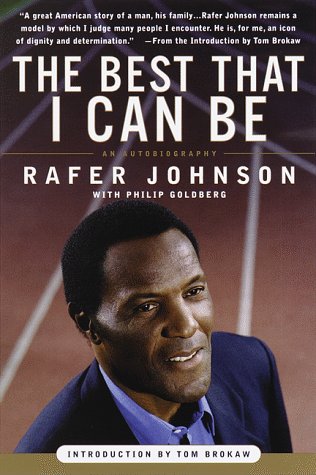
The 1960 Olympic decathlon gold-medal winner, lifelong Christian, and African-American hero recounts his journey from a Texas shanty town to rural California to UCLA, where he became a world-famous athlete and began his remarkable career.
Die Inhaltsangabe kann sich auf eine andere Ausgabe dieses Titels beziehen.
Über die Autorinnen und Autoren
Rafer Johnson won the gold medal for the decathlon in the 1960 Olympic Games, posting a new Olympic record in the event. After the Olympics, he devoted his time to his family, his career, and helping others. To this end, he became a sports commentator, worked with Robert F. Kennedy, is President of Rafer Johnson Enterprises, and Chairman of the Board for the Southern California Special Olympics. He lives in Los Angeles with his wife, and has two children.
Rafer Johnson is President of Rafer Johnson Enterprises.
Aus dem Klappentext
n's story is the classic American dream: hard work leading to success, honor, and glory. Here, he openly writes about his humble beginnings in an obscure African American Texas ghetto, his growing up in the all-white, sun-drenched Californian town of Kingsburg, and his time at UCLA as the president of the student body and an acclaimed athlete. His talents brought him to dramatic athletic duels in Moscow, Melbourne, and Rome, and to the glamour of acting, broadcasting, and politics in Hollywood, Washington, D.C., and the rest of the nation.
Structured around the ten events of the decathlon, Rafer's memoir vividly describes an exceptional life. It introduces remarkable people, both unknown and celebrated (the Kennedy family; Gloria Steinem; Bill Bright, founder of Campus Crusade; Tom Brokaw; and others), who befriended Rafer and affected his life. It tells of obstacles and tragedies--crippling injuries, an alcoholic father, the assassination of hi
Auszug. © Genehmigter Nachdruck. Alle Rechte vorbehalten.
My friendship with the Kennedys had a strong influence on my political views. Knowing that powerful people were willing to put themselves on the line for equality made me confident that working within the system was not a lost cause.
At the time, it was fashionable for commentators and political opponents to call Bobby "ruthless." That quality might have been evident in his earlier years, or behind closed doors in the corridors of power, but I never saw any sign of it. Aggressive, yes; ambitious, yes; combative, yes. But those are traits we like our leaders to have, as long as they stand for what is right, decent, and equitable. Bobby had a quality that great athletes have: He knew how to win. In a small way, I had an early taste of what he could do when he put his power and can-do attitude to work. When People to People was having difficulty moving students into and out of the country due to governmental red tape, I called the attorney general's office. Within hours, the problem was solved. I had no doubt that Bobby could make bigger things happen as well.
Many observers have noted that Bobby changed a great deal during the course of his public career. In fact, one thing that always impressed me was his consistency. His compassion for the less fortunate and his dedication to improving their lot were part of his makeup. Many historians believe that he was the real force behind the civil rights agenda in his brother's administration. Under Bobby's leadership the justice department finally exercised its power on behalf of minorities--enforcing desegregation laws, investigating voting rights violations, and recommending qualified blacks for positions as federal judges and U.S. marshals.
I never doubted Bobby's sincerity and basic decency. Unlike most politicians, he did not pander to his audience. At times he would even say things that made his supporters uncomfortable. I saw him with rich people and poor, young and old, whites and blacks, liberals and conservatives; he always spoke his mind, and he treated everyone, from servants to cabinet members, with respect.
In some ways he did change, though. He grew wiser, better informed, and more decisive about the issues facing the country. I saw him respond to a tour of Brooklyn's Bedford-Stuyvesant with a major restoration plan that transformed that blighted neighborhood. I saw him fight for Native American rights after observing conditions on reservations. I saw him befriend Cesar Chavez and lend his support to the United Farm Workers after visiting the migrant labor camps in California. I also saw him come out against the Vietnam War, even though he himself had supported military intervention during his brother's administration.
If I needed any further convincing about Bobby's integrity, I got it the night I had dinner with him and Stokely Carmichael. After courageously leading the Student Nonviolent Coordinating Committee's voting rights campaign, Stokely had grown increasingly inflammatory, using "Black Power" as a rallying cry for radical change. The fact that Bobby would invite to his home a man who compared black membership in the Democratic Party to Jews becoming Nazis was a statement in itself. Bobby listened to Stokely's views with interest. Then the subject shifted to an event in the news: A black man had hijacked an American plane and forced it to fly to Cuba. Stokely's position was that the United States was not a true homeland to blacks, and that violent acts like hijacking were justifiable reactions to oppression. Acknowledging the nation's shameful legacy of racism, Bobby spoke the plain and simple truth: The hijacker was a criminal who just happened to be black, and he was endangering the lives of innocent people.
This is a solid man, I said to myself. He has a strong sense of justice, and he tells it like it is without altering his message or manner to suit the occasion. I vowed that if he ever ran for national office, I would do everything I could to help him get elected.
When Bobby declared himself a candidate for president in 1968, I was overjoyed. Like many others, I had come to see him as the one person who could keep the country from tearing itself apart. The Democratic Party and the nation needed a peace candidate, and Bobby was the logical choice. He had hesitated to enter the race, though, and Senator Eugene McCarthy had filled the void, demonstrating that President Lyndon B. Johnson was vulnerable by scoring big in the New Hampshire primary. Then Bobby joined the fray and President Johnson announced that he would not seek re-election. It was a three-way race for the Democratic nomination between Senator Kennedy, Senator McCarthy, and Vice President Hubert Humphrey.
I immediately geared up to help my friend win the all-important California primary. Each step of his campaign strengthened my conviction that he was the right man at the right time. His speeches were not only galvanizing, they were unlike politics as usual: He spoke his heart, telling audiences what he felt they needed to hear, not what would win him votes. Then came his defining moment as a candidate--the devastating night that Martin Luther King, Jr., was assassinated. Bobby was on his way to a campaign stop in Indianapolis when he heard the news. Instead of cancelling his speech, as his handlers and police advised, he stood before a mostly black crowd of about a thousand and told them what had taken place. With his voice cracking, he kept the shaken audience calm and urged them to "make an effort, as Martin Luther King did, to understand and to comprehend, and to replace that violence, that stain of bloodshed that has spread across our land, with an effort to understand with compassion and love." In the following days, riots erupted in 167 American cities. Indianapolis was not one of them.
Named an official delegate for the Kennedy ticket, I immediately began to devote all my spare time to the campaign. Shirley MacLaine, Andy Williams, and I organized a "Hollywood for Kennedy" fund-raising gala at the L.A. Sports Arena. I flew to wherever in the state I was needed, addressing rallies, speaking at press conferences, trying to convince voters that Senator Kennedy was someone who could bring the fractured nation together and deliver on his promises.
All of which made my employer, KNBC, nervous. Management feared that if a member of the station's news division was too closely identified with a candidate for office, other candidates would demand equal time and the station might be penalized by the Federal Communications Commission. They told me I would have to stop making public appearances. I refused. Their position seemed absurd to me. I never uttered a word about politics on the air, and I wasn't about to wear RFK buttons on my blazer or insert campaign slogans into the football scores. Nevertheless, I was taken off the air. I remained on the payroll and was given writing assignments, but I was not allowed on camera.
My lawyer, Donald Dell, filed a complaint. The FCC ruled in my favor; my political activities did not violate the equal time regulations. But then my relationship with management--which had not been ideal in the first place--had chilled. In addition, the primary was only weeks away and the race was close. At that crucial time I wanted to contribute...
„Über diesen Titel“ kann sich auf eine andere Ausgabe dieses Titels beziehen.
Suchergebnisse für The Best That I Can Be: An Autobiography

Beispielbild für diese ISBN
Best That I Can Be
Anbieter: Gulf Coast Books, Cypress, TX, USA
Verkäuferbewertung 5 von 5 Sternen

hardcover. Zustand: Good. Bestandsnummer des Verkäufers 0385487606-3-27650996
Gebraucht kaufen
EUR 4,22
Versand gratis
Versand innerhalb von USA
Versand innerhalb von USA
Anzahl: 1 verfügbar
Beispielbild für diese ISBN
Best That I Can be: An Autobio
Anbieter: World of Books (was SecondSale), Montgomery, IL, USA
Verkäuferbewertung 5 von 5 Sternen
Zustand: Acceptable. Item in acceptable condition! Textbooks may not include supplemental items i.e. CDs, access codes etc. Bestandsnummer des Verkäufers 00103913374
Gebraucht kaufen
EUR 4,23
Versand gratis
Versand innerhalb von USA
Versand innerhalb von USA
Anzahl: 1 verfügbar
Beispielbild für diese ISBN
Best That I Can be: An Autobio
Anbieter: World of Books (was SecondSale), Montgomery, IL, USA
Verkäuferbewertung 5 von 5 Sternen
Zustand: Very Good. Item in very good condition! Textbooks may not include supplemental items i.e. CDs, access codes etc. Bestandsnummer des Verkäufers 00093310344
Gebraucht kaufen
EUR 4,23
Versand gratis
Versand innerhalb von USA
Versand innerhalb von USA
Anzahl: 1 verfügbar
Beispielbild für diese ISBN
Best That I Can be: An Autobio
Anbieter: World of Books (was SecondSale), Montgomery, IL, USA
Verkäuferbewertung 5 von 5 Sternen
Zustand: Good. Item in good condition. Textbooks may not include supplemental items i.e. CDs, access codes etc. Bestandsnummer des Verkäufers 00102632660
Gebraucht kaufen
EUR 4,23
Versand gratis
Versand innerhalb von USA
Versand innerhalb von USA
Anzahl: 1 verfügbar
Beispielbild für diese ISBN
Best That I Can Be
Verlag:
Doubleday (edition First Edition), 1998
ISBN 10: 0385487606
ISBN 13: 9780385487603
Gebraucht
Hardcover
Erstausgabe
Anbieter: BooksRun, Philadelphia, PA, USA
Verkäuferbewertung 5 von 5 Sternen
Hardcover. Zustand: Very Good. First Edition. With dust jacket. It's a well-cared-for item that has seen limited use. The item may show minor signs of wear. All the text is legible, with all pages included. It may have slight markings and/or highlighting. Bestandsnummer des Verkäufers 0385487606-8-1-29
Gebraucht kaufen
EUR 5,48
Versand gratis
Versand innerhalb von USA
Versand innerhalb von USA
Anzahl: 1 verfügbar
Beispielbild für diese ISBN
The Best That I Can Be : An Autobiography
Verlag:
Doubleday Religious Publishing Group, The, 1998
ISBN 10: 0385487606
ISBN 13: 9780385487603
Gebraucht
Hardcover
Erstausgabe
Anbieter: Better World Books, Mishawaka, IN, USA
Verkäuferbewertung 5 von 5 Sternen
Zustand: Very Good. 1st. Former library copy. Pages intact with possible writing/highlighting. Binding strong with minor wear. Dust jackets/supplements may not be included. Includes library markings. Stock photo provided. Product includes identifying sticker. Better World Books: Buy Books. Do Good. Bestandsnummer des Verkäufers GRP73180376
Gebraucht kaufen
EUR 6,12
Versand gratis
Versand innerhalb von USA
Versand innerhalb von USA
Anzahl: 3 verfügbar
Beispielbild für diese ISBN
Best That I Can Be
Anbieter: ThriftBooks-Dallas, Dallas, TX, USA
Verkäuferbewertung 5 von 5 Sternen
Hardcover. Zustand: Very Good. No Jacket. May have limited writing in cover pages. Pages are unmarked. ~ ThriftBooks: Read More, Spend Less. Bestandsnummer des Verkäufers G0385487606I4N00
Gebraucht kaufen
EUR 7,18
Versand gratis
Versand innerhalb von USA
Versand innerhalb von USA
Anzahl: 1 verfügbar
Beispielbild für diese ISBN
Best That I Can Be
Anbieter: ThriftBooks-Atlanta, AUSTELL, GA, USA
Verkäuferbewertung 5 von 5 Sternen
Hardcover. Zustand: As New. No Jacket. Pages are clean and are not marred by notes or folds of any kind. ~ ThriftBooks: Read More, Spend Less. Bestandsnummer des Verkäufers G0385487606I2N00
Gebraucht kaufen
EUR 7,18
Versand gratis
Versand innerhalb von USA
Versand innerhalb von USA
Anzahl: 1 verfügbar
Beispielbild für diese ISBN
Best That I Can Be
Anbieter: ThriftBooks-Atlanta, AUSTELL, GA, USA
Verkäuferbewertung 5 von 5 Sternen
Hardcover. Zustand: Very Good. No Jacket. May have limited writing in cover pages. Pages are unmarked. ~ ThriftBooks: Read More, Spend Less. Bestandsnummer des Verkäufers G0385487606I4N00
Gebraucht kaufen
EUR 7,18
Versand gratis
Versand innerhalb von USA
Versand innerhalb von USA
Anzahl: 1 verfügbar
Beispielbild für diese ISBN
Best That I Can Be
Anbieter: HPB-Red, Dallas, TX, USA
Verkäuferbewertung 5 von 5 Sternen
hardcover. Zustand: Good. Connecting readers with great books since 1972! Used textbooks may not include companion materials such as access codes, etc. May have some wear or writing/highlighting. We ship orders daily and Customer Service is our top priority! Bestandsnummer des Verkäufers S_381673230
Gebraucht kaufen
EUR 4,43
EUR 3,22 Versand
Versand innerhalb von USA
Versand innerhalb von USA
Anzahl: 1 verfügbar