
Verwandte Artikel zu The Mating Mind: How Sexual Choice Shaped the Evolution...
Inhaltsangabe
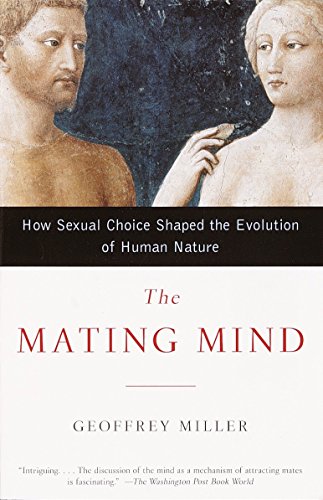
At once a pioneering study of evolution and an accessible and lively reading experience, a book that offers the most convincing—and radical—explanation for how and why the human mind evolved.
Consciousness, morality, creativity, language, and art: these are the traits that make us human. Scientists have traditionally explained these qualities as merely a side effect of surplus brain size, but Miller argues that they were sexual attractors, not side effects. He bases his argument on Darwin’ s theory of sexual selection, which until now has played second fiddle to Darwin’ s theory of natural selection, and draws on ideas and research from a wide range of fields, including psychology, economics, history, and pop culture. Witty, powerfully argued, and continually thought-provoking, The Mating Mind is a landmark in our understanding of our own species.
Die Inhaltsangabe kann sich auf eine andere Ausgabe dieses Titels beziehen.
Über die Autorin bzw. den Autor
GEOFFREY F. MILLER is senior research fellow at the Centre for Economic Learning and Social Evolution at University College, London. Born in 1965 in Cincinnati, he studied at Columbia University and received a Ph.D. in cognitive psychology from Stanford University. After moving to Europe, he worked at the Universities of Sussex and Nottingham and at the Max Planck Institute of Psychological Research in Munich. He lives in Surrey with his family.
Von der hinteren Coverseite
At once a pioneering study of evolution and an accessible and lively read, The Mating Mind offers the most convincing -- and radical -- explanation to date for how and why the human mind evolved. Traditionally, evolutionary theory has explained intelligence as merely a by-product of surplus brain size. But psychologist Geoffrey Miller argues that it actively evolved, like the peacock's tail, for courtship and mating, and thereby shaped human nature.
Certain traits are attractive because they indicate the overall fitness of a potential mate. Miller maintains that both human sexes have evolved many significant ways of displaying fitness via expressions of creative intelligence such as storytelling, poetry, art, music, sports, dance, humor, kindness, and leadership. In support of this provocative thesis, he has gathered evidence from psychology, economics, history, pop culture, and Darwin's theory of sexual selection to present an utterly original synthesis of research.
Aus dem Klappentext
At once a pioneering study of evolution and an accessible and lively reading experience, The Mating Mind marks the arrival of a prescient and provocative new science writer. Psychologist Geoffrey Miller offers the most convincing-and radical-explanation for how and why the human mind evolved.
Consciousness, morality, creativity, language, and art: these are the traits that make us human. Scientists have traditionally explained these qualities as merely a side effect of surplus brain size, but Miller argues that they were sexual attractors, not side effects. He bases his argument on Darwin's theory of "sexual selection, which until now has played second fiddle to Darwin's theory of "natural selection, and draws on ideas and research from a wide range of fields, including psychology, economics, history, and pop culture. Witty, powerfully argued, and continually thought-provoking, "The Mating Mind is a landmark in our understanding of our own species.
Auszug. © Genehmigter Nachdruck. Alle Rechte vorbehalten.
Central Park
Central Park divides two of Manhattan's greatest treasure collections. On the West Side stands the American Museum of Natural History, with its dinosaur fossils, stuffed African elephants, dioramas of apes, and displays of ancient human remains. On the East Side stands the Metropolitan Museum of Art, with its Rembrandt self-portraits, peacock-shaped sitar, gold rapiers, Roman temple, Etruscan mirrors, and Jacques Louis David's Death of Socrates.
These works symbolize our unique human capacities for art, music, sports, religion, self-consciousness, and moral virtue, and they have troubled me ever since my student days studying biology at Columbia University. It was easy enough for me to take a taxi along the West Seventy-ninth Street transverse (the natural history museum) to East Eighty-first Street (the Met). It was not so easy for our ancestors to cross over from the pre-human world of natural history to the world of human culture. How did they transform themselves from apes to New Yorkers? Their evolutionary path seems obscure.
Yet we know there must have been a path. The human mind evolved somehow. The question scientists have asked for over a century is: How? Most people equate evolution with "survival of the fittest," and indeed most theories about the mind's evolution have tried to find survival advantages for everything that makes humans unique. To extend the metaphor, one kind of theory suggests our problem was not following the transverse to a collection of decorative arts, but traveling a different route to some useful inventions. Perhaps the human mind evolved for military prowess, symbolized by the Sea-Air-Space Museum on the aircraft carrier USS Intrepid, docked at Pier 86. Or perhaps our minds evolved for reciprocal economic advantage, symbolized by the World Trade Center and Wall Street, or through a thirst for pure knowledge, as housed in the New York Public Library. The survival advantages of better technology, trade, and knowledge seem obvious, so many believe the mind's evolution must have been technophilic and survivalist.
Ever since the Darwinian revolution, this survivalist view has seemed the only scientifically respectable possibility. Yet it remains unsatisfying. It leaves too many riddles unexplained. Human language evolved to be much more elaborate than necessary for basic survival functions. From a pragmatic biological viewpoint, art and music seem like pointless wastes of energy. Human morality and humor seem irrelevant to the business of finding food and avoiding predators. Moreover, if human intelligence and creativity were so useful, it is puzzling that other apes did not evolve them.
Even if the survivalist theory could take us from the world of natural history to our capacities for invention, commerce, and knowledge, it cannot account for the more ornamental and enjoyable aspects of human culture: art, music, sports, drama, comedy, and political ideals. At this point the survivalist theories usually point out that along the transverse lies the Central Park Learning Center. Perhaps the ornamental frosting on culture's cake arose through a general human ability to learn new things. Perhaps our big brains, evolved for technophilic survivalism, can be co-opted for the arts. However, this side-effect view is equally unsatisfying. Temperamentally, it reflects nothing more than a Wall Street trader's contempt for leisure. Biologically, it predicts that other big-brained species like elephants and dolphins should have invented their own versions of the human arts. Psychologically, it fails to explain why it is so much harder for us to learn mathematics than music, surgery than sports, and rational science than religious myth.
I think we can do better. We do not have to pretend that everything interesting and enjoyable about human behavior is a side-effect of some utilitarian survival ability or general learning capacity. I take my inspiration not from the Central Park Learning Center on the north side of the transverse but from the Ramble on the south side. The Ramble is a 37-acre woodland hosting 250 species of birds. Every spring, they sing to attract sexual partners. Their intricate songs evolved for courtship. Could some of our puzzling human abilities have evolved for the same function?
A Mind for Courtship
This book proposes that our minds evolved not just as survival machines, but as courtship machines. Every one of our ancestors managed not just to live for a while, but to convince at least one sexual partner to have enough sex to produce offspring. Those proto-humans that did not attract sexual interest did not become our ancestors, no matter how good they were at surviving. Darwin realized this, and argued that evolution is driven not just by natural selection for survival, but by an equally important process that he called sexual selection through mate choice. Following his insight, I shall argue that the most distinctive aspects of our minds evolved largely through the sexual choices our ancestors made.
The human mind and the peacock's tail may serve similar biological functions. The peacock's tail is the classic example of sexual selection through mate choice. It evolved because peahens preferred larger, more colorful tails. Peacocks would survive better with shorter, lighter, drabber tails. But the sexual choices of peahens have made peacocks evolve big, bright plumage that takes energy to grow and time to preen, and makes it harder to escape from predators such as tigers. The peacock's tail evolved through mate choice. Its biological function is to attract peahens. The radial arrangement of its yard-long feathers, with their iridescent blue and bronze eye-spots and their rattling movement, can be explained scientifically only if one understands that function. The tail makes no sense as an adaptation for survival, but it makes perfect sense as an adaptation for courtship.
The human mind's most impressive abilities are like the peacock's tail: they are courtship tools, evolved to attract and entertain sexual partners. By shifting our attention from a survival-centered view of evolution to a courtship-centered view, I shall try to show how, for the first time, we can understand more of the richness of human art, morality, language, and creativity.
A 1993 Gallup Poll showed that almost half of all Americans accept that humans evolved gradually over millions of years. Yet only about 10 percent believe that natural selection, alone and unguided, can account for the human mind's astounding abilities. Most think that the mind's evolution must have been guided by some intelligent force, some active designer. Even in more secular nations such as Britain, many accept that humans evolved from apes, but doubt that natural selection suffices to explain our minds.
Despite being a committed Darwinian, I share these doubts. I do not think that natural selection for survival can explain the human mind. Our minds are entertaining, intelligent, creative, and articulate far beyond the demands of surviving on the plains of Pleistocene Africa. To me, this points to the work of some intelligent force and some active designer. However, I think the active designers were our ancestors, using their powers of sexual choice to influence—unconsciously—what kind of offspring they produced. By intelligently choosing their sexual partners for their mental abilities, our ancestors became the intelligent force behind the human mind's evolution.
Evolutionary Psychology Turns Dionysian
The time is ripe for more ambitious theories of human nature. Our species has never been richer, better educated, more numerous, or more aware of our common historical origin and common planetary fate. As our self-confidence has grown, our need for comforting myths has waned. Since the...
„Über diesen Titel“ kann sich auf eine andere Ausgabe dieses Titels beziehen.
Suchergebnisse für The Mating Mind: How Sexual Choice Shaped the Evolution...

Beispielbild für diese ISBN
The Mating Mind: How Sexual Choice Shaped the Evolution of Human Nature
Anbieter: World of Books (was SecondSale), Montgomery, IL, USA
Verkäuferbewertung 5 von 5 Sternen

Zustand: Acceptable. Item in acceptable condition! Textbooks may not include supplemental items i.e. CDs, access codes etc. Bestandsnummer des Verkäufers 00102243783
Gebraucht kaufen
EUR 5,92
Versand gratis
Versand innerhalb von USA
Versand innerhalb von USA
Anzahl: 1 verfügbar
Beispielbild für diese ISBN
The Mating Mind : How Sexual Choice Shaped the Evolution of Human Nature
Verlag:
Knopf Doubleday Publishing Group, 2001
ISBN 10: 038549517X
ISBN 13: 9780385495172
Gebraucht
Softcover
Anbieter: Better World Books, Mishawaka, IN, USA
Verkäuferbewertung 5 von 5 Sternen
Zustand: Good. Pages intact with minimal writing/highlighting. The binding may be loose and creased. Dust jackets/supplements are not included. Stock photo provided. Product includes identifying sticker. Better World Books: Buy Books. Do Good. Bestandsnummer des Verkäufers 4206519-6
Gebraucht kaufen
EUR 5,93
Versand gratis
Versand innerhalb von USA
Versand innerhalb von USA
Anzahl: 3 verfügbar
Beispielbild für diese ISBN
The Mating Mind : How Sexual Choice Shaped the Evolution of Human Nature
Verlag:
Knopf Doubleday Publishing Group, 2001
ISBN 10: 038549517X
ISBN 13: 9780385495172
Gebraucht
Softcover
Anbieter: Better World Books: West, Reno, NV, USA
Verkäuferbewertung 5 von 5 Sternen
Zustand: Good. Pages intact with minimal writing/highlighting. The binding may be loose and creased. Dust jackets/supplements are not included. Stock photo provided. Product includes identifying sticker. Better World Books: Buy Books. Do Good. Bestandsnummer des Verkäufers 4206519-6
Gebraucht kaufen
EUR 5,93
Versand gratis
Versand innerhalb von USA
Versand innerhalb von USA
Anzahl: 3 verfügbar
Beispielbild für diese ISBN
The Mating Mind: How Sexual Choice Shaped the Evolution of Human Nature
Anbieter: HPB-Ruby, Dallas, TX, USA
Verkäuferbewertung 5 von 5 Sternen
Paperback. Zustand: Very Good. Connecting readers with great books since 1972! Used books may not include companion materials, and may have some shelf wear or limited writing. We ship orders daily and Customer Service is our top priority! Bestandsnummer des Verkäufers S_467325834
Gebraucht kaufen
EUR 3,56
EUR 3,21 Versand
Versand innerhalb von USA
Versand innerhalb von USA
Anzahl: 1 verfügbar
Beispielbild für diese ISBN
The Mating Mind: How Sexual Choice Shaped the Evolution of Human Nature
Anbieter: HPB-Movies, Dallas, TX, USA
Verkäuferbewertung 5 von 5 Sternen
Paperback. Zustand: Very Good. Connecting readers with great books since 1972! Used books may not include companion materials, and may have some shelf wear or limited writing. We ship orders daily and Customer Service is our top priority! Bestandsnummer des Verkäufers S_465013349
Gebraucht kaufen
EUR 3,56
EUR 3,21 Versand
Versand innerhalb von USA
Versand innerhalb von USA
Anzahl: 1 verfügbar
Beispielbild für diese ISBN
The Mating Mind: How Sexual Choice Shaped the Evolution of Human Nature
Anbieter: HPB-Emerald, Dallas, TX, USA
Verkäuferbewertung 5 von 5 Sternen
Paperback. Zustand: Very Good. Connecting readers with great books since 1972! Used books may not include companion materials, and may have some shelf wear or limited writing. We ship orders daily and Customer Service is our top priority! Bestandsnummer des Verkäufers S_465770684
Gebraucht kaufen
EUR 3,56
EUR 3,21 Versand
Versand innerhalb von USA
Versand innerhalb von USA
Anzahl: 1 verfügbar
Beispielbild für diese ISBN
The Mating Mind: How Sexual Choice Shaped the Evolution of Human Nature
Anbieter: Half Price Books Inc., Dallas, TX, USA
Verkäuferbewertung 5 von 5 Sternen
Paperback. Zustand: Very Good. Connecting readers with great books since 1972! Used books may not include companion materials, and may have some shelf wear or limited writing. We ship orders daily and Customer Service is our top priority! Bestandsnummer des Verkäufers S_469273740
Gebraucht kaufen
EUR 3,87
EUR 2,99 Versand
Versand innerhalb von USA
Versand innerhalb von USA
Anzahl: 1 verfügbar
Beispielbild für diese ISBN
The Mating Mind: How Sexual Choice Shaped the Evolution of Human Nature
Anbieter: HPB-Diamond, Dallas, TX, USA
Verkäuferbewertung 5 von 5 Sternen
Paperback. Zustand: Very Good. Connecting readers with great books since 1972! Used books may not include companion materials, and may have some shelf wear or limited writing. We ship orders daily and Customer Service is our top priority! Bestandsnummer des Verkäufers S_470835190
Gebraucht kaufen
EUR 3,87
EUR 3,21 Versand
Versand innerhalb von USA
Versand innerhalb von USA
Anzahl: 1 verfügbar
Beispielbild für diese ISBN
The Mating Mind: How Sexual Choice Shaped the Evolution of Human Nature
Anbieter: ThriftBooks-Atlanta, AUSTELL, GA, USA
Verkäuferbewertung 5 von 5 Sternen
Paperback. Zustand: Fair. No Jacket. Readable copy. Pages may have considerable notes/highlighting. ~ ThriftBooks: Read More, Spend Less. Bestandsnummer des Verkäufers G038549517XI5N00
Gebraucht kaufen
EUR 7,39
Versand gratis
Versand innerhalb von USA
Versand innerhalb von USA
Anzahl: 1 verfügbar
Beispielbild für diese ISBN
The Mating Mind: How Sexual Choice Shaped the Evolution of Human Nature
Anbieter: ThriftBooks-Atlanta, AUSTELL, GA, USA
Verkäuferbewertung 5 von 5 Sternen
Paperback. Zustand: Good. No Jacket. Pages can have notes/highlighting. Spine may show signs of wear. ~ ThriftBooks: Read More, Spend Less. Bestandsnummer des Verkäufers G038549517XI3N00
Gebraucht kaufen
EUR 7,39
Versand gratis
Versand innerhalb von USA
Versand innerhalb von USA
Anzahl: 2 verfügbar