
Inhaltsangabe
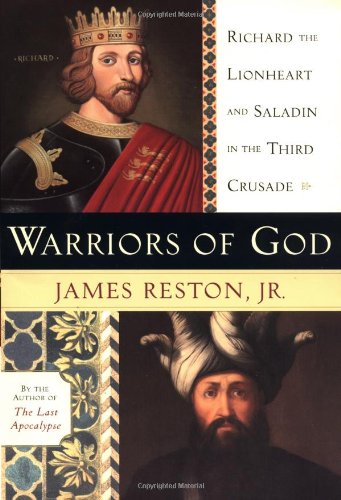
The epic story of the battle for the Holy Land focuses on the two legendary figures at the center of the Third Crusade and explores the conflict that transformed the world during the late twelfth century and the roles of Richard the Lionheart, the English king and homosexual leader of the Crusaders, and Saladin, the visionary head of the Islamic forces. 20,000 first printing.
Die Inhaltsangabe kann sich auf eine andere Ausgabe dieses Titels beziehen.
Über die Autorin bzw. den Autor
JAMES RESTON, JR., is the author eleven previous books, including The Last Apocalypse and Galileo: A Life. He has written articles for The New Yorker, Esquire, Vanity Fair, Time, Rolling Stone, and many other publications, and the scripts for three "Frontline" documentaries. He lives in Chevy Chase, Maryland.
Aus dem Klappentext
The epic story of the battle for the Holy Land and the two larger-than-life figures at its center.
James Reston, Jr., the author of Galileo: A Life (called "masterful" and "brilliant" by the Washington Post) and the critically lauded The Last Apocalypse, a stunningly original portrait of the Christian world at the turn of first millennium, now re-creates the collision of the Christian holy wars and the Muslim jihad at the end of the twelfth century. A dual biography of the legendary Richard the Lionheart and the Sultan Saladin, iconic hero of the Islamic world, Warriors of God recounts the life of each man and reveals the passions of the times that brought them face-to-face in the final battle of the Third Crusade.
Richard the Lionheart, commonly depicted as the romantic personification of chivalry, here emerges in his full complexity and contradictions as Reston examines the dark side of Richard's role as the leader of the blood-soaked Crusades and breaks new ground by openly discussing Richard's homosexuality. Reston's compelling portrait of Saladin brings to life the wise, highly cultured leader who realized an enduring Arab dream by uniting Egypt and Syria and whose conquest of Jerusalem not only sparked the Third Crusade but ignited the first jihad and turned Saladin into a hero of epic proportions. In riveting descriptions, Reston captures the fascinating clash of the two armies as they battled their way to the outskirts of Jerusalem. There, Saladin's brilliant maneuvers and Richard's sudden failure of nerve turned the tide. Sweeping readers into a mesmerizing period of history, Warriors of God is a provocative look at two towering leaders and the not always noble causes for which they fought.
Auszug. © Genehmigter Nachdruck. Alle Rechte vorbehalten.
Chapter One
A Sultan Is Born
Early in the twelfth century, in the city of Tovin in northern Armenia close to Georgia, there lived an eminent family of Kurds, the master of whose house was sur-named Najm ad-Din, which meant "excellent prince and star of religion." Najm ad-Din had a boon comrade named Bihruz, a man of intelligence and charm, qualities matched only by his bent for trouble. Bihruz had the misfortune to be discovered in a compromising position with the wife of the local emir, who promptly had Bihruz seized and castrated and banished from his fief.
After this humiliation Najm ad-Din decided to accompany his disgraced friend to Baghdad, the seat of the Abbasid caliphate, where the Caliph, Al Muqtafi li-amri'llah ("he who follows the orders of God"), reigned supreme over the Muslim world of the eastern Mediterranean. In Baghdad the Sultan of Iraq noticed their talents. Since eunuchs were then favored as teachers and administrators, Bihruz became the tutor of the Sultan's sons and a companion to the Sultan himself in the games of chess and draughts. He rose quickly in power and influence and soon became responsible for building some of the great buildings of the land. In his rise to power Bihruz brought his friend, Najm ad-Din, along with him. Among the rewards the Sultan bestowed on Bihruz for his service was the castle at Takreet, on the Tigris River, and Bihruz in turn bestowed the command of it on his friend, Najm ad-Din.
At the castle in Takreet, Najm ad-Din was joined by his younger and more ambitious brother, named Shirkuh, and together these Kurds from the north seemed marked for greatness. For the Arab world had arrived at a critical juncture in its history. Forty years earlier, in the year a.d. 1098, Europeans had descended on Palestine, conquering Jerusalem in what the Franks called a crusade and establishing a powerful state called the Kingdom of Jerusalem, which stretched from Antioch in the north to Elath on the Red Sea. Along the coastline and in the mountains the foreigners built huge fortresses to protect their kingdom, and thus the Muslim world was fractured and invaded, beaten, and occupied.
In the year 532 (a.d. 1137 in the Christian calendar) a son named Yusuf was born to Najm ad-Din. In Arab lands this was an ambiguous name, which was associated with all the vicissitudes of the life of Joseph the Prophet, the low life as well as the high, the greed and falseness as well as the piety and truth. The circumstances of Yusuf's birth seemed ominous as well. For on the very night that Yusuf was born, the child's uncle, Shirkuh, had a dispute with the Isfahsalar, commander at the castle gate, after the officer had insulted a woman and she had come to Shirkuh in tears. In a rage Shirkuh snatched the halberd of the commander and killed him with his own weapon. When their powerful patron, the eunuch Bihruz, heard of this in Baghdad, he was appalled and banished the brothers from Takreet in disgrace. That so terrible an event accompanied the birth of Yusuf was considered a bad sign, but later it would be said, "Good may come of adversity when you least expect it. And such was the case with Yusuf." From Takreet the brothers went to Mosul in northern Mesopotamia.
In Mosul, in the face of the European occupation of Palestine, a strong Arab leader named Zengy had taken power and was making strides in uniting the far-flung domains of Islam, where Mesopotamia was traditionally divided from Syria, where Antioch fought with Aleppo, Tripoli with Homs, Jerusalem with Damascus, where the Sunni branch of Islam fought with the Shi'ite branch. In his quest to overcome the divisions of the Muslim world, Zengy called these Kurdish brothers to his service. Najm ad-Din became the commander of Zengy's fortress in Baalbek in the Bek?a Valley, while Shirkuh became a powerful commander in the vizier's armies.
In November 1144, Zengy's forces captured Edessa in northern Mesopotamia, and thus the first of the fledgling Crusader provinces fell. The fall of Edessa was a shock to Europe. Largely through the eloquence of the Cistercian monk Bernard of Clairvaux, a campaign for a new Crusade began, and among the first to heed this call was the King of France, Louis VI, and his Queen, Eleanor of Aquitaine. In 1146, before the new Crusaders arrived in the Holy Land, Zengy died, and he was replaced by an even more powerful figure, Nur ad-Din. Two years later the Crusader forces were crushed outside the walls of Damascus, turning the Second Crusade into a total disaster and emboldening the forces of Islam further in their quest for the reconquest of Palestine.
The boy, Yusuf, grew up in Baalbek and Damascus. Though he was slight of build, his intelligence, his mannerliness, his generosity, his piety, and his modesty were noticed in the palaces of Damascus. Like a few others of his age, he was drawn to wine and women in his adolescence, but the seriousness of the historical situation eventually impressed him, and he renounced these temptations. Later it would be said that from the education of his sovereign, Nur ad-Din, Yusuf—later called Salah ad-Din or Saladin—learned to walk in the path of righteousness, to act virtuously, and to be zealous in waging war against infidels. In the court of Damascus the principle of striving in Allah's cause was emphasized, and the youth took to heart this invocation in the Koran: "Those who strive in Our Cause, we will surely guide in Our way, for verily Allah is with those who do right."
In 1163 Nur ad-Din saw clearly the next step in the unification of the Arab world against the European occupation. In Egypt the Fatimite caliphate (which practiced the Shi'ite rather than the Sunni way of Islam) was in disarray, and this presented the lord of Syria with a target of opportunity. Nur ad-Din ordered Shirkuh, Saladin's charismatic uncle, to undertake a succession of invasions to the south and ordered the young Saladin, now twenty-six years old, to accompany his uncle. Reluctantly, Saladin complied.
As Shirkuh and Saladin headed south, Nur ad-Din himself laid siege to the greatest of all the Crusader castles, Krak des Chevaliers, in central Syria, but the fortress was impregnable and the Muslim forces were turned back. The time was not yet ripe for a frontal assault on the Crusader kingdom.
In 1164, with Saladin in command of the vanguard of the army, Shirkuh conquered Cairo. But within weeks he was forced to withdraw when Crusader forces came to the aid of the Egyptian caliphate. Three years later a second invasion failed, again due to the support of the Crusaders, for above all else the Crusader kingdom could not abide a united Egypt and Syria. So desperate was this crisis considered in the Crusader kingdom that any baron refusing to heed the summons forfeited 10 percent of his income. Two further invasions faltered, until on January 8, 1169, in the fifth attempt, Shirkuh entered Cairo in triumph. Gloriously, he proclaimed himself to be the new King of Egypt—and then, abruptly, died two months later. Poison was suspected.
Pondering this reverse in Damascus, Nur ad-Din settled on Saladin as his uncle's successor. The young soldier was chosen not because of his strengths but because of the perceived weaknesses of his youth and inexperience. In truth, Nur ad-Din did not want a powerful competitor in Cairo, and he was certain that he could control his malleable and polite ward. In this he would be disappointed.
At first Saladin was the compliant subordinate. Mercilessly, he followed Nur ad-Din's orders to expunge the Shi'ite way of Islam in Egypt and replace it with the Sunni way. He requested of his lord that his father, Najm ad-Din, be allowed to come to Cairo. "My happiness will thus be complete," he wrote to his lord in Damascus, "and my adventure will be similar to...
„Über diesen Titel“ kann sich auf eine andere Ausgabe dieses Titels beziehen.
Weitere beliebte Ausgaben desselben Titels

Suchergebnisse für Warriors of God: Richard the Lionheart and Saladin...

Beispielbild für diese ISBN
Warriors of God Richard the Li
Anbieter: World of Books (was SecondSale), Montgomery, IL, USA
Verkäuferbewertung 5 von 5 Sternen

Zustand: Good. Good condition ex-library book with usual library markings and stickers. Bestandsnummer des Verkäufers 00103904340
Gebraucht kaufen
EUR 4,88
Versand gratis
Versand innerhalb von USA
Versand innerhalb von USA
Anzahl: 1 verfügbar
Beispielbild für diese ISBN
Warriors of God Richard the Li
Anbieter: World of Books (was SecondSale), Montgomery, IL, USA
Verkäuferbewertung 5 von 5 Sternen
Zustand: Very Good. Item in very good condition! Textbooks may not include supplemental items i.e. CDs, access codes etc. Bestandsnummer des Verkäufers 00106165904
Gebraucht kaufen
EUR 6,06
Versand gratis
Versand innerhalb von USA
Versand innerhalb von USA
Anzahl: 1 verfügbar
Beispielbild für diese ISBN
Warriors of God Richard the Li
Anbieter: World of Books (was SecondSale), Montgomery, IL, USA
Verkäuferbewertung 5 von 5 Sternen
Zustand: Good. Item in good condition. Textbooks may not include supplemental items i.e. CDs, access codes etc. Bestandsnummer des Verkäufers 00090054401
Gebraucht kaufen
EUR 6,06
Versand gratis
Versand innerhalb von USA
Versand innerhalb von USA
Anzahl: 5 verfügbar
Beispielbild für diese ISBN
Warriors of God Richard the Li
Anbieter: World of Books (was SecondSale), Montgomery, IL, USA
Verkäuferbewertung 5 von 5 Sternen
Zustand: Acceptable. Item in acceptable condition! Textbooks may not include supplemental items i.e. CDs, access codes etc. Bestandsnummer des Verkäufers 00104308267
Gebraucht kaufen
EUR 6,06
Versand gratis
Versand innerhalb von USA
Versand innerhalb von USA
Anzahl: 1 verfügbar
Beispielbild für diese ISBN
Warriors of God: Richard the Lionheart and Saladin in the Third Crusade
Anbieter: BookHolders, Towson, MD, USA
Verkäuferbewertung 5 von 5 Sternen
Zustand: Good. [ No Hassle 30 Day Returns ][ Ships Daily ] [ Underlining/Highlighting: NONE ] [ Writing: NONE ] [ Edition: first ] Publisher: Doubleday Pub Date: 5/15/2001 Binding: Hardcover Pages: 384 first edition. Bestandsnummer des Verkäufers 6470228
Gebraucht kaufen
EUR 6,06
Versand gratis
Versand innerhalb von USA
Versand innerhalb von USA
Anzahl: 1 verfügbar
Beispielbild für diese ISBN
Warriors of God: Richard the Lionheart and Saladin in the Third Crusade
Anbieter: Wonder Book, Frederick, MD, USA
Verkäuferbewertung 5 von 5 Sternen
Zustand: Very Good. Very Good condition. Very Good dust jacket. A copy that may have a few cosmetic defects. May also contain light spine creasing or a few markings such as an owner's name, short gifter's inscription or light stamp. Bestandsnummer des Verkäufers E20A-01911
Gebraucht kaufen
EUR 6,31
Versand gratis
Versand innerhalb von USA
Versand innerhalb von USA
Anzahl: 2 verfügbar
Beispielbild für diese ISBN
Warriors of God : Richard the Lionheart and Saladin in the Third Crusade
Verlag:
Doubleday Religious Publishing Group, The, 2001
ISBN 10: 0385495617
ISBN 13: 9780385495615
Gebraucht
Hardcover
Erstausgabe
Anbieter: Better World Books: West, Reno, NV, USA
Verkäuferbewertung 5 von 5 Sternen
Zustand: Good. 1st. Pages intact with minimal writing/highlighting. The binding may be loose and creased. Dust jackets/supplements are not included. Stock photo provided. Product includes identifying sticker. Better World Books: Buy Books. Do Good. Bestandsnummer des Verkäufers 4338400-20
Gebraucht kaufen
EUR 6,39
Versand gratis
Versand innerhalb von USA
Versand innerhalb von USA
Anzahl: 1 verfügbar
Beispielbild für diese ISBN
Warriors of God: Richard the Lionheart and Saladin in the Third Crusade
Anbieter: HPB-Ruby, Dallas, TX, USA
Verkäuferbewertung 5 von 5 Sternen
hardcover. Zustand: Very Good. Connecting readers with great books since 1972! Used books may not include companion materials, and may have some shelf wear or limited writing. We ship orders daily and Customer Service is our top priority! Bestandsnummer des Verkäufers S_466400161
Gebraucht kaufen
EUR 3,41
EUR 3,29 Versand
Versand innerhalb von USA
Versand innerhalb von USA
Anzahl: 1 verfügbar
Beispielbild für diese ISBN
Warriors of God: Richard the Lionheart and Saladin in the Third Crusade
Anbieter: HPB Inc., Dallas, TX, USA
Verkäuferbewertung 5 von 5 Sternen
Hardcover. Zustand: Very Good. Connecting readers with great books since 1972! Used books may not include companion materials, and may have some shelf wear or limited writing. We ship orders daily and Customer Service is our top priority! Bestandsnummer des Verkäufers S_466565504
Gebraucht kaufen
EUR 3,44
EUR 3,29 Versand
Versand innerhalb von USA
Versand innerhalb von USA
Anzahl: 1 verfügbar
Foto des Verkäufers
Warriors of God: Richard the Lionheart and Saladin in the Third Crusade
Anbieter: clickgoodwillbooks, Indianapolis, IN, USA
Verkäuferbewertung 5 von 5 Sternen
Zustand: acceptable. Used - Acceptable: All pages and the cover are intact, but shrink wrap, dust covers, or boxed set case may be missing. Pages may include limited notes, highlighting, or minor water damage but the text is readable. Item may be missing bundled media. Bestandsnummer des Verkäufers 3O6WBH001UIG_ns
Gebraucht kaufen
EUR 3,47
EUR 3,50 Versand
Versand innerhalb von USA
Versand innerhalb von USA
Anzahl: 1 verfügbar