
Verwandte Artikel zu Dynasty: The Rise and Fall of the House of Caesar
Inhaltsangabe
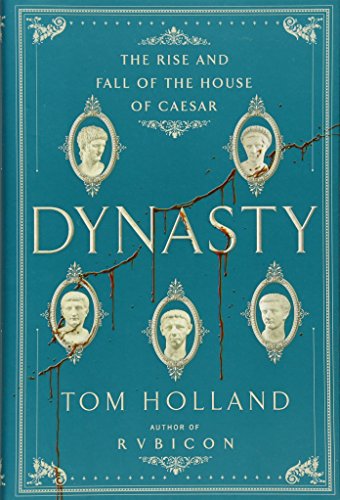
Author and historian Tom Holland returns to his roots in Roman history and the audience he cultivated with Rubicon—his masterful, witty, brilliantly researched popular history of the fall of the Roman republic—with Dynasty, a luridly fascinating history of the reign of the first five Roman emperors.
Dynasty continues Rubicon's story, opening where that book ended: with the murder of Julius Caesar. This is the period of the first and perhaps greatest Roman Emperors and it's a colorful story of rule and ruination, running from the rise of Augustus through to the death of Nero. Holland's expansive history also has distinct shades of I Claudius, with five wonderfully vivid (and in three cases, thoroughly depraved) Emperors—Augustus, Tiberius, Caligula, Claudius, and Nero—featured, along with numerous fascinating secondary characters. Intrigue, murder, naked ambition and treachery, greed, gluttony, lust, incest, pageantry, decadence—the tale of these five Caesars continues to cast a mesmerizing spell across the millennia.
Die Inhaltsangabe kann sich auf eine andere Ausgabe dieses Titels beziehen.
Über die Autorin bzw. den Autor
TOM HOLLAND is the author of numerous history books, including Rubicon, Persian Fire, and The Histories, a new translation of Herodotus. He wrote and presented Islam: The Untold Story, a documentary commissioned for Channel 4 in Britain based on his book In the Shadow of the Sword. He lives in London with his wife and two daughters
Auszug. © Genehmigter Nachdruck. Alle Rechte vorbehalten.
AD 40. It is early in the year. Gaius Julius Caesar Augustus Germanicus sits on a lofty platform beside the Ocean. As waves break on the shore and spray hangs in the air, he gazes out to sea. Many Roman ships over the years have been lost to its depths. Strange monsters are rumoured to lurk in its grey waters, while beyond the horizon there lies an island teeming with savage and mustachioed head-hunters: Britain. Perils such as these, lurking as they do on the very margins of civilisation, are fit to challenge even the boldest and most iron-willed hero.
The story of the Roman people, though, has always had about it an aura of the epic. They have emerged from dim and provincial obscurity to the command of the world: a feat like no other in history. Repeatedly put to trial, repeatedly surviving it triumphant, Rome has been well steeled for global rule. Now, seven hundred and ninety-two years after her founding, the man who ranks as her emperor wields power worthy of a god. Lined up alongside him on the northern beach are rank upon rank of the most formidable fighting force on the planet: armour-clad legionaries, catapults, battlefield artillery. The Emperor Gaius scans their length. He gives a command. At once, there is a blaring of trumpets. The signal for battle. Then silence. The Emperor raises his voice. 'Soldiers!' he cries. 'I command you to pick up shells. Fill your helmets with the spoils of the Ocean.' And the legionaries, obedient to their emperor's order, do so.
Such, at any rate, is the story. But is it true? Did the soldiers really pick up shells? And if they did – why? The episode is one of the most notorious in the life of a man whose entire career remains to this day a thing of infamy. Caligula, the name by which the Emperor Gaius is better known, is one of the few people from ancient history to be as familiar to pornographers as to classicists. The scandalous details of his reign have always provoked prurient fascination. 'But enough of the emperor; now to the monster.' So wrote Gaius Suetonius Tranquillus, a scholar and archivist in the imperial palace who doubled in his spare time as a biographer of the Caesars, and whose life of Caligula is the oldest extant one that we possess. Written almost a century after the Emperor's death, it catalogues a quite sensational array of depravities and crimes. He slept with his sisters! He dressed up as the goddess Venus! He planned to award his horse the highest magistracy in Rome! Set against the background of such stunts, Caligula's behaviour on the Channel coast comes to seem a good deal less surprising. Suetonius certainly had no problem in explaining his behaviour. 'He was ill in both body and mind.'
But if Caligula was sick, then so too was Rome. The powers of life and death wielded by an emperor would have been abhorrent to an earlier generation. Almost a century before Caligula massed his legions on the shores of the Ocean and gazed out to Britain, his great-great-great-great-uncle had done the same – and then actually crossed the Channel. The exploits of Gaius Julius Caesar had been as spectacular as any in his city's history: not only two invasions of Britain but the permanent annexation of Gaul, as the Romans called what today is France. He had achieved his feats, though, as a citizen of a republic – one in which it was taken for granted by most that death was the only conceivable alternative to liberty. When Julius Caesar, trampling down this presumption, had laid claim to a primacy over his fellow citizens, it had resulted first in civil war, and then, after he had crushed his domestic foes as he had previously crushed the Gauls, in his assassination. Only after two more murderous bouts of slaughtering one another had the Roman people finally been inured to their servitude. Submission to the rule of a single man had redeemed their city and its empire from self-destruction – but the cure itself had been a kind of sickness.
Augustus, their new master had called himself, 'The Divinely Favoured One'. The great-nephew of Julius Caesar, he had waded through blood to secure the command of Rome and her empire – and then, his rivals once dispatched, had coolly posed as a prince of peace. As cunning as he was ruthless, as patient as he was decisive, Augustus had managed to maintain his supremacy for decades, and then to die in his bed. Key to this achievement had been his ability to rule with rather than against the grain of Roman tradition: for by pretending that he was not an autocrat, he had licensed his fellow citizens to pretend that they were still free. A veil of shimmering and seductive subtlety had been draped over the brute contours of his dominance. Time, though, had seen this veil become increasingly threadbare. On Augustus's death in AD 14, the powers that he had accumulated over the course of his long and mendacious career stood revealed, not as temporary expediencies, but rather as a package to be handed down to an heir. His choice of successor had been a man raised since childhood in his own household, an aristocrat by the name of Tiberius. The many qualities of the new Caesar, which ranged from exemplary aristocratic pedigree to a track record as Rome's finest general, had counted for less than his status as Augustus's adopted son – and everyone had known it.
Tiberius, a man who all his life had been wedded to the virtues of the vanished Republic, had made an unhappy monarch; but Caligula, who had succeeded him in turn after a reign of twenty-three years, was unembarrassed. That he ruled the Roman world by virtue neither of age nor of experience, but as the great-grandson of Augustus, bothered him not the slightest. 'Nature produced him, in my opinion, to demonstrate just how far unlimited vice can go when combined with unlimited power.' Such was the obituary delivered on him by Seneca, a philosopher who had known him well. The judgement, though, was not just on Caligula, but on Seneca's own peers, who had cringed and grovelled before the Emperor while he was still alive, and on the Roman people as a whole. The age was a rotten one: diseased, debased, degraded.
Or so many believed. Not everyone agreed. The regime established by Augustus would never have endured had it failed to offer what the Roman people had come so desperately to crave after decades of civil war: peace and order. The vast agglomeration of provinces ruled from Rome, which stretched from the North Sea to the Sahara, and from the Atlantic to the Fertile Crescent, reaped the benefits as well. Three centuries on, when the nativity of the most celebrated man to have been born in Augustus's reign stood in infinitely clearer focus than it had done at the time, a bishop named Eusebius could see in the Emperor's achievements the very guiding hand of God. 'It was not just as a consequence of human action,' he declared, 'that the greater part of the world should have come under Roman rule at the precise moment Jesus was born. The coincidence that saw our Saviour begin his mission against such a backdrop was undeniably arranged by divine agency. After all – had the world still been at war, and not united under a single form of government, then how much more difficult would it have been for the disciples to undertake their travels.'
Eusebius could see, with the perspective provided by distance, just how startling was the feat of globalisation brought to fulfilment under Augustus and his successors. Brutal though the methods deployed to uphold it were, the sheer immensity of the regions pacified by Roman arms was unprecedented. 'To accept a gift,' went an ancient saying, 'is to sell your liberty.' Rome held her conquests in fee; but the peace that she...
„Über diesen Titel“ kann sich auf eine andere Ausgabe dieses Titels beziehen.
Suchergebnisse für Dynasty: The Rise and Fall of the House of Caesar

Beispielbild für diese ISBN
Dynasty: The Rise and Fall of the House of Caesar
Anbieter: World of Books (was SecondSale), Montgomery, IL, USA
Verkäuferbewertung 5 von 5 Sternen

Zustand: Good. Item in good condition. Textbooks may not include supplemental items i.e. CDs, access codes etc. Bestandsnummer des Verkäufers 00107085282
Gebraucht kaufen
EUR 29,05
Versand gratis
Versand innerhalb von USA
Versand innerhalb von USA
Anzahl: 2 verfügbar
Beispielbild für diese ISBN
Dynasty: The Rise and Fall of the House of Caesar
Anbieter: World of Books (was SecondSale), Montgomery, IL, USA
Verkäuferbewertung 5 von 5 Sternen
Zustand: Very Good. Item in very good condition! Textbooks may not include supplemental items i.e. CDs, access codes etc. Bestandsnummer des Verkäufers 00110076439
Gebraucht kaufen
EUR 29,05
Versand gratis
Versand innerhalb von USA
Versand innerhalb von USA
Anzahl: 1 verfügbar
Beispielbild für diese ISBN
Dynasty: The Rise and Fall of the House of Caesar
Anbieter: McCord Books, NORWALK, IA, USA
Verkäuferbewertung 5 von 5 Sternen
hardcover. Zustand: Fair. Some wear to dust jacket, little smudging on edge of pages, text is unmarked. Bestandsnummer des Verkäufers 250305012
Gebraucht kaufen
EUR 27,71
EUR 4,36 Versand
Versand innerhalb von USA
Versand innerhalb von USA
Anzahl: 1 verfügbar
Beispielbild für diese ISBN
Dynasty: The Rise and Fall of the House of Caesar
Anbieter: HPB Inc., Dallas, TX, USA
Verkäuferbewertung 5 von 5 Sternen
Hardcover. Zustand: Very Good. Connecting readers with great books since 1972! Used books may not include companion materials, and may have some shelf wear or limited writing. We ship orders daily and Customer Service is our top priority! Bestandsnummer des Verkäufers S_485666410
Gebraucht kaufen
EUR 29,08
EUR 3,27 Versand
Versand innerhalb von USA
Versand innerhalb von USA
Anzahl: 1 verfügbar
Beispielbild für diese ISBN
Dynasty: The Rise and Fall of the House of Caesar
Anbieter: GoldBooks, Denver, CO, USA
Verkäuferbewertung 5 von 5 Sternen
Hardcover. Zustand: new. New Copy. Customer Service Guaranteed. Bestandsnummer des Verkäufers 35P55_65_0385537840
Neu kaufen
EUR 95,33
EUR 4,80 Versand
Versand innerhalb von USA
Versand innerhalb von USA
Anzahl: 1 verfügbar
Beispielbild für diese ISBN
Dynasty: The Rise and Fall of the House of Caesar
Anbieter: Revaluation Books, Exeter, Vereinigtes Königreich
Verkäuferbewertung 5 von 5 Sternen
Hardcover. Zustand: Brand New. 482 pages. 9.75x6.75x1.75 inches. In Stock. Bestandsnummer des Verkäufers 0385537840
Neu kaufen
EUR 104,33
EUR 14,59 Versand
Versand von Vereinigtes Königreich nach USA
Versand von Vereinigtes Königreich nach USA
Anzahl: 1 verfügbar