
Verwandte Artikel zu How to Stop Time: Heroin from A to Z
Inhaltsangabe
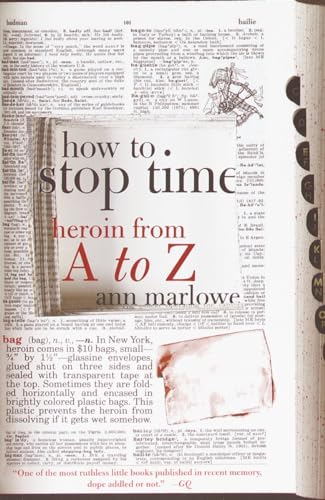
How to Stop Time is an important contemporary contribution to the classic accounts of the seductive attractions and dangerous distractions of drug use.
In this hypnotic and piercingly intelligent chronicle, Ann Marlowe dissects her former heroin habit, and recounts in harrowing detail the rigors and realities of life under the influence while building a successful Wall Street career and establishing a reputation as a critic in the alternative press. A one-time Harvard grad student in philosophy, Marlowe ruthlessly examines the paradoxical nature of addiction, and connects her own experience to a wider discussion of heroin in the context of our post-consumer, digital society.
Die Inhaltsangabe kann sich auf eine andere Ausgabe dieses Titels beziehen.
Über die Autorin bzw. den Autor
Ann Marlowe is a New York writer and critic who has written on music, books, and culture for The Village Voice, LA Weekly, Artforum, and Bookforum. She lives in New York City.
Von der hinteren Coverseite
How to Stop Time is an important contemporary contribution to the classic accounts of the seductive attractions and dangerous distractions of drug use.
In this hypnotic and piercingly intelligent chronicle, Ann Marlowe dissects her former heroin habit, and recounts in harrowing detail the rigors and realities of life under the influence while building a successful Wall Street career and establishing a reputation as a critic in the alternative press. A one-time Harvard grad student in philosophy, Marlowe ruthlessly examines the paradoxical nature of addiction, and connects her own experience to a wider discussion of heroin in the context of our post-consumer, digital society.
Auszug. © Genehmigter Nachdruck. Alle Rechte vorbehalten.
Excerpt
a
When I was six or seven, a Chanukah gift for me arrivedin the mail. The slender brown paper-wrapped box wasfrom my aunt Ruth, who lived in Manhattan and alwayssent me fun presents, so I tore off the paper as fast as Icould. Inside was a white B. Altman box. Oh no. I'dtold my parents I wanted a bow and arrow, a really goodjump rope, and a Slinky, but this was probably clothes.Boring. Reluctantly, I opened the cardboard container.
Inside was a white crewneck sweater, with a red Aembroidered directly in the center of the chest, underneaththe neckline. This wasn't going anywhere nearschool. I got teased enough for the frumpy clothes mymother bought me, but this was really bad. I didn't evenlike the colors: white was icky. And Aunt Ruth knew myfavorite color was blue, my second favorite green?whydid she get me a red initial?
abstention
I roll the empty ice-cream spoon around in my mouth."You don't have to take the finish off," my mother tellsme. "Put that back in the dish. It's close to your bedtimeanyway." We are eating butterscotch ice cream by thelight of a mosquito candle in the full dark of our backyard.My little brother, just four, is asleep in his room.Since I turned ten, my bedtime is nine thirty, instead ofnine, and I guess that I have a half hour to go.
It is very quiet; there is no through traffic on our suburbanNew Jersey street, and the houses are on lots of anacre or more. Our three lawn chairs are on the octagonalpatio in the center of our backyard lawn, where the cultivatedand the wild have fought to a draw. The lawn ismarshy, and the woods that ring it on three sidesencroach each spring in the form of hundreds of treeseedlings I must pluck out as they appear. On the fourthside of the lawn the dark bulk of our house rises, lit onlyby the ceiling light in the kitchen and one lamp in thefamily room.
I stay still, hoping that if my parents forget about mypresence they will talk about secret, adult things. Dad,olive-skinned and handsome, with closely cropped blackhair already flecked with gray?he is, after all, forty-one?wearsbaggy chino shorts, a madras shirt, socksand sandals. Mom, a little taller, paler, short-haired,"pleasant looking" in her words, is in a short-sleevedman-tailored yellow blouse, her favorite color, a bluecotton skirt that falls below her knees, stockings (despitethe heat) and sober brown lace-ups. The stockings arefor her varicose veins, the shoes for her flat feet, theblouse to conceal the tissue missing from her neck sinceshe had half of her cancerous thyroid removed twentyyears before.
Instead of feeling sorry for my mother's infirmities, Iam appalled by them. Although she suggests that I toowill eventually have varicose veins, I hotly deny it. And Ihate the shoes she makes me wear, ugly things with "support";she insists that I have flat feet like hers. The moreshe draws attention to her physical imperfections, themore I?even at ten?want to distance myself from her,to show her that I am strong and athletic and healthy.
I am tall for my age?alas, not now?and have small,regular features. The only problem is my hair, a mass ofblack ringlets at odds both with the straight-haired fashionsof the times, and our mainly Anglo-Saxon town.And my clothes, chosen by my mother. Because shethinks fashion is created to manipulate people intospending money needlessly, she won't buy me the expensivetrendy clothes I want; because two of her uncles aregarment manufacturers and she grew up knowing howto judge fabric, she won't buy the cheap imitations thatwould please me nearly as much. Instead of the fashionablehot pants I covet, I am wearing an archaic shorts setin a pink and yellow floral print I know is uncool, anoutfit I'm glad my school friends aren't here to see.
At least the sixties have pushed my mom towardgreater informality: now, in 1968, I no longer have towear white gloves and black Maryjanes on special occasions.But why couldn't my father pick my clothes? Iloved his old black leather motorcycle jacket hanging inthe laundry room closet. Mother says he wore it whenhe courted her, and he drove a little MG convertible. "Itwas so small," she laughs when she remembers. But itsounds a lot more fun than the two Rambler stationwagons he chose for us. Washed-out red (1964) andhospital green (1965), they were inexpensive and highlyrated, I've been told, by Consumer Reports. When I askwhy my friends' parents have more glamorous cars, I amtold they are pretentious, and buy their cars on credit.My parents buy theirs for cash, and advise me to do thesame when I grow up.
The crickets and frogs make a rough music in thebackground of my parents' voices. You can't see anyother houses from the back of the house; my parentshave told me we are lucky to have one-acre zoning inour town. This is also why it is safe for me to walkaround the neighborhood by myself, or even to school amile away. My parents talk a lot about safety, buttonight the conversation is duller, revolving aroundrepairs to the washing machine. The talk doesn't interestme until I hear the names of our next-door neighbors,the Van Eingens, whose little girl and I ride our bikes upand down the street together. I could see them sitting ontheir patio when I followed my parents out the laundryroom door to the backyard a half hour ago.
"... Must have a drinking problem," my mother issaying. "They've been out there at least since I broughtthe steak out to you at the grill, and I saw they had severalbeer bottles on the table then." "They have peopleover a lot," my father offers. "They don't have educatedvoices," my mother notes. "I don't believe either of themwent to college." "But he must be doing well," myfather counters, "he mentioned he was buying a Lincoln.""Probably on credit," my mother responds.
My parents didn't demonize drinking; it was just oneof those things, like golf, or buying showy cars, that theythought beneath people of their intelligence and goodeducation. Both of them had been to graduate schooland studied science and knew, for instance, that golfprovided little exercise, that many expensive cars werepoorly engineered, that buying on credit was cost-ineffective,and that alcohol injured your health, made yousay stupid things and increased your chances of injuringyourself in freak accidents. I knew our Ramblers werepractical, but I had much more fun riding in the cars ofmy parents' friends, showy automobiles that are belovedcollectors' items today.
I was too sheltered to even wonder if the Van Eingenswere having more fun than my parents, who between thetwo of them didn't have a drink a week. Drugs were completelyout of the question. My mother and father had fewfriends and socialized only a few times a year, mainly withequally abstemious relatives whose foibles they talkedabout behind their back between visits. What we calledthe liquor cabinet held, upon sneak inspection, a dustybottle of Benedictine, whatever that was, and another witha name I at least recognized: Scotch. Both were nearly full,and I left them that way. I had no curiosity about alcoholin grade school. This I must have picked up from the culture,for by junior high I'd gotten tipsy a few times at parties.But then and now, alcohol isn't my drug.
Just as rare as my parents' puritanism about alcohol isheroin's entrance into my consciousness through familystories. I grew up hearing of a legendary great uncle, theblack sheep of my father's family, who was in due coursea minor league ballplayer, a merchant sailor, and ajunkie. My father's Hebrew name, David, was his, andbefore I was born he died at the Federal Narcotics Farmin Lexington, Kentucky. This is all I know about...
„Über diesen Titel“ kann sich auf eine andere Ausgabe dieses Titels beziehen.
Suchergebnisse für How to Stop Time: Heroin from A to Z

Foto des Verkäufers
How to Stop Time: Heroin from A to Z
Verlag:
Knopf Doubleday Publishing Group, 2000
ISBN 10: 0385720165
ISBN 13: 9780385720168
Gebraucht
Softcover
Anbieter: Greenworld Books, Arlington, TX, USA
Verkäuferbewertung 5 von 5 Sternen

Zustand: very_good. Fast Free Shipping â" Very Good condition book with a firm cover and clean pages. Shows normal use and some light wear or limited notes markings. A solid, nice copy to enjoy. Bestandsnummer des Verkäufers GWV.0385720165.VG
Gebraucht kaufen
EUR 4,59
Versand gratis
Versand innerhalb von USA
Versand innerhalb von USA
Anzahl: 1 verfügbar
Foto des Verkäufers
How to Stop Time: Heroin from A to Z
Verlag:
Knopf Doubleday Publishing Group, 2000
ISBN 10: 0385720165
ISBN 13: 9780385720168
Gebraucht
Softcover
Anbieter: Greenworld Books, Arlington, TX, USA
Verkäuferbewertung 5 von 5 Sternen
Zustand: good. Fast Free Shipping â" Good condition. It may show normal signs of use, such as light writing, highlighting, or library markings, but all pages are intact and the book is fully readable. A solid, complete copy that's ready to enjoy. Bestandsnummer des Verkäufers GWV.0385720165.G
Gebraucht kaufen
EUR 5,22
Versand gratis
Versand innerhalb von USA
Versand innerhalb von USA
Anzahl: 1 verfügbar
Beispielbild für diese ISBN
How to Stop Time: Heroin from A to Z
Verlag:
Knopf Doubleday Publishing Group, 2000
ISBN 10: 0385720165
ISBN 13: 9780385720168
Gebraucht
Softcover
Anbieter: World of Books (was SecondSale), Montgomery, IL, USA
Verkäuferbewertung 5 von 5 Sternen
Zustand: Good. Item in good condition. Textbooks may not include supplemental items i.e. CDs, access codes etc. Bestandsnummer des Verkäufers 00107654010
Gebraucht kaufen
EUR 5,28
Versand gratis
Versand innerhalb von USA
Versand innerhalb von USA
Anzahl: 1 verfügbar
Beispielbild für diese ISBN
How to Stop Time: Heroin from A to Z
Anbieter: ThriftBooks-Atlanta, AUSTELL, GA, USA
Verkäuferbewertung 5 von 5 Sternen
Paperback. Zustand: Fair. No Jacket. Readable copy. Pages may have considerable notes/highlighting. ~ ThriftBooks: Read More, Spend Less. Bestandsnummer des Verkäufers G0385720165I5N00
Gebraucht kaufen
EUR 5,87
Versand gratis
Versand innerhalb von USA
Versand innerhalb von USA
Anzahl: 1 verfügbar
Beispielbild für diese ISBN
How to Stop Time: Heroin from A to Z
Anbieter: ThriftBooks-Dallas, Dallas, TX, USA
Verkäuferbewertung 5 von 5 Sternen
Paperback. Zustand: Very Good. No Jacket. May have limited writing in cover pages. Pages are unmarked. ~ ThriftBooks: Read More, Spend Less. Bestandsnummer des Verkäufers G0385720165I4N00
Gebraucht kaufen
EUR 5,87
Versand gratis
Versand innerhalb von USA
Versand innerhalb von USA
Anzahl: 1 verfügbar
Beispielbild für diese ISBN
How to Stop Time: Heroin from A to Z
Anbieter: ThriftBooks-Atlanta, AUSTELL, GA, USA
Verkäuferbewertung 5 von 5 Sternen
Paperback. Zustand: Good. No Jacket. Pages can have notes/highlighting. Spine may show signs of wear. ~ ThriftBooks: Read More, Spend Less. Bestandsnummer des Verkäufers G0385720165I3N00
Gebraucht kaufen
EUR 5,87
Versand gratis
Versand innerhalb von USA
Versand innerhalb von USA
Anzahl: 1 verfügbar
Beispielbild für diese ISBN
How to Stop Time: Heroin from A to Z
Anbieter: ThriftBooks-Dallas, Dallas, TX, USA
Verkäuferbewertung 5 von 5 Sternen
Paperback. Zustand: Good. No Jacket. Pages can have notes/highlighting. Spine may show signs of wear. ~ ThriftBooks: Read More, Spend Less. Bestandsnummer des Verkäufers G0385720165I3N00
Gebraucht kaufen
EUR 5,87
Versand gratis
Versand innerhalb von USA
Versand innerhalb von USA
Anzahl: 1 verfügbar
Beispielbild für diese ISBN
How to Stop Time: Heroin from A to Z
Anbieter: ThriftBooks-Dallas, Dallas, TX, USA
Verkäuferbewertung 5 von 5 Sternen
Paperback. Zustand: Fair. No Jacket. Readable copy. Pages may have considerable notes/highlighting. ~ ThriftBooks: Read More, Spend Less. Bestandsnummer des Verkäufers G0385720165I5N00
Gebraucht kaufen
EUR 5,87
Versand gratis
Versand innerhalb von USA
Versand innerhalb von USA
Anzahl: 1 verfügbar
Beispielbild für diese ISBN
How to Stop Time: Heroin from A to Z
Anbieter: ThriftBooks-Reno, Reno, NV, USA
Verkäuferbewertung 5 von 5 Sternen
Paperback. Zustand: Good. No Jacket. Pages can have notes/highlighting. Spine may show signs of wear. ~ ThriftBooks: Read More, Spend Less. Bestandsnummer des Verkäufers G0385720165I3N00
Gebraucht kaufen
EUR 5,87
Versand gratis
Versand innerhalb von USA
Versand innerhalb von USA
Anzahl: 1 verfügbar
Beispielbild für diese ISBN
How to Stop Time : Heroin from A to Z
Verlag:
Knopf Doubleday Publishing Group, 2000
ISBN 10: 0385720165
ISBN 13: 9780385720168
Gebraucht
Softcover
Anbieter: Better World Books, Mishawaka, IN, USA
Verkäuferbewertung 5 von 5 Sternen
Zustand: Good. Pages intact with minimal writing/highlighting. The binding may be loose and creased. Dust jackets/supplements are not included. Stock photo provided. Product includes identifying sticker. Better World Books: Buy Books. Do Good. Bestandsnummer des Verkäufers 4026772-6
Gebraucht kaufen
EUR 5,93
Versand gratis
Versand innerhalb von USA
Versand innerhalb von USA
Anzahl: 1 verfügbar