
Verwandte Artikel zu Probabilistic Logic Networks: A Comprehensive Framework...
Inhaltsangabe
Abstract In this chapter we provide an overview of probabilistic logic networks (PLN), including our motivations for developing PLN and the guiding principles underlying PLN. We discuss foundational choices we made, introduce PLN knowledge representation, and briefly introduce inference rules and truth-values. We also place PLN in context with other approaches to uncertain inference. 1.1 Motivations This book presents Probabilistic Logic Networks (PLN), a systematic and pragmatic framework for computationally carrying out uncertain reasoning – r- soning about uncertain data, and/or reasoning involving uncertain conclusions. We begin with a few comments about why we believe this is such an interesting and important domain of investigation. First of all, we hold to a philosophical perspective in which “reasoning” – properly understood – plays a central role in cognitive activity. We realize that other perspectives exist; in particular, logical reasoning is sometimes construed as a special kind of cognition that humans carry out only occasionally, as a deviation from their usual (intuitive, emotional, pragmatic, sensorimotor, etc.) modes of thought. However, we consider this alternative view to be valid only according to a very limited definition of “logic.” Construed properly, we suggest, logical reasoning may be understood as the basic framework underlying all forms of cognition, including those conventionally thought of as illogical and irrational.
Die Inhaltsangabe kann sich auf eine andere Ausgabe dieses Titels beziehen.
Von der hinteren Coverseite
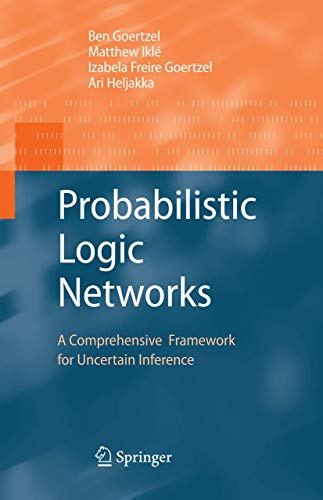
This book describes Probabilistic Logic Networks (PLN), a novel conceptual, mathematical and computational approach to uncertain inference. Going beyond prior probabilistic approaches to uncertain inference, PLN encompasses such ideas as induction, abduction, analogy, fuzziness and speculation, and reasoning about time and causality. The book provides an overview of PLN in the context of other approaches to uncertain inference. Topics addressed in the text include:
- the basic formalism of PLN knowledge representation
- the conceptual interpretation of the terms used in PLN
- an indefinite probability approach to quantifying uncertainty, providing a general method for calculating the "weight-of-evidence" underlying the conclusions of uncertain inference
- specific PLN inference rules and the corresponding truth-value formulas used to determine the strength of the conclusion of an inference rule from the strengths of the premises
- large-scale inference strategies
- inference using variables
- indefinite probabilities involving quantifiers
- inheritance based on properties or patterns
- the Novamente Cognition Engine, an application of PLN
- temporal and causal logic in PLN
Researchers and graduate students in artificial intelligence, computer science, mathematics and cognitive sciences will find this novel perspective on uncertain inference a thought-provoking integration of ideas from a variety of other lines of inquiry.
„Über diesen Titel“ kann sich auf eine andere Ausgabe dieses Titels beziehen.
Suchergebnisse für Probabilistic Logic Networks: A Comprehensive Framework...

Beispielbild für diese ISBN
Probabilistic Logic Networks: A Comprehensive Framework for Uncertain Inference
Anbieter: Tim's Used Books Provincetown Mass., Provincetown, MA, USA
Verkäuferbewertung 5 von 5 Sternen

Hardcover. Zustand: Very Good. 2nd Edition. No marks in text. Not a library book. Ships today in a cardboard enclosure, with tracking. The book you see listed here is the book you'll receive. Tim's Used Books, open shop in Provincetown, Mass., recognized for great books and great service since 1991. shelf p/orange and blue. Bestandsnummer des Verkäufers 269133
Gebraucht kaufen
EUR 44,31
EUR 5,71 Versand
Versand innerhalb von USA
Versand innerhalb von USA
Anzahl: 1 verfügbar
Foto des Verkäufers
Probabilistic Logic Networks: A Comprehensive Framework for Uncertain Inference
Anbieter: -OnTimeBooks-, Phoenix, AZ, USA
Verkäuferbewertung 5 von 5 Sternen
Zustand: good. A copy that has been read, remains in good condition. All pages are intact, and the cover is intact. The spine and cover show signs of wear. Pages can include notes and highlighting and show signs of wear, and the copy can include "From the library of" labels or previous owner inscriptions. 100% GUARANTEE! Shipped with delivery confirmation, if you're not satisfied with purchase please return item! Ships via media mail. Bestandsnummer des Verkäufers OTV.0387768718.G
Gebraucht kaufen
EUR 100,51
Versand gratis
Versand innerhalb von USA
Versand innerhalb von USA
Anzahl: 1 verfügbar
Foto des Verkäufers
Probabilistic Logic Networks : A Comprehensive Framework for Uncertain Inference
Anbieter: GreatBookPrices, Columbia, MD, USA
Verkäuferbewertung 5 von 5 Sternen
Zustand: New. Bestandsnummer des Verkäufers 5596957-n
Neu kaufen
EUR 180,26
EUR 2,32 Versand
Versand innerhalb von USA
Versand innerhalb von USA
Anzahl: Mehr als 20 verfügbar
Beispielbild für diese ISBN
Probabilistic Logic Networks: A Comprehensive Framework for Uncertain Inference
Anbieter: California Books, Miami, FL, USA
Verkäuferbewertung 4 von 5 Sternen

Zustand: New. Bestandsnummer des Verkäufers I-9780387768717
Neu kaufen
EUR 182,65
Versand gratis
Versand innerhalb von USA
Versand innerhalb von USA
Anzahl: Mehr als 20 verfügbar
Foto des Verkäufers
Probabilistic Logic Networks
Print-on-DemandAnbieter: BuchWeltWeit Ludwig Meier e.K., Bergisch Gladbach, Deutschland
Verkäuferbewertung 5 von 5 Sternen
Buch. Zustand: Neu. This item is printed on demand - it takes 3-4 days longer - Neuware -Abstract In this chapter we provide an overview of probabilistic logic networks (PLN), including our motivations for developing PLN and the guiding principles underlying PLN. We discuss foundational choices we made, introduce PLN knowledge representation, and briefly introduce inference rules and truth-values. We also place PLN in context with other approaches to uncertain inference. 1.1 Motivations This book presents Probabilistic Logic Networks (PLN), a systematic and pragmatic framework for computationally carrying out uncertain reasoning - r- soning about uncertain data, and/or reasoning involving uncertain conclusions. We begin with a few comments about why we believe this is such an interesting and important domain of investigation. First of all, we hold to a philosophical perspective in which 'reasoning' - properly understood - plays a central role in cognitive activity. We realize that other perspectives exist; in particular, logical reasoning is sometimes construed as a special kind of cognition that humans carry out only occasionally, as a deviation from their usual (intuitive, emotional, pragmatic, sensorimotor, etc.) modes of thought. However, we consider this alternative view to be valid only according to a very limited definition of 'logic.' Construed properly, we suggest, logical reasoning may be understood as the basic framework underlying all forms of cognition, including those conventionally thought of as illogical and irrational. 344 pp. Englisch. Bestandsnummer des Verkäufers 9780387768717
Neu kaufen
EUR 160,49
EUR 23,00 Versand
Versand von Deutschland nach USA
Versand von Deutschland nach USA
Anzahl: 2 verfügbar
Foto des Verkäufers
Probabilistic Logic Networks
Print-on-DemandAnbieter: moluna, Greven, Deutschland
Verkäuferbewertung 5 von 5 Sternen
Gebunden. Zustand: New. Dieser Artikel ist ein Print on Demand Artikel und wird nach Ihrer Bestellung fuer Sie gedruckt. Provides a comprehensive framework for uncertain reasoning, integrating probability theory, predicate and term logic, and pattern theoryConsiders a broad scope of reasoning typesFuses rigorous mathematics with practical computation to descr. Bestandsnummer des Verkäufers 5911090
Neu kaufen
EUR 136,16
EUR 48,99 Versand
Versand von Deutschland nach USA
Versand von Deutschland nach USA
Anzahl: Mehr als 20 verfügbar
Foto des Verkäufers
Probabilistic Logic Networks : A Comprehensive Framework for Uncertain Inference
Anbieter: GreatBookPricesUK, Woodford Green, Vereinigtes Königreich
Verkäuferbewertung 5 von 5 Sternen
Zustand: New. Bestandsnummer des Verkäufers 5596957-n
Neu kaufen
EUR 170,38
EUR 17,44 Versand
Versand von Vereinigtes Königreich nach USA
Versand von Vereinigtes Königreich nach USA
Anzahl: Mehr als 20 verfügbar
Beispielbild für diese ISBN
Probabilistic Logic Networks: A Comprehensive Framework for Uncertain Inference
Anbieter: Ria Christie Collections, Uxbridge, Vereinigtes Königreich
Verkäuferbewertung 5 von 5 Sternen
Zustand: New. In English. Bestandsnummer des Verkäufers ria9780387768717_new
Neu kaufen
EUR 181,83
EUR 13,13 Versand
Versand von Vereinigtes Königreich nach USA
Versand von Vereinigtes Königreich nach USA
Anzahl: Mehr als 20 verfügbar
Foto des Verkäufers
Probabilistic Logic Networks : A Comprehensive Framework for Uncertain Inference
Print-on-DemandAnbieter: AHA-BUCH GmbH, Einbeck, Deutschland
Verkäuferbewertung 5 von 5 Sternen
Buch. Zustand: Neu. nach der Bestellung gedruckt Neuware - Printed after ordering - Abstract In this chapter we provide an overview of probabilistic logic networks (PLN), including our motivations for developing PLN and the guiding principles underlying PLN. We discuss foundational choices we made, introduce PLN knowledge representation, and briefly introduce inference rules and truth-values. We also place PLN in context with other approaches to uncertain inference. 1.1 Motivations This book presents Probabilistic Logic Networks (PLN), a systematic and pragmatic framework for computationally carrying out uncertain reasoning - r- soning about uncertain data, and/or reasoning involving uncertain conclusions. We begin with a few comments about why we believe this is such an interesting and important domain of investigation. First of all, we hold to a philosophical perspective in which 'reasoning' - properly understood - plays a central role in cognitive activity. We realize that other perspectives exist; in particular, logical reasoning is sometimes construed as a special kind of cognition that humans carry out only occasionally, as a deviation from their usual (intuitive, emotional, pragmatic, sensorimotor, etc.) modes of thought. However, we consider this alternative view to be valid only according to a very limited definition of 'logic.' Construed properly, we suggest, logical reasoning may be understood as the basic framework underlying all forms of cognition, including those conventionally thought of as illogical and irrational. Bestandsnummer des Verkäufers 9780387768717
Neu kaufen
EUR 174,36
EUR 35,00 Versand
Versand von Deutschland nach USA
Versand von Deutschland nach USA
Anzahl: 1 verfügbar
Foto des Verkäufers
Probabilistic Logic Networks
Print-on-DemandAnbieter: buchversandmimpf2000, Emtmannsberg, BAYE, Deutschland
Verkäuferbewertung 5 von 5 Sternen
Buch. Zustand: Neu. This item is printed on demand - Print on Demand Titel. Neuware -Abstract In this chapter we provide an overview of probabilistic logic networks (PLN), including our motivations for developing PLN and the guiding principles underlying PLN. We discuss foundational choices we made, introduce PLN knowledge representation, and briefly introduce inference rules and truth-values. We also place PLN in context with other approaches to uncertain inference. 1.1 Motivations This book presents Probabilistic Logic Networks (PLN), a systematic and pragmatic framework for computationally carrying out uncertain reasoning ¿ r- soning about uncertain data, and/or reasoning involving uncertain conclusions. We begin with a few comments about why we believe this is such an interesting and important domain of investigation. First of all, we hold to a philosophical perspective in which ¿reasoning¿ ¿ properly understood ¿ plays a central role in cognitive activity. We realize that other perspectives exist; in particular, logical reasoning is sometimes construed as a special kind of cognition that humans carry out only occasionally, as a deviation from their usual (intuitive, emotional, pragmatic, sensorimotor, etc.) modes of thought. However, we consider this alternative view to be valid only according to a very limited definition of ¿logic.¿ Construed properly, we suggest, logical reasoning may be understood as the basic framework underlying all forms of cognition, including those conventionally thought of as illogical and irrational.Springer-Verlag KG, Sachsenplatz 4-6, 1201 Wien 344 pp. Englisch. Bestandsnummer des Verkäufers 9780387768717
Neu kaufen
EUR 160,49
EUR 60,00 Versand
Versand von Deutschland nach USA
Versand von Deutschland nach USA
Anzahl: 1 verfügbar