
Verwandte Artikel zu Principles and Models of Biological Transport
Inhaltsangabe
Focus, Organization, and Content This book, like the first edition, deals with the mass transport processes that take place in living systems, with a focus on the normal behavior of eukaryotic cells and the - ganisms they constitute, in their normal physiological environment. As a consequence of this focus, the structure and content of the book differ from those of traditional transport texts. We do not start with the engineering principles of mass transport (which are well presented elsewhere) and then seek biological applications of these principles; rather, we begin with the biological processes themselves, and then - velop the models and analytical tools that are needed to describe them. This approach has several consequences. First of all, it drives the content of the text in a direction distinctively different from conventional transport texts. This is - cause the tools and models needed to describe complex biological processes are often different from those employed to describe more well-characterized inanimate systems. Many biological processes must still be described phenomenologically, using me- odologies like nonequilibrium thermodynamics. Simple electrical analogs employing a paucity of parameters can be more useful for characterization and prediction than complex theories based on the behavior of more well-defined systems on a laboratory bench. By allowing the biology to drive the choice of analysis tools and models, the latter are consistently presented in the context of real biological systems, and analysis and biology are interwoven throughout.
Die Inhaltsangabe kann sich auf eine andere Ausgabe dieses Titels beziehen.
Von der hinteren Coverseite
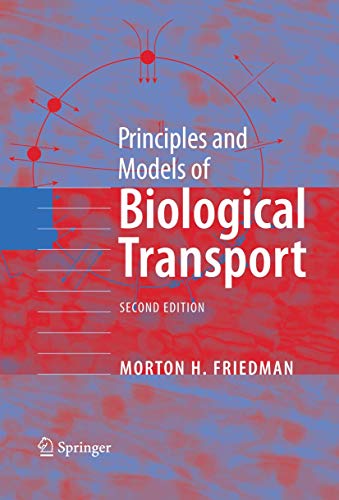
Principles and Models of Biological Transport, 2nd ed.
Morton H. Friedman
Transport processes are ubiquitous in the living organism, underlying nerve conduction and muscle contraction, digestion, kidney function and the nourishment of every cell in the body. The mechanisms by which these processes take place, and the models that describe them, are the subject of Principles and Models of Biological Transport. Beginning with the principles of thermodynamics and the organization of the cell, the text discusses each of the transport mechanisms found in the organism, their structure at the molecular level, their function and features, and their integration into tissues and organs.
Courses based on the text will be of interest to students who wish to understand the fundamentals of biological transport and the models that describe it. It will provide readers with the knowledge necessary to interpret transport experiments in biological systems and to predict performance or behavior from transport data. Advanced undergraduates or graduate students in Biomedical Engineering or Physiology and Biophysics will find this book useful, as will other engineers (Mechanical, Chemical, Environmental) who have some familiarity with biology, or Biology students who prefer a more quantitative approach to the subject.
The new edition includes numerous figures and references, and problems at the end of each chapter. It is supported by an open web site http://biotrans.pratt.duke.edu/ to facilitate its use in class. The web site allows faculty users to share syllabi based on the text and to post additional problems that can serve as illustrations or be given to students; all users are welcome to note corrections and suggest improvements in the text, and to add new material to the knowledge base. The web site is intended to support a "community of the book" that can maintain its currency and value into the future.
About the author:
Morton H. Friedman is Professor and former Chair of the Biomedical Engineering Department at Duke University and Professor of Medicine in the Duke University Medical Center. He originated the biological transport course in the Department of Biomedical Engineering at Johns Hopkins University and taught at The Ohio State University prior to arriving at Duke. He is a Fellow of the American Association for the Advancement of Science, the Biomedical Engineering Society, and the American Society of Mechanical Engineers, a Founding Fellow of the American Institute for Medical and Biological Engineering, and recipient of the H.R. Lissner medal and the Richard Skalak award of the American Society of Mechanical Engineers.
„Über diesen Titel“ kann sich auf eine andere Ausgabe dieses Titels beziehen.
Suchergebnisse für Principles and Models of Biological Transport

Beispielbild für diese ISBN
Principles And Models Of Biological Transport
Anbieter: Basi6 International, Irving, TX, USA
Verkäuferbewertung 5 von 5 Sternen

Zustand: Brand New. New. US edition. Expediting shipping for all USA and Europe orders excluding PO Box. Excellent Customer Service. Bestandsnummer des Verkäufers ABEOCT25-85071
Beispielbild für diese ISBN
Principles And Models Of Biological Transport
Anbieter: Romtrade Corp., STERLING HEIGHTS, MI, USA
Verkäuferbewertung 5 von 5 Sternen
Zustand: New. This is a Brand-new US Edition. This Item may be shipped from US or any other country as we have multiple locations worldwide. Bestandsnummer des Verkäufers ABBB-159674
Beispielbild für diese ISBN
PRINCIPLES AND MODELS OF BIOLOGICAL TRANSPORT
Anbieter: Basi6 International, Irving, TX, USA
Verkäuferbewertung 5 von 5 Sternen
Zustand: Brand New. New. US edition. Expediting shipping for all USA and Europe orders excluding PO Box. Excellent Customer Service. Bestandsnummer des Verkäufers ABEOCT25-85072
Beispielbild für diese ISBN
Principles and Models of Biological Transport
Anbieter: The Maryland Book Bank, Baltimore, MD, USA
Verkäuferbewertung 5 von 5 Sternen
hardcover. Zustand: Very Good. 2nd. Used - Very Good. Bestandsnummer des Verkäufers 19-G-6-0005
Gebraucht kaufen
EUR 81,52
EUR 4,18 Versand
Versand innerhalb von USA
Versand innerhalb von USA
Anzahl: 1 verfügbar
Beispielbild für diese ISBN
Principles and Models of Biological Transport
Anbieter: Books Puddle, Woodside, NY, USA
Verkäuferbewertung 4 von 5 Sternen

Zustand: New. pp. xviii + 510 2nd Edition. Bestandsnummer des Verkäufers 26394284
Neu kaufen
EUR 93,35
EUR 3,56 Versand
Versand innerhalb von USA
Versand innerhalb von USA
Anzahl: 1 verfügbar
Beispielbild für diese ISBN
Principles and Models of Biological Transport
Anbieter: Majestic Books, Hounslow, Vereinigtes Königreich
Verkäuferbewertung 4 von 5 Sternen
Zustand: New. pp. xviii + 510. Bestandsnummer des Verkäufers 7453683
Neu kaufen
EUR 90,63
EUR 7,75 Versand
Versand von Vereinigtes Königreich nach USA
Versand von Vereinigtes Königreich nach USA
Anzahl: 1 verfügbar
Beispielbild für diese ISBN
Principles and Models of Biological Transport
Anbieter: Biblios, Frankfurt am main, HESSE, Deutschland
Verkäuferbewertung 4 von 5 Sternen
Zustand: New. pp. xviii + 510. Bestandsnummer des Verkäufers 18394278
Neu kaufen
EUR 93,54
EUR 9,95 Versand
Versand von Deutschland nach USA
Versand von Deutschland nach USA
Anzahl: 1 verfügbar
Foto des Verkäufers
Principles and Models of Biological Transport
Print-on-DemandAnbieter: BuchWeltWeit Ludwig Meier e.K., Bergisch Gladbach, Deutschland
Verkäuferbewertung 5 von 5 Sternen
Buch. Zustand: Neu. This item is printed on demand - it takes 3-4 days longer - Neuware -Focus, Organization, and Content This book, like the first edition, deals with the mass transport processes that take place in living systems, with a focus on the normal behavior of eukaryotic cells and the - ganisms they constitute, in their normal physiological environment. As a consequence of this focus, the structure and content of the book differ from those of traditional transport texts. We do not start with the engineering principles of mass transport (which are well presented elsewhere) and then seek biological applications of these principles; rather, we begin with the biological processes themselves, and then - velop the models and analytical tools that are needed to describe them. This approach has several consequences. First of all, it drives the content of the text in a direction distinctively different from conventional transport texts. This is - cause the tools and models needed to describe complex biological processes are often different from those employed to describe more well-characterized inanimate systems. Many biological processes must still be described phenomenologically, using me- odologies like nonequilibrium thermodynamics. Simple electrical analogs employing a paucity of parameters can be more useful for characterization and prediction than complex theories based on the behavior of more well-defined systems on a laboratory bench. By allowing the biology to drive the choice of analysis tools and models, the latter are consistently presented in the context of real biological systems, and analysis and biology are interwoven throughout. 532 pp. Englisch. Bestandsnummer des Verkäufers 9780387792392
Neu kaufen
EUR 106,99
EUR 23,00 Versand
Versand von Deutschland nach USA
Versand von Deutschland nach USA
Anzahl: 2 verfügbar
Foto des Verkäufers
Principles and Models of Biological Transport
Print-on-DemandAnbieter: moluna, Greven, Deutschland
Verkäuferbewertung 5 von 5 Sternen
Gebunden. Zustand: New. Dieser Artikel ist ein Print on Demand Artikel und wird nach Ihrer Bestellung fuer Sie gedruckt. Focus, Organization, and Content This book, like the first edition, deals with the mass transport processes that take place in living systems, with a focus on the normal behavior of eukaryotic cells and the - ganisms they constitute, in their normal physiol. Bestandsnummer des Verkäufers 5911288
Neu kaufen
EUR 89,99
EUR 48,99 Versand
Versand von Deutschland nach USA
Versand von Deutschland nach USA
Anzahl: Mehr als 20 verfügbar
Foto des Verkäufers
Principles and Models of Biological Transport
Anbieter: AHA-BUCH GmbH, Einbeck, Deutschland
Verkäuferbewertung 5 von 5 Sternen
Buch. Zustand: Neu. Druck auf Anfrage Neuware - Printed after ordering - Focus, Organization, and Content This book, like the first edition, deals with the mass transport processes that take place in living systems, with a focus on the normal behavior of eukaryotic cells and the - ganisms they constitute, in their normal physiological environment. As a consequence of this focus, the structure and content of the book differ from those of traditional transport texts. We do not start with the engineering principles of mass transport (which are well presented elsewhere) and then seek biological applications of these principles; rather, we begin with the biological processes themselves, and then - velop the models and analytical tools that are needed to describe them. This approach has several consequences. First of all, it drives the content of the text in a direction distinctively different from conventional transport texts. This is - cause the tools and models needed to describe complex biological processes are often different from those employed to describe more well-characterized inanimate systems. Many biological processes must still be described phenomenologically, using me- odologies like nonequilibrium thermodynamics. Simple electrical analogs employing a paucity of parameters can be more useful for characterization and prediction than complex theories based on the behavior of more well-defined systems on a laboratory bench. By allowing the biology to drive the choice of analysis tools and models, the latter are consistently presented in the context of real biological systems, and analysis and biology are interwoven throughout. Bestandsnummer des Verkäufers 9780387792392
Neu kaufen
EUR 121,81
EUR 42,86 Versand
Versand von Deutschland nach USA
Versand von Deutschland nach USA
Anzahl: 1 verfügbar