
Verwandte Artikel zu Early Astronomy (Springer Study Edition)
Inhaltsangabe
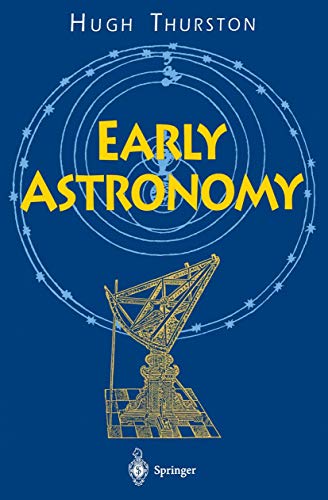
People must have watched the skies from time immemorial. Human beings have always shown intellectual curiosity in abundance, and before the invention of modern distractions people had more time-and more mental energy-to devote to stargazing than we have. Megaliths, Chinese oracle bones, Babylonian clay tablets, and Mayan glyphs all yield evi dence of early peoples' interest in the skies. To understand early astronomy we need to be familiar with various phenomena that could-and still can-be seen in the sky. For instance, it seems that some early people were interested in the points on the horizon where the moon rises or sets and marked the directions of these points with megaliths. These directions go through a complicated cycle-much more complicated than the cycle of the phases of the moon from new to full and back to new, and more complicated than the cycle of the rising and setting directions of the sun. Other peoples were interested in the irregular motions of the planets and in the way in which the times of rising of the various stars varied through the year, so we need to know about these phenomena, i. e. , about retrogression and about heliacal rising, to usc the technical terms. The book opens with an explanation of these matters. Early astronomers did more than just gaze in awe at the heavenly bodies; they tried to understand the complex details of their movements. By 300 H. C.
Die Inhaltsangabe kann sich auf eine andere Ausgabe dieses Titels beziehen.
Von der hinteren Coverseite
The earliest investigations that can be called scientific are concerned with the sky; they are the beginnings of astronomy. Many early civilizations produced astronomical texts, and several cultures that left no written records left monuments and artifacts - ranging from rock paintings to Stonehenge - that show a clear interest in astronomy. Civilizations in China, Mesopotamia, India, and Greece had highly developed astronomies, and the astronomy of the Mayas was by no means negligible. Greek astronomy, as developed by medieval Arab philosophers, evolved into the astronomy of Copernicus. This displaced the Earth from the stationary central position that almost all earlier astronomies had assumed. Soon thereafter, in the first decades of the seventeenth century, Kepler found the true shape of the planetary orbits and Galileo introduced the telescope for astronomical observations. This book covers the history of astronomy from its earliest beginnings to this point, which marks the beginning of modern instrumental and mathematical astronomy. The work of earlier astronomers, of all civilizations, remains as a triumph of the human intellect.
„Über diesen Titel“ kann sich auf eine andere Ausgabe dieses Titels beziehen.
Suchergebnisse für Early Astronomy (Springer Study Edition)

Beispielbild für diese ISBN
Early Astronomy (Springer Study Edition)
Anbieter: Strand Book Store, ABAA, New York, NY, USA
Verkäuferbewertung 4 von 5 Sternen

Paperback. Zustand: Good. In-depth coverage of the history of astronomy from the earliest beginnings to Galileo's invention of the telescope, which marks the beginning of modern instrumental and mathematical astronomy. 139 illus. 268p. Pap. Bestandsnummer des Verkäufers 3795388
Gebraucht kaufen
EUR 17,99
EUR 7,84 Versand
Versand innerhalb von USA
Versand innerhalb von USA
Anzahl: 1 verfügbar
Foto des Verkäufers
Early Astronomy
Anbieter: Fox & Hedgehog, Moraga, CA, USA
Verkäuferbewertung 5 von 5 Sternen

Softcover. Zustand: Very Good. With 139 B&W illustrations (illustrator). New York: Springer, 1996. First softcover printiing (stated, with number line). Softcover. Very Good. Oversize, 9 1/4 x 6 1/4 x 1/2 inches. With 139 B&W illustrations. Sewn binding. A solid copy with tight bindiing and square, uncreased spine. No marks. Mild cover wear. First softcover printiing (stated, with number line). Bestandsnummer des Verkäufers 1980
Gebraucht kaufen
EUR 32,39
Versand gratis
Versand innerhalb von USA
Versand innerhalb von USA
Anzahl: 1 verfügbar
Beispielbild für diese ISBN
Early Astronomy (Springer Study Edition)
Verlag:
Springer August 1996, 1996
ISBN 10: 0387948228
ISBN 13: 9780387948225
Gebraucht
Trade Paperback
Anbieter: Magus Books Seattle, Seattle, WA, USA
Verkäuferbewertung 5 von 5 Sternen
Trade Paperback. Zustand: VG-. used trade paperback edition. lightly shelfworn, corners perhaps slightly bumped. pages and binding are clean, straight and tight. there are no marks to the text or other serious flaws. Bestandsnummer des Verkäufers 1326339
Gebraucht kaufen
EUR 31,21
EUR 4,37 Versand
Versand innerhalb von USA
Versand innerhalb von USA
Anzahl: 1 verfügbar
Beispielbild für diese ISBN
Early Astronomy (Springer Study Edition)
Anbieter: Affordable Collectibles, Columbia, MO, USA
Verkäuferbewertung 5 von 5 Sternen
Paperback. Zustand: Very Good. Nice clean used book with no marks or highlights. Bestandsnummer des Verkäufers 23030053
Gebraucht kaufen
EUR 35,05
EUR 3,49 Versand
Versand innerhalb von USA
Versand innerhalb von USA
Anzahl: 1 verfügbar
Beispielbild für diese ISBN
Early Astronomy
Anbieter: Chiron Media, Wallingford, Vereinigtes Königreich
Verkäuferbewertung 5 von 5 Sternen
PF. Zustand: New. Bestandsnummer des Verkäufers 6666-IUK-9780387948225
Neu kaufen
EUR 57,34
EUR 18,06 Versand
Versand von Vereinigtes Königreich nach USA
Versand von Vereinigtes Königreich nach USA
Anzahl: 10 verfügbar
Foto des Verkäufers
Early Astronomy
Print-on-DemandAnbieter: BuchWeltWeit Ludwig Meier e.K., Bergisch Gladbach, Deutschland
Verkäuferbewertung 5 von 5 Sternen
Taschenbuch. Zustand: Neu. This item is printed on demand - it takes 3-4 days longer - Neuware -People must have watched the skies from time immemorial. Human beings have always shown intellectual curiosity in abundance, and before the invention of modern distractions people had more time-and more mental energy-to devote to stargazing than we have. Megaliths, Chinese oracle bones, Babylonian clay tablets, and Mayan glyphs all yield evi dence of early peoples' interest in the skies. To understand early astronomy we need to be familiar with various phenomena that could-and still can-be seen in the sky. For instance, it seems that some early people were interested in the points on the horizon where the moon rises or sets and marked the directions of these points with megaliths. These directions go through a complicated cycle-much more complicated than the cycle of the phases of the moon from new to full and back to new, and more complicated than the cycle of the rising and setting directions of the sun. Other peoples were interested in the irregular motions of the planets and in the way in which the times of rising of the various stars varied through the year, so we need to know about these phenomena, i. e. , about retrogression and about heliacal rising, to usc the technical terms. The book opens with an explanation of these matters. Early astronomers did more than just gaze in awe at the heavenly bodies; they tried to understand the complex details of their movements. By 300 H. C. 284 pp. Englisch. Bestandsnummer des Verkäufers 9780387948225
Neu kaufen
EUR 53,49
EUR 23,00 Versand
Versand von Deutschland nach USA
Versand von Deutschland nach USA
Anzahl: 2 verfügbar
Beispielbild für diese ISBN
Early Astronomy
Anbieter: Romtrade Corp., STERLING HEIGHTS, MI, USA
Verkäuferbewertung 5 von 5 Sternen
Zustand: New. This is a Brand-new US Edition. This Item may be shipped from US or any other country as we have multiple locations worldwide. Bestandsnummer des Verkäufers ABBB-255915
Beispielbild für diese ISBN
Early Astronomy (Springer Study Edition)
Anbieter: Ria Christie Collections, Uxbridge, Vereinigtes Königreich
Verkäuferbewertung 5 von 5 Sternen
Zustand: New. In English. Bestandsnummer des Verkäufers ria9780387948225_new
Neu kaufen
EUR 67,17
EUR 13,16 Versand
Versand von Vereinigtes Königreich nach USA
Versand von Vereinigtes Königreich nach USA
Anzahl: Mehr als 20 verfügbar
Beispielbild für diese ISBN
Early Astronomy
Anbieter: Books Puddle, Woodside, NY, USA
Verkäuferbewertung 4 von 5 Sternen
Zustand: New. pp. 284. Bestandsnummer des Verkäufers 26315731
Neu kaufen
EUR 79,84
EUR 3,49 Versand
Versand innerhalb von USA
Versand innerhalb von USA
Anzahl: 4 verfügbar
Beispielbild für diese ISBN
Early Astronomy
Print-on-DemandAnbieter: Majestic Books, Hounslow, Vereinigtes Königreich
Verkäuferbewertung 4 von 5 Sternen
Zustand: New. Print on Demand pp. 284 49:B&W 6.14 x 9.21 in or 234 x 156 mm (Royal 8vo) Perfect Bound on White w/Gloss Lam. Bestandsnummer des Verkäufers 7564940
Neu kaufen
EUR 79,29
EUR 7,58 Versand
Versand von Vereinigtes Königreich nach USA
Versand von Vereinigtes Königreich nach USA
Anzahl: 4 verfügbar