
Verwandte Artikel zu Out of Place: A Memoir
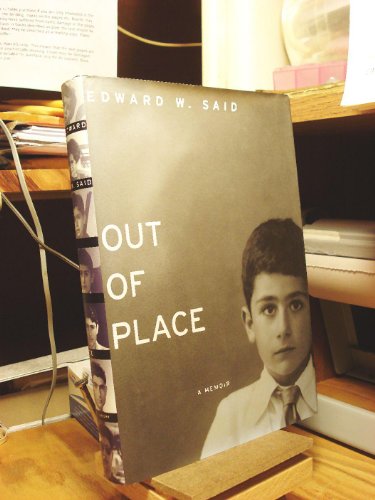
Inhaltsangabe
The respected scholar and cultural critic describes growning up in Palestine, Egypt, and Lebanon and the family and diverse cultural factors that shaped his life. By the author of Orientalism and Peace and Its Discontents. 25,000 first printing. Tour.
Die Inhaltsangabe kann sich auf eine andere Ausgabe dieses Titels beziehen.
Über die Autorin bzw. den Autor
Edward W. Said is University Professor of English and Comparative Literature at Columbia University. He is the author of seventeen books, including <b>Orientalism</b>, which was nominated for a National Book Critics Circle Award. <b>Orientalism, Culture and Imperialism, Covering Islam, Peace and Its Discontents, The Politics of Dispossession, Representations of the Intellectual</b>, and <b>The Question of Palestine</b> are available in Vintage paperback.
Aus dem Klappentext
Place</b> is an extraordinary story of exile, a narrative of many departures, a celebration of an irrecoverable past. A fatal medical diagnosis in 1991 convinced Edward Said that he should leave a record of where he was born and spent his childhood, and so with this memoir he rediscovers the Arab landscape of his early years--"the many places and people [who] no longer exist . . . Essentially a lost world." Vast changes occurred as Palestine became Israel, Lebanon was transformed by twenty years of civil war, and the colonial Egypt of King Farouk disappeared forever by 1952. <br> <br>Born in Jerusalem in 1935, Said was the only son in a prosperous family of five children. His ferociously demanding father upheld many Victorian values and ideals, and his adoring mother inspired his love of music, theater, and literature. His aunt Nabiha gave him his first sense of what it meant to leave Palestine, something never discussed by the family.
Auszug. © Genehmigter Nachdruck. Alle Rechte vorbehalten.
All families invent their parents and children, give each of them a story, character, fate, and even a language. There was always something wrong with how I was invented and meant to fit in with the world of my parents and four sisters. Whether this was because I constantly misread my part or because of some deep flaw in my being I could not tell for most of my early life. Sometimes I was intransigent, and proud of it. At other times I seemed to myself to be nearly devoid of any character at all, timid, uncertain, without will. Yet the overriding sensation I had was of always being out of place. Thus it took me about fifty years to become accustomed to, or, more exactly, to feel less uncomfortable with, Edward, a foolishly English name yoked forcibly to the unmistakably Arabic family name Said. True my mother told me that I had been named Edward after the Prince of Wales, who cut so fine a figure in 1935, the year of my birth, and Said was the name of various uncles and cousins. But the rationale of my name broke down both when I discovered no grandparents called Said and when I tried to connect my fancy English name with its Arabic partner. For years, and depending on the exact circumstances, I would rush past "Edward" and emphasize "Said"; at other times I would do the reverse, or connect these two to each other so quickly that neither would be clear. The one thing I could not tolerate, but very often would have to endure, was the disbelieving, and hence undermining, reaction: Edward? Said?
The travails of bearing such a name were compounded by an equally unsettling quandary when it came to language. I have never known what language I spoke first, Arabic or English, or which one was really mine beyond any doubt. What I do know, however, is that the two have always been together in my life, one resonating in the other, sometimes ironically, sometimes nostalgically, most often each correcting, and commenting on, the other. Each can seem like my absolutely first language, but neither is. I trace this primal instability back to my mother, whom I remember speaking to me in both English and Arabic, although she always wrote to me in English--once a week, all her life, as did I, all of hers. Certain spoken phrases of hers like tislamli or mish "arfa shu biddi "amal? or rouh"ha--dozens of them--were Arabic, and I was never conscious of having to translate them or, even in cases like tislamli, knowing exactly what they meant. They were a part of her infinitely maternal atmosphere, which in moments of great stress I found myself yearning for in the softly uttered phrase "ya mama," an atmosphere dreamily seductive then suddenly snatched away, promising something in the end never given.
But woven into her Arabic speech were English words like "naughty boy" and of course my name, pronounced "Edwaad." I am still haunted by the memory of the sound, at exactly the same time and place, of her voice calling me "Edwaad," the word wafting through the dusk air at closing time of the Fish Garden (a small Zamalek park with aquarium) and of myself, undecided whether to answer her back or to remain in hiding for just awhile longer, enjoying the pleasure of being called, being wanted, the non-Edward part of myself taking luxurious respite by not answering until the silence of my being became unendurable. Her English deployed a rhetoric of statement and norms that has never left me. Once my mother left Arabic and spoke English there was a more objective and serious tone that mostly banished the forgiving and musical intimacy of her first language, Arabic. At age five or six I knew that I was irremediably "naughty" and at school was all manner of comparably disapproved-of things like "fibber" and "loiterer." By the time I was fully conscious of speaking English fluently, if not always correctly, I regularly referred to myself not as "me" but as "you." "Mummy doesn't love you, naughty boy," she would say, and I would respond, in half-plaintive echoing, half-defiant assertion, "Mummy doesn't love you, but Auntie Melia loves you." Auntie Melia was her elderly maiden aunt, who doted on me when I was a very young child. "No she doesn't," my mother persisted. "All right. Saleh [Auntie Melia's Sudanese driver] loves you," I would conclude, rescuing something from the enveloping gloom.
I hadn't then any idea where my mother's English came from or who, in the national sense of the phrase, she was: this strange state of ignorance continued until relatively late in my life, when I was in graduate school. In Cairo, one of the places where I grew up, her spoken Arabic was fluent Egyptian, but to my keener ears, and to those of the many Egyptians she knew, it was if not outright Shami, then perceptibly inflected by it. "Shami" (Damascene) is the collective adjective and noun used by Egyptians to describe both an Arabic speaker who is not Egyptian and someone who is from Greater Syria, i.e., Syria itself, Lebanon, Palestine, Jordan; but "Shami" is also used to designate the Arabic dialect spoken by a Shami. Much more than my father, whose linguistic ability was primitive compared to hers, my mother had an excellent command of classical Arabic as well as the demotic. Not enough of the latter to disguise her as Egyptian, however, which of course she was not. Born in Nazareth, then sent to boarding school and junior college in Beirut, she was Palestinian, even though her mother, Munira, was Lebanese. I never knew her father, but he, I discovered, was the Baptist minister in Nazareth, although he originally came from Safad, via a sojourn in Texas.
Not only could I not absorb, much less master, all the meanderings and interruptions of these details as they broke up a simple dynastic sequence, but I could not grasp why she was not a straight English mummy. I have retained this unsettled sense of many identities--mostly in conflict with each other--all of my life, together with an acute memory of the despairing feeling that I wish we could have been all-Arab, or all-European and American, or all-Orthodox Christian, or all-Muslim, or all-Egyptian, and so on. I found I had two alternatives with which to counter what in effect was the process of challenge, recognition, and exposure, questions and remarks like "What are you?"; "But Said is an Arab name"; "You're American?"; "You're American without an American name, and you've never been to America"; "You don't look American!"; "How come you were born in Jerusalem and you live here?"; "You're an Arab after all, but what kind are you? A Protestant?"
I do not remember that any of the answers I gave out loud to such probings were satisfactory or even memorable. My alternatives were hatched entirely on my own: one might work, say, in school, but not in church or on the street with my friends. The first was to adopt my father's brashly assertive tone and say to myself, "I'm an American citizen," and that's it. He was American by dint of having lived in the United States followed by service in the army during World War I. Partly because this alternative meant his making of me something incredible, I found it the least convincing. To say "I am an American citizen" in an English school in wartime Cairo dominated by British troops and with what seemed to me a totally homogeneous Egyptian populace was a foolhardy venture, to be risked in public only when I was challenged officially to name my citizenship; in private...
„Über diesen Titel“ kann sich auf eine andere Ausgabe dieses Titels beziehen.
Suchergebnisse für Out of Place: A Memoir

Foto des Verkäufers
Out of Place: A Memoir
Anbieter: Dream Books Co., Denver, CO, USA
Verkäuferbewertung 5 von 5 Sternen

Zustand: acceptable. This copy has clearly been enjoyedâ"expect noticeable shelf wear and some minor creases to the cover. Binding is strong, and all pages are legible. May contain previous library markings or stamps. Bestandsnummer des Verkäufers DBV.0394587391.A
Gebraucht kaufen
EUR 3,96
Versand gratis
Versand innerhalb von USA
Versand innerhalb von USA
Anzahl: 1 verfügbar
Foto des Verkäufers
Out of Place: A Memoir
Anbieter: Dream Books Co., Denver, CO, USA
Verkäuferbewertung 5 von 5 Sternen
Zustand: good. Gently used with minimal wear on the corners and cover. A few pages may contain light highlighting or writing, but the text remains fully legible. Dust jacket may be missing, and supplemental materials like CDs or codes may not be included. May be ex-library with library markings. Ships promptly! Bestandsnummer des Verkäufers DBV.0394587391.G
Gebraucht kaufen
EUR 4,04
Versand gratis
Versand innerhalb von USA
Versand innerhalb von USA
Anzahl: 1 verfügbar
Beispielbild für diese ISBN
Out of Place A Memoir
Anbieter: World of Books (was SecondSale), Montgomery, IL, USA
Verkäuferbewertung 5 von 5 Sternen
Zustand: Acceptable. Item in acceptable condition! Textbooks may not include supplemental items i.e. CDs, access codes etc. Bestandsnummer des Verkäufers 00103704257
Gebraucht kaufen
EUR 4,14
Versand gratis
Versand innerhalb von USA
Versand innerhalb von USA
Anzahl: 2 verfügbar
Beispielbild für diese ISBN
Out of Place A Memoir
Anbieter: World of Books (was SecondSale), Montgomery, IL, USA
Verkäuferbewertung 5 von 5 Sternen
Zustand: Good. Item in good condition. Textbooks may not include supplemental items i.e. CDs, access codes etc. Bestandsnummer des Verkäufers 00109024376
Gebraucht kaufen
EUR 4,14
Versand gratis
Versand innerhalb von USA
Versand innerhalb von USA
Anzahl: 1 verfügbar
Beispielbild für diese ISBN
Out of Place: A Memoir
Anbieter: ThriftBooks-Atlanta, AUSTELL, GA, USA
Verkäuferbewertung 5 von 5 Sternen
Hardcover. Zustand: Good. No Jacket. Pages can have notes/highlighting. Spine may show signs of wear. ~ ThriftBooks: Read More, Spend Less. Bestandsnummer des Verkäufers G0394587391I3N00
Gebraucht kaufen
EUR 5,89
Versand gratis
Versand innerhalb von USA
Versand innerhalb von USA
Anzahl: 1 verfügbar
Beispielbild für diese ISBN
Out of Place: A Memoir
Anbieter: ThriftBooks-Atlanta, AUSTELL, GA, USA
Verkäuferbewertung 5 von 5 Sternen
Hardcover. Zustand: Good. No Jacket. Former library book; Pages can have notes/highlighting. Spine may show signs of wear. ~ ThriftBooks: Read More, Spend Less. Bestandsnummer des Verkäufers G0394587391I3N10
Gebraucht kaufen
EUR 5,89
Versand gratis
Versand innerhalb von USA
Versand innerhalb von USA
Anzahl: 1 verfügbar
Beispielbild für diese ISBN
Out of Place: A Memoir
Anbieter: ThriftBooks-Dallas, Dallas, TX, USA
Verkäuferbewertung 5 von 5 Sternen
Hardcover. Zustand: Good. No Jacket. Pages can have notes/highlighting. Spine may show signs of wear. ~ ThriftBooks: Read More, Spend Less. Bestandsnummer des Verkäufers G0394587391I3N00
Gebraucht kaufen
EUR 5,89
Versand gratis
Versand innerhalb von USA
Versand innerhalb von USA
Anzahl: 1 verfügbar
Beispielbild für diese ISBN
Out of Place: A Memoir
Anbieter: ThriftBooks-Atlanta, AUSTELL, GA, USA
Verkäuferbewertung 5 von 5 Sternen
Hardcover. Zustand: Good. No Jacket. Missing dust jacket; Pages can have notes/highlighting. Spine may show signs of wear. ~ ThriftBooks: Read More, Spend Less. Bestandsnummer des Verkäufers G0394587391I3N01
Gebraucht kaufen
EUR 5,89
Versand gratis
Versand innerhalb von USA
Versand innerhalb von USA
Anzahl: 1 verfügbar
Beispielbild für diese ISBN
Out of Place: A Memoir
Anbieter: BooksRun, Philadelphia, PA, USA
Verkäuferbewertung 5 von 5 Sternen
Hardcover. Zustand: Very Good. 1. With dust jacket. It's a well-cared-for item that has seen limited use. The item may show minor signs of wear. All the text is legible, with all pages included. It may have slight markings and/or highlighting. Bestandsnummer des Verkäufers 0394587391-11-1-29
Gebraucht kaufen
EUR 6,68
Versand gratis
Versand innerhalb von USA
Versand innerhalb von USA
Anzahl: 1 verfügbar
Beispielbild für diese ISBN
Out of Place : A Memoir
Verlag:
Knopf Doubleday Publishing Group, 1999
ISBN 10: 0394587391
ISBN 13: 9780394587394
Gebraucht
Hardcover
Anbieter: Better World Books, Mishawaka, IN, USA
Verkäuferbewertung 5 von 5 Sternen
Zustand: Very Good. Pages intact with possible writing/highlighting. Binding strong with minor wear. Dust jackets/supplements may not be included. Stock photo provided. Product includes identifying sticker. Better World Books: Buy Books. Do Good. Bestandsnummer des Verkäufers 5890179-6
Gebraucht kaufen
EUR 8,24
Versand gratis
Versand innerhalb von USA
Versand innerhalb von USA
Anzahl: 1 verfügbar