
Verwandte Artikel zu The Science of Success: Napoleon Hill's Proven...
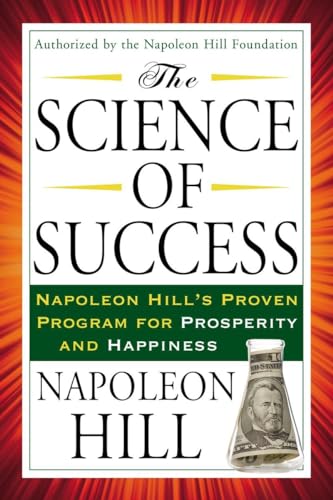
The Science of Success: Napoleon Hill's Proven Program for Prosperity and Happiness (Tarcher Success Classics) - Softcover
Inhaltsangabe
Rare writings from Napoleon Hill—perfect for the THINK AND GROW RICH fan in your life, or for aspiring followers of Napoleon Hill’s philosophy.
The Science of Success is a collection of writings by and about Napoleon Hill, author of the most widely read book on personal prosperity philosophy ever published, Think and Grow Rich. These essays and writings contain teachings on the nature of prosperity and how to attain it, and are published here in book form for the very first time. This work is a must-have item for Hill’s millions of fans worldwide!
Die Inhaltsangabe kann sich auf eine andere Ausgabe dieses Titels beziehen.
Über die Autorin bzw. den Autor
Napoleon Hill was born in 1883 in Wise County, Virginia. He began his writing career at age thirteen as a “mountain reporter” for small-town newspapers and went on to become America’s most beloved motivational author. His most famous work, Think and Grow Rich, is one of the bestselling books of all time.
Auszug. © Genehmigter Nachdruck. Alle Rechte vorbehalten.
Part One
UNCOLLECTED WORKS
“The formula appears to be simple . . . it appears to be basic. Yet it represents the distilled effort of a lifetime.”
THE MAN WHO TAUGHT MILLIONS HOW TO SUCCEED
by John Johnson
There’s hardly a person alive today who doesn’t know of Napoleon Hill and his law of success. Millions of readers throughout the world have read and bene?ted from his teachings. Few, however, may be aware of the tremendous personal success of their author . . . a man who used his philosophy to rise from small town oblivion to international prominence. In this issue, “The Man Who Taught Millions How to Succeed” tells the fabulous story of his life and reveals how the formula he originated can bring success to you!
All Americans were inspired and stirred when they heard, in 1933, the resonant voice of Franklin Delano Roosevelt proclaim, “We have nothing to fear but fear itself.” Men everywhere were electri?ed by this statement which brought a halt to the panic that had shattered our economy and had shaken the foundations of our government.
While the President spoke these words another man listened with quiet satisfaction. This man was accustomed to supplying words and ideas for others in every walk of life. Doing so was his life’s work. The fact that the President of the United States saw ?t to use the idea he, in his capacity as con?dential advisor, had expressed was another milestone in a long and fruitful career dedicated to giving the world a philosophy that men could use to better themselves.
This man who remained anonymously in the shadows was Napoleon Hill. As the author of Think and Grow Rich, How to Raise Your Own Salary,and other best sellers, he might be considered a successful writer. But those who really understand the message he tries to convey recognize him as much more than just an author. Writing is only one of the instruments he has used to tell millions the truth about themselves and the powers they seldom realize that they possess.
What are these powers? Succinctly stated, they include vast and untapped reservoirs of human intelligence and ability. Hill has the distinction of having devoted his life to the creation of a formula which unleashes these powers with maximum force . . . and of teaching people how to apply his ?ndings in their daily lives.
The voice of 65-year-old Napoleon Hill has been heard in every corner of the world . . . and its effects have been potent. Millions of readers in 20 foreign nations have read his books. Even far-off India has been stirred by his work. Through the in?uence of Mahatma Gandhi, a publisher in Bombay, India, publishes and distributes all of the Hill success books. In Brazil his books have been translated and published in the Portuguese language. And a special edition of his most popular book, Think and Grow Rich,was published in Sydney, Australia, and distributed throughout the British Empire. Although this book was ?rst published in the United States in 1937, it is still a “best seller” throughout the nation, and huge numbers of copies of it have been purchased by employers as gifts for their employees.
Napoleon Hill started his quest for the formula of success early in life. When he found it, he shared his knowledge with waiting millions who otherwise might have remained shrouded in the obscurity from which they came.
His motivation for doing so can be found in the almost unbelievable story of his life. The son of an impoverished Virginia mountaineer, he seemed fated to spend his life wallowing in unrelieved ignorance. “Moonshiners, mountain stills, illiteracy, and deadly family feuds were the principal industries of our community,” he says with a smile, “and the usual home was a crumbling clapboard shack or a dirt-?oored cabin.”
The Hills lived in a house of the latter description. When his mother died, young Napoleon, a name bestowed in honor of a rich paternal great uncle, was still a child. The blow left its mark. Probably to hide the scar, he achieved the distinction of being the toughest boy in Wise County. He wore it like a badge of honor—until his father presented the nine-year-old boy with a stepmother.
The new Mrs. Hill brought a fresh outlook into the household. Not a mountaineer herself, she was appalled by what she found . . . and she was determined to change it. Napoleon, who could have been her biggest problem, turned into her greatest victory.
“I was introduced to her as the ‘meanest’ boy in town,” the famed success-scientist recalls. “But my stepmother took one look at me and said, ‘He’s not the meanest boy. He’s only a boy who hasn’t learned how to direct his smartness to constructive ends.’” In a sense, these words were to become the cornerstone of the philosophy he was destined to develop in the decades that followed. Mrs. Hill became a guiding light. Using her dowry, she sent her husband to school and didn’t rest until he was a successful dentist. Napoleon and his younger brother were rescued by her determination to give them a chance. At 12 the future inspirer of millions completed grade school; at 14 he was a part-time reporter for 15 newspapers, and at 15, after completing high school, he entered a business college at Tazewell, Virginia. As his horizons expanded, his abhorrence of ignorance grew and his determination to advance increased.
When he ?nished business college, he got a job with a leading attorney. How the callow 16-year-old managed to make the connection is a saga of audacity . . . and foresight. He reasoned that his ?rst job should be a stepping-stone. A good start was essential and money, at this point, was almost unimportant.
Accordingly, he wrote a letter to Rufus A. Ayres, a former attorney general of Virginia and one of the state’s most famous lawyers. The letter, in substance, said as follows:
I have just completed a business college course and am well-quali?ed to serve as your secretary, a position I am very anxious to have. Since I have no previous experience, I know that at the beginning of working for you will be of more value to me than it will be to you. Because of this, I am willing to pay for the privilege of working with you. You may charge any sum you consider fair, provided that at the end of three months that amount will become my salary. The sum I am to pay you can be deducted from what you pay me when I start to earn money.
“General Ayres,” Hill recalls, “was so taken with my letter that he hired me.” At the end of the ?rst month the famous attorney began paying him a regular salary, and before long the young man was one of his trusted lieutenants.
Legal work appealed to Hill so much that, for a while, he considered making it his career. When he was 18 he decided to matriculate at Georgetown University Law School, in Washington, D.C., in order to qualify for the bar. Doing so required tremendous nerve. He had no money to ?nance his education. However, he did have an idea. Since he had made money writing for newspapers, he felt that he might do so again. This time he wanted to specialize in writing biographical stories about successful people . . . the kind of stories that many magazines of the period were publishing.
HILL MEETS SUCCESS PERSONIFIED
As a ?rst step he approached Senator Bob Taylor of Tennessee. In addition to being a senator, Taylor was the publisher of an important periodical of the day. Young Hill wanted some assurance of a regular income from his writing. Taylor, intrigued by the young man, offered to give him letters of introduction to prominent people who might make good subjects for future articles. When their interview was over, Hill’s list included Thomas...
„Über diesen Titel“ kann sich auf eine andere Ausgabe dieses Titels beziehen.
Suchergebnisse für The Science of Success: Napoleon Hill's Proven...

Beispielbild für diese ISBN
The Science of Success: Napoleon Hill's Proven Program for Prosperity and Happiness (Tarcher Success Classics)
Anbieter: World of Books (was SecondSale), Montgomery, IL, USA
Verkäuferbewertung 5 von 5 Sternen

Zustand: Acceptable. Item in acceptable condition! Textbooks may not include supplemental items i.e. CDs, access codes etc. Bestandsnummer des Verkäufers 00106128036
Gebraucht kaufen
EUR 3,22
Versand gratis
Versand innerhalb von USA
Versand innerhalb von USA
Anzahl: 1 verfügbar
Beispielbild für diese ISBN
The Science of Success: Napoleon Hill's Proven Program for Prosperity and Happiness (Tarcher Success Classics)
Anbieter: World of Books (was SecondSale), Montgomery, IL, USA
Verkäuferbewertung 5 von 5 Sternen
Zustand: Good. Item in good condition. Textbooks may not include supplemental items i.e. CDs, access codes etc. Bestandsnummer des Verkäufers 00106419086
Gebraucht kaufen
EUR 3,22
Versand gratis
Versand innerhalb von USA
Versand innerhalb von USA
Anzahl: 1 verfügbar
Foto des Verkäufers
The Science of Success: Napoleon Hill's Proven Program for Prosperity and Happiness (Tarcher Success Classics)
Anbieter: Zoom Books East, Glendale Heights, IL, USA
Verkäuferbewertung 5 von 5 Sternen
Zustand: good. Book is in good condition and may include underlining highlighting and minimal wear. The book can also include "From the library of" labels. May not contain miscellaneous items toys, dvds, etc. . We offer 100% money back guarantee and 24 7 customer service. Bestandsnummer des Verkäufers ZEV.0399170952.G
Gebraucht kaufen
EUR 3,97
Versand gratis
Versand innerhalb von USA
Versand innerhalb von USA
Anzahl: 2 verfügbar
Beispielbild für diese ISBN
The Science of Success: Napoleon Hill's Proven Program for Prosperity and Happiness (Tarcher Success Classics)
Verlag:
Tarcher (edition Illustrated), 2014
ISBN 10: 0399170952
ISBN 13: 9780399170959
Gebraucht
Paperback
Anbieter: BooksRun, Philadelphia, PA, USA
Verkäuferbewertung 5 von 5 Sternen
Paperback. Zustand: Fair. Illustrated. The item might be beaten up but readable. May contain markings or highlighting, as well as stains, bent corners, or any other major defect, but the text is not obscured in any way. Bestandsnummer des Verkäufers 0399170952-7-1
Gebraucht kaufen
EUR 4,47
Versand gratis
Versand innerhalb von USA
Versand innerhalb von USA
Anzahl: 1 verfügbar
Foto des Verkäufers
The Science of Success: Napoleon Hill's Proven Program for Prosperity and Happiness (Tarcher Success Classics)
Anbieter: Greenworld Books, Arlington, TX, USA
Verkäuferbewertung 5 von 5 Sternen
Zustand: good. Fast Free Shipping â" Good condition. It may show normal signs of use, such as light writing, highlighting, or library markings, but all pages are intact and the book is fully readable. A solid, complete copy that's ready to enjoy. Bestandsnummer des Verkäufers GWV.0399170952.G
Gebraucht kaufen
EUR 4,55
Versand gratis
Versand innerhalb von USA
Versand innerhalb von USA
Anzahl: 1 verfügbar
Foto des Verkäufers
The Science of Success: Napoleon Hill's Proven Program for Prosperity and Happiness (Tarcher Success Classics)
Anbieter: Greenworld Books, Arlington, TX, USA
Verkäuferbewertung 5 von 5 Sternen
Zustand: very_good. Fast Free Shipping â" Very Good condition book with a firm cover and clean pages. Shows normal use and some light wear or limited notes markings. A solid, nice copy to enjoy. Bestandsnummer des Verkäufers GWV.0399170952.VG
Gebraucht kaufen
EUR 4,57
Versand gratis
Versand innerhalb von USA
Versand innerhalb von USA
Anzahl: 1 verfügbar
Foto des Verkäufers
The Science of Success: Napoleon Hill's Proven Program for Prosperity and Happiness (Tarcher Success Classics)
Anbieter: Greenworld Books, Arlington, TX, USA
Verkäuferbewertung 5 von 5 Sternen
Zustand: acceptable. Fast Free Shipping â" A well-loved copy with text fully readable and cover pages intact. May display wear such as writing, highlighting, bends, folds or library marks. Still a complete and usable book. Bestandsnummer des Verkäufers GWV.0399170952.A
Gebraucht kaufen
EUR 4,59
Versand gratis
Versand innerhalb von USA
Versand innerhalb von USA
Anzahl: 1 verfügbar
Beispielbild für diese ISBN
The Science of Success: Napoleon Hill's Proven Program for Prosperity and Happiness
Anbieter: World of Books Inc, Montgomery, IL, USA
Verkäuferbewertung 4 von 5 Sternen

Paperback. Zustand: Good. Rare writings from Napoleon Hill--perfect for the THINK AND GROW RICH fan in your life, or for aspiring followers of Napoleon Hill's philosophy. The Science of Success is a collection of writings by and about Napoleon Hill, author of the most widely read book on personal prosperity philosophy ever published, Think and Grow Rich. These essays and writings contain teachings on the nature of prosperity and how to attain it, and are published here in book form for the very first time. This work is a must-have item for Hill's millions of fans worldwide! Bestandsnummer des Verkäufers CIN0399170952G
Gebraucht kaufen
EUR 5,01
Versand gratis
Versand innerhalb von USA
Versand innerhalb von USA
Anzahl: 1 verfügbar
Beispielbild für diese ISBN
The Science of Success: Napoleon Hill's Proven Program for Prosperity and Happiness
Anbieter: World of Books Inc, Montgomery, IL, USA
Verkäuferbewertung 4 von 5 Sternen
Paperback. Zustand: Fair. Rare writings from Napoleon Hill--perfect for the THINK AND GROW RICH fan in your life, or for aspiring followers of Napoleon Hill's philosophy. The Science of Success is a collection of writings by and about Napoleon Hill, author of the most widely read book on personal prosperity philosophy ever published, Think and Grow Rich. These essays and writings contain teachings on the nature of prosperity and how to attain it, and are published here in book form for the very first time. This work is a must-have item for Hill's millions of fans worldwide! Bestandsnummer des Verkäufers CIN0399170952A
Gebraucht kaufen
EUR 5,01
Versand gratis
Versand innerhalb von USA
Versand innerhalb von USA
Anzahl: 1 verfügbar
Beispielbild für diese ISBN
The Science of Success: Napoleon Hill's Proven Program for Prosperity and Happiness
Verlag:
Penguin Publishing Group, 2014
ISBN 10: 0399170952
ISBN 13: 9780399170959
Gebraucht
Paperback
Anbieter: ThriftBooks-Dallas, Dallas, TX, USA
Verkäuferbewertung 5 von 5 Sternen
Paperback. Zustand: Good. No Jacket. Pages can have notes/highlighting. Spine may show signs of wear. ~ ThriftBooks: Read More, Spend Less. Bestandsnummer des Verkäufers G0399170952I3N00
Gebraucht kaufen
EUR 6,41
Versand gratis
Versand innerhalb von USA
Versand innerhalb von USA
Anzahl: 1 verfügbar