
Verwandte Artikel zu The Republic of Conscience
Inhaltsangabe
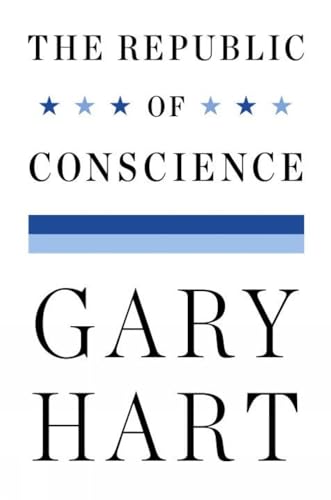
Former Senator Gary Hart’s The Republic of Conscience is a meditation on the growing gap between the founding principles of the United States Constitution and our current political landscape.
Going back as early as 400 BC, the idea of a true republic has been threatened by narrow, special interests taking precedence over the commonwealth. The United States Constitution was drafted to protect against such corruption, but as Gary Hart details inThe Republic of Conscience, America is nowhere near the republic it set out to be almost 250 years ago, falling to the very misconduct it hoped to avoid.
In his latest book, the former Colorado Senator and presidential contender describes ‘the increasing gap between purpose and performance’ in America, emphasizing how the sense of national interest has become distorted and diluted over time. Focusing on the years after World War II, Hart tackles major American institutions—the military, the CIA, Congress—and outlines how these establishments have led the country away from its founding principles, not closer to them.
Full of original and incisive analysis, The Republic of Conscience is Hart’s examination and remedy for the millions of Americans who feel jaded, confused, and disappointed by their current government. A testament to Hart’s political faith in the founding fathers, this book is one citizen’s attempt to recapture the Republic, and a timely reminder for the next July 4th holiday.
Die Inhaltsangabe kann sich auf eine andere Ausgabe dieses Titels beziehen.
Über die Autorin bzw. den Autor
Gary Hart is an American politician and a former Colorado senator, serving in Congress from 1975 to 1987. Since retiring from the Senate, Hart resumed his private law practice and has written several books on U.S. history and politics. In 2014, President Barack Obama named Hart as the new United States Special Envoy for Northern Ireland.
Auszug. © Genehmigter Nachdruck. Alle Rechte vorbehalten.
PREFACE
America’s founders created a republic knowing that it, like all republics from ancient Athens and Rome onward, would be vulnerable to corruption. From 400 BC onward, corruption of the republican ideal took the form of narrow, individual, and special interests taking precedence over the common good and the commonwealth. Our founders knew that if this evil insinuated itself into the new American Republic, our nation would not long survive in the form they had designed and had hoped for it.
By these classic standards, the American Republic in the twenty-first century is massively corrupt. A vast and cancerous network of lobbying, campaign fund-raising, and access to policy makers in administrations and lawmakers in Congress is based purely and simply on special and narrow interests. This tragedy is compounded by two relatively recent trends: More than four hundred former members of Congress, not to mention their spouses and family members, have joined the lobbying ranks; and former administration officials come and go from one administration to another with periods of lobbying activities in between.
Thus, a permanent political class has established itself in our nation’s capital. Whether incestuous is an appropriate description or not, it is most certainly a system that an increasing number of Americans distrust—and with considerable reason. Friends promote friends. Rolodexes are shared. Networks are maintained. The system is increasingly closed to outsiders, or at least to outsiders who have yet to attain membership. National leadership appears to be limited to a few families.
Such a permanent political system rarely produces innovative policies or creative agendas. To contest for a seat in the United States Senate, even in a medium-size state such as Colorado, requires millions, sometimes tens of millions, of dollars. Very little of that sum is produced by small contributions. Most of it comes from the institutional investors and political action committees with specific agendas that have proliferated in both political parties. Senators and members of Congress spend hours each day telephoning large contributors, pleading for money. Television networks routinely decry this trend even though they are the principal beneficiaries of the hundreds of millions of dollars spent on political advertising.
To raise these staggering sums requires a candidate to subscribe to established agendas. Those agendas do not represent the national interest. They represent a panoply of special interests. Successful candidates arrive in office heavily beholden to those interests that have contributed. Their flexibility, creativity, and imagination are circumscribed by whatever commitments had to be made to finance a campaign. At the very least, they have traded access, the coin of the political realm, for campaign contributions.
But this is not the kind of government our founders created and envisioned for future generations. Even a casual reading of the Constitutional debates, speeches, and voluminous correspondence reveals the founders’ deep concerns, based on their intimate familiarity with the theorists of the republic from Athens through Machiavelli to the English and Scottish Enlightenment, over the threat of corruption, the danger to all republics.
We can only imagine what Washington, Adams, Hamilton, Madison, and Jefferson, among many others, would say about today’s American Republic. Being pragmatists, they would recognize that a nation that increased a hundredfold in population in two centuries, that adapted itself to world leadership after World War II, and that now struggles to compete in a globalized economy would have to change and adjust. But they also knew the difference between policy that must adapt to new realities and principles that must not.
Indeed, they believed that the first principles of every constitution must be frequently renewed to prevent corruption. And the necessity for a timely renewal of principles is the central purpose of this book.
As a veteran of campaigning, holding public office, and advising various administrations, I find no justification in our Constitution for the political system we have now created or have permitted to be created by others. Instead, this system is the product of the refusal to enact campaign finance reforms, to restrict transition from public office to lobbying, and to provide limited candidate access to free media. This is not a mysterious or complex secret process everyday Americans cannot understand. It is the product of interest groups who prefer to trade cash for access, television networks who prefer paid political advertising to open access to the public airwaves, hugely lucrative lobbying organizations, and the compounding of this corrupt system by recent Supreme Court decisions.
Out of this entire morass, nothing would dumbfound a returning founder more than decisions by the current Supreme Court allowing corporations to contribute unlimited amounts of money to promote their particular narrow interests. This stands as nothing more nor less than the highest judicial body in the Republic sanctioning the corruption of that Republic.
This book attempts to contrast the Republic our founders created and hoped would be perpetuated with the government we now have. Each area of legislation and policy today is dominated by the interest groups concerned with it. Rather than starting with a view of what is best for the nation long-term, the common good, legislators and policy makers seek to reconcile the demands of each narrow interest concerned with that issue. Being men of experience, our founders anticipated this, but they wanted those governing our nation to consider the demands of particular interests in the broader context of the national interest. They feared the corruption that inevitably results when governance becomes nothing more than a process for satisfying an endless host of particular interests. This accounts for their insistence on “disinterested” representatives.
The disappearance of a sense of the national interest, and the consequent governance by and for special interests, reflects itself in today’s political process through the channeling of hundreds of millions of dollars from interest groups to lobbyists and then to officeholders and office seekers. The result is the rise of a permanent political class increasingly remote from everyday Americans and a system that could lead to the ultimate destruction of the republican ideal. This is the corruption we were warned about from our earliest beginnings that would destroy the American Republic.
The new realities of the twenty-first century do not require the United States to abandon the principles upon which it was founded. Neither our economic foundation, nor our foreign policy, nor our national defense requires a corrupt political system. Indeed, commitment to the commonwealth and the common good, including a growing economy, an enlightened foreign policy, and strong national security, will make us more successful and will attract the favorable opinion of mankind.
Preservation and renewal of those first principles represent the duty we owe our founders to keep the Republic they bequeathed to us and our posterity.
INTRODUCTION
This is a book about a republic—the American Republic—what it was meant to be and what it has become. In some crucial respects the twenty-first-century American Republic is not the country our founders thought they had created.
The search for the causes of the increasing gap between word and deed starts with an understanding of what a republic actually is or ought to be.
At their best, republics, including ours, have demonstrated four basic qualities: popular sovereignty; a sense of the common good; demonstration of civic...
„Über diesen Titel“ kann sich auf eine andere Ausgabe dieses Titels beziehen.
Suchergebnisse für The Republic of Conscience

Beispielbild für diese ISBN
The Republic of Conscience
Verlag:
Blue Rider Press (edition ), 2015
ISBN 10: 0399175237
ISBN 13: 9780399175237
Gebraucht
Hardcover
Anbieter: BooksRun, Philadelphia, PA, USA
Verkäuferbewertung 5 von 5 Sternen

Hardcover. Zustand: Fair. With dust jacket. The item might be beaten up but readable. May contain markings or highlighting, as well as stains, bent corners, or any other major defect, but the text is not obscured in any way. Bestandsnummer des Verkäufers 0399175237-7-1-29
Gebraucht kaufen
EUR 5,36
Versand gratis
Versand innerhalb von USA
Versand innerhalb von USA
Anzahl: 1 verfügbar
Beispielbild für diese ISBN
The Republic of Conscience
Anbieter: Open Books, Chicago, IL, USA
Verkäuferbewertung 5 von 5 Sternen
Hardcover. Zustand: Very Good. Open Books is a nonprofit social venture that provides literacy experiences for thousands of readers each year through inspiring programs and creative capitalization of books. Bestandsnummer des Verkäufers mon0000759155
Gebraucht kaufen
EUR 2,28
EUR 3,42 Versand
Versand innerhalb von USA
Versand innerhalb von USA
Anzahl: 1 verfügbar
Beispielbild für diese ISBN
The Republic of Conscience
Anbieter: ThriftBooks-Atlanta, AUSTELL, GA, USA
Verkäuferbewertung 5 von 5 Sternen
Hardcover. Zustand: Very Good. No Jacket. Former library book; May have limited writing in cover pages. Pages are unmarked. ~ ThriftBooks: Read More, Spend Less. Bestandsnummer des Verkäufers G0399175237I4N10
Gebraucht kaufen
EUR 5,79
Versand gratis
Versand innerhalb von USA
Versand innerhalb von USA
Anzahl: 1 verfügbar
Beispielbild für diese ISBN
The Republic of Conscience
Anbieter: ThriftBooks-Dallas, Dallas, TX, USA
Verkäuferbewertung 5 von 5 Sternen
Hardcover. Zustand: Very Good. No Jacket. May have limited writing in cover pages. Pages are unmarked. ~ ThriftBooks: Read More, Spend Less. Bestandsnummer des Verkäufers G0399175237I4N00
Gebraucht kaufen
EUR 5,79
Versand gratis
Versand innerhalb von USA
Versand innerhalb von USA
Anzahl: 1 verfügbar
Beispielbild für diese ISBN
The Republic of Conscience
Anbieter: ThriftBooks-Atlanta, AUSTELL, GA, USA
Verkäuferbewertung 5 von 5 Sternen
Hardcover. Zustand: Very Good. No Jacket. May have limited writing in cover pages. Pages are unmarked. ~ ThriftBooks: Read More, Spend Less. Bestandsnummer des Verkäufers G0399175237I4N00
Gebraucht kaufen
EUR 5,79
Versand gratis
Versand innerhalb von USA
Versand innerhalb von USA
Anzahl: 1 verfügbar
Beispielbild für diese ISBN
The Republic of Conscience
Anbieter: Wonder Book, Frederick, MD, USA
Verkäuferbewertung 5 von 5 Sternen
Zustand: Very Good. Very Good condition. Very Good dust jacket. A copy that may have a few cosmetic defects. May also contain light spine creasing or a few markings such as an owner's name, short gifter's inscription or light stamp. Bestandsnummer des Verkäufers G11A-02862
Gebraucht kaufen
EUR 6,16
Versand gratis
Versand innerhalb von USA
Versand innerhalb von USA
Anzahl: 1 verfügbar
Beispielbild für diese ISBN
The Republic of Conscience
Anbieter: The Maryland Book Bank, Baltimore, MD, USA
Verkäuferbewertung 5 von 5 Sternen
hardcover. Zustand: Like New. Used - Like New. Bestandsnummer des Verkäufers 6-Y-5-0211
Gebraucht kaufen
EUR 2,28
EUR 4,01 Versand
Versand innerhalb von USA
Versand innerhalb von USA
Anzahl: 1 verfügbar
Beispielbild für diese ISBN
The Republic of Conscience : Tk
Verlag:
Penguin Publishing Group, 2015
ISBN 10: 0399175237
ISBN 13: 9780399175237
Gebraucht
Hardcover
Anbieter: Better World Books, Mishawaka, IN, USA
Verkäuferbewertung 5 von 5 Sternen
Zustand: Very Good. Former library copy. Pages intact with possible writing/highlighting. Binding strong with minor wear. Dust jackets/supplements may not be included. Includes library markings. Stock photo provided. Product includes identifying sticker. Better World Books: Buy Books. Do Good. Bestandsnummer des Verkäufers 6092769-75
Gebraucht kaufen
EUR 6,30
Versand gratis
Versand innerhalb von USA
Versand innerhalb von USA
Anzahl: 2 verfügbar
Beispielbild für diese ISBN
The Republic of Conscience
Verlag:
Blue Rider Press June 2015, 2015
ISBN 10: 0399175237
ISBN 13: 9780399175237
Gebraucht
Hardcover
Anbieter: Montclair Book Center, Montclair, NJ, USA
Verkäuferbewertung 4 von 5 Sternen

Hardcover. Zustand: NEW Discounted. Bestandsnummer des Verkäufers 129384
Gebraucht kaufen
EUR 11,46
EUR 5,13 Versand
Versand innerhalb von USA
Versand innerhalb von USA
Anzahl: 1 verfügbar
Foto des Verkäufers
The Republic of Conscience
Verlag:
Blue Rider Press, 2015
ISBN 10: 0399175237
ISBN 13: 9780399175237
Gebraucht
Hardcover
Erstausgabe
Signiert
Anbieter: curtis paul books, inc., Crestline, CA, USA
Verkäuferbewertung 5 von 5 Sternen
Hardcover. Zustand: Fine. Zustand des Schutzumschlags: Fine. First Edition; First Printing. First edition hardcover with full number line. Signed by Hart to the title page. Fine condition, appears unread, in like DJ in mylar. ; Large 8vo 9" - 10" tall; Signed by Author. Bestandsnummer des Verkäufers 34401
Gebraucht kaufen
EUR 44,08
EUR 3,84 Versand
Versand innerhalb von USA
Versand innerhalb von USA
Anzahl: 1 verfügbar