
Verwandte Artikel zu The Queer Sixties
Inhaltsangabe
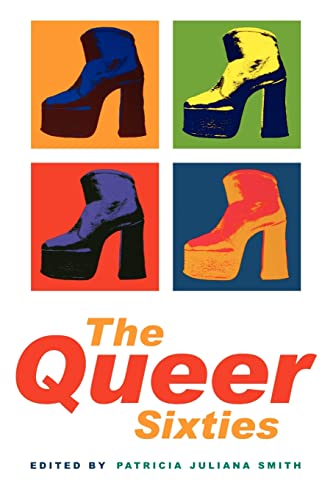
The Queer Sixties assembles an impressive group of cultural critics to go against the grain of 1960s studies, and proposes new and different ways of the last decade before the closet doors swung open. Imbued with the zeitgeist of the 60s, this playful and powerful collection rescues the persistence of the queer imaginary.
Die Inhaltsangabe kann sich auf eine andere Ausgabe dieses Titels beziehen.
Über die Autorin bzw. den Autor
Patricia Juliana Smith is Assistant Professor of English at UCLA.
Auszug. © Genehmigter Nachdruck. Alle Rechte vorbehalten.
The Queer Sixties
By Patricia Juliana SmithRoutledge
Copyright © 1999 Patricia Juliana SmithAll right reserved.
ISBN: 0415921694
Chapter One
PULP POLITICS
Strategies of Vision in Pro-Lesbian Pulp Novels,
1955-1965
Yvonne Keller
DESPITE THE ADVANCES in gay community formation encouraged by thedislocations of World War II, for lesbians, the 1950s and early 1960s in theUnited States were a difficult time. Dominant culture sought a return to amythical pre-War, pre-Depression "normality," visioned in ideologically conservativeterms in which "men were men and women were housewives"(Whitfield 43). This, alongside increased public discourse on homosexualityas a psychological disease and the Cold War notion that homosexuals were apressing political threat, made the fifties, as Lillian Faderman writes, "perhapsthe worst time in history for women to love women" (Odd Girls 157).Despite their benign Father Knows Best image, the 1950s and early 1960s were,to some extent, an age of paranoia, fed by deep fears of the bomb and communism.Both assuaging and mirroring such anxieties was a general atmosphereof voyeurism; for example, in popular culture Hugh Hefner beganPlayboy?displaying scantily clad women for the man who looks?and JamesBond's "license to look" (at women) was more important to the success of theIan Fleming thrillers than his license to kill (Denning 102). On a politicalfront, visual technologies of spying and surveillance dominated public lifeand discourse as the Julius and Ethel Rosenberg and Alger Hiss spy trialsthreatened every all-American boy's (and girl's) presumed innocence. Indeedtwo potent American fears?fear of the communist conspiracy and the fearthat a member of one's family might be homosexual?were linked in the perceivedthreat that homosexuals could be blackmailed into becoming communistspies (Epstein; Whitfield 43). As a result, even extremely closetedhomosexuals and lesbians were barred or dismissed from federal jobs and themilitary; the Federal Bureau of Investigation (FBI) began broad surveillanceof homophile organizations and gay gathering places; and urban policeheightened their harassment of homosexual citizens (D'Emilio 60).
Given the fierce public disapproval of homosexuality, lesbian representationwas scarce and lesbians of the time repeatedly attest to the frustrationof their desire for such images in popular culture. In every public art, lesbianismwas invisible: the Hays Code banned the depiction of homosexuality inHollywood films; the nascent television industry never showed recognizablehomosexuals; and mainstream New York book publishers offered only atrickle of covertly lesbian literary texts. Outside the pathological images profferedby psychiatry and occasional scandal magazine articles that capitalizedon the fear of homosexuality, lesbian pulp novels were the only medium thatafforded a large stock of these images. Marked by their explicitly lesbian, sensationalizedcovers, which advertised "twilight women," "forbidden love," orthe "limbo of lesbianism," these books were mass-market, cheaply madepaperbacks with lesbian themes. The genre of lesbian pulp novels came intoexistence thanks to the "paperback revolution" begun by Pocket Books,which in 1941 greatly increased its distribution channels, and thus sales.Book outlets?mostly bookstores?had numbered around 1,000 beforeWorld War II, but Pocket Books's new use of newspaper distribution outletssuch as newsstands and grocery store racks created an impressive 100,000outlets for cheap paperbacks. Pocket Books's success was imitated by manyother mainstream East Coast presses, notably Fawcett, Beacon, and Midland-Tower,which promoted paperback originals of genres such as Westerns,mysteries, thrillers, and, most important for my focus here, lesbian pulps,with astonishing success.
These new mechanisms of distribution meant, in essence, that morebooks with lesbian themes were cheaply and widely available during thistime than at any previous time in U.S. history. While their existence is onlybriefly noted in a few publishing histories, millions of lesbian-centered textswere bought during this time. Tereska Torres's Women's Barracks (1950), forexample, a story of a houseful of French women living in England duringWorld War II, quickly sold over 1 million copies; by 1968, over 3 millioncopies had been printed (Adams 259, 273), and as of 1975 it ranked as the244th best-selling American novel (Hackett 16). Even Radclyffe Hall's lesbianclassic, The Well of Loneliness, when reissued as a lesbian pulp completewith a sensationalist cover that proclaimed in large, red type: "Why can't I benormal?" achieved sales of over 100,000 copies a year. Claire Morgan's1952 The Price of Salt, a tale of two women who fall in love in New York City,had sold over a half-million copies by 1958, and by 1963, the Ladder estimatedthat there were over 1 million copies in print (Highsmith, pbk. cover;"Crosscurrents" 14). Given that best-selling hardcover novels in the 1950ssold an average of 30,000 copies and the sales of typical trade hardcoverstoday can be as little as 5,000 copies the first year, these figures are extremelyhigh. Clearly, the publishers had a new, successful genre on their hands.
Lesbian pulps thrived from 1950 to 1965. The genre began with thepublication of Women's Barracks in 1950, followed in 1952 by Vin Packer'sbest-seller Spring Fire, a story of love between two midwestern sorority sisters.These two relatively unhomophobic books, both written by women (one ofwhom described herself as a lesbian), made publishers aware of a potentiallylarge market that was (at least at first) assumed to consist of heterosexualmen. This belief led to the publication of many poorly written, fast-pacedtales involving frequent sex and written from a male point of view, a kind oflesbian pulp that I call "virile adventures." In contrast, my focus here is pro-lesbianpulps?a subset of lesbian pulps, often written by lesbians, with generallymore positive lesbian representation?which were published in quantityonly toward the end of the 1950s. Ann Bannon's famous Beebo Brinkerseries, for example, is a series of six books featuring the same characters,published between 1957 and 1962, and Randy Salem's ten books appearedbetween 1959 and 1965. After 1965, however, what some called "the goldenage" of lesbian paperbacks was over: mainstream publishers no longer publishedlesbian pulps because of the changing times and the increased incorporationof lesbian themes either in fiction of more established literary qualityor in the new openly pornographic fiction published by small, opportunistic,nonmainstream presses.
Clearly lesbian pulps flourished largely because of the publishingindustry's ability to make money from homosexual themes, but there areother reasons as well. First was the form: true, pulp novels made money, butthey were a devalued form of writing; and few of their editors were concernedabout their content. Second was gender: the lesbians depicted werestill women?which meant, to more men than just Hugh Hefner, that theywere still sexually available to men and, moreover, nonthreatening to depict(to heterosexual men, of course); not coincidentally, fewer pulp novels werepublished with gay male themes. Third was the use of vision: voyeurismin particular worked as a form of pleasure and reassurance over anxietiesabout social hierarchies; it reinstated the power of men...
„Über diesen Titel“ kann sich auf eine andere Ausgabe dieses Titels beziehen.
Suchergebnisse für The Queer Sixties

Beispielbild für diese ISBN
The Queer Sixties
Anbieter: World of Books (was SecondSale), Montgomery, IL, USA
Verkäuferbewertung 5 von 5 Sternen

Zustand: Good. Item in good condition and has highlighting/writing on text. Used texts may not contain supplemental items such as CDs, info-trac etc. Bestandsnummer des Verkäufers 00107104776
Gebraucht kaufen
EUR 6,55
Versand gratis
Versand innerhalb von USA
Versand innerhalb von USA
Anzahl: 1 verfügbar
Beispielbild für diese ISBN
The Queer Sixties
Anbieter: ThriftBooks-Dallas, Dallas, TX, USA
Verkäuferbewertung 5 von 5 Sternen
Paperback. Zustand: As New. No Jacket. Pages are clean and are not marred by notes or folds of any kind. ~ ThriftBooks: Read More, Spend Less. Bestandsnummer des Verkäufers G0415921694I2N00
Gebraucht kaufen
EUR 7,66
Versand gratis
Versand innerhalb von USA
Versand innerhalb von USA
Anzahl: 1 verfügbar
Beispielbild für diese ISBN
The Queer Sixties
Anbieter: Better World Books, Mishawaka, IN, USA
Verkäuferbewertung 5 von 5 Sternen
Zustand: Good. Pages intact with minimal writing/highlighting. The binding may be loose and creased. Dust jackets/supplements are not included. Stock photo provided. Product includes identifying sticker. Better World Books: Buy Books. Do Good. Bestandsnummer des Verkäufers 4771739-6
Gebraucht kaufen
EUR 9,85
Versand gratis
Versand innerhalb von USA
Versand innerhalb von USA
Anzahl: 1 verfügbar
Beispielbild für diese ISBN
The Queer Sixties
Anbieter: Zubal-Books, Since 1961, Cleveland, OH, USA
Verkäuferbewertung 5 von 5 Sternen
Zustand: Very Good. 272 pp., Paperback, very good. - If you are reading this, this item is actually (physically) in our stock and ready for shipment once ordered. We are not bookjackers. Buyer is responsible for any additional duties, taxes, or fees required by recipient's country. Bestandsnummer des Verkäufers ZB1336380
Gebraucht kaufen
EUR 19,27
EUR 3,90 Versand
Versand innerhalb von USA
Versand innerhalb von USA
Anzahl: 1 verfügbar
Foto des Verkäufers
The Queer Sixties
Anbieter: Goulds Book Arcade, Sydney, Newtown, Sydney, NSW, Australien
Verkäuferbewertung 5 von 5 Sternen
Paperback. Zustand: Very Good. The dust jacket is a little worn. The edges of the book are slightly foxed. 272 pages. Books listed here are not stored at the shop. Please contact us if you want to pick up a book from Newtown. Bestandsnummer des Verkäufers 164479
Gebraucht kaufen
EUR 14,33
EUR 21,65 Versand
Versand von Australien nach USA
Versand von Australien nach USA
Anzahl: 1 verfügbar
Beispielbild für diese ISBN
The Queer Sixties
Anbieter: Moe's Books, Berkeley, CA, USA
Verkäuferbewertung 4 von 5 Sternen

Soft cover. Zustand: Very good. No jacket. Cover corners are lightly worn. Pages are clean and unmarked. Bestandsnummer des Verkäufers 1136712
Gebraucht kaufen
EUR 31,22
EUR 5,63 Versand
Versand innerhalb von USA
Versand innerhalb von USA
Anzahl: 1 verfügbar
Beispielbild für diese ISBN
The Queer Sixties
Verlag:
Taylor & Francis Ltd, 1999
ISBN 10: 0415921694
ISBN 13: 9780415921695
Neu
Paperback / softback
Anbieter: THE SAINT BOOKSTORE, Southport, Vereinigtes Königreich
Verkäuferbewertung 5 von 5 Sternen
Paperback / softback. Zustand: New. This item is printed on demand. New copy - Usually dispatched within 5-9 working days. Bestandsnummer des Verkäufers C9780415921695
Neu kaufen
EUR 46,37
EUR 18,41 Versand
Versand von Vereinigtes Königreich nach USA
Versand von Vereinigtes Königreich nach USA
Anzahl: 5 verfügbar
Beispielbild für diese ISBN
The Queer Sixties
Print-on-DemandAnbieter: Majestic Books, Hounslow, Vereinigtes Königreich
Verkäuferbewertung 4 von 5 Sternen
Zustand: New. pp. 300 23:B&W 6 x 9 in or 229 x 152 mm Perfect Bound on White w/Gloss Lam This item is printed on demand. Bestandsnummer des Verkäufers 7515792
Neu kaufen
EUR 57,96
EUR 7,60 Versand
Versand von Vereinigtes Königreich nach USA
Versand von Vereinigtes Königreich nach USA
Anzahl: 3 verfügbar
Beispielbild für diese ISBN
The Queer Sixties
Print-on-DemandAnbieter: PBShop.store US, Wood Dale, IL, USA
Verkäuferbewertung 5 von 5 Sternen
PAP. Zustand: New. New Book. Shipped from UK. THIS BOOK IS PRINTED ON DEMAND. Established seller since 2000. Bestandsnummer des Verkäufers L0-9780415921695
Neu kaufen
EUR 70,62
Versand gratis
Versand innerhalb von USA
Versand innerhalb von USA
Anzahl: Mehr als 20 verfügbar
Beispielbild für diese ISBN
The Queer Sixties
Anbieter: California Books, Miami, FL, USA
Verkäuferbewertung 4 von 5 Sternen
Zustand: New. Bestandsnummer des Verkäufers I-9780415921695
Neu kaufen
EUR 71,35
Versand gratis
Versand innerhalb von USA
Versand innerhalb von USA
Anzahl: Mehr als 20 verfügbar