
Verwandte Artikel zu Submarine: A Guided Tour Inside a Nuclear Warship (Tom...
Submarine: A Guided Tour Inside a Nuclear Warship (Tom Clancy's Military Referenc, Band 1) - Softcover
Inhaltsangabe
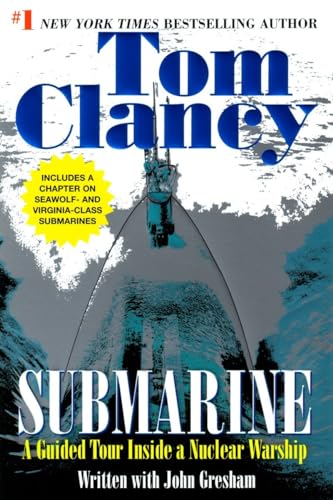
Only the author of The Hunt for Red October could capture the reality of life aboard a nuclear submarine. Only a writer of Mr. Clancy's magnitude could obtain security clearance for information, diagrams, and photographs never before available to the public. Now, every civilian can enter this top secret world...the weapons, the procedures, the people themselves...the startling facts behind the fiction that made Tom Clancy a #1 bestselling author.
Die Inhaltsangabe kann sich auf eine andere Ausgabe dieses Titels beziehen.
Über die Autorin bzw. den Autor
A little more than thirty years ago Tom Clancy was a Maryland insurance broker with a passion for naval history. Years before, he had been an English major at Baltimore’s Loyola College and had always dreamed of writing a novel. His first effort, The Hunt for Red October, sold briskly as a result of rave reviews, then catapulted onto the New York Times bestseller list after President Reagan pronounced it “the perfect yarn.” From that day forward, Clancy established himself as an undisputed master at blending exceptional realism and authenticity, intricate plotting, and razor-sharp suspense. He passed away in October 2013.
Auszug. © Genehmigter Nachdruck. Alle Rechte vorbehalten.
Chapter One:
The Silent Service
Early History
When tracing the roots of the modern submarine, one is usually faced with a number of different places to start. Legend has it that Alexander the Great descended into the ocean in 332 b.c. near the city of Tyre, in a primitive diving bell. The great mind of Leonardo da Vinci is said to have created a primitive submersible boat of wooden frame design covered in goatskins, with oars providing propulsion through waterproof sweeps. A British contribution to early submarine concepts came in the late 1500s from William Bourne, a carpenter and gunmaker. It included the concept of double hull construction, as well as ballast and trim systems. The first concept for a military submarine came from a Dutch physicist, Cornelius van Drebbel. In addition to actually building and demonstrating a primitive submersible, he proposed a design specifically created to destroy other ships.
It was the United States (albeit still colonies in rebellion) that created the first workable military submarine design. In 1776, a Yale University student named David Bushnell designed the appropriately named Turtle. The Turtle was an egg-shaped submersible boat that had the ability to sneak up on a ship, submerge under the intended victim, bore a drill bit with a waterproof time bomb attached into the bottom of the hull, and escape before the bomb was detonated by a clockwork fuse. It was propelled by a hand-cranked screw, and had room for one overworked crewman.
On the night of September 6, 1776, Sergeant Ezra Lee of the Continental Army took the Turtle to attack HMS Eagle of the British squadron blockading Boston. But when he maneuvered underneath, he was unable to attach his bomb. During his escape, he was followed by British soldiers in a rowboat. Frantic, he released the bomb, which exploded literally in the faces of his pursuers. Though all parties escaped unhurt, it was a promising start to the modern military submarine.
A more substantive advance was the Nautilus, designed by the American Robert Fulton, who would go on to design the first steamboat. The Nautilus was a distinct improvement over the Turtle in that it cruised under the intended victim, towing the explosive bomb or torpedo, as it was then called, until the bomb contacted the target and detonated with a contact fuse. The design was an exceptional success, destroying a number of target vessels in test runs. The French, who were sufficiently impressed to award Fulton a contract, actually considered for a time using it in the planned invasion of Britain. By 1804 Fulton was demonstrating the boat to the British, who despised the idea for its underhanded nature and, more importantly, its potential to sweep British ships from coastal zones. In the end, Fulton returned to America to begin work on his steamboats.
It remained for the Americans to create a submarine that would actually sink an enemy vessel in wartime. In 1863 a submersible boat was designed by Confederate army officer Horace Hunley. His boat, the CSS H. L. Hunley, was propelled by eight men turning a hand-cranked propeller. For armament, an explosive mine or torpedo was secured to a long spar protruding out in front of the Hunley. The idea was for the Hunley to ram the spar torpedo into the side of a target ship, where it would be detonated.
Unfortunately the Hunley was difficult to handle, and several crews, along with her designer, were killed during test dives. Nevertheless on October 17, 1864, the Hunley attacked the Union steam corvette Housatonic in the harbor at Charleston, South Carolina. In the ensuing attack the Hunley sank the Housatonic, although she herself was also sunk. A submarine had finally drawn blood in combat.
Over the next four decades a number of different submarine designs evolved in various European countries. In the 1880s a really practical design was built in America by an Irish immigrant, John Holland. Originally backed by the Fenian Society (an early North American free Ireland society), it was designed to allow Irish separatists to attack units of the British fleet. In 1900 Holland won a submarine design competition held by the U.S. Navy. From this contract came the USS Holland (SS-1), the first practical combat submarine. The Holland included such innovative features as self-propelled torpedoes fired from a reloadable tube, a battery-powered electric motor for submerged operations, and an advanced hull shape to allow it to move efficiently through the seas. The design was so successful that the U.S. Navy eventually bought a total of seven Holland-designed boats. Ironically, the British even bought some of the Holland boats for the Royal Navy. Holland’s company, the Electric Boat Company, continues to build submarines as part of General Dynamics Corporation.
World War I
The period before World War I saw a number of innovations in military submarines. This included the development of diesel engines, improved periscopes and torpedoes, and the development of wireless technology, which allowed them to be directed from shore bases. Within a month of the outbreak of World War I, the German Unterseeboot fleet, or U-boats as they came to be called, were sinking British naval units in the North Sea. In one well-known incident the elderly U-9 sank three British armored cruisers, causing over 1,400 casualties. Throughout the war, both the Allies and the Central Powers took a toll of each other’s warships, especially in the Gallipoli Campaign in the Dardanelles.
During World War I the Germans consistently led the world in the production of new U-boats. But the international rules concerning attacks on merchant ships kept the Germans from fully utilizing their potential. Germany feared that unrestricted submarine warfare, with the practice of not warning the victim, might bring the United States into the war. By 1915 the need to isolate Britain from her sources of war supplies caused Kaiser Wilhelm to declare unrestricted submarine warfare an active policy. Soon German submarines were taking a huge toll of merchant shipping and threatening to win the war against Britain all on their own. But after the ocean liner Lusitania was sunk by U-20 in 1915, the United States entered the war on the side of the Allies. It would take two more years for the Allies to win the war and beat back the U-boat threat.
So important was the submarine in World War I that a whole new form of naval conflict, antisubmarine warfare (ASW), was born. From it came techniques such as the convoy and the Q-ship (armed merchant decoy), as well as weapons and sensors such as the antisubmarine detector (ASDIC/sonar), and the depth charge. And so deadly had the U-boats been that Germany was specifically banned from having them under the Treaty of Versailles. The victors of World War I split up the remaining U-boats for examination and testing. That might have been the end of military submarines except that the seeds of World War II were contained in the Treaty of Versailles, and the military submarine would continue to develop.
World War II
During the period between the world wars, submarine development continued at a steady pace. In the United States and Britain efforts were concentrated on the creation of long-range “fleet” submarines designed to support the battle fleets, while nations such as Japan, Russia, and Italy developed submarines more for coastal defense. Once Adolf Hitler had risen to power, Germany secretly began to rebuild its dreaded fleet of U-boats, in direct violation of the Treaty of Versailles. By the beginning of World War II, a number of improvements were made to the submarines themselves, such as torpedoes with magnetic fuses and sonars, and...
„Über diesen Titel“ kann sich auf eine andere Ausgabe dieses Titels beziehen.
Suchergebnisse für Submarine: A Guided Tour Inside a Nuclear Warship (Tom...

Beispielbild für diese ISBN
Submarine (Tom Clancy's Military Reference)
Verlag:
G.P. Putnam's Sons (edition Reissue), 2003
ISBN 10: 0425190013
ISBN 13: 9780425190012
Gebraucht
Paperback
Anbieter: BooksRun, Philadelphia, PA, USA
Verkäuferbewertung 5 von 5 Sternen

Paperback. Zustand: Very Good. Reissue. It's a well-cared-for item that has seen limited use. The item may show minor signs of wear. All the text is legible, with all pages included. It may have slight markings and/or highlighting. Bestandsnummer des Verkäufers 0425190013-11-1
Gebraucht kaufen
EUR 5,11
Versand gratis
Versand innerhalb von USA
Versand innerhalb von USA
Anzahl: 1 verfügbar
Beispielbild für diese ISBN
Submarine (Tom Clancys Military Reference)
Anbieter: Hawking Books, Edgewood, TX, USA
Verkäuferbewertung 4 von 5 Sternen

Zustand: Very Good. Very Good Condition. Five star seller - Buy with confidence! Bestandsnummer des Verkäufers X0425190013X2
Gebraucht kaufen
EUR 6,42
Versand gratis
Versand innerhalb von USA
Versand innerhalb von USA
Anzahl: 1 verfügbar
Beispielbild für diese ISBN
Submarine: A Guided Tour Inside a Nuclear Warship
Verlag:
Penguin Publishing Group, 2003
ISBN 10: 0425190013
ISBN 13: 9780425190012
Gebraucht
Paperback
Anbieter: ThriftBooks-Phoenix, Phoenix, AZ, USA
Verkäuferbewertung 5 von 5 Sternen
Paperback. Zustand: Good. No Jacket. Pages can have notes/highlighting. Spine may show signs of wear. ~ ThriftBooks: Read More, Spend Less. Bestandsnummer des Verkäufers G0425190013I3N00
Gebraucht kaufen
EUR 6,60
Versand gratis
Versand innerhalb von USA
Versand innerhalb von USA
Anzahl: 1 verfügbar
Beispielbild für diese ISBN
Submarine: A Guided Tour Inside a Nuclear Warship
Verlag:
Penguin Publishing Group, 2003
ISBN 10: 0425190013
ISBN 13: 9780425190012
Gebraucht
Paperback
Anbieter: ThriftBooks-Atlanta, AUSTELL, GA, USA
Verkäuferbewertung 5 von 5 Sternen
Paperback. Zustand: Fair. No Jacket. Readable copy. Pages may have considerable notes/highlighting. ~ ThriftBooks: Read More, Spend Less. Bestandsnummer des Verkäufers G0425190013I5N00
Gebraucht kaufen
EUR 6,60
Versand gratis
Versand innerhalb von USA
Versand innerhalb von USA
Anzahl: 1 verfügbar
Beispielbild für diese ISBN
Submarine: A Guided Tour Inside a Nuclear Warship
Verlag:
Penguin Publishing Group, 2003
ISBN 10: 0425190013
ISBN 13: 9780425190012
Gebraucht
Paperback
Anbieter: ThriftBooks-Atlanta, AUSTELL, GA, USA
Verkäuferbewertung 5 von 5 Sternen
Paperback. Zustand: Good. No Jacket. Former library book; Pages can have notes/highlighting. Spine may show signs of wear. ~ ThriftBooks: Read More, Spend Less. Bestandsnummer des Verkäufers G0425190013I3N10
Gebraucht kaufen
EUR 6,60
Versand gratis
Versand innerhalb von USA
Versand innerhalb von USA
Anzahl: 1 verfügbar
Beispielbild für diese ISBN
Submarine: A Guided Tour Inside a Nuclear Warship
Verlag:
Penguin Publishing Group, 2003
ISBN 10: 0425190013
ISBN 13: 9780425190012
Gebraucht
Paperback
Anbieter: ThriftBooks-Reno, Reno, NV, USA
Verkäuferbewertung 5 von 5 Sternen
Paperback. Zustand: Good. No Jacket. Pages can have notes/highlighting. Spine may show signs of wear. ~ ThriftBooks: Read More, Spend Less. Bestandsnummer des Verkäufers G0425190013I3N00
Gebraucht kaufen
EUR 6,60
Versand gratis
Versand innerhalb von USA
Versand innerhalb von USA
Anzahl: 1 verfügbar
Beispielbild für diese ISBN
Submarine: A Guided Tour Inside a Nuclear Warship
Verlag:
Penguin Publishing Group, 2003
ISBN 10: 0425190013
ISBN 13: 9780425190012
Gebraucht
Paperback
Anbieter: ThriftBooks-Dallas, Dallas, TX, USA
Verkäuferbewertung 5 von 5 Sternen
Paperback. Zustand: Good. No Jacket. Pages can have notes/highlighting. Spine may show signs of wear. ~ ThriftBooks: Read More, Spend Less. Bestandsnummer des Verkäufers G0425190013I3N00
Gebraucht kaufen
EUR 6,60
Versand gratis
Versand innerhalb von USA
Versand innerhalb von USA
Anzahl: 1 verfügbar
Beispielbild für diese ISBN
Submarine (Tom Clancy's Military Reference)
Anbieter: HPB-Emerald, Dallas, TX, USA
Verkäuferbewertung 5 von 5 Sternen
Paperback. Zustand: Very Good. Connecting readers with great books since 1972! Used books may not include companion materials, and may have some shelf wear or limited writing. We ship orders daily and Customer Service is our top priority! Bestandsnummer des Verkäufers S_455367633
Gebraucht kaufen
EUR 3,62
EUR 3,30 Versand
Versand innerhalb von USA
Versand innerhalb von USA
Anzahl: 1 verfügbar
Beispielbild für diese ISBN
Submarine (Tom Clancy's Military Reference)
Anbieter: HPB Inc., Dallas, TX, USA
Verkäuferbewertung 5 von 5 Sternen
Paperback. Zustand: Very Good. Connecting readers with great books since 1972! Used books may not include companion materials, and may have some shelf wear or limited writing. We ship orders daily and Customer Service is our top priority! Bestandsnummer des Verkäufers S_452845187
Gebraucht kaufen
EUR 3,62
EUR 3,30 Versand
Versand innerhalb von USA
Versand innerhalb von USA
Anzahl: 1 verfügbar
Beispielbild für diese ISBN
Submarine (Tom Clancy's Military Reference)
Verlag:
Penguin Publishing Group, 2003
ISBN 10: 0425190013
ISBN 13: 9780425190012
Gebraucht
paperback
Anbieter: HPB-Red, Dallas, TX, USA
Verkäuferbewertung 5 von 5 Sternen
paperback. Zustand: Good. Connecting readers with great books since 1972! Used textbooks may not include companion materials such as access codes, etc. May have some wear or writing/highlighting. We ship orders daily and Customer Service is our top priority! Bestandsnummer des Verkäufers S_436753669
Gebraucht kaufen
EUR 4,53
EUR 3,30 Versand
Versand innerhalb von USA
Versand innerhalb von USA
Anzahl: 1 verfügbar