
Verwandte Artikel zu The Teeth of the Tiger (A Jack Ryan Jr. Novel, Band...
Inhaltsangabe
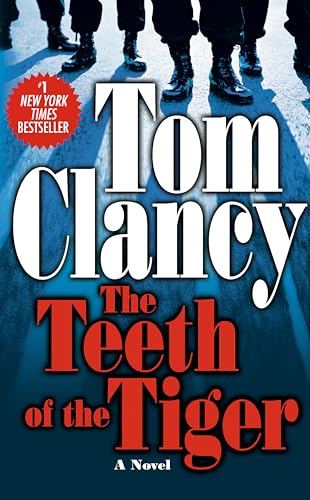
Tom Clancy brings Jack Ryan's son—Jack Ryan, Jr.—to the forefront in this #1 New York Times bestselling thriller.
A man named Mohammed sits in a café in Vienna, about to propose a deal to a Colombian. What if they combined his network of Middle East agents and sympathizers with the Colombian’s drug network in America? The potential for profits would be enormous—and the potential for destruction unimaginable.
A young man in suburban Maryland who has grown up around intrigue is about to put his skills to the test. Taught the ways of the world firsthand by agents, statesmen, analysts, Secret Servicemen, and black-op specialists, he crosses the radar of “The Campus”—a secret organization set up to identify local terrorist threats and deal with them by any means necessary.
His name: Jack Ryan, Jr.
Die Inhaltsangabe kann sich auf eine andere Ausgabe dieses Titels beziehen.
Über die Autorin bzw. den Autor
A little more than thirty years ago Tom Clancy was a Maryland insurance broker with a passion for naval history. Years before, he had been an English major at Baltimore’s Loyola College and had always dreamed of writing a novel. His first effort, The Hunt for Red October—the first of the phenomenally successful Jack Ryan novels—sold briskly as a result of rave reviews, then catapulted onto the New York Times bestseller list after President Reagan pronounced it “the perfect yarn.” From that day forward, Clancy established himself as an undisputed master at blending exceptional realism and authenticity, intricate plotting, and razor-sharp suspense. He passed away in October 2013.
Auszug. © Genehmigter Nachdruck. Alle Rechte vorbehalten.
Chapter One
THE CAMPUS
THE TOWN
of West Odenton, Maryland, isn't much of a town at all, just a post office for people who live in the general area, a few gas stations and a 7-Eleven, plus the usual fast-food places for people who need a fat-filled breakfast on the drive from Columbia, Maryland, to their jobs in Washington, D.C. And half a mile from the modest post office building was a mid-rise office building of government-undistinguished architecture. It was nine stories high, and on the capacious front lawn a low decorative monolith made of gray brick with silvery lettering said HENDLEY ASSOCIATES, without explaining what, exactly, Hendley Associates was. There were few hints. The roof of the building was flat, tar-and-gravel over reinforced concrete, with a small penthouse to house the elevator machinery and another rectangular structure that gave no clue about its identity. In fact, it was made of fiberglass, white in color, and radio-transparent. The building itself was unusual only in one thing: Except for a few old tobacco barns that barely exceeded twenty-five feet in height, it was the only building higher than two stories that sat on a direct line of sight from the National Security Agency located at Fort Meade, Maryland, and the headquarters of the Central Intelligence Agency at Langley, Virginia. Some other entrepreneurs had wished to build on that sight line, but zoning approval had never been granted, for many reasons, all of them false.
Behind the building was a small antenna farm not unlike that found next to a local television station-a half-dozen six-meter parabolic dishes sat inside a twelve-foot-high, razor-wire-crowned Cyclone fence enclosure and pointed at various commercial communications satellites. The entire complex, which wasn't terribly complex at all, comprised fifteen and a third acres in Maryland's Howard County, and was referred to as "The Campus" by the people who worked there. Nearby was the Johns Hopkins University Applied Physics Laboratory, a government-consulting establishment of long standing and well-established sensitivity of function.
To the public, Hendley Associates was a trader in stocks, bonds, and international currencies, though, oddly, it did little in the way of public business. It was not known to have any clients, and while it was whispered to be quietly active in local charities (the Johns Hopkins University School of Medicine was rumored to be the main recipient of Hendley's corporate largesse), nothing had ever leaked to the local media. In fact, it had no public-relations department at all. Neither was it rumored to be doing anything untoward, though its chief executive officer was known to have had a somewhat troubled past, as a result of which he was shy of publicity, which, on a few rare occasions, he'd dodged quite adroitly and amiably, until, finally, the local media had stopped asking. Hendley's employees were scattered about locally, mostly in Columbia, lived upper-middle-class lifestyles, and were generally as remarkable as Beaver's father, Ward Cleaver.
Gerald Paul Hendley, Jr., had had a stellar career in the commodities business, during which he'd amassed a sizable personal fortune and then turned to elected public service in his late thirties, soon becoming a United States senator from South Carolina. Very quickly, he'd acquired a reputation as a legislative maverick who eschewed special interests and their campaign money offers, and followed a rather ferociously independent political track, leaning toward liberal on civil-rights issues, but decidedly conservative on defense and foreign relations. He'd never shied away from speaking his mind, which had made him good and entertaining copy for the press, and eventually there were whispered-about presidential aspirations.
Toward the end of his second six-year term, however, he'd suffered a great personal tragedy. He'd lost his wife and three children in an accident on Interstate 185 just outside of Columbia, South Carolina, their station wagon crushed beneath the wheels of a Kenworth tractor-trailer. It had been a predictably crushing blow, and soon thereafter, at the very beginning of the campaign for his third term, more misfortune had struck him. It became known through a column in the New York Times that his personal investment portfolio-he'd always kept it private, saying that since he took no money for his campaigning, he had no need to disclose his net worth except in the most general of terms-showed evidence of insider trading. This suspicion was confirmed with deeper delving by the newspapers and TV, and despite Hendley's protest that the Securities and Exchange Commission had never actually published guidelines about what the law meant, it appeared to some that he'd used his inside knowledge on future government expenditures to benefit a real-estate investment enterprise which would profit him and his co-investors over fifty million dollars. Worse still, when challenged on the question in a public debate by the Republican candidate-a self-described "Mr. Clean"-he responded with two mistakes. First, he'd lost his temper in front of rolling cameras. Second, he'd told the people of South Carolina that if they doubted his honesty, then they could vote for the fool with whom he shared the stage. For a man who'd never put a political foot wrong in his life, that surprise alone had cost him five percent of the state's voters. The remainder of his lackluster campaign had only slid downhill, and despite the lingering sympathy vote from those who remembered the annihilation of his family, his seat had ended up an upset-loss for the Democrats, which had further been exacerbated by a venomous concession statement. Then he'd left public life for good, not even returning to his antebellum plantation northwest of Charleston but rather moving to Maryland and leaving his life entirely behind. One further flamethrower statement at the entire congressional process had burned whatever bridges might have remained open to him.
His current home was a farm dating back to the eighteenth century, where he raised Appaloosa horses-riding and mediocre golf were his only remaining hobbies-and lived the quiet life of a gentleman farmer. He also worked at The Campus seven or eight hours per day, commuting back and forth in a chauffeured stretch Cadillac.
Fifty-two now, tall, slender and silver-haired, he was well known without being known at all, perhaps the one lingering aspect of his political past.
"YOU DID well in the mountains," Jim Hardesty said, waving the young Marine to a chair.
"Thank you, sir. You did okay, too, sir."
"Captain, anytime you walk back through your front door after it's all over, you've done well. I learned that from my training officer. About sixteen years ago," he added.
Captain Caruso did the mental arithmetic and decided that Hardesty was a little older than he looked. Captain in the U.S. Army Special Forces, then CIA, plus sixteen years made him closer to fifty than forty. He must have worked very hard indeed to keep in shape.
"So," the officer asked, "what can I do for you?"
"What did Terry tell you?" the spook asked.
"He told me I'd be talking with somebody named Pete Alexander."
"Pete got called out of town suddenly," Hardesty explained.
The officer accepted the explanation at face value. "Okay, anyway, the general said you Agency guys are on some kind of talent hunt, but you're not willing to grow your own," Caruso answered honestly.
"Terry is a good man, and a damned fine Marine, but he can be a little parochial."
"Maybe so, Mr. Hardesty, but he's going to be my boss soon, when he takes over Second Marine Division, and I'm trying to stay on his good side. And you still haven't told me why I'm here."...
„Über diesen Titel“ kann sich auf eine andere Ausgabe dieses Titels beziehen.
Suchergebnisse für The Teeth of the Tiger (A Jack Ryan Jr. Novel, Band...

Beispielbild für diese ISBN
The Teeth of the Tiger
Anbieter: World of Books (was SecondSale), Montgomery, IL, USA
Verkäuferbewertung 5 von 5 Sternen

Zustand: Fair. Tom Clancy's Jack Ryan: Ghost War is out now on Prime Video! Tom Clancy brings Jack Ryan's son--Jack Ryan, Jr.--to the forefront in this #1 New York Times bestselling thriller. A man named Mohammed sits in a café in Vienna, about to propose a deal to a Colombian. What if they combined his network of Middle East agents and sympathizers with the Colombian's drug network in America? The potential for profits would be enormous--and the potential for destruction unimaginable. A young man in suburban Maryland who has grown up around intrigue is about to put his skills to the test. Taught the ways of the world firsthand by agents, statesmen, analysts, Secret Servicemen, and black-op specialists, he crosses the radar of "The Campus"--a secret organization set up to identify local terrorist threats and deal with them by any means necessary. His name: Jack Ryan, Jr. Bestandsnummer des Verkäufers 00103852458
Gebraucht kaufen
EUR 3,77
Versand gratis
Versand innerhalb von USA
Versand innerhalb von USA
Anzahl: Mehr als 20 verfügbar
Beispielbild für diese ISBN
The Teeth of the Tiger
Anbieter: World of Books (was SecondSale), Montgomery, IL, USA
Verkäuferbewertung 5 von 5 Sternen
Zustand: Very Good. Tom Clancy's Jack Ryan: Ghost War is out now on Prime Video! Tom Clancy brings Jack Ryan's son--Jack Ryan, Jr.--to the forefront in this #1 New York Times bestselling thriller. A man named Mohammed sits in a café in Vienna, about to propose a deal to a Colombian. What if they combined his network of Middle East agents and sympathizers with the Colombian's drug network in America? The potential for profits would be enormous--and the potential for destruction unimaginable. A young man in suburban Maryland who has grown up around intrigue is about to put his skills to the test. Taught the ways of the world firsthand by agents, statesmen, analysts, Secret Servicemen, and black-op specialists, he crosses the radar of "The Campus"--a secret organization set up to identify local terrorist threats and deal with them by any means necessary. His name: Jack Ryan, Jr. Bestandsnummer des Verkäufers 00108766489
Gebraucht kaufen
EUR 3,77
Versand gratis
Versand innerhalb von USA
Versand innerhalb von USA
Anzahl: 10 verfügbar
Beispielbild für diese ISBN
The Teeth of the Tiger
Anbieter: World of Books (was SecondSale), Montgomery, IL, USA
Verkäuferbewertung 5 von 5 Sternen
Zustand: Good. Tom Clancy's Jack Ryan: Ghost War is out now on Prime Video! Tom Clancy brings Jack Ryan's son--Jack Ryan, Jr.--to the forefront in this #1 New York Times bestselling thriller. A man named Mohammed sits in a café in Vienna, about to propose a deal to a Colombian. What if they combined his network of Middle East agents and sympathizers with the Colombian's drug network in America? The potential for profits would be enormous--and the potential for destruction unimaginable. A young man in suburban Maryland who has grown up around intrigue is about to put his skills to the test. Taught the ways of the world firsthand by agents, statesmen, analysts, Secret Servicemen, and black-op specialists, he crosses the radar of "The Campus"--a secret organization set up to identify local terrorist threats and deal with them by any means necessary. His name: Jack Ryan, Jr. Bestandsnummer des Verkäufers 00100917112
Gebraucht kaufen
EUR 3,77
Versand gratis
Versand innerhalb von USA
Versand innerhalb von USA
Anzahl: Mehr als 20 verfügbar
Beispielbild für diese ISBN
The Teeth of the Tiger
Verlag:
G.P. Putnam's Sons, 2004
ISBN 10: 0425197409
ISBN 13: 9780425197400
Gebraucht
Mass Market Paperback
Anbieter: Gulf Coast Books, Cypress, TX, USA
Verkäuferbewertung 5 von 5 Sternen
Mass Market Paperback. Zustand: Very Good. Bestandsnummer des Verkäufers 0425197409-2-36128385
Gebraucht kaufen
EUR 3,78
Versand gratis
Versand innerhalb von USA
Versand innerhalb von USA
Anzahl: 8 verfügbar
Beispielbild für diese ISBN
The Teeth of the Tiger (A Jack Ryan Jr. Novel)
Anbieter: Orion Tech, Kingwood, TX, USA
Verkäuferbewertung 5 von 5 Sternen
Mass Market Paperback. Zustand: Fair. Bestandsnummer des Verkäufers 0425197409-4-24243997
Gebraucht kaufen
EUR 3,78
Versand gratis
Versand innerhalb von USA
Versand innerhalb von USA
Anzahl: 6 verfügbar
Beispielbild für diese ISBN
The Teeth of the Tiger (A Jack Ryan Jr. Novel)
Anbieter: Your Online Bookstore, Houston, TX, USA
Verkäuferbewertung 5 von 5 Sternen
Mass Market Paperback. Zustand: Fair. Bestandsnummer des Verkäufers 0425197409-4-23982808
Gebraucht kaufen
EUR 3,78
Versand gratis
Versand innerhalb von USA
Versand innerhalb von USA
Anzahl: 7 verfügbar
Beispielbild für diese ISBN
The Teeth of the Tiger (A Jack Ryan Jr. Novel)
Anbieter: Gulf Coast Books, Cypress, TX, USA
Verkäuferbewertung 5 von 5 Sternen
Mass Market Paperback. Zustand: Fair. Bestandsnummer des Verkäufers 0425197409-4-28749965
Gebraucht kaufen
EUR 3,78
Versand gratis
Versand innerhalb von USA
Versand innerhalb von USA
Anzahl: 3 verfügbar
Beispielbild für diese ISBN
The Teeth of the Tiger (A Jack Ryan Jr. Novel)
Anbieter: Orion Tech, Kingwood, TX, USA
Verkäuferbewertung 5 von 5 Sternen
Mass Market Paperback. Zustand: Very Good. Bestandsnummer des Verkäufers 0425197409-2-19435915
Gebraucht kaufen
EUR 3,78
Versand gratis
Versand innerhalb von USA
Versand innerhalb von USA
Anzahl: 5 verfügbar
Beispielbild für diese ISBN
The Teeth of the Tiger (A Jack Ryan Jr. Novel)
Anbieter: Your Online Bookstore, Houston, TX, USA
Verkäuferbewertung 5 von 5 Sternen
Mass Market Paperback. Zustand: Very Good. Bestandsnummer des Verkäufers 0425197409-2-19421088
Gebraucht kaufen
EUR 3,78
Versand gratis
Versand innerhalb von USA
Versand innerhalb von USA
Anzahl: 4 verfügbar
Foto des Verkäufers
The Teeth of the Tiger
Anbieter: 3Brothers Bookstore, Egg harbor township, NJ, USA
Verkäuferbewertung 5 von 5 Sternen
Zustand: good. Books may contain some notes and highlighting. Supplements such as Access Codes, Cd's Dust Jackets, etc. are not guaranteed with used book purchases. Bestandsnummer des Verkäufers EVV.0425197409.G
Gebraucht kaufen
EUR 3,91
Versand gratis
Versand innerhalb von USA
Versand innerhalb von USA
Anzahl: 1 verfügbar