
Verwandte Artikel zu The Taking of Pelham One Two Three
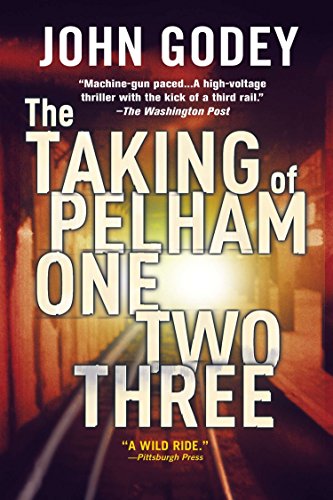
Inhaltsangabe
THIS AFTERNOON IN NEW YORK CITY, AFTER A SUBWAY TRAIN LEFT THE PELHAM STATION AT 1:23 P.M., THE EVENTS OF THE DAY TOOK A TERRIFYING DETOUR…
“You will all remain seated. Anyone who tries to get up, or even moves, will be shot. There will be no further warning. If you move you will be killed…”
Four men, armed with submachine guns, have seized a New York City subway train, holding all seventeen passengers—and the entire city—hostage. The identities of the hijackers are unknown. Their demands seem impossible. Their threats are real. Their escape seems inconceivable.
Only one thing is certain: they aren’t stopping for anything.
Die Inhaltsangabe kann sich auf eine andere Ausgabe dieses Titels beziehen.
Über die Autorin bzw. den Autor
Milton Freedgood was a professional publicist for several movie studios before he decided to concentrate on his writing. Under the pesudonym John Godey, he wrote several novels. The Taking of Pelham One Two Three was the most successful. He died at his home in West New York, NJ on April 21, 2006.
Auszug. © Genehmigter Nachdruck. Alle Rechte vorbehalten.
ONE
STEEVER
Steever stood on the southbound local platform of theLexington Avenue line at Fifty- ninth Street and chewed hisgum with a gentle motion of his heavy jaws, like a softmouthedretriever schooled to hold game firmly but withoutbruising it.
His posture was relaxed and at the same time emphatic,as if a low center of gravity and some inner certitude combinedto make him casually immovable. He wore a navyblue raincoat, neatly buttoned, and a dark gray hat tiltedforward, not rakishly but squarely, the brim bent at a sharpangle over his forehead, throwing a rhomboid of shadowover his eyes. His sideburns and the hair at the back of hishead were white, dramatic against the darkness of his complexion,unexpected in a man who appeared to be in hisearly thirties.
The florist’s box was outsize, suggesting an opulent,even overwhelming burst of blooms inside, designed forsome once- in- a-lifetime anniversary or to make amendsfor an enormous sin or betrayal. If any of the passengerson the platform were inclined to smile at that joke of aflorist’s box, in respect of the unlikely man who held it sonegligently under his arm, aimed upward at a forty- five degreeangle toward the grimy station ceiling, they managedto suppress it. He wasn’t a man to smile at, howeversympathetically.
Steever did not stir, or show any sign of anticipation oreven awareness, when the approaching train gave off itsfirst distant vibrations, gradually increasing through variouslevels and quantities of sound. Four- eyed—amber andwhite marker lights over white sealed- beam headlights—Pelham One Two Three lumbered into the station. Brakessighed; the train settled; the doors rattled open. Steeverwas positioned precisely so that he faced the center doorof the fifth car of the ten- car train. He entered the car,turned left, and walked to the isolated double seat directlyfacing the conductor’s cab. It was unoccupied. He satdown, standing the florist’s box between his knees, andglancing incuriously at the back of the conductor, whowas leaning well forward out of his window, inspecting theplatform.
Steever clasped his hands on the top of the florist’sbox. They were very broad hands, with short, thick fingers.The doors closed, and the train started with a lurchthat tilted the passengers first backward, then forward.Steever, without seeming to brace himself, barely moved.
RYDER
Ryder withheld the token for a part of a second— a pausethat was imperceptible to an eye but that his consciousnessregistered— before dropping it into the slot and pushingthrough the turnstile. Walking toward the platform,he examined his hesitancy with the token. Nerves? Nonsense.A concession, maybe even a form of consecration, onthe eve of battle, but nothing else. You lived or you died.Holding the brown valise in his left hand, the heavilyweighted Valpac in his right, he stepped onto the Twenty eighthStreet station platform and walked toward thesouth end. He stopped on a line with the placard thathung over the edge of the platform, bearing the number10, black on a white ground, indicating the point wherethe front of a ten- car train stopped. As usual, there were afew front- end haunters— as he had taken to thinking ofthem— including the inevitable overachiever who stoodwell beyond the 10 placard, and would have to scurryback when the train came in. The front- enders, he hadlong ago determined, expressed a dominant facet of thehuman condition: the mindless need to be first, to runahead of the pack for the simple sake of being ahead.He eased back against the wall and set his suitcasesdown, one on each side of him, just touching the edge ofhis shoes. His navy blue raincoat touched the wall onlylightly, but any contact would ensure picking up grime,grit, dust particles, even, possibly, some graffito freshly appliedin hot red lipstick and even hotter bitterness orirony. Shrugging, he pulled the brim of his dark- gray hatdecisively lower over his eyes, which were gray and stilland set deeply in bony sockets, promising a more asceticface than the rounded cheeks and the puffy area aroundhis lips justified. He leaned more of his weight against thewall and slid his hands into the deep slashed pockets ofthe coat. A fingernail caught on a fluff of nylon. Gently,using his free hand outside the pocket to anchor the nylon,he disengaged his finger and withdrew his hand.
A rumbling sound heightened to a clatter, and an expresstrain whipped through on the northbound track, itslights flickering between the pillars like a defective moviefilm. At the edge of the platform, a man glared at the disappearingexpress, then turned to Ryder, appealing forcommunion, for sympathy. Ryder looked at him with theabsolute neutrality that was the authentic mask of the subwayrider, of any New Yorker, or perhaps the actual faceNew Yorkers were born with, or issued, or, wherever theywere born, assumed once they won their spurs as bona fideresidents. The man, indifferent to the rebuff, paced theplatform, muttering indignantly. Beyond him, across thefour sets of tracks, the northbound platform provided adreary mirror image of the southbound: the tiled rectanglereading “28th Street,” the dirty walls, the gray floor,the resigned or impatient passengers, the rear- end haunters(and what was their hangup?)...
The pacing man turned abruptly to the edge of theplatform, planted his feet on the yellow line, bent at thewaist, and peered back down the track. Down- platform,there were three more leaners, supplicants praying to thedark tunnel beyond the station. Ryder heard the sound ofan approaching train and saw the leaners retreat, butonly a few inches, giving ground grudgingly, cautiouslychallenging the train to kill them if it dared. It swept intothe station, and its front end stopped in precise alignmentwith the overhanging placard. Ryder looked at his watch.Two to go. Ten minutes. He came away from the wall,turned, and studied the nearby poster.
It was the Levy’s Bread ad, an old friend. He had firstseen it when it was newly installed, pristine and unmarked.But it had begun accumulating graffiti (or defacements, inthe official language) almost at once. It pictured a blackchild eating Levy’s bread, and the caption read YOU DON’THAVE TO BE JEWISH TO LOVE LEVY’S. This was followed byan angry scrawl in red ballpoint ink: BUT YOU DO HAVE TOBE A NIGGER TO CHEAT ON WELFARE AND SUPPORT YOURLITTLE BLACK BASTARDS. Beneath that, in block letters, asif to cancel out bitterness with the simple antidote of piety,were the words JESUS SAVES. But still another hand, neitherraging nor sweet, perhaps above the battle, had addedPLAID STAMPS.
Three separate entries followed, whose message Ryderhad never been able to fathom:
VOICE IDENTIFICATION DOES NOT PROVE SPEECH CONTENT.PSYCHIATRY IS BASED ON FICTION NOVELS. SCREWWORMSCAUSE SPITTING. After that, the ideologue took overagain, riposte following riposte: MARX STINX. SO DOES JESUSCHRIST. SO DOES PANTHER. SO DOES EVERYBODY. SO DOES I.Such as it was, Ryder thought, it was the true voice of thepeople, squeezing out their anxieties into the public view,never questioning that they deserved a hearing. He turnedaway from the poster and watched the tail of the train whipout of the station. He put his back against the wall again,between his suitcases, and looked casually down- platform.A figure in blue was walking toward him. Ryder picked outhis insignia— a Transit Authority cop. He noted details: oneshoulder lower than the other so that he seemed to be listing,bushy carrot- colored sideburns curling down to a pointan inch below the earlobes... A car length away the TAcop stopped, glanced at him, then faced squarely outward.He folded his arms across his chest, unfolded them, tookhis hat off. The hair on top of his head was...
„Über diesen Titel“ kann sich auf eine andere Ausgabe dieses Titels beziehen.
Suchergebnisse für The Taking of Pelham One Two Three

Beispielbild für diese ISBN
The Taking of Pelham One Two Three
Verlag:
Penguin Publishing Group, 2012
ISBN 10: 0425253309
ISBN 13: 9780425253304
Gebraucht
Paperback
Anbieter: ThriftBooks-Atlanta, AUSTELL, GA, USA
Verkäuferbewertung 5 von 5 Sternen

Paperback. Zustand: Fair. No Jacket. Readable copy. Pages may have considerable notes/highlighting. ~ ThriftBooks: Read More, Spend Less. Bestandsnummer des Verkäufers G0425253309I5N00
Gebraucht kaufen
EUR 12,29
Versand gratis
Versand innerhalb von USA
Versand innerhalb von USA
Anzahl: 1 verfügbar
Beispielbild für diese ISBN
The Taking of Pelham One Two Three
Verlag:
Penguin Publishing Group, 2012
ISBN 10: 0425253309
ISBN 13: 9780425253304
Gebraucht
paperback
Anbieter: Books From California, Simi Valley, CA, USA
Verkäuferbewertung 4 von 5 Sternen

paperback. Zustand: Good. Bestandsnummer des Verkäufers mon0004255501
Gebraucht kaufen
EUR 8,36
EUR 4,45 Versand
Versand innerhalb von USA
Versand innerhalb von USA
Anzahl: 1 verfügbar
Beispielbild für diese ISBN
The Taking of Pelham One Two Three
Verlag:
Penguin Publishing Group, 2012
ISBN 10: 0425253309
ISBN 13: 9780425253304
Gebraucht
Softcover
Anbieter: Better World Books, Mishawaka, IN, USA
Verkäuferbewertung 5 von 5 Sternen
Zustand: Good. Pages intact with minimal writing/highlighting. The binding may be loose and creased. Dust jackets/supplements are not included. Stock photo provided. Product includes identifying sticker. Better World Books: Buy Books. Do Good. Bestandsnummer des Verkäufers 14807896-75
Gebraucht kaufen
EUR 13,14
Versand gratis
Versand innerhalb von USA
Versand innerhalb von USA
Anzahl: 1 verfügbar
Beispielbild für diese ISBN
The Taking of Pelham One Two Three
Verlag:
Penguin Publishing Group, 2012
ISBN 10: 0425253309
ISBN 13: 9780425253304
Gebraucht
Softcover
Anbieter: Better World Books, Mishawaka, IN, USA
Verkäuferbewertung 5 von 5 Sternen
Zustand: Good. Former library copy. Pages intact with minimal writing/highlighting. The binding may be loose and creased. Dust jackets/supplements are not included. Includes library markings. Stock photo provided. Product includes identifying sticker. Better World Books: Buy Books. Do Good. Bestandsnummer des Verkäufers 5360556-6
Gebraucht kaufen
EUR 13,14
Versand gratis
Versand innerhalb von USA
Versand innerhalb von USA
Anzahl: 1 verfügbar
Beispielbild für diese ISBN
The Taking of Pelham One Two Three
Anbieter: Lakeside Books, Benton Harbor, MI, USA
Verkäuferbewertung 5 von 5 Sternen
Zustand: New. Brand New! Not Overstocks or Low Quality Book Club Editions! Direct From the Publisher! We're not a giant, faceless warehouse organization! We're a small town bookstore that loves books and loves it's customers! Buy from Lakeside Books! Bestandsnummer des Verkäufers OTF-S-9780425253304
Neu kaufen
EUR 16,77
EUR 3,56 Versand
Versand innerhalb von USA
Versand innerhalb von USA
Anzahl: Mehr als 20 verfügbar
Foto des Verkäufers
Taking of Pelham One Two Three
Anbieter: GreatBookPrices, Columbia, MD, USA
Verkäuferbewertung 5 von 5 Sternen
Zustand: New. Bestandsnummer des Verkäufers 16675034-n
Neu kaufen
EUR 18,00
EUR 2,36 Versand
Versand innerhalb von USA
Versand innerhalb von USA
Anzahl: Mehr als 20 verfügbar
Foto des Verkäufers
The Taking of Pelham One Two Three (Paperback or Softback)
Verlag:
Berkley Publishing Group 12/4/2012, 2012
ISBN 10: 0425253309
ISBN 13: 9780425253304
Neu
Paperback or Softback
Anbieter: BargainBookStores, Grand Rapids, MI, USA
Verkäuferbewertung 5 von 5 Sternen
Paperback or Softback. Zustand: New. The Taking of Pelham One Two Three. Book. Bestandsnummer des Verkäufers BBS-9780425253304
Foto des Verkäufers
Taking of Pelham One Two Three
Verlag:
Penguin Publishing Group, 2012
ISBN 10: 0425253309
ISBN 13: 9780425253304
Gebraucht
Softcover
Anbieter: GreatBookPrices, Columbia, MD, USA
Verkäuferbewertung 5 von 5 Sternen
Zustand: As New. Unread book in perfect condition. Bestandsnummer des Verkäufers 16675034
Gebraucht kaufen
EUR 19,21
EUR 2,36 Versand
Versand innerhalb von USA
Versand innerhalb von USA
Anzahl: Mehr als 20 verfügbar
Foto des Verkäufers
The Taking of Pelham One Two Three
Anbieter: Rarewaves.com USA, London, LONDO, Vereinigtes Königreich
Verkäuferbewertung 5 von 5 Sternen
Paperback. Zustand: New. Bestandsnummer des Verkäufers LU-9780425253304
Neu kaufen
EUR 22,36
Versand gratis
Versand von Vereinigtes Königreich nach USA
Versand von Vereinigtes Königreich nach USA
Anzahl: Mehr als 20 verfügbar
Foto des Verkäufers
The Taking of Pelham One Two Three
Anbieter: Rarewaves USA, HEBRON, KY, USA
Verkäuferbewertung 5 von 5 Sternen
Paperback. Zustand: New. Bestandsnummer des Verkäufers LU-9780425253304
Neu kaufen
EUR 23,38
Versand gratis
Versand innerhalb von USA
Versand innerhalb von USA
Anzahl: Mehr als 20 verfügbar