
Verwandte Artikel zu The Rhesus Chart (A Laundry Files Novel, Band 5)
Inhaltsangabe
The Hugo Award-winning author of The Delirium Brief reveals the secrets of The Laundry Files in an adventure of Lovecraftian horror and espionage hi-jinks...
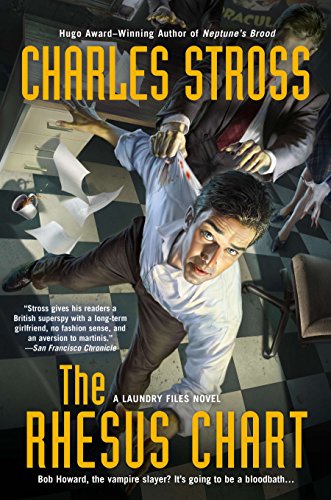
As a newly appointed junior manager within the Laundry—the clandestine organization responsible for protecting Britain against supernatural threats—Bob Howard is expected to show some initiative to help the agency battle the forces of darkness. But shining a light on what’s best left in the shadows is the last thing Bob wants to do—especially when those shadows hide an occult parasite spreading a deadly virus.
Traders employed by a merchant bank in London are showing signs of infection—an array of unusual symptoms such as super-strength and -speed, an uncanny talent for mind control, an extreme allergic reaction to sunlight, and an unquenchable thirst for blood. While his department is tangled up in bureaucratic red tape (and Buffy reruns) debating how to stop the rash of vampirism, Bob digs deeper into the bank’s history—only to uncover a blood-curdling conspiracy between men and monsters...
Die Inhaltsangabe kann sich auf eine andere Ausgabe dieses Titels beziehen.
Über die Autorin bzw. den Autor
Charles Stross is a full-time science fiction writer. The author of six Hugo-nominated novels and winner of the 2005 Hugo Award for best novella (“The Concrete Jungle”), Stross has had his work translated into more than twelve languages. In addition to the Laundry Files Novels (The Atrocity Archives, The Jennifer Morgue, The Fuller Memorandum, The Apocalypse Codex), he is the author of Accelerando, Wireless, Saturn's Children, and Neptune's Brood.
Auszug. © Genehmigter Nachdruck. Alle Rechte vorbehalten.
1.
PROLOGUE: ONE MONTH AGO
“DON’T BE SILLY, BOB,” SAID MO. “EVERYBODY KNOWS vampires don’t exist.”
I froze with my chopsticks halfway to my mouth, the tiny corpse of a tempura-battered baby squid clutched precariously between them, while I flailed for a reply to her non sequitur. We were dining out at an uncomfortably pricey conveyor-belt sushi restaurant just off Leicester Square—it was my treat, although I had an ulterior motive. Unfortunately I was in the doghouse for some reason. I didn’t know why, and it might not even have been related to the deed I’d brought her here to apologize for, but dinner showed every sign of turning into one of those rare but depressingly unfocussed marital arguments we had every few months. And the most prominent warning sign was this: the replacement of reasoned discussion with peremptory denial.
“We can’t be sure of that. I mean, doesn’t that take us right into proving-a-negative territory? The ubiquity of the legends, the consistent elements, all suggest to me that maybe we’ve been looking in the wrong place—”
We were here because I thought it might help soften her up before I apologized for what I’d done to her friend Pete the month before. But instead of unwinding or letting me tell her about my latest office project, she’d switched into hypercritical mode as soon as we got to our booth. Apology shelved. Perhaps she’d just had a bad day at the office, but begging forgiveness for sins of necessity committed in the line of duty was clearly off the menu for the time being. Ten years together, seven of them married, have taught me to recognize the signs: right now if I reminded her that the sun rose in the east she’d start by stonewalling then escalate to a land war in Asia.
“Bob.” When she said my name like that, it gave me flashbacks to Miss Pearson in Primary Two (not my favorite teacher): “Vampires can’t exist. There’d be detailed records in the archives; they couldn’t possibly evade detection by the state for any significant period. Besides which”—she aimed an alarmingly sharp wooden chopstick at my nose—“there’d be corpses everywhere. Human blood is a poor nutrient source; it’s about 60 percent plasma by volume and only provides about 900 calories per liter, so your hypothetical blood-sucking fiend is going to have to drink about two and a half liters per a day. Those calories don’t come in the form of useful stuff like glucose and fat: it’s mostly protein from circulating red blood cells. Dracula would have to exsanguinate a victim every day just to stay alive, and would suffer from chronic ketoacidosis. The total number of intentional homicides for the whole country is around 700 a year; a single vampire would cause a 50 percent spike in the murder rate. Or they’d have to take transfusion-sized donations about two thousand times a year.” She capped the boss-level takedown with a tight-lipped, triumphant smile, the better to conceal her incisors: “If you think you, or I, or anyone in the office could mind-control hundreds of people well enough to prevent at least one of them going to their GP to complain about the lethargy and anemia . . .”
I gave in to the inevitable. “You’ve researched this already, haven’t you?”
“It came up in a brainstorming exercise about six years ago. We were investigating using ecosystem analysis to evaluate the probability of emergent new threat modalities. We also brainstormed golems, werewolves, and sasquatch.” She took a spoonful of miso soup. “If they existed we’d know about them, Bob.”
“But”—I paused to swallow my squid and pluck another one from the color-coded plate in front of me—“your model assumes they’re obligate hemophages, doesn’t it? And that they’re endothermic, or at least have an energy budget not entirely unlike every other vertebrate known to science. What if that’s not the whole story? What if they eat—”
“Bob.” She stopped short of rolling her eyes, but I could see she was bored, and growing more annoyed by the minute: “Eat your baby tentacle monsters before they go cold.”
Mo has an aversion to pseudopods. When we first met, some very unpleasant people were trying to sacrifice her in order to summon an alien horror from beyond spacetime. I’d distracted them long enough for the seventh cavalry to arrive, and sometime after that Mo and I had started dating—but she still couldn’t (and can’t) stomach calamari. I cleaned my plate and watched as she finished her soup.
“I’m done here,” she announced, picking up her violin case without asking whether I was still hungry. “I’m going home.”
Which is why I didn’t get a chance to apologize for dragging Pete into the business in Colorado Springs. Or to explain my hypothesis about what vampirism really was, and what I was doing about it. Or to save our marriage.
• • •
THE NAME’S HOWARD, BOB HOWARD. I’M A COMPUTER SCIENCE graduate and IT person, and I work for the British government in London, as does my wife Mo, Dominique O’Brien, who is a few years older than I am but still (in my opinion) a gorgeous redhead.
That’s the mundane version, cleared for public consumption. It is also deeply misleading, but it’s the version I’m allowed to give to friends and family without being required to kill them, so we’ll call that a net win. It’s also not entirely false.
The secret organization I work for is commonly called the Laundry because when it was established in its current form in 1940 it was based above a Chinese laundry in Soho. As Q Department, SOE, it was tasked with waging an occult war against the Ahnenerbe-SS. Today, the name may have changed several times but it’s the same organization—the one you have just been admitted to, if you’re reading this classified journal and your hair isn’t on fire due to the security wards on the cover.
I’m actually a specialist in a field called Applied Computational Demonology: the summoning and binding to service of unspeakable horrors from other dimensions, by means of mathematical tools. Magic is a branch of applied mathematics: we live in a multiverse, there is a platonic realm of pure numbers, and when we solve certain theorems, listeners in alien universes hear the echoes. By performing certain derivations and manipulating theorems, we can make extradimensional entities sit up and listen, and sometimes get them to do what we want them to. True names have power: you should assume that any names or locations I give you may have been changed in the interest of security.
Although ritual magic has been around since the dawn of time (and indeed the Laundry’s antecedents go back at least as far as Sir John Dee, in service to Queen Elizabeth the First under Sir Francis Walsingham), it was first systematized and placed on a concrete theoretical footing by Alan Turing in the 1940s. There are dark rumors that his “suicide” might have been a deeply misguided attempt to shut down a perceived security risk; if so, it was the organization’s biggest mistake ever. Later on they took to recruiting anyone who rediscovered the truth by accident—which led, via the mushrooming popularity of computing during the 1980s and 1990s, to an increasingly unwieldy and overstaffed org chart full of disgruntled CS postgrad researchers and mathematicians.
I ended up in...
„Über diesen Titel“ kann sich auf eine andere Ausgabe dieses Titels beziehen.
Suchergebnisse für The Rhesus Chart (A Laundry Files Novel, Band 5)

Beispielbild für diese ISBN
The Rhesus Chart
Anbieter: ThriftBooks-Reno, Reno, NV, USA
Verkäuferbewertung 5 von 5 Sternen

Hardcover. Zustand: Very Good. No Jacket. Former library book; May have limited writing in cover pages. Pages are unmarked. ~ ThriftBooks: Read More, Spend Less. Bestandsnummer des Verkäufers G0425256863I4N10
Gebraucht kaufen
EUR 6,36
Versand gratis
Versand innerhalb von USA
Versand innerhalb von USA
Anzahl: 1 verfügbar
Beispielbild für diese ISBN
The Rhesus Chart
Anbieter: ThriftBooks-Phoenix, Phoenix, AZ, USA
Verkäuferbewertung 5 von 5 Sternen
Hardcover. Zustand: Very Good. No Jacket. Former library book; May have limited writing in cover pages. Pages are unmarked. ~ ThriftBooks: Read More, Spend Less. Bestandsnummer des Verkäufers G0425256863I4N10
Gebraucht kaufen
EUR 6,36
Versand gratis
Versand innerhalb von USA
Versand innerhalb von USA
Anzahl: 1 verfügbar
Beispielbild für diese ISBN
The Rhesus Chart
Anbieter: ThriftBooks-Atlanta, AUSTELL, GA, USA
Verkäuferbewertung 5 von 5 Sternen
Hardcover. Zustand: Fair. No Jacket. Readable copy. Pages may have considerable notes/highlighting. ~ ThriftBooks: Read More, Spend Less. Bestandsnummer des Verkäufers G0425256863I5N00
Gebraucht kaufen
EUR 6,36
Versand gratis
Versand innerhalb von USA
Versand innerhalb von USA
Anzahl: 1 verfügbar
Beispielbild für diese ISBN
The Rhesus Chart
Anbieter: ThriftBooks-Atlanta, AUSTELL, GA, USA
Verkäuferbewertung 5 von 5 Sternen
Hardcover. Zustand: Very Good. No Jacket. Former library book; May have limited writing in cover pages. Pages are unmarked. ~ ThriftBooks: Read More, Spend Less. Bestandsnummer des Verkäufers G0425256863I4N10
Gebraucht kaufen
EUR 6,36
Versand gratis
Versand innerhalb von USA
Versand innerhalb von USA
Anzahl: 1 verfügbar
Beispielbild für diese ISBN
The Rhesus Chart
Anbieter: ThriftBooks-Dallas, Dallas, TX, USA
Verkäuferbewertung 5 von 5 Sternen
Hardcover. Zustand: Fair. No Jacket. Former library book; Readable copy. Pages may have considerable notes/highlighting. ~ ThriftBooks: Read More, Spend Less. Bestandsnummer des Verkäufers G0425256863I5N10
Gebraucht kaufen
EUR 6,36
Versand gratis
Versand innerhalb von USA
Versand innerhalb von USA
Anzahl: 1 verfügbar
Beispielbild für diese ISBN
The Rhesus Chart
Anbieter: ThriftBooks-Dallas, Dallas, TX, USA
Verkäuferbewertung 5 von 5 Sternen
Hardcover. Zustand: Very Good. No Jacket. Former library book; May have limited writing in cover pages. Pages are unmarked. ~ ThriftBooks: Read More, Spend Less. Bestandsnummer des Verkäufers G0425256863I4N10
Gebraucht kaufen
EUR 6,36
Versand gratis
Versand innerhalb von USA
Versand innerhalb von USA
Anzahl: 1 verfügbar
Beispielbild für diese ISBN
The Rhesus Chart
Verlag:
Penguin Publishing Group, 2014
ISBN 10: 0425256863
ISBN 13: 9780425256862
Gebraucht
Hardcover
Anbieter: Better World Books, Mishawaka, IN, USA
Verkäuferbewertung 5 von 5 Sternen
Zustand: Good. Former library copy. Pages intact with minimal writing/highlighting. The binding may be loose and creased. Dust jackets/supplements are not included. Includes library markings. Stock photo provided. Product includes identifying sticker. Better World Books: Buy Books. Do Good. Bestandsnummer des Verkäufers 4610325-75
Gebraucht kaufen
EUR 8,43
Versand gratis
Versand innerhalb von USA
Versand innerhalb von USA
Anzahl: 2 verfügbar
Beispielbild für diese ISBN
The Rhesus Chart
Verlag:
Penguin Publishing Group, 2014
ISBN 10: 0425256863
ISBN 13: 9780425256862
Gebraucht
Hardcover
Anbieter: Better World Books, Mishawaka, IN, USA
Verkäuferbewertung 5 von 5 Sternen
Zustand: Very Good. Former library copy. Pages intact with possible writing/highlighting. Binding strong with minor wear. Dust jackets/supplements may not be included. Includes library markings. Stock photo provided. Product includes identifying sticker. Better World Books: Buy Books. Do Good. Bestandsnummer des Verkäufers 5827999-75
Gebraucht kaufen
EUR 8,43
Versand gratis
Versand innerhalb von USA
Versand innerhalb von USA
Anzahl: 1 verfügbar
Beispielbild für diese ISBN
The Rhesus Chart (Laundry Files)
Anbieter: St Vincent de Paul of Lane County, Eugene, OR, USA
Verkäuferbewertung 5 von 5 Sternen
Zustand: Good. hardcover 100% of proceeds go to charity! Good condition with all pages in tact. Item shows signs of use and may have cosmetic defects. Bestandsnummer des Verkäufers N-04-4919
Gebraucht kaufen
EUR 4,96
EUR 3,51 Versand
Versand innerhalb von USA
Versand innerhalb von USA
Anzahl: 1 verfügbar
Beispielbild für diese ISBN
The Rhesus Chart
Anbieter: HPB-Red, Dallas, TX, USA
Verkäuferbewertung 5 von 5 Sternen
hardcover. Zustand: Very Good. Connecting readers with great books since 1972! Used textbooks may not include companion materials such as access codes, etc. May have some wear or limited writing/highlighting. We ship orders daily and Customer Service is our top priority! Bestandsnummer des Verkäufers S_480312735
Gebraucht kaufen
EUR 5,42
EUR 3,29 Versand
Versand innerhalb von USA
Versand innerhalb von USA
Anzahl: 1 verfügbar