
Verwandte Artikel zu Tom Clancy Support and Defend: A Campus Novel
Inhaltsangabe
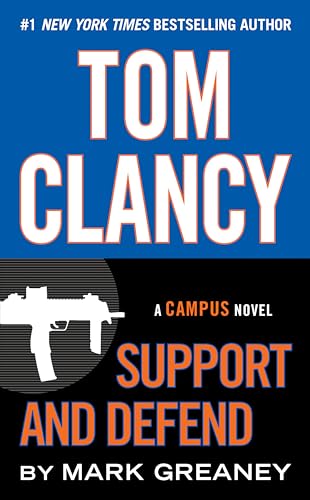
Over the course of three decades, Tom Clancy created a world alive with prescient action and remarkable individuals. In Tom Clancy Support and Defend, covert agent Dominic Caruso faces the deadliest challenge of his career.
Dominic Caruso. Nephew of President Jack Ryan. FBI agent. And operator for the top secret U.S. intelligence agency known as The Campus. Already scarred by the death of his brother, Caruso is further devastated when he is unable to save a friend and his family from a terrorist attack. Ethan Ross was a mid-level staffer for the National Security Council. Now he’s a wanted fugitive on the run with a microdrive that contains enough information to destroy American intelligence efforts around the world. The CIA is desperate to get the drive back before it’s captured by the Russians or one of the various terrorist groups also vying for it.
Only Caruso stands in their way—but can he succeed without the aid of his Campus colleagues?
Die Inhaltsangabe kann sich auf eine andere Ausgabe dieses Titels beziehen.
Über die Autorin bzw. den Autor
A little more than thirty years ago Tom Clancy was a Maryland insurance broker with a passion for naval history. Years before, he had been an English major at Baltimore’s Loyola College and had always dreamed of writing a novel. His first effort, The Hunt for Red October—the first of the phenomenally successful Jack Ryan novels—sold briskly as a result of rave reviews, then catapulted onto the New York Times bestseller list after President Reagan pronounced it “the perfect yarn.” From that day forward, Clancy established himself as an undisputed master at blending exceptional realism and authenticity, intricate plotting, and razor-sharp suspense. He passed away in October 2013.
Mark Greaney has a degree in international relations and political science. In his research for the Gray Man novels, including Mission Critical, Agent in Place, Gunmetal Gray, Back Blast, Dead Eye, Ballistic, On Target, and The Gray Man, he traveled to more than fifteen countries and trained alongside military and law enforcement in the use of firearms, battlefield medicine, and close-range combative tactics. He is also the author of the New York Times bestsellers Tom Clancy Support and Defend, Tom Clancy Full Force and Effect, Tom Clancy Commander in Chief, and Tom Clancy True Faith and Allegiance. With Tom Clancy, he coauthored Locked On, Threat Vector, and Command Authority.
Auszug. © Genehmigter Nachdruck. Alle Rechte vorbehalten.
PRINCIPAL CHARACTERS
Dominic Caruso: operative, The Campus
Ethan Ross: deputy assistant director for Near East and North African affairs, National Security Council
Eve Pang: computer network systems engineer, Ross’s girlfriend
Darren Albright: supervisory special agent, FBI Counterintelligence Division
Nolan and Beale: investigative specialists, FBI Special Surveillance Group
Adara Sherman: director of transportation, The Campus
Harlan Banfield: journalist, member of the International Transparency Project
Gianna Bertoli: director, International Transparency Project
Mohammed Mobasheri: Iranian Revolutionary Guard
Kashan, Shiraz, Isfahan, and Ormand: operatives, Quds Force
Arturo: Venezuelan General Intelligence officer
Leo: Venezuelan General Intelligence officer
Rigoberto Finn: polygraph examiner, FBI
Gerry Hendley: director, The Campus/Hendley Associates
Arik Yacoby: former operative, Shayetet 13, Israeli naval Special Forces
David: Israeli intelligence agent
Phillip McKell: computer network expert
PROLOGUE
THE COAST OF INDIA appeared in the moonlight. There wasn’t much to it, really, just a narrow strip of sand that emerged from the darkness a few hundred meters off the ship’s bow, but the first sight of land in four days told the man standing on the foredeck two important things.
One: The ingression phase of his operation had succeeded.
And two: The time had come to slit the captain’s throat.
The man on the foredeck drew his knife and moved toward the stairs leading up to the navigation bridge. Two of his men fell into step behind him, but they were just along to watch. Responsibility for killing the captain fell to the leader and, in truth, he considered it no burden; in fact, he welcomed the opportunity to once again put his commitment to this mission on display for the others.
The leader and his team of six had spent three days on board an Omani fishing trawler on the open water of the Arabian Sea. Last night they came abreast of this eighty-foot dry-goods vessel and waved a shredded fan belt in the air. In Hindi they asked for help, but when the cargo ship drew even with them, the leader and his men scurried aboard like swamp rats and overran the small crew; they slaughtered all save the captain, and ordered him to head due east with a course set for India’s Malabar Coast.
It had taken the leader half a day to convince the terrified captain he would not suffer the same fate as his crew. Killing him would make a lie of this, of course, but as the leader climbed the steps up to the dark bridge, he wasn’t troubling himself about going back on his promise; his mind was already off this boat and onto the objective phase of the operation.
The leader was a lieutenant in the Ezzedeen Al-Qassam Brigades, the militant wing of the Palestinian political organization Hamas. He’d been sent on this mission to target a single man, but he had known all along that many others, the captain and his crew, for instance, would necessarily be sacrificed in the action.
So far he had been in total control of his operation. The next phase, by contrast, was in the hands of someone else, and this worried him greatly. Everything now hinged on the competence of a local contact. A woman, he had been told in his mission brief, who had verified the presence of the target and the disposition of the local police and had also, Inshallah, delivered a vehicle to his landing point and, Inshallah, remembered to leave the keys under the driver’s seat.
The leader lost his balance momentarily at the top of the stairs on the outer bridge deck, and he reached out to steady himself. The men behind him were still climbing, they had not seen him stumble, and he was glad of this. They might wonder if it was a show of nerves on his part, and this he could not allow. Actually it was just a slight sway to starboard that unbalanced him, and it stood to reason his sea legs would falter. Born in the Gaza Strip, the leader had grown up within sight of the ocean but had never set foot on anything larger than a fishing skiff with an outboard motor before this week.
He had been chosen because of his intelligence, his ruthlessness, and his resolve, but certainly not for any maritime prowess.
Up here on the bridge deck, the leader stopped to scan the night in all directions. There were few signs of civilization onshore except for some wooden shacks, but an electric glow hung in the haze over the huge coastal metropolis of Kochi just forty-five kilometers to the south.
Satisfied no one was around to hear a scream across the open water, he reached for the door latch.
The middle-aged Indian captain did not turn as the leader entered the bridge. He kept his hands on the wheel, looking straight ahead, his chest heaving from dread.
He knew.
The leader continued forward with his knife shielded down behind his thigh; he’d planned on asking a question as he approached, something nonchalant to distract the man, to put him at ease for the moment, but instead he kept silent, raising the blade in his right hand.
At three paces he rushed the man’s back, reached around in front of his body with the knife, then thrust the blade into his neck and pulled it back across the bare throat. He withdrew the knife and took a single stride back. The Indian spun, blood spewed across the bridge, catching the leader’s pants and sneakers though he leapt back the length of the small room to avoid it.
The other two watched through a portal by the door, clear of the arterial spray.
The captain dropped to his knees, air hissed and gurgled through the bloody wound for a moment. Then he died. Mercifully quick for everyone, the leader thought.
“Allahu Akbar.” He said it with reverence, and he stepped over the body, tracking through the blood because there was no way to avoid it, and he put his hands on the wheel.
But for only a moment—he was no captain. In fact, none of the men on board knew how to bring the cargo ship safely into port, the captain had even told them there was no port where they were going, so the leader just pulled the engines back to idle and ordered his men to move to the tender that had already been packed with gear and lowered into the black water on the port side.
• • •
TWENTY MINUTES LATER the seven men climbed out of the small tender and into gentle shoreline surf, then pulled the boat onto the sand, beaching it just clear of the licking waves.
Leaving the boat here in the open would be no problem. They would not need it again; the leader’s exfiltration route would be overland to the east, into Madurai and then out on an aircraft with forged papers. Plus, the boat would not stand out and jeopardize the mission, as several other small watercraft lay unattended around this spit of sand. Net fishermen had left them for the night, having first removed their outboard motors and taken them back to their thatched-roof homes to protect them from thieves.
The men pulled black canvas bags from the tender and donned their gear. Three strapped heavy vests under their large black windbreakers; the other four hung small rifles on slings around their necks along with pouches of extra ammunition. The guns were micro-Uzis, a nine-millimeter machine pistol of Israeli manufacture, but any irony in the choice of firearm was outweighed by the gun’s undeniable...
„Über diesen Titel“ kann sich auf eine andere Ausgabe dieses Titels beziehen.
Suchergebnisse für Tom Clancy Support and Defend: A Campus Novel

Beispielbild für diese ISBN
Tom Clancy Support and Defend
Anbieter: World of Books (was SecondSale), Montgomery, IL, USA
Verkäuferbewertung 5 von 5 Sternen

Zustand: Very Good. Over the course of three decades, Tom Clancy created a world alive with prescient action and remarkable individuals. In Tom Clancy Support and Defend, covert agent Dominic Caruso faces the deadliest challenge of his career. Dominic Caruso. Nephew of President Jack Ryan. FBI agent. And operator for the top secret U.S. intelligence agency known as The Campus. Already scarred by the death of his brother, Caruso is further devastated when he is unable to save a friend and his family from a terrorist attack. Ethan Ross was a mid-level staffer for the National Security Council. Now he's a wanted fugitive on the run with a microdrive that contains enough information to destroy American intelligence efforts around the world. The CIA is desperate to get the drive back before it's captured by the Russians or one of the various terrorist groups also vying for it. Only Caruso stands in their way--but can he succeed without the aid of his Campus colleagues? Bestandsnummer des Verkäufers 00108946283
Gebraucht kaufen
EUR 3,71
Versand gratis
Versand innerhalb von USA
Versand innerhalb von USA
Anzahl: 2 verfügbar
Beispielbild für diese ISBN
Tom Clancy Support and Defend:
Anbieter: World of Books (was SecondSale), Montgomery, IL, USA
Verkäuferbewertung 5 von 5 Sternen
Zustand: Acceptable. Item in acceptable condition! Textbooks may not include supplemental items i.e. CDs, access codes etc. Bestandsnummer des Verkäufers 00081999679
Gebraucht kaufen
EUR 3,71
Versand gratis
Versand innerhalb von USA
Versand innerhalb von USA
Anzahl: 10 verfügbar
Beispielbild für diese ISBN
Tom Clancy Support and Defend
Anbieter: World of Books (was SecondSale), Montgomery, IL, USA
Verkäuferbewertung 5 von 5 Sternen
Zustand: Good. Over the course of three decades, Tom Clancy created a world alive with prescient action and remarkable individuals. In Tom Clancy Support and Defend, covert agent Dominic Caruso faces the deadliest challenge of his career. Dominic Caruso. Nephew of President Jack Ryan. FBI agent. And operator for the top secret U.S. intelligence agency known as The Campus. Already scarred by the death of his brother, Caruso is further devastated when he is unable to save a friend and his family from a terrorist attack. Ethan Ross was a mid-level staffer for the National Security Council. Now he's a wanted fugitive on the run with a microdrive that contains enough information to destroy American intelligence efforts around the world. The CIA is desperate to get the drive back before it's captured by the Russians or one of the various terrorist groups also vying for it. Only Caruso stands in their way--but can he succeed without the aid of his Campus colleagues? Bestandsnummer des Verkäufers 00098774351
Gebraucht kaufen
EUR 3,71
Versand gratis
Versand innerhalb von USA
Versand innerhalb von USA
Anzahl: 15 verfügbar
Beispielbild für diese ISBN
Tom Clancy Support and Defend (A Campus Novel)
Anbieter: Your Online Bookstore, Houston, TX, USA
Verkäuferbewertung 5 von 5 Sternen
Mass Market Paperback. Zustand: Good. Bestandsnummer des Verkäufers 0425279227-3-19469854
Gebraucht kaufen
EUR 3,72
Versand gratis
Versand innerhalb von USA
Versand innerhalb von USA
Anzahl: 1 verfügbar
Beispielbild für diese ISBN
Tom Clancy Support and Defend (A Campus Novel)
Anbieter: Gulf Coast Books, Cypress, TX, USA
Verkäuferbewertung 5 von 5 Sternen
Mass Market Paperback. Zustand: Fair. Bestandsnummer des Verkäufers 0425279227-4-21825989
Gebraucht kaufen
EUR 3,72
Versand gratis
Versand innerhalb von USA
Versand innerhalb von USA
Anzahl: 3 verfügbar
Beispielbild für diese ISBN
Tom Clancy Support and Defend (A Campus Novel)
Anbieter: Your Online Bookstore, Houston, TX, USA
Verkäuferbewertung 5 von 5 Sternen
Mass Market Paperback. Zustand: Fair. Bestandsnummer des Verkäufers 0425279227-4-19306940
Gebraucht kaufen
EUR 3,72
Versand gratis
Versand innerhalb von USA
Versand innerhalb von USA
Anzahl: 1 verfügbar
Foto des Verkäufers
Tom Clancy Support and Defend (A Campus Novel)
Anbieter: Zoom Books Company, Lynden, WA, USA
Verkäuferbewertung 5 von 5 Sternen
Zustand: very_good. Book is in very good condition and may include minimal underlining highlighting. The book can also include "From the library of" labels. May not contain miscellaneous items toys, dvds, etc. . We offer 100% money back guarantee and 24 7 customer service. Bestandsnummer des Verkäufers ZBV.0425279227.VG
Gebraucht kaufen
EUR 4,05
Versand gratis
Versand innerhalb von USA
Versand innerhalb von USA
Anzahl: 6 verfügbar
Foto des Verkäufers
Tom Clancy Support and Defend (A Campus Novel)
Anbieter: Zoom Books East, Glendale Heights, IL, USA
Verkäuferbewertung 5 von 5 Sternen
Zustand: good. Book is in good condition and may include underlining highlighting and minimal wear. The book can also include "From the library of" labels. May not contain miscellaneous items toys, dvds, etc. . We offer 100% money back guarantee and 24 7 customer service. Bestandsnummer des Verkäufers ZEV.0425279227.G
Gebraucht kaufen
EUR 4,05
Versand gratis
Versand innerhalb von USA
Versand innerhalb von USA
Anzahl: 2 verfügbar
Foto des Verkäufers
Tom Clancy Support and Defend (A Campus Novel)
Anbieter: Used Book Company, Egg Harbor Township, NJ, USA
Verkäuferbewertung 5 von 5 Sternen
Zustand: Very Good. Shows minimal signs of wear and previous use. Can include minimal notes/highlighting. A portion of your purchase benefits nonprofits! - Note: Edition & format may differ from what is shown in stock photo & item details. May not include supplementary material (toys, access code, dvds, etc). Bestandsnummer des Verkäufers 584ZST000ETO_ns
Gebraucht kaufen
EUR 4,20
Versand gratis
Versand innerhalb von USA
Versand innerhalb von USA
Anzahl: 1 verfügbar
Foto des Verkäufers
Tom Clancy Support and Defend (A Campus Novel)
Anbieter: Zoom Books East, Glendale Heights, IL, USA
Verkäuferbewertung 5 von 5 Sternen
Zustand: very_good. Book is in very good condition and may include minimal underlining highlighting. The book can also include "From the library of" labels. May not contain miscellaneous items toys, dvds, etc. . We offer 100% money back guarantee and 24 7 customer service. Bestandsnummer des Verkäufers ZEV.0425279227.VG
Gebraucht kaufen
EUR 4,48
Versand gratis
Versand innerhalb von USA
Versand innerhalb von USA
Anzahl: 1 verfügbar