
Verwandte Artikel zu Google Earth Engine and Artificial Intelligence for...
Google Earth Engine and Artificial Intelligence for Earth Observation: Algorithms and Sustainable Applications - Softcover
Buch 12 von 26: Earth Observation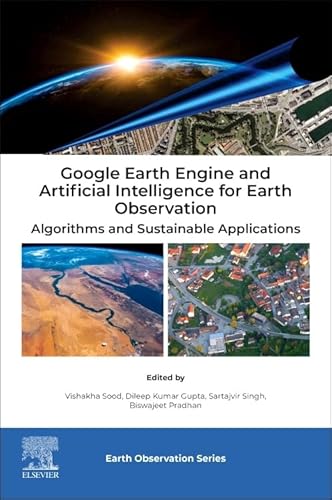
Inhaltsangabe
Google Earth Engine and Artificial Intelligence for Earth Observation: Algorithms and Sustainable Applications explores a wide range of transformative data fusion techniques of Artificial Intelligence (AI) technologies applied to Google Earth Engine (GEE) techniques. It includes a wide range of scientific domains that can utilize remote sensing and geographic information systems (GIS) through detailed case studies. This book delves into the challenges of AI-driven tools and technologies for Earth observation data analysis, offering possible solutions and directly addressing current and upcoming needs within Earth observation. Google Earth Engine and Artificial Intelligence for Earth Observation: Algorithms and Sustainable Applications is a useful reference for geospatial scientists, remote sensing experts, and environmental scientists utilizing remote sensing to apply the latest AI techniques to data obtained from GEE for their research and teaching.
Die Inhaltsangabe kann sich auf eine andere Ausgabe dieses Titels beziehen.
Über die Autorinnen und Autoren
Vishakha Sood is currently working as a Scientist at the Indian Institute of Technology, Ropar, Punjab, under the Women Scientist Scheme (WOS) of the Department of Science and Technology (DST), Government of India. She is also the founder of Aiotronics Automation Pvt. Ltd., supported under the Himachal Pradesh Chief Minister Startup Scheme. She received her Ph.D. in Electronics and Communication Engineering from Chitkara University, Punjab, in 2020. She earned her B.Tech. degree from Himachal Pradesh University in 2008 and her M.Tech. degree in Electronics and Communication Engineering from Punjab Technical University in 2011. She also completed an MBA in Human Resource Management in 2010. She has extensive academic and research experience and has authored research articles in SCI‑indexed journals and SCOPUS‑indexed book chapters and holds several inventions. Her research interests include satellite sensors, remote sensing, and digital image analysis. She is a Senior Member of IEEE and an active member of professional bodies including the Indian Society of Remote Sensing (ISRS), Indian Society for Technical Education (ISTE), Punjab Science Congress (Punjab Academy of Sciences), IEEE Sensors Council, IEEE Geoscience and Remote Sensing Society, IEEE Women in Engineering, and the European Geosciences Union (EGU).
Dileep Kumar Gupta received his doctoral degree from the Department of Physics, Indian Institute of Technology (Banaras Hindu University), Varanasi, India. He is currently working as Assistant Professor (Grade II) at Galgotias University, Greater Noida, India. His research expertise lies in microwave active and passive remote sensing, electronics and sensor systems, GNSS-based applications, and algorithm development for soil moisture and crop parameter retrieval using ground‑based and space‑borne platforms. His work closely integrates antenna‑enabled sensing systems with data processing methodologies. He has published extensively in peer‑reviewed journals, conference proceedings, and book chapters, and has also served as an editor for academic books with international publishers. His broader research interests include multi‑sensor remote sensing, microwave system applications, geoinformatics, and the use of artificial intelligence and machine learning techniques in remote sensing data analysis.
Dr. Sartajvir Singh is currently serving as Chief Scientific Officer at the Center of Excellence in Socio-Environmental Sustainability for River Sand Mining (SENSRS) and Project Director (ICSSR Project) at Indian Institute of Technology Ropar, India. He is a digital image analyst with expertise in remote sensing and earned his PhD in Electronics & Communication Engineering (Outstanding Thesis Awardee, 2018) after completing his M. Tech (Gold Medalist) and B.Tech with Distinction. He is a Registered Indian Patent & Trademark Agent and a DGCA-approved drone operator, with 70+ innovations (35+ patents granted) and 90+ SCI/Scopus-indexed publications. He has secured over four Crore (INR) research funding, received multiple fellowships, held editorial positions, and is an IEEE Senior Member, advancing electronics, image processing, and geospatial intelligence.
Professor Pradhan is a globally recognized expert in geospatial analytics and artificial intelligence applications in Earth and environmental sciences. Currently a Distinguished Professor at the University of Technology Sydney (UTS), Australia, he also leads the Centre for Advanced Modelling and Geospatial Information Systems (CAMGIS). With a PhD in GIS-based modeling, Prof. Pradhan has over two decades of experience in spatial data science, remote sensing, natural hazard modeling, and environmental monitoring. He has been listed among the world's top 2% scientists by Stanford University and received numerous international awards, including from IEEE and Elsevier. A Fellow of the Royal Geographical Society (FRGS), he also serves on editorial boards of several top-tier journals. His research integrates geospatial AI and deep learning for disaster risk reduction, land use planning, and sustainability.
Von der hinteren Coverseite
Google Earth Engine and Artificial Intelligence for Earth Observation explores a wide range of transformative data fusion techniques of Artificial Intelligence (AI) technologies applied to Google Earth Engine (GEE) techqnieus. It includes a wide range of scientific domains that can utilise remote sensing and geographic information systems (GIS) through detailed case studies. The book delves into the challenges of AI-driven tools and technologies for Earth observation data analysis, offering possible solutions and directly addressing current and upcoming needs within Earth Observation. Google Earth Engine and Artificial Intelligence for Earth Observation is a useful reference for geospatial scientists, remote sensing experts, and environmental scientists utilising remote sensing to apply the latest AI techniques to data obtained from GEE for their research and teaching.
„Über diesen Titel“ kann sich auf eine andere Ausgabe dieses Titels beziehen.
Suchergebnisse für Google Earth Engine and Artificial Intelligence for...

Beispielbild für diese ISBN
Google Earth Engine and Artificial Intelligence for Earth Observation : Algorithms and Sustainable Applications
Anbieter: GreatBookPrices, Columbia, MD, USA
Verkäuferbewertung 5 von 5 Sternen

Zustand: As New. Unread book in perfect condition. Bestandsnummer des Verkäufers 48394962
Gebraucht kaufen
EUR 187,76
EUR 2,35 Versand
Versand innerhalb von USA
Versand innerhalb von USA
Anzahl: Mehr als 20 verfügbar
Beispielbild für diese ISBN
Google Earth Engine and Artificial Intelligence for Earth Observation : Algorithms and Sustainable Applications
Anbieter: GreatBookPricesUK, Woodford Green, Vereinigtes Königreich
Verkäuferbewertung 5 von 5 Sternen
Zustand: New. Bestandsnummer des Verkäufers 48394962-n
Neu kaufen
EUR 181,43
EUR 17,68 Versand
Versand von Vereinigtes Königreich nach USA
Versand von Vereinigtes Königreich nach USA
Anzahl: Mehr als 20 verfügbar
Beispielbild für diese ISBN
Google Earth Engine and Artificial Intelligence for Earth Observation: Algorithms and Sustainable Applications
Anbieter: Ria Christie Collections, Uxbridge, Vereinigtes Königreich
Verkäuferbewertung 5 von 5 Sternen
Zustand: New. In English. Bestandsnummer des Verkäufers ria9780443273728_new
Neu kaufen
EUR 186,92
EUR 17,61 Versand
Versand von Vereinigtes Königreich nach USA
Versand von Vereinigtes Königreich nach USA
Anzahl: Mehr als 20 verfügbar
Beispielbild für diese ISBN
Google Earth Engine and Artificial Intelligence for Earth Observation : Algorithms and Sustainable Applications
Anbieter: GreatBookPricesUK, Woodford Green, Vereinigtes Königreich
Verkäuferbewertung 5 von 5 Sternen
Zustand: As New. Unread book in perfect condition. Bestandsnummer des Verkäufers 48394962
Gebraucht kaufen
EUR 187,70
EUR 17,68 Versand
Versand von Vereinigtes Königreich nach USA
Versand von Vereinigtes Königreich nach USA
Anzahl: Mehr als 20 verfügbar
Beispielbild für diese ISBN
Google Earth Engine and Artificial Intelligence for Earth Observation : Algorithms and Sustainable Applications
Anbieter: GreatBookPrices, Columbia, MD, USA
Verkäuferbewertung 5 von 5 Sternen
Zustand: New. Bestandsnummer des Verkäufers 48394962-n
Neu kaufen
EUR 208,58
EUR 2,35 Versand
Versand innerhalb von USA
Versand innerhalb von USA
Anzahl: Mehr als 20 verfügbar
Beispielbild für diese ISBN
Google Earth Engine and Artificial Intelligence for Earth Observation (Paperback)
Verlag:
Elsevier - Health Sciences Division, Philadelphia, 2025
ISBN 10: 0443273723
ISBN 13: 9780443273728
Neu
Paperback
Anbieter: CitiRetail, Stevenage, Vereinigtes Königreich
Verkäuferbewertung 5 von 5 Sternen
Paperback. Zustand: new. Paperback. Google Earth Engine and Artificial Intelligence for Earth Observation: Algorithms and Sustainable Applications This item is printed on demand. Shipping may be from our UK warehouse or from our Australian or US warehouses, depending on stock availability. Bestandsnummer des Verkäufers 9780443273728
Neu kaufen
EUR 181,44
EUR 43,60 Versand
Versand von Vereinigtes Königreich nach USA
Versand von Vereinigtes Königreich nach USA
Anzahl: 1 verfügbar
Foto des Verkäufers
Google Earth Engine and Artificial Intelligence for Earth Observation
Anbieter: moluna, Greven, Deutschland
Verkäuferbewertung 5 von 5 Sternen
Zustand: New. Includes utilization of AI with GEE tools for a spectrum of scientific domains in remote sensing and geographic information systems (GIS) including natural hazard assessment, aquatic and hydrological applications, and forest coverHighlights. Bestandsnummer des Verkäufers 1966234201
Neu kaufen
EUR 178,78
EUR 48,99 Versand
Versand von Deutschland nach USA
Versand von Deutschland nach USA
Anzahl: Mehr als 20 verfügbar
Foto des Verkäufers
Google Earth Engine and Artificial Intelligence for Earth Observation
Anbieter: AHA-BUCH GmbH, Einbeck, Deutschland
Verkäuferbewertung 5 von 5 Sternen
Taschenbuch. Zustand: Neu. Neuware - Google Earth Engine and Artificial Intelligence for Earth Observation: Algorithms and Sustainable Applications explores a wide range of transformative data fusion techniques of Artificial Intelligence (AI) technologies applied to Google Earth Engine (GEE) techniques. It includes a wide range of scientific domains that can utilize remote sensing and geographic information systems (GIS) through detailed case studies. This book delves into the challenges of AI-driven tools and technologies for Earth observation data analysis, offering possible solutions and directly addressing current and upcoming needs within Earth observation. Google Earth Engine and Artificial Intelligence for Earth Observation: Algorithms and Sustainable Applications is a useful reference for geospatial scientists, remote sensing experts, and environmental scientists utilizing remote sensing to apply the latest AI techniques to data obtained from GEE for their research and teaching. Bestandsnummer des Verkäufers 9780443273728
Neu kaufen
EUR 248,95
EUR 35,00 Versand
Versand von Deutschland nach USA
Versand von Deutschland nach USA
Anzahl: 2 verfügbar