
Verwandte Artikel zu Off Season
Inhaltsangabe
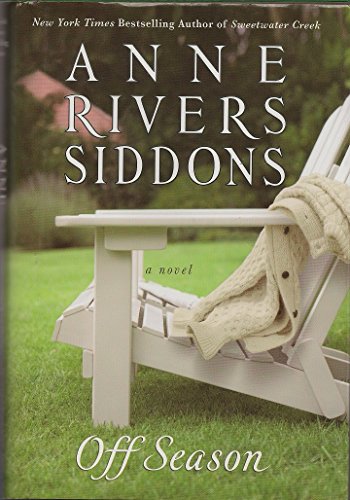
Acclaimed novelist Anne Rivers Siddons's new novel is a stunning tale of love and loss.
For as long as she can remember, they were Cam and Lilly--happily married, totally in love with each other, parents of a beautiful family, and partners in life. Then, after decades of marriage, it ended as every great love story does...in loss. After Cam's death, Lilly takes a lone road trip to her and Cam's favorite spot on the remote coast of Maine, the place where they fell in love over and over again, where their ghosts still dance. There, she looks hard to her past--to a first love that ended in tragedy; to falling in love with Cam; to a marriage filled with exuberance, sheer life, and safety-- to try to figure out her future.
It is a journey begun with tender memories and culminating in a revelation that will make Lilly re-evaluate everything she thought was true about her husband and her marriage.
Die Inhaltsangabe kann sich auf eine andere Ausgabe dieses Titels beziehen.
Über die Autorin bzw. den Autor
OFF SEASON is Anne Rivers Siddons's 17th novel. Her previous bestselling novels include Sweetwater Creek, Islands, Nora Nora, Low Country, Up Island, Fault Lines, Downtown, Hill Towns, Colony, Outer Banks, King's Oak, Peachtree Road, Homeplace, Fox's Earth, The House Next Door, and Heartbreak Hotel. She is also the author of a work of nonfiction, John Chancellor Makes Me Cry. She and her husband, Heyward, split their time between their home in Charleston, SC and Brooklin, ME.
Auszug. © Genehmigter Nachdruck. Alle Rechte vorbehalten.
Off Season
By Anne Rivers SiddonsGrand Central Publishing
Copyright © 2008 Anne Rivers SiddonsAll right reserved.
ISBN: 978-0-446-52787-3
Chapter One
There were seven of us at Edgewater that summer, if you count my brother Jeebs. None of us did, really. Jeebs was thirteen and gone into another orbit of his own; he entered ours only when he had nothing else to do, and then grudgingly.That left Harriet Randall, aged eleven; Ben and Carolyn Forrest, who were twins, aged ten; Cecie Wentworth, aged eleven; Peter Cornish, aged twelve; and Joby Gardiner, eleven. And of course, me. Elizabeth Allen Constable but called, by my own creed, Lilly and nothing else. I was eleven that summer of 1962 and stonily determined not to be confused with my mother, who was Elizabeth, too.
My mother: Elizabeth Potter Constable; painter, activist (in her own words), great beauty. She was sporadic and only adequate at the first two, but at the third she was spectacularly successful. Turned heads followed Liz Constable wherever she went.
It was the apogee of the frenzied Jackie Kennedy mythology, and even up here in this rural saltmeadow world almost untouched by fashion for a century, women wore their hair in carefully tousled bouffants and put on crisp white sleeveless blouses and Bermuda shorts to go to the post office or general store (which were one and the same). The yacht club cocktail-and-chowder suppers looked like a Norman Rockwell magazine cover of an idyllic girls' camp. Into the middle of all the matched Lilly Pulitzer wrap skirts and T-shirts, the huge sunglasses pushed casually above foreheads to form chic headbands, my mother would drift barefoot like an idle racing sloop, her hair in its uncombed little Greek-boy tousle of curls, her white pants smeared with paint, the striped French matelot T-shirt she had affected since a trip to Cannes when she was sixteen daubed with it. There would not be a vestige of makeup on her pure medieval features, only a flush of sunburn on her high cheekbones and a slick of Chap Stick on her full, tender mouth-a Piero della Francesca mouth, according to Brooks Burns, two cottages down, who was a classical scholar and eighty years old, and had been in love with my mother, according to my father, since she came here as a bride.
"Eyes like summer rain on the ocean," he would say. "Eyes like clear pond ice."
"Eyes like a frozen February crust over Eggemoggin Reach," I might have added, "especially when those black brows come together over them."
But I doubted that anyone but my father and Jeebs and I had seen that. My mother's brows were two silky black slashes set straight over her eyes, which were clear, light-spilling gray and fringed with black lashes. With her sun-streaked copper curls they were striking; you expected slender sienna arches. I had those brows, I was often told, and the gray eyes, too, but even to me they often looked stormy and sulky instead of mythic. I had seen my mother, in her studio just before she came out to join us for an evening, slick her eyebrows with some sort of cream, and lightly redden her cheeks, and finger-tousle her hair before the old seashell mirror that hung beside the studio door. Once or twice I saw her daub a sunset smear on her cheek or forehead, or stain her shirt lightly with it. The result was a careless beauty seemingly preoccupied with things more important than her looks. It served her well.
I spied on my mother shamelessly during the summer. I'm still not quite sure why. I think I was looking for revelations, epiphanies, a map for knowing where the real woman and mother lay. It seemed that if I found it, I would have the map for myself, could chart a course by it. But I never did, and after that summer I did not spy on her again. Instead, I set about trying to become the direct antithesis of the woman in her mirror. It got me in endless trouble with her, though not so much with my father.
"Let her be," he would tell her from the rocking chair on the porch that was his regular summertime emplacement. "You wouldn't want a perfect little copy of you, would you? I would think one is enough."
"She could do worse," I heard my mother say once, tightly, in the days when I still eavesdropped. "Not much," I thought my father murmured from the rocker, but I was never sure of that.
And yet she was not all artifice. All the children from the cottages around us flocked to ours as naturally as thirsty birds to a birdbath. All the cottages down on this particular cove were members of the Middle Harbor Yacht Club, in the old Retreat Colony up the road, and had full privilege to join the brown, scabby-kneed colony children on the dock and in the tenders and small Beetle Cats in the harbor, or playing Ping-Pong in the raffish old clubhouse, or camping out on the islands in the bay across the harbor. And sometimes we did, but summer friendships are cemented early and tightly, and we came to be regarded as privileged outlanders, "too good for us," hanging around only with each other at Liz Constable's cottage. My mother really loved children, or, perhaps, I thought that summer, the children of others, and never seemed annoyed or bored with our endless and obscure yelping games, or the little flotilla of kayaks and Shellback dinghies that were tied up all summer beside my family's old Friendship sloop at the end of our dock. We were the only cottage in our settlement that had a deepwater dock. All the others kept their boats at the yacht club.
Mother vanished for long periods during the day, into her studio or at the desk in her bedroom, writing letters or phoning on behalf of her causes. They were good New England liberal causes, my father often said: birth-control information for young girls, Martin Luther King, Jr., and his incendiary young civil rights battle, meals for the infirm and disenfranchised of Hancock County, cleaning up the effluent-fouled streams and bays nearby.
I know she was serious about these causes. I had seen her in tears over some social injustice or other featured on the flickery old black-and-white television in the cottage living room. And I know that there were people in the colony, women mainly, who found her indiscreet and vaguely threatening and her causes as unseemly in our little nineteenth-century fiefdom as a fart at the Chowder Race. I know too that she honestly did not care a finger flick what people thought of her activism or her painting. But she did care, secretly and profoundly, about maintaining her role as a careless natural beauty, a warm, funny woman far above artifice and agendas. I could never fathom the why of that as a child; complexity is largely beyond children.
But I still can't today.
At noon Clara Anderson, who "did" for us mornings and who was the third generation of her family to do so for mine, would make a tray of bologna and cheese sandwiches and lemonade and put it on the big side screened porch, and we would rush in and wolf them down and be off again in a chattering swarm, out to the water or to the badminton and croquet courts my grandfather had carved out of the woods behind the cottage.
The other cottage mothers in our cove knew where to call if they had need of their children. So far as I knew, none of them ever worried that their offspring might be a bother to my mother, or that they might be in any way unsafe. Of course it was Clara who had the day-to-day burden of us, but she too liked children and had three of her own, and in our defense we had not yet absorbed any of the early-blooming horrors creeping into the cities then:...
„Über diesen Titel“ kann sich auf eine andere Ausgabe dieses Titels beziehen.
Suchergebnisse für Off Season

Beispielbild für diese ISBN
Off Season
Verlag:
Grand Central Publishing, 2008
ISBN 10: 0446527874
ISBN 13: 9780446527873
Gebraucht
Hardcover
Anbieter: World of Books (was SecondSale), Montgomery, IL, USA
Verkäuferbewertung 5 von 5 Sternen

Zustand: Acceptable. Item in acceptable condition! Textbooks may not include supplemental items i.e. CDs, access codes etc. Bestandsnummer des Verkäufers 00088461549
Gebraucht kaufen
EUR 3,78
Versand gratis
Versand innerhalb von USA
Versand innerhalb von USA
Anzahl: 3 verfügbar
Beispielbild für diese ISBN
Off Season
Verlag:
Grand Central Publishing, 2008
ISBN 10: 0446527874
ISBN 13: 9780446527873
Gebraucht
Hardcover
Anbieter: World of Books (was SecondSale), Montgomery, IL, USA
Verkäuferbewertung 5 von 5 Sternen
Zustand: Good. Item in good condition. Textbooks may not include supplemental items i.e. CDs, access codes etc. Bestandsnummer des Verkäufers 00082811183
Gebraucht kaufen
EUR 3,78
Versand gratis
Versand innerhalb von USA
Versand innerhalb von USA
Anzahl: Mehr als 20 verfügbar
Beispielbild für diese ISBN
Off Season
Verlag:
Grand Central Publishing, 2008
ISBN 10: 0446527874
ISBN 13: 9780446527873
Gebraucht
Hardcover
Anbieter: Your Online Bookstore, Houston, TX, USA
Verkäuferbewertung 5 von 5 Sternen
Hardcover. Zustand: Good. Bestandsnummer des Verkäufers 0446527874-3-21466962
Gebraucht kaufen
EUR 3,79
Versand gratis
Versand innerhalb von USA
Versand innerhalb von USA
Anzahl: 1 verfügbar
Beispielbild für diese ISBN
Off Season
Verlag:
Grand Central Publishing, 2008
ISBN 10: 0446527874
ISBN 13: 9780446527873
Gebraucht
Hardcover
Anbieter: Orion Tech, Kingwood, TX, USA
Verkäuferbewertung 5 von 5 Sternen
Hardcover. Zustand: Good. Bestandsnummer des Verkäufers 0446527874-3-18009493
Gebraucht kaufen
EUR 3,79
Versand gratis
Versand innerhalb von USA
Versand innerhalb von USA
Anzahl: 1 verfügbar
Beispielbild für diese ISBN
Off Season
Verlag:
Grand Central Publishing, 2008
ISBN 10: 0446527874
ISBN 13: 9780446527873
Gebraucht
Hardcover
Anbieter: Gulf Coast Books, Cypress, TX, USA
Verkäuferbewertung 5 von 5 Sternen
Hardcover. Zustand: Fair. Bestandsnummer des Verkäufers 0446527874-4-26022648
Gebraucht kaufen
EUR 3,79
Versand gratis
Versand innerhalb von USA
Versand innerhalb von USA
Anzahl: 1 verfügbar
Foto des Verkäufers
Off Season
Verlag:
Grand Central Publishing, 2008
ISBN 10: 0446527874
ISBN 13: 9780446527873
Gebraucht
Hardcover
Anbieter: 3Brothers Bookstore, Egg harbor township, NJ, USA
Verkäuferbewertung 5 von 5 Sternen
Zustand: very_good. Cover may have light wear, pages in very good condition and binding is sturdy; may have other light shelf wear or creases. May have notes or highlighting. Bestandsnummer des Verkäufers EVV.0446527874.VG
Gebraucht kaufen
EUR 3,86
Versand gratis
Versand innerhalb von USA
Versand innerhalb von USA
Anzahl: 2 verfügbar
Foto des Verkäufers
Off Season
Verlag:
Grand Central Publishing, 2008
ISBN 10: 0446527874
ISBN 13: 9780446527873
Gebraucht
Hardcover
Anbieter: Used Book Company, Egg Harbor Township, NJ, USA
Verkäuferbewertung 5 von 5 Sternen
Zustand: Good. Shows moderate signs of wear and previous use. Can include notes/highlighting. A portion of your purchase benefits nonprofits! - Note: Edition & format may differ from what is shown in stock photo & item details. May not include supplementary material (toys, access code, dvds, etc). Bestandsnummer des Verkäufers 584ZSU00111V_ns
Gebraucht kaufen
EUR 3,94
Versand gratis
Versand innerhalb von USA
Versand innerhalb von USA
Anzahl: 1 verfügbar
Foto des Verkäufers
Off Season
Verlag:
Grand Central Publishing, 2008
ISBN 10: 0446527874
ISBN 13: 9780446527873
Gebraucht
Hardcover
Anbieter: 3Brothers Bookstore, Egg harbor township, NJ, USA
Verkäuferbewertung 5 von 5 Sternen
Zustand: like_new. Book is in like new condition with only potential shelf wear. No marking or highlighting. Bestandsnummer des Verkäufers EVV.0446527874.LN
Gebraucht kaufen
EUR 4,30
Versand gratis
Versand innerhalb von USA
Versand innerhalb von USA
Anzahl: 1 verfügbar
Foto des Verkäufers
Off Season
Verlag:
Grand Central Publishing, 2008
ISBN 10: 0446527874
ISBN 13: 9780446527873
Gebraucht
Hardcover
Anbieter: Greenworld Books, Arlington, TX, USA
Verkäuferbewertung 5 von 5 Sternen
Zustand: very_good. Fast Free Shipping â" Very Good condition book with a firm cover and clean pages. Shows normal use and some light wear or limited notes markings. A solid, nice copy to enjoy. Bestandsnummer des Verkäufers GWV.0446527874.VG
Gebraucht kaufen
EUR 4,63
Versand gratis
Versand innerhalb von USA
Versand innerhalb von USA
Anzahl: 1 verfügbar
Foto des Verkäufers
Off Season
Verlag:
Grand Central Publishing, 2008
ISBN 10: 0446527874
ISBN 13: 9780446527873
Gebraucht
Hardcover
Anbieter: ZBK Books, Carlstadt, NJ, USA
Verkäuferbewertung 5 von 5 Sternen
Zustand: very_good. Fast & Free Shipping â" Very Good condition book with a firm cover and clean pages. Shows normal use and some light wear or limited notes markings. A solid, nice copy to enjoy. Bestandsnummer des Verkäufers ZWV.0446527874.VG
Gebraucht kaufen
EUR 4,63
Versand gratis
Versand innerhalb von USA
Versand innerhalb von USA
Anzahl: 1 verfügbar