
Verwandte Artikel zu Death of a Travelling Man (A Hamish Macbeth Mystery,...
Death of a Travelling Man (A Hamish Macbeth Mystery, 9) - Softcover
Buch 9 von 37: Hamish Macbeth Mysteries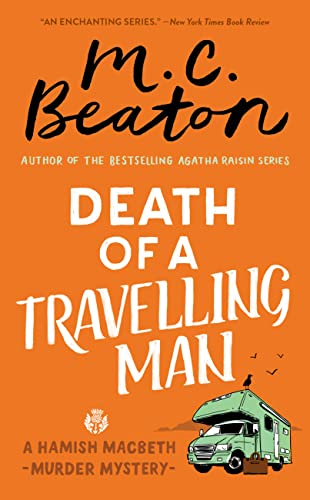
Inhaltsangabe
In this cozy mystery from an internationally bestselling author, Scotland's most quick-witted but unambitious policeman must solve the murder of an irritating newcomer.
Lochdubh constable Hamish Macbeth's life is going to pot. He has—horrors!—been promoted, his new boss is a dunce, and a self-proclaimed traveler named Sean and his girlfriend have parked their rusty eyesore of a van in the middle of the village. Hamish smells trouble, and he's right as usual.
The doctor's drugs go missing. Money vanishes. Neighbors suddenly become unneighborly. The tension only explodes after the itinerant Sean is found brutally beaten to death. Suspicion quickly falls on his girlfriend, but with nobody willing to talk, the canny Hamish faces the tough task of worming the facts out of the villagers.
As he uncovers a bizarre story around the murdered traveler, Macbeth knows he must find the truth soon, before the killer gets away for good.
Die Inhaltsangabe kann sich auf eine andere Ausgabe dieses Titels beziehen.
Über die Autorin bzw. den Autor
M. C. Beaton has won international acclaim for her New York Times bestselling Hamish Macbeth mysteries. The BBC has aired 24 episodes based on the series. Beaton is also the author of the bestselling Agatha Raisin series, which will air as an eight-episode dramatic series on Sky1, starring Ashley Jensen. She lives in the Cotswolds with her husband. For more information, you can visit MCBeaton.com.
Auszug. © Genehmigter Nachdruck. Alle Rechte vorbehalten.
Death of a Travelling Man
By M. C. BeatonGrand Central Publishing
Copyright © 2013 M. C. Beaton
All rights reserved.
ISBN: 978-0-446-57351-1All rights reserved.
CHAPTER 1
From his brimstone bed, at break of day,
A-walking the Devil is gone,
To look at his little snug farm of the World,
And see how his stock went on.
—Robert Southey
Police Sergeant Hamish Macbeth was never to forget that fine spring day.
It was the day the devil came to Lochdubh.
Hamish was strolling along the waterfront of the tiny Highland village, glad tobe free for a brief spell from the bloodhound efficiency of his sidekick, P.C.Willie Lamont. Although his promotion to sergeant had meant more pay, it hadalso meant that this eager beaver of a policeman had been thrust upon him,interfering with Hamish's easygoing life and home. Willie was also a cleanlinessfanatic and Hamish was tired of living with the all-pervading smell ofdisinfectant.
The day was fine and warm, unusual for March in the Highlands. Snow glittered onthe twin peaks of the mountains which soared above the village, and the sea lochlay calm and placid in the morning sun. Peat smoke rose from cottage chimneys,seagulls swooped and dived.
And then Hamish saw it, parked in front of what was once the Lochdubh Hotel,still up for sale. It was a battered old bus which had been converted into atravelling home. At one time in its career the bus had been painted psychedeliccolours but even these had faded into pastel streaks overlaid with brown trailsof rust.
Hamish went up to it and knocked at the door. The door jerked open. A tall mansmiled down at Hamish. He was incredibly handsome. Jet black hair grew to awidow's peak on his forehead. His eyes were green, grass-green without a fleckof brown in them. His face and arms were tanned golden-brown. He was wearing ablue-and-white-checked shirt and blue jeans moulded to long muscular legs.
"You are not allowed to park here," said Hamish, wondering why he should takesuch an instant and violent dislike to this handsome man.
"I am a traveller," the man said in a cultivated English voice. "My name is SeanGourlay."
Hamish's face hardened. Sean would have been called a hippie not so long ago anda beatnik a long time before that. Now he belonged to that unlovable crowd whoeuphemistically referred to themselves as travellers, the itinerant race whodescended on places like Stonehenge complete with battered unlicensed vehicles,dirt, drugs and dogs. To some charitable souls who had never had their sheepripped apart by dogs or their land turned into a sewer, the travellers carriedwith them an aura of romance, like the gypsies they pretended to be. Living onthe dole, they travelled aimlessly from place to place. The reason these nomadiclayabouts claimed to be "travellers" or sometimes "new travellers" was that theydemanded the privileges and camping rights given to gypsies, privileges oftendating back centuries. Hamish was tolerant of gypsies and knew them all. He hadno time for these so-called travellers.
"You are not a gypsy," said Hamish, "and therefore have no rights. This isprivate property."
A girl squeezed in beside Sean at the doorway. She had straggly sun-bleachedhair, a small dirty face, and a thin, flat-chested body. "Get lost, pig,"she said, in the guttural accents of Glasgow.
Hamish ignored her. He addressed himself to Sean. "I can direct you to a placeup on the moors where you can camp."
Sean gave him a blinding smile. "But I like this village," he said.
"And so do I," retorted Hamish, "which is why I am ordering you to move on.Let's see your driving license."
A stream of four-letter words erupted from the girl. Sean dug into the backpocket of his jeans and produced a clean new driving license, issued only a fewmonths ago. The girl had now jumped down from the bus. She was very small instature. She leaped up and down in front of Hamish, cursing and yelling. "Pig"was the politest epithet. There was a peculiar, almost sinister magnetism aboutSean. He paid no attention to the girl whatsoever and Hamish found himself doingthe same. He examined Sean's insurance and the road-tax disc on the bus. Bothwere in order.
He handed back the papers and said firmly, "Now, get moving."
Sean grinned. "Certainly, officer."
The girl told Hamish to perform an impossible anatomical act on himself and thensuddenly bolted back into the bus, like some small hairy animal darting into itslair.
"Pay no attention to Cheryl," said Sean lazily. "Rather an excitable type."
"Her full name?" snapped Hamish.
"Cheryl Higgins, like the professor."
Hamish waited until Sean had climbed into the driver's seat, until the busclattered off. He stood with his hands on his hips and watched it go. Then heshook his head. He should not have allowed Sean to upset him. If they parked upon the moors, they would not stay long. He knew the travellers preferred to bewith their own kind. It was unusual to find just two of them and one old bus.This fine weather was unusual. Soon there would be the "lambing blizzard," thatlast vicious fall of snow which always arrived in the late spring to plague theshepherds.
His mind turned to the problem of P.C. Willie Lamont. He would not have mindedat all having a helper. All policemen, however crime-free the area they livedin, were landed with a lot of paperwork. Hamish regarded the police station ashis home, his own home, and he wished he could manage to get Willie to livesomewhere else in the village. As he ambled back again in the direction of thepolice station, he saw that his dog, Towser, was once more tied up in thegarden. Poor Towser was always being banished outside these days, thoughtHamish. Willie must be scrubbing the floors ... again. He decided to go up toTommel Castle Hotel where his friend, Priscilla Halburton-Smythe, was working inthe hotel gift shop. Priscilla's father, Colonel Halburton-Smythe, had turnedhis home into a hotel to recoup the vast losses he had made by trusting hismoney to a charlatan. The hotel had prospered, having excellent shooting andfishing and high-enough charges to appeal to the snobbish and the parvenues whothought the colonel's high-handed manner with his guests was a sign of truebreeding, rather than the mixture of arrogance and sheer bloody-mindedness thatit, in truth, was.
As he unhitched Towser and led the dog to the police Land Rover, Hamishreflected sadly that having Willie in the police station was like being marriedto a nag of a wife. Archie Maclean, the fisherman, spent most of his time eitherin the pub or sitting on the harbour wall to get away from his wife's perpetualcleaning.
The new gift shop was a pleasant place, full of the very best of Scottish goods:Edinburgh crystal, Caithness glass, silver jewellery, fine woollens, along witha multitude of cheaper goods for the tourist to take home—shortbread,locally made fudge, guidebooks, postcards, souvenir pens and pencils, andstuffed toys.
Priscilla was wearing her new tourist uniform of frilled white shirt and shorttartan skirt. Hamish wondered what the tourists made of her, this graceful womanwith the smooth blonde hair and the superb figure who looked as if she hadstepped out of the pages of Vogue.
She saw Hamish and smiled. "I've had a coffee machine put in here. You must havegot word of it."
"I am not mooching," said Hamish, who nearly always was. "But I will have thecoffee, nonetheless."
"What brings you here, Sergeant?" asked Priscilla as she poured two mugs ofcoffee. She never tired of calling him Sergeant these days, he reflected. Heknew she took his...
„Über diesen Titel“ kann sich auf eine andere Ausgabe dieses Titels beziehen.
Ihre gesetzlichen Garantierechte: Alle Verbraucher:innen in der EU profitieren von mindestens 2 Jahren gesetzlichem Garantieschutz für alle in der EU verkauften Konsumgüter. Mehr erfahren
Suchergebnisse für Death of a Travelling Man (A Hamish Macbeth Mystery,...

Foto des Verkäufers
Death of a Travelling Man (A Hamish Macbeth Mystery, 9)
Verlag:
Grand Central Publishing, 2013
ISBN 10: 0446573515
ISBN 13: 9780446573511
Gebraucht
Softcover
Anbieter: Zoom Books East, Glendale Heights, IL, USA
Verkäuferbewertung 5 von 5 Sternen

Zustand: good. Book is in good condition and may include underlining highlighting and minimal wear. The book can also include "From the library of" labels. May not contain miscellaneous items toys, dvds, etc. . We offer 100% money back guarantee and 24 7 customer service. Bestandsnummer des Verkäufers ZEV.0446573515.G
Gebraucht kaufen
EUR 4,15
Versand gratis
Versand innerhalb von USA
Versand innerhalb von USA
Anzahl: 1 verfügbar
Foto des Verkäufers
Death of a Travelling Man (A Hamish Macbeth Mystery, 9)
Verlag:
Grand Central Publishing, 2013
ISBN 10: 0446573515
ISBN 13: 9780446573511
Gebraucht
Softcover
Anbieter: Zoom Books Company, Lynden, WA, USA
Verkäuferbewertung 5 von 5 Sternen
Zustand: very_good. Book is in very good condition and may include minimal underlining highlighting. The book can also include "From the library of" labels. May not contain miscellaneous items toys, dvds, etc. . We offer 100% money back guarantee and 24 7 customer service. Bestandsnummer des Verkäufers ZBV.0446573515.VG
Gebraucht kaufen
EUR 4,16
Versand gratis
Versand innerhalb von USA
Versand innerhalb von USA
Anzahl: 1 verfügbar
Foto des Verkäufers
Death of a Travelling Man (A Hamish Macbeth Mystery, 9)
Verlag:
Grand Central Publishing, 2013
ISBN 10: 0446573515
ISBN 13: 9780446573511
Gebraucht
Softcover
Anbieter: Zoom Books East, Glendale Heights, IL, USA
Verkäuferbewertung 5 von 5 Sternen
Zustand: acceptable. Book is in acceptable condition and shows signs of wear. Book may also include underlining highlighting. The book can also include "From the library of" labels. May not contain miscellaneous items toys, dvds, etc. . We offer 100% money back guarantee and 24 7 customer service. Bestandsnummer des Verkäufers ZEV.0446573515.A
Gebraucht kaufen
EUR 4,29
Versand gratis
Versand innerhalb von USA
Versand innerhalb von USA
Anzahl: 2 verfügbar
Foto des Verkäufers
Death of a Travelling Man (A Hamish Macbeth Mystery, 9)
Verlag:
Grand Central Publishing, 2013
ISBN 10: 0446573515
ISBN 13: 9780446573511
Gebraucht
Softcover
Anbieter: Goodwill, Brooklyn Park, MN, USA
Verkäuferbewertung 4 von 5 Sternen

Zustand: good. Cover does not match photos; some content may vary from version shown. Book markings. Bent corners. Bestandsnummer des Verkäufers MINV.0446573515.G
Gebraucht kaufen
EUR 2,45
EUR 3,64 Versand
Versand innerhalb von USA
Versand innerhalb von USA
Anzahl: 1 verfügbar
Foto des Verkäufers
Death of a Travelling Man (A Hamish Macbeth Mystery, 9)
Verlag:
Grand Central Publishing, 2013
ISBN 10: 0446573515
ISBN 13: 9780446573511
Gebraucht
Softcover
Anbieter: Blue Vase Books, Interlochen, MI, USA
Verkäuferbewertung 5 von 5 Sternen
Zustand: acceptable. Mass market paperback in ACCEPTABLE condition. Book is perfectly usable, but has heavy wear or cosmetic issues which may include a cocked spine, creased spine, heavy wear, yellowed pages, price stickers, etc. Cover art may be different from that shown in photo. Bestandsnummer des Verkäufers BVV.0446573515.A
Gebraucht kaufen
EUR 6,15
Versand gratis
Versand innerhalb von USA
Versand innerhalb von USA
Anzahl: 1 verfügbar
Beispielbild für diese ISBN
Death of a Travelling Man
Verlag:
Grand Central Publishing, 2013
ISBN 10: 0446573515
ISBN 13: 9780446573511
Gebraucht
Mass Market Paperback
Anbieter: ThriftBooks-Atlanta, AUSTELL, GA, USA
Verkäuferbewertung 5 von 5 Sternen
Mass Market Paperback. Zustand: Good. No Jacket. Pages can have notes/highlighting. Spine may show signs of wear. ~ ThriftBooks: Read More, Spend Less. Bestandsnummer des Verkäufers G0446573515I3N00
Gebraucht kaufen
EUR 6,15
Versand gratis
Versand innerhalb von USA
Versand innerhalb von USA
Anzahl: 1 verfügbar
Beispielbild für diese ISBN
Death of a Travelling Man
Verlag:
Grand Central Publishing, 2013
ISBN 10: 0446573515
ISBN 13: 9780446573511
Gebraucht
Mass Market Paperback
Anbieter: ThriftBooks-Dallas, Dallas, TX, USA
Verkäuferbewertung 5 von 5 Sternen
Mass Market Paperback. Zustand: Fair. No Jacket. Readable copy. Pages may have considerable notes/highlighting. ~ ThriftBooks: Read More, Spend Less. Bestandsnummer des Verkäufers G0446573515I5N00
Gebraucht kaufen
EUR 6,19
Versand gratis
Versand innerhalb von USA
Versand innerhalb von USA
Anzahl: 1 verfügbar
Beispielbild für diese ISBN
Death of a Travelling Man
Verlag:
Grand Central Publishing, 2013
ISBN 10: 0446573515
ISBN 13: 9780446573511
Gebraucht
Mass Market Paperback
Anbieter: ThriftBooks-Dallas, Dallas, TX, USA
Verkäuferbewertung 5 von 5 Sternen
Mass Market Paperback. Zustand: Very Good. No Jacket. May have limited writing in cover pages. Pages are unmarked. ~ ThriftBooks: Read More, Spend Less. Bestandsnummer des Verkäufers G0446573515I4N00
Gebraucht kaufen
EUR 6,19
Versand gratis
Versand innerhalb von USA
Versand innerhalb von USA
Anzahl: 1 verfügbar
Beispielbild für diese ISBN
Death of a Travelling Man
Verlag:
Grand Central Publishing, 2013
ISBN 10: 0446573515
ISBN 13: 9780446573511
Gebraucht
Mass Market Paperback
Anbieter: ThriftBooks-Atlanta, AUSTELL, GA, USA
Verkäuferbewertung 5 von 5 Sternen
Mass Market Paperback. Zustand: Fair. No Jacket. Readable copy. Pages may have considerable notes/highlighting. ~ ThriftBooks: Read More, Spend Less. Bestandsnummer des Verkäufers G0446573515I5N00
Gebraucht kaufen
EUR 6,19
Versand gratis
Versand innerhalb von USA
Versand innerhalb von USA
Anzahl: 1 verfügbar
Beispielbild für diese ISBN
Death of a Travelling Man
Verlag:
Grand Central Publishing, 2013
ISBN 10: 0446573515
ISBN 13: 9780446573511
Gebraucht
Mass Market Paperback
Anbieter: ThriftBooks-Dallas, Dallas, TX, USA
Verkäuferbewertung 5 von 5 Sternen
Mass Market Paperback. Zustand: Good. No Jacket. Pages can have notes/highlighting. Spine may show signs of wear. ~ ThriftBooks: Read More, Spend Less. Bestandsnummer des Verkäufers G0446573515I3N00
Gebraucht kaufen
EUR 6,19
Versand gratis
Versand innerhalb von USA
Versand innerhalb von USA
Anzahl: 1 verfügbar