
Verwandte Artikel zu Happiness Is a Choice
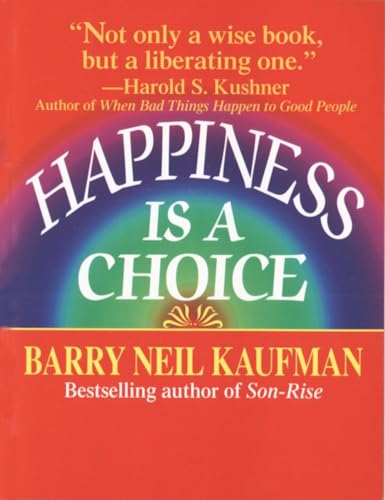
Inhaltsangabe
"Barry very explicity reveals the options and choices we can all make to find the road to happiness."
BERNIE SIEGEL, M.D.
Author of LOVE, MEDICINE AND MIRACLES
Barry Neil Kaufman, therapist, author, motivational speaker, and founder of the Option Institute shows you how you can use the traits of happy people to change your life quickly, and easily. His shortcuts to happiness include: making happiness the priority; accepting your personal authenticity, the freedom to be yourself; learning to discard regrets about the past and worries about the future, and so much more.
Die Inhaltsangabe kann sich auf eine andere Ausgabe dieses Titels beziehen.
Über die Autorin bzw. den Autor
Barry Neil Kaufman teaches a uniquely self-accepting and empowering process (The Option Process®), which has both educational and therapeutic applications. He and his wife, Samahria, are co-founders and co-directors of The Option Institute and Fellowship, which offers programs for people either challenged by adversity or trying to improve the quality of their lives. The Kaufmans, with their staff, also counsel individuals, couples, and families. Additionally, Mr. Kaufman lectures at universities, presents motivational talks, guides workshops and seminars, and has appeared in mass media throughout the country.
Von der hinteren Coverseite
"Barry very explicity reveals the options and choices we can all make to find the road to happiness."
BERNIE SIEGEL, M.D.
Author of LOVE, MEDICINE AND MIRACLES
Barry Neil Kaufman, therapist, author, motivational speaker, and founder of the Option Institute shows you how you can use the traits of happy people to change your life quickly, and easily. His shortcuts to happiness include: making happiness the priority; accepting your personal authenticity, the freedom to be yourself; learning to discard regrets about the past and worries about the future, and so much more.
Aus dem Klappentext
very explicity reveals the options and choices we can all make to find the road to happiness."
BERNIE SIEGEL, M.D.
Author of LOVE, MEDICINE AND MIRACLES
Barry Neil Kaufman, therapist, author, motivational speaker, and founder of the Option Institute shows you how you can use the traits of happy people to change your life quickly, and easily. His shortcuts to happiness include: making happiness the priority; accepting your personal authenticity, the freedom to be yourself; learning to discard regrets about the past and worries about the future, and so much more.
Auszug. © Genehmigter Nachdruck. Alle Rechte vorbehalten.
Years ago, following the publication of my first book about the uplifting journey my family took to heal our special child (once neurologically impaired and dysfunctioning), I spoke with a man who had written quite a different saga. He documented what he experienced as the difficult and damning reality of parenting a “less-than-perfect” youngster. He declared without apology that he hated people like me.
“You take something that’s terrible,” he said flatly, “and make believe it’s beautiful.”
I considered his point of view for a moment. “Did you ever consider,” I asked softly, “that you might be taking something that’s beautiful and making believe it’s terrible?”
At that moment, I realized that neither one of us held the truth, only a vision we had each created and then used to embrace our situation. I had decided to see my son and his difficulties as an opportunity to grow, learn and love. He regarded his situation as a curse. Our different experiences had followed from those distinctly different visions.
Wanting to reach out to him, I told him that I, too, would have once been overwhelmed and devastated by such an event. I remember, in grade school, watching a group of mentally retarded students trying to master the simplest aspects of a baseball game without success. I turned away, confused and uncomfortable about what I had witnessed. In high school, a boy in one of my classes walked with a limp, his left hand and arm contorted awkwardly. When he tried to speak, he had tremendous difficulty forming words and drooled uncontrollably each time he labored to verbalize even the shortest sentence. The teacher told us that Douglas had been born that way. Sometimes, other students mimicked his movements and laughed at their pantomimes. For one semester I tried to help him by carrying his bookbag, though I felt somewhat awkward, embarrassed and scared each time. I never knew what to say to him, so we walked together from the bus to the school building in silence.
Before the arrival of our first child, I thought about Douglas and how his life seemed like torture to me. I remember lying in bed one night, staring at the huge abdomen of my pregnant wife and thinking, “Oh God, what if … just what if what happened to Douglas happened to us and our child?” I remember praying for a healthy baby. Indeed, our first two children, both daughters, arrived as healthy and energetic little people. Our third child was very different. However, by the time of his arrival, my wife and I both had changed dramatically from the frightened and uncomfortable people who had greeted those first years of marriage and child rearing.
I tried to explain how the world had changed for me, in significant and irrevocable ways, once I had changed my own vision of life and had begun to make happiness and love priorities. As a result, my wife and I could greet our special child as a wonderful opportunity. The man with the different point of view listened to my sharing without comment. Finally, he laughed at my unending enthusiasm. He decided I had been well-intentioned but, nonetheless, naive and unrealistic in my hopefulness and happiness. He questioned the validity of my attitude. Ultimately, he preferred what he called his sanity.
The way we choose to see the world creates the world we see.
During a question-and-answer segment immediately following a class I had conducted on developing attitudes of self-trust, a participant raised his hand tentatively. When I nodded at him, he withdrew at first, then leaned forward cautiously.
“My question is, um, somewhat related to what we’ve discussed, but in a bit of a different direction, and, er, more personal. I am having so much trouble with my asthma. I’ve gone from doctor to doctor. I take all the medication they’ve prescribed, but nothing really helps. I just can’t stand it. I wonder if you could say something, well, anything, that might be useful.”
I hesitated for a moment and considered sharing with him several scientific studies that would lay a foundation for what I knew would be my answer. However, the class had only minutes left. Finally, I smiled broadly and said, “This may sound silly or crazy or both, but I’ll do my best to give you a useful response. Be happy with your asthma! Instead of treating it like an enemy, embrace it like a friend. If you change your attitude about your condition you’ll change the chemistry in your body. Every thought we have is a physical event. Neurotransmitters and neuropeptides pop into existence throughout the body each time we activate a belief. Change the belief (the thought, the perspective, the judgment) and we change or, at the very least, influence the physical event we call our ‘bodymind.’ Your attitude and intelligence exist everywhere in the 50 trillion cells of your body. This is a marvelous and concrete opportunity for you, not just a pie-in-the-sky game. Give yourself and your asthma a different message and see what happens. So, when you have the tightness in your chest, the shortness of breath, the wheezing or coughing, you could first welcome it, talk to it, even play with it. Then open yourself, ultimately, to loving it … really loving it!”
He seemed amused, intrigued and skeptical. “I thought you’d say something like that,” he replied, chuckling. “Well, what do I have to lose? Okay, I’ll try it.”
The very next day, he came to the morning session of the program visibly rested and alert. “I had a special experience last night,” he told the group. “I greeted my nightly wheezing with a smile instead of my usual annoyance or depression. I actually did say hello out loud and laughed. I talked to my asthma like a friend. Wow! I told my asthma, we sure have a lot of history together.” He smiled shyly, then continued, “I even thanked my bronchial tubes each time I coughed. At first, I felt … well, absolutely ridiculous, but soon something magically freed up inside and I really felt loving and loved.” His eyes filled with tears. “You know, in no time at all, I fell asleep. Right now, I feel more comfortable and peaceful in my body than I have in months.”
This man had eased himself into being happy and loving toward a condition he had previously viewed as intolerable. He had created a powerful attitudinal advantage for himself. His play, his talk and his laughter helped him to change his vision of asthma from enemy to friend, and his new vision in turn changed his experience.
Each of us can, in a simple and easy way, access an amazing attitudinal advantage within ourselves once we come to know that happiness (and love) is a choice and misery is optional (not inevitable).
I never knew I could just claim happiness, at any time, as my birthright and not be limited by the condemning evidence of my own personal history and the past. That awareness, which I previously resisted as preposterous, has been a blessing and changed my life profoundly, allowing me in my own imperfect way to be so much more loving, peaceful and useful to myself and all those I touch.
During this past summer (as in many previous summers), my teaching staff and I lived and worked for two full months with a group of forty-two adults who had come together as strangers for eight weeks to form what became an instant family. This diverse group included a physician, a farmer, a lawyer, a social worker, homemakers, an engineer, a psychotherapist, a nurse, an artist, a carpenter, an actress, a computer...
„Über diesen Titel“ kann sich auf eine andere Ausgabe dieses Titels beziehen.
Suchergebnisse für Happiness Is a Choice

Beispielbild für diese ISBN
Happiness Is a Choice
Anbieter: World of Books (was SecondSale), Montgomery, IL, USA
Verkäuferbewertung 5 von 5 Sternen

Zustand: Very Good. Item in very good condition! Textbooks may not include supplemental items i.e. CDs, access codes etc. Bestandsnummer des Verkäufers 00104760104
Gebraucht kaufen
EUR 3,72
Versand gratis
Versand innerhalb von USA
Versand innerhalb von USA
Anzahl: 2 verfügbar
Beispielbild für diese ISBN
Happiness Is a Choice
Anbieter: World of Books (was SecondSale), Montgomery, IL, USA
Verkäuferbewertung 5 von 5 Sternen
Zustand: Good. Item in good condition. Textbooks may not include supplemental items i.e. CDs, access codes etc. Bestandsnummer des Verkäufers 00092167329
Gebraucht kaufen
EUR 3,72
Versand gratis
Versand innerhalb von USA
Versand innerhalb von USA
Anzahl: 20 verfügbar
Beispielbild für diese ISBN
Happiness Is a Choice
Anbieter: Gulf Coast Books, Cypress, TX, USA
Verkäuferbewertung 5 von 5 Sternen
Paperback. Zustand: Fair. Bestandsnummer des Verkäufers 0449907996-4-20584256
Gebraucht kaufen
EUR 3,73
Versand gratis
Versand innerhalb von USA
Versand innerhalb von USA
Anzahl: 1 verfügbar
Beispielbild für diese ISBN
Happiness Is a Choice
Anbieter: World of Books (was SecondSale), Montgomery, IL, USA
Verkäuferbewertung 5 von 5 Sternen
Zustand: Acceptable. Item in good condition. Textbooks may not include supplemental items i.e. CDs, access codes etc. Bestandsnummer des Verkäufers 00069863519
Gebraucht kaufen
EUR 3,75
Versand gratis
Versand innerhalb von USA
Versand innerhalb von USA
Anzahl: 1 verfügbar
Foto des Verkäufers
Happiness Is a Choice
Anbieter: 3Brothers Bookstore, Egg harbor township, NJ, USA
Verkäuferbewertung 5 von 5 Sternen
Zustand: very_good. Cover may have light wear, pages in very good condition and binding is sturdy; may have other light shelf wear or creases. May have notes or highlighting. Bestandsnummer des Verkäufers EVV.0449907996.VG
Gebraucht kaufen
EUR 3,88
Versand gratis
Versand innerhalb von USA
Versand innerhalb von USA
Anzahl: 1 verfügbar
Foto des Verkäufers
Happiness Is a Choice
Anbieter: Zoom Books East, Glendale Heights, IL, USA
Verkäuferbewertung 5 von 5 Sternen
Zustand: very_good. Book is in very good condition and may include minimal underlining highlighting. The book can also include "From the library of" labels. May not contain miscellaneous items toys, dvds, etc. . We offer 100% money back guarantee and 24 7 customer service. Bestandsnummer des Verkäufers ZEV.0449907996.VG
Gebraucht kaufen
EUR 4,06
Versand gratis
Versand innerhalb von USA
Versand innerhalb von USA
Anzahl: 3 verfügbar
Foto des Verkäufers
Happiness Is a Choice
Anbieter: Zoom Books Company, Lynden, WA, USA
Verkäuferbewertung 5 von 5 Sternen
Zustand: very_good. Book is in very good condition and may include minimal underlining highlighting. The book can also include "From the library of" labels. May not contain miscellaneous items toys, dvds, etc. . We offer 100% money back guarantee and 24 7 customer service. Bestandsnummer des Verkäufers ZBV.0449907996.VG
Gebraucht kaufen
EUR 4,06
Versand gratis
Versand innerhalb von USA
Versand innerhalb von USA
Anzahl: 6 verfügbar
Foto des Verkäufers
Happiness Is a Choice
Anbieter: Zoom Books East, Glendale Heights, IL, USA
Verkäuferbewertung 5 von 5 Sternen
Zustand: good. Book is in good condition and may include underlining highlighting and minimal wear. The book can also include "From the library of" labels. May not contain miscellaneous items toys, dvds, etc. . We offer 100% money back guarantee and 24 7 customer service. Bestandsnummer des Verkäufers ZEV.0449907996.G
Gebraucht kaufen
EUR 4,06
Versand gratis
Versand innerhalb von USA
Versand innerhalb von USA
Anzahl: 4 verfügbar
Foto des Verkäufers
Happiness Is a Choice
Anbieter: 3Brothers Bookstore, Egg harbor township, NJ, USA
Verkäuferbewertung 5 von 5 Sternen
Zustand: good. Books may contain some notes and highlighting. Supplements such as Access Codes, Cd's Dust Jackets, etc. are not guaranteed with used book purchases. Bestandsnummer des Verkäufers EVV.0449907996.G
Gebraucht kaufen
EUR 4,12
Versand gratis
Versand innerhalb von USA
Versand innerhalb von USA
Anzahl: 1 verfügbar
Beispielbild für diese ISBN
Happiness Is a Choice
Verlag:
Ballantine Books (edition Reprint), 1994
ISBN 10: 0449907996
ISBN 13: 9780449907993
Gebraucht
Paperback
Anbieter: BooksRun, Philadelphia, PA, USA
Verkäuferbewertung 5 von 5 Sternen
Paperback. Zustand: Very Good. Reprint. It's a well-cared-for item that has seen limited use. The item may show minor signs of wear. All the text is legible, with all pages included. It may have slight markings and/or highlighting. Bestandsnummer des Verkäufers 0449907996-11-1
Gebraucht kaufen
EUR 4,33
Versand gratis
Versand innerhalb von USA
Versand innerhalb von USA
Anzahl: 2 verfügbar