
Verwandte Artikel zu Ralph Compton Vengeance Rider (A Buck Fletcher Western,...
Ralph Compton Vengeance Rider (A Buck Fletcher Western, Band 3) - Softcover
Buch 3 von 3: A Buck Fletcher Western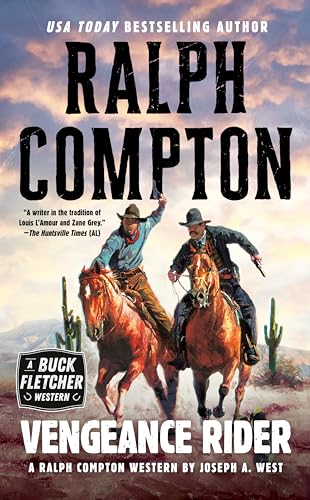
Inhaltsangabe
Saddle up with legendary gunfighter Doc Holliday in this Ralph Compton western.
Buck Fletcher plans to race his horse for a $10,000 prize—money he needs to send his sick daughter to a faraway clinic. Then some outlaws steal his steed, and his daughter’s last hope with it. Though it’s been ten years since Buck slapped leather and traded lead with the badmen of the frontier, he’s quick to fasten on his gun belt again for the chase.
The thieves are led by Port Austin, a man who fears no retribution for the lives he takes—not with a ruthless band of brothers guarding his back. But Buck is not alone either. Doc Holliday, a legend of loyalty and ferocity, rides beside him, eager to help on a mission of vengeance—and a quest to save a little girl’s life....
More Than Six Million Ralph Compton Books in Print!
Die Inhaltsangabe kann sich auf eine andere Ausgabe dieses Titels beziehen.
Über die Autorin bzw. den Autor
Ralph Compton stood six-foot-eight without his boots. He worked as a musician, a radio announcer, a songwriter, and a newspaper columnist. His first novel, The Goodnight Trail, was a finalist for the Western Writers of America Medicine Pipe Bearer Award for best debut novel. He was also the author of the Sundown Rider series and the Border Empire series.
As a little boy growing up in a small fishing village in Scotland, Joseph West enjoyed many happy Saturday mornings at the local cinema in the company of Roy and Gene and Hoppy. His lifelong ambition was to become a cowboy, but he was sidetracked by a career in law enforcement and journalism. He now resides with his wife and daughter in Palm Beach, Florida, where he enjoys horse riding, cowboy action shooting, and studying Western history.
Auszug. © Genehmigter Nachdruck. Alle Rechte vorbehalten.
A LIVING LEGEND
All eyes turned to the old man who was walking toward them, supporting himself on a silver-headed cane in his left hand. “I think I’ll deal myself a hand of this little fracas if y’all don’t mind.”
“Step away, old-timer,” Fletcher said. “This isn’t your fight.”
The old man smiled. “Damn it all, Buck. I’m but thirty-seven years old. Younger than you, a lot better looking, and I must say, when you get right down to it, a whole heap better mannered.”
Jesse, his eyes ugly, snarled: “The man is right. This ain’t your fight, Doc.”
Doc! Fletcher knew why the old man had seemed so familiar. The last time he’d seen Doc Holliday had been in Deadwood, ten years before. But the little gambler’s tuberculosis was now far gone and the disease had aged him terribly.
Grief and fear spiked in Fletcher as he heard Doc say: “Jesse Taylor, Buck Fletcher is my friend. You know I can’t walk away from this.”
“Then so be it, Doc,” Jesse said. His shotgun came up fast.
Fletcher drew, but his gun still had to clear the leather when Doc fired, skinning his Colt from a shoulder holster with lightning speed.
THE IMMORTAL COWBOY
This is respectfully dedicated to the “American Cowboy.” His was the saga sparked by the turmoil that followed the Civil War, and the passing of more than a century has by no means diminished the flame.
True, the old days and the old ways are but treasured memories, and the old trails have grown dim with the ravages of time, but the spirit of the cowboy lives on.
In my travels—to Texas, Oklahoma, Kansas, Nebraska, Colorado, Wyoming, New Mexico, and Arizona—I always find something that reminds me of the Old West. While I am walking these plains and mountains for the first time, there is this feeling that a part of me is eternal, that I have known these old trails before. I believe it is the undying spirit of the frontier calling, allowing me, through the mind’s eye, to step back into time. What is the appeal of the Old West of the American frontier?
It has been epitomized by some as the dark and bloody period in American history. Its heroes—Crockett, Bowie, Hickok, Earp—have been reviled and criticized. Yet the Old West lives on, larger than life.
It has become a symbol of freedom, where there was always another mountain to climb and another river to cross; when a dispute between two men was settled not with expensive lawyers, but with fists, knives or guns. Barbaric? Maybe. But some things never change. When the cowboy rode into the pages of American history, he left behind a legacy that lives within the hearts of us all.
—Ralph Compton
One
The horse was gone . . . and with its loss came the death of hope.
Tiny McCue lay dead in a pool of his own blood, his small, thin body shot to doll rags, the tracks of the six riders who had murdered him pointing due south.
Buck Fletcher took off his hat and wiped his sweaty brow with the back of his wrist, still desperately grappling to believe what he was seeing. His face bleak, he kneeled and looked more closely at Tiny’s body.
Judging by the hole it had made, the little puncher had been shot in the back by a rifle at long range; then another six bullets had been pumped into his chest while he lay helpless on the ground.
The thong was still over the hammer of Tiny’s Colt. The man never even had a chance to draw.
Fletcher rose, a sigh escaping, unbidden, from his lips. Tiny had not returned to the ranch after he’d left to exercise the bay thoroughbred, a chore he performed regularly. That had been two days ago.
At first Fletcher had not been too concerned, thinking that Tiny had stopped over at one of the surrounding ranches, something he did now and then to swap lies with other punchers.
But when another day went by, he’d grown worried. The Black Hills country was beautiful, but hidden within its rugged splendor it harbored a hundred different ways to kill a man and sometimes all it took was a momentary lapse in concentration, a thoughtless choice or just some mighty bad luck.
It looked like Tiny had run into all three.
Fletcher had set out earlier that morning to search for the man, and after three hours of following tracks this is what he’d found.
Around him the magnificent, uncaring land was bathed in morning sunlight, and the blue shadows were slowly washing from the arroyos and canyons of the surrounding hills. Jays quarreled noisily among the branches of the yellow aspen and higher up the slopes, green arrowheads of spruce stirred in a warm, southern breeze and, towering above the trees, rose soaring, fantastic spires of gray rock. The sky was a clear, brilliant blue, streaked here and there with hazy smears of white cloud, and the air smelled of pine and wildflowers.
All this Buck Fletcher experienced without joy. A dull rage burned in him, changing the color of his eyes from the same blue as the sky to a hard, gunmetal gray, and his mouth under his sweeping dragoon mustache tightened into a thin line.
Six men had come here, to his range on Two-Bit Creek in the Dakota Territory, and killed his hired hand. And they had taken the horse that meant the difference between life and death for Fletcher’s six-year-old daughter.
Slowly, with deliberate motions, Fletcher rolled a smoke, a scalding anger building in him.
He had not taken up his guns for almost ten years now, and had thought to never do so again.
But he vowed to himself that he would take them up once again and exact a terrible vengeance.
He had been wronged and he would bring about the reckoning.
Fletcher lifted Tiny’s body onto the back of his horse. He was stepping into the stirrup, preparing to swing into the saddle, when the puncher’s hat fell to the ground. Fletcher picked up the hat and made to jam it back on the man’s head. But something caught his eye; the corner of a twenty-dollar bill sticking out of the band.
There was a total of eighty dollars neatly folded into the hatband, and a picture of a buxom woman in corsets torn with loving care from a drummer’s catalog.
Fletcher shook his head. It was little enough to show for fifteen years as a puncher and a dozen drives up the dusty, dangerous trails from Texas. Little enough to compensate a man for the rheumatisms that plagued him every winter and the pain from the Kiowa arrowhead of strap iron buried deep in his lower back, too dangerously close to the spine to be removed.
Sometimes, especially when the red wheat whiskey was on him, Tiny was a talking man, and Fletcher recalled him once saying that he had an older sister back to Laredo, married to a man who traveled in hardware. He would get his wife to send the woman the eighty dollars, plus whatever Savannah considered a fair amount for the puncher’s guns, saddle and horse.
It was not much of a legacy as legacies go, but it was all there was, that and the month’s wages still owing to him.
After a careful study of the woman in the corsets, Fletcher folded up the scrap of paper and shoved it into Tiny’s shirt pocket. It might bring the little rider some comfort to be buried with it.
Fletcher swung into the saddle and headed north toward his ranch on the Two-Bit. His buckskin gelding, made uneasy by the smell of blood and the nearness of death, tossed his head, jangling the bit, and once the horse shied as a jackrabbit burst from under his feet and zigzagged its way across the buffalo grass.
Ahead of Fletcher rose the looming bulk of Dome...
„Über diesen Titel“ kann sich auf eine andere Ausgabe dieses Titels beziehen.
Suchergebnisse für Ralph Compton Vengeance Rider (A Buck Fletcher Western,...

Beispielbild für diese ISBN
Ralph Compton Vengeance Rider
Anbieter: World of Books (was SecondSale), Montgomery, IL, USA
Verkäuferbewertung 5 von 5 Sternen

Zustand: Good. Item in good condition. Textbooks may not include supplemental items i.e. CDs, access codes etc. Bestandsnummer des Verkäufers 00090164387
Gebraucht kaufen
EUR 3,63
Versand gratis
Versand innerhalb von USA
Versand innerhalb von USA
Anzahl: 16 verfügbar
Beispielbild für diese ISBN
Ralph Compton Vengeance Rider
Anbieter: World of Books (was SecondSale), Montgomery, IL, USA
Verkäuferbewertung 5 von 5 Sternen
Zustand: Acceptable. Item in acceptable condition! Textbooks may not include supplemental items i.e. CDs, access codes etc. Bestandsnummer des Verkäufers 00091024974
Gebraucht kaufen
EUR 3,63
Versand gratis
Versand innerhalb von USA
Versand innerhalb von USA
Anzahl: 1 verfügbar
Beispielbild für diese ISBN
Ralph Compton Vengeance Rider
Anbieter: World of Books (was SecondSale), Montgomery, IL, USA
Verkäuferbewertung 5 von 5 Sternen
Zustand: Very Good. Item in very good condition! Textbooks may not include supplemental items i.e. CDs, access codes etc. Bestandsnummer des Verkäufers 00110473853
Gebraucht kaufen
EUR 3,63
Versand gratis
Versand innerhalb von USA
Versand innerhalb von USA
Anzahl: 1 verfügbar
Beispielbild für diese ISBN
Vengeance Rider: A Ralph Compton Novel (Gunfighter Series)
Anbieter: Your Online Bookstore, Houston, TX, USA
Verkäuferbewertung 5 von 5 Sternen
Mass Market Paperback. Zustand: Good. Bestandsnummer des Verkäufers 0451212207-3-20257432
Gebraucht kaufen
EUR 3,64
Versand gratis
Versand innerhalb von USA
Versand innerhalb von USA
Anzahl: 2 verfügbar
Beispielbild für diese ISBN
Vengeance Rider: A Ralph Compton Novel (Gunfighter Series)
Anbieter: Orion Tech, Kingwood, TX, USA
Verkäuferbewertung 5 von 5 Sternen
Mass Market Paperback. Zustand: Good. Bestandsnummer des Verkäufers 0451212207-3-23167359
Gebraucht kaufen
EUR 3,64
Versand gratis
Versand innerhalb von USA
Versand innerhalb von USA
Anzahl: 2 verfügbar
Beispielbild für diese ISBN
Vengeance Rider: A Ralph Compton Novel (Gunfighter Series)
Anbieter: Gulf Coast Books, Cypress, TX, USA
Verkäuferbewertung 5 von 5 Sternen
Mass Market Paperback. Zustand: Fair. Bestandsnummer des Verkäufers 0451212207-4-24114065
Gebraucht kaufen
EUR 3,64
Versand gratis
Versand innerhalb von USA
Versand innerhalb von USA
Anzahl: 1 verfügbar
Beispielbild für diese ISBN
Vengeance Rider: A Ralph Compton Novel (Gunfighter Series)
Anbieter: Gulf Coast Books, Cypress, TX, USA
Verkäuferbewertung 5 von 5 Sternen
Mass Market Paperback. Zustand: Good. Bestandsnummer des Verkäufers 0451212207-3-17620966
Gebraucht kaufen
EUR 3,64
Versand gratis
Versand innerhalb von USA
Versand innerhalb von USA
Anzahl: 1 verfügbar
Beispielbild für diese ISBN
Vengeance Rider: A Ralph Compton Novel (Gunfighter Series)
Verlag:
Berkley (edition PF), 2004
ISBN 10: 0451212207
ISBN 13: 9780451212207
Gebraucht
Mass Market Paperback
Anbieter: BooksRun, Philadelphia, PA, USA
Verkäuferbewertung 5 von 5 Sternen
Mass Market Paperback. Zustand: Very Good. PF. It's a well-cared-for item that has seen limited use. The item may show minor signs of wear. All the text is legible, with all pages included. It may have slight markings and/or highlighting. Bestandsnummer des Verkäufers 0451212207-11-1
Gebraucht kaufen
EUR 4,11
Versand gratis
Versand innerhalb von USA
Versand innerhalb von USA
Anzahl: 2 verfügbar
Beispielbild für diese ISBN
Vengeance Rider: A Ralph Compton Novel (Gunfighter Series)
Verlag:
Berkley (edition PF), 2004
ISBN 10: 0451212207
ISBN 13: 9780451212207
Gebraucht
Mass Market Paperback
Anbieter: BooksRun, Philadelphia, PA, USA
Verkäuferbewertung 5 von 5 Sternen
Mass Market Paperback. Zustand: Very Good. PF. It's a well-cared-for item that has seen limited use. The item may show minor signs of wear. All the text is legible, with all pages included. It may have slight markings and/or highlighting. Bestandsnummer des Verkäufers 0451212207-11-6
Gebraucht kaufen
EUR 4,21
Versand gratis
Versand innerhalb von USA
Versand innerhalb von USA
Anzahl: 1 verfügbar
Foto des Verkäufers
Vengeance Rider: A Ralph Compton Novel (Gunfighter Series)
Anbieter: Reliant Bookstore, El Dorado, KS, USA
Verkäuferbewertung 5 von 5 Sternen
Zustand: good. This book is in good condition with very minimal damage. Pages may have minimal notes or highlighting. Cover image on the book may vary from photo. Ships out quickly in a secure plastic mailer. Bestandsnummer des Verkäufers 56JTFY002FMX_ns
Gebraucht kaufen
EUR 4,40
Versand gratis
Versand innerhalb von USA
Versand innerhalb von USA
Anzahl: 4 verfügbar