
Verwandte Artikel zu A Field Guide to Awkward Silences
Inhaltsangabe
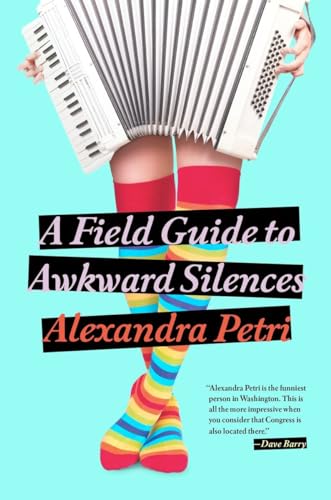
Washington Post columnist Alexandra Petri turns her satirical eye on her own life in this hilarious new memoir...
Most twentysomethings spend a lot of time avoiding awkwardness.
Not Alexandra Petri.
Afraid of rejection? Alexandra Petri has auditioned for America’s Next Top Model. Afraid of looking like an idiot? Alexandra Petri lost Jeopardy! by answering “Who is that dude?” on national TV. Afraid of bad jokes? Alexandra Petri won an international pun championship.
Petri has been a debutante, reenacted the Civil War, and fended off suitors at a Star Wars convention while wearing a Jabba the Hutt suit. One time, she let some cult members she met on the street baptize her, just to be polite. She’s a connoisseur of the kind of awkwardness that most people spend whole lifetimes trying to avoid. If John Hodgman and Amy Sedaris had a baby…they would never let Petri babysit it.
But Petri is here to tell you: Everything you fear is not so bad. Trust her. She’s tried it. And in the course of her misadventures, she’s learned that there are worse things out there than awkwardness—and that interesting things start to happen when you stop caring what people think.
Die Inhaltsangabe kann sich auf eine andere Ausgabe dieses Titels beziehen.
Über die Autorin bzw. den Autor
Some people are born awkward. Some achieve awkwardness. Some have awkwardness thrust upon them. Alexandra Petri is all three. She is a Washington Post columnist and blogger, an International Pun Champion, a playwright, and a Jeopardy! loser, and she’s been on your TV a couple of times. She is also a congressman’s kid, if that will make you buy this book! When she remembers, she does stand-up comedy too, but she’s been locked in her apartment for the past nine months making this book for you and hissing when exposed to sunlight.
Auszug. © Genehmigter Nachdruck. Alle Rechte vorbehalten.
FLOPPER
I am afraid of many things. Drowning, fire, the disapproval of strangers on the Internet, that I’ll be hit by a bus without having had a chance to clear my browser history, that one day everyone else on the subway will suddenly be able to hear what I am thinking and turn on me. You know, the usuals.
One thing I’m not afraid of? Looking like an idiot.
See, I knew I was a writer. That was protection. No matter where I went, no matter what I did, I could turn it into a story. Fall through a hole in the sidewalk? Story. Make the worst Final Jeopardy! wager of all time? Story. Anger the lord of the ocean, stab a one-eyed guy, and get very, very lost on my way home to Ithaca? Epic story.
Those were the two things I knew about myself: that I was a writer, and that I didn’t mind looking stupid. Growing up, you figure out pretty quickly which of your friends is the person who doesn’t mind looking like an idiot, and that was me, hands down. I was the one going over to strangers and asking if the mothership had landed. I was the one standing in an airport with a giant foam cow hat on my head, accordion open, ready to greet friends as they landed, and not even because I’d lost a bet. Mortification was a poison to which I had built up immunity after years of exposure. Besides, it was much less embarrassing to be me than to have to stand next to me and admit you were with me.
And the writer in me had noticed that the bigger of an idiot you appeared to be, the better the story was. Nobody wants to hear, “And everything went smoothly, just exactly according to plan.” Something had to go wrong. You had to trip up. That was where the excitement lay.
I collected experiences the way some people collect old coins or commemorative stamps.
One year, for fun, I called the ExtenZe male enhancement hotline every day for a month, with different voices, just to see what would happen. (What happened, if you want to know, was that Phoebe, who worked the dinner shift, got annoyed when I identified myself as Franklin Delano Roosevelt (a fun fact about the ExtenZe male enhancement hotline is that they make you identify yourself before you start your call) and threatened to transfer me to the police.)
All of this seemed to be leading to some kind of grand adventure. I sat there, glumly, waiting for a wizard to drop by the house and invite me to steal dragon-gold, or a wise old man in a brown hoodie to offer to teach me the ways of the Force. But no one showed. I would have to strike out on my own.
What was a field in which a willingness to look foolish might come in handy?
Of course! Reality television.
Like anyone growing up after 1980, I always had the dim, nagging sense that I was supposed to be famous for something. A certain measure of fame just seems like our birthright these days, next to life, liberty, and the pursuit of happiness. Food, shelter, Wi-fi, and the sense that someone’s watching; these are the modern requirements for survival. The only thing more terrifying than the feeling you’re being watched is the feeling that you’re not. Privacy is just an uncomfortable reminder that you’re not a celebrity.
My portion of fame, I knew, was waiting somewhere, neatly labeled in a holding facility. To claim it, all I’d have to do would be fill out some sort of form and show up in the designated audition city. And until that moment it was my right, as an American, to stare at the television and mutter, “I could do that.”
If I were being really honest with myself, these people I saw competing on television all possessed skills that I lacked—whether on American Idol or America’s Got Talent or even America’s Most Wanted. I could hold a tune, but only the way you hold a stranger’s cat: not closely and not long (not to mention the strange yowling noises). I Got some Talents, all right—excellent grammar, for one—but they weren’t the kind of thing that would exactly sing on the national stage. Whenever I tried to “smize,” model-style, people asked if I’d been possessed by an ancient and evil spirit. I had never murdered anyone, to the best of my knowledge, and if I did I would certainly not elude capture for long.
But there are always two ways of making it on the air: to be spectacular, and to be spectacularly bad. The second group was more fun to watch anyway. Why be Kelly Clarkson or Carrie Underwood or that one ventriloquist guy whose puppets all seemed oddly racist (get new dummies, Terry Fator! Then you won’t have to sit there with a pained expression while they rant about the people taking our jobs), when you could be short, sweatshirted William Hung, wrangling his painfully earnest way through “She Bangs!” or Leonid the Magnificent, dropping his equipment as the big red X’s buzzed above him, weeping profusely and promising that “next time, I will be perfect”? Sure, on one path lay Kelly’s international fame and Terry’s bucket loads of gold, but on the other lay William’s Christmas album, Hung For The Holidays. Now that was what I called a career trajectory. That was a story!
And that was going to be my way in.
I was going to seek failure out— n the national stage, with a glowing neon X attached.
The plan was simple. I just had to become dramatically, unquestionably, horrifically bad at something. I had to get myself in front of the judges and flop like no one they’d seen before.
Maybe, if I worked hard, I could become just as earth-shatteringly terrible as my idols and wind up on the air. It certainly seemed like my best shot.
My trouble was that I’d had little practice failing. I came up during a very specific era of child-rearing in which everyone seemed to believe that if Little Sally ever failed at anything, ever, she was going to be completely wrecked for life. Dutifully they set about sanding off the sharp edges of existence and childproofing all possible scenarios against hazards of choking under pressure. Trophies for everyone! A part for everyone in the school play. No failure. No rejection. You are a golden snowflake. Have a sticker.
For someone who hoped to make a career of rejection, this was a considerable setback.
I had no opportunity to pursue failure in high school either, where, distressingly, I kept succeeding at things. By senior year, I had been appointed president of four clubs and had mysteriously become captain of the volleyball team, even though I never left the bench. As a flop, I was a failure.
College was a different story. With a clean slate and thousands of people who didn’t know that I was doing it on purpose, I could begin my training for the big bomb.
I began collecting rejections.
There was an art, I quickly learned, to flopping. You couldn’t just be bad. Half the art is knowing how to go too far. You must keep a straight face. If you’re auditioning, you must sing badly, but feelingly. You must put the emphasis on the wrong syllable, read comedy as tragedy and tragedy as comedy. Overact, overgesture, pause for no reason midsentence and open and close your mouth like a bewildered carp. You must, in a word, turn in a whole performance.
I began my training in my freshman year, auditioning for plays under a false name. You could be more convincingly terrible, I discovered, when you had a backstory, so I crafted a character. Her name was Gloria Nichols. She had recently lost a lot of weight, loved to make bold gestures where no...
„Über diesen Titel“ kann sich auf eine andere Ausgabe dieses Titels beziehen.
Suchergebnisse für A Field Guide to Awkward Silences

Beispielbild für diese ISBN
A Field Guide to Awkward Silences
Anbieter: More Than Words, Waltham, MA, USA
Verkäuferbewertung 5 von 5 Sternen

Zustand: Good. . good. All orders guaranteed and ship within 24 hours. Before placing your order for please contact us for confirmation on the book's binding. Check out our other listings to add to your order for discounted shipping. Bestandsnummer des Verkäufers WAL-U-1c-02264
Gebraucht kaufen
EUR 0,92
EUR 3,55 Versand
Versand innerhalb von USA
Versand innerhalb von USA
Anzahl: 1 verfügbar
Beispielbild für diese ISBN
A Field Guide to Awkward Silences
Anbieter: World of Books (was SecondSale), Montgomery, IL, USA
Verkäuferbewertung 5 von 5 Sternen
Hardback. Zustand: Good. Washington Post columnist Alexandra Petri turns her satirical eye on her own life in this hilarious new memoir. Most twentysomethings spend a lot of time avoiding awkwardness. Not Alexandra Petri. Afraid of rejection? Alexandra Petri has auditioned for>America's Next Top Model. Afraid of looking like an idiot? Alexandra Petri lost>Jeopardy> by answering Who is that dude? on national TV. Afraid of bad jokes? Alexandra Petri won an international pun championship. Petri has been a debutante, reenacted the Civil War, and fended off suitors at a>Star Wars convention while wearing a Jabba the Hutt suit. One time, she let some cult members she met on the street baptize her, just to be polite. She's a connoisseur of the kind of awkwardness that most people spend whole lifetimes trying to avoid. If John Hodgman and Amy Sedaris had a baby.they would never let Petri babysit it. But Petri is here to tell you: Everything you fear is not so bad. Trust her. She's tried it. And in the course of her misadventures, she's learned that there are worse things out there than awkwardness--and that interesting things start to happen when you stop caring what people think. Bestandsnummer des Verkäufers 00101567587
Gebraucht kaufen
EUR 4,56
Versand gratis
Versand innerhalb von USA
Versand innerhalb von USA
Anzahl: 4 verfügbar
Beispielbild für diese ISBN
A Field Guide to Awkward Silences
Anbieter: BooksRun, Philadelphia, PA, USA
Verkäuferbewertung 5 von 5 Sternen
Hardcover. Zustand: Very Good. With dust jacket. It's a well-cared-for item that has seen limited use. The item may show minor signs of wear. All the text is legible, with all pages included. It may have slight markings and/or highlighting. Bestandsnummer des Verkäufers 0451469607-11-6-29
Gebraucht kaufen
EUR 4,94
Versand gratis
Versand innerhalb von USA
Versand innerhalb von USA
Anzahl: 1 verfügbar
Foto des Verkäufers
A Field Guide to Awkward Silences
Anbieter: Used Book Company, Egg Harbor Township, NJ, USA
Verkäuferbewertung 5 von 5 Sternen
Zustand: Very Good. Former library copy. Shows minimal signs of wear and previous use. Can include notes/highlighting. A portion of your purchase benefits nonprofits! - Note: Edition & format may differ from what is shown in stock photo & item details. May not include supplementary material such as toys, access code, dvds, etc. Bestandsnummer des Verkäufers UBCV.0451469607.VG
Gebraucht kaufen
EUR 5,07
Versand gratis
Versand innerhalb von USA
Versand innerhalb von USA
Anzahl: 1 verfügbar
Beispielbild für diese ISBN
A Field Guide to Awkward Silences
Anbieter: World of Books Inc, Montgomery, IL, USA
Verkäuferbewertung 4 von 5 Sternen

Hardback. Zustand: Good. Washington Post columnist Alexandra Petri turns her satirical eye on her own life in this hilarious new memoir. Most twentysomethings spend a lot of time avoiding awkwardness. Not Alexandra Petri. Afraid of rejection? Alexandra Petri has auditioned for>America's Next Top Model. Afraid of looking like an idiot? Alexandra Petri lost>Jeopardy> by answering Who is that dude? on national TV. Afraid of bad jokes? Alexandra Petri won an international pun championship. Petri has been a debutante, reenacted the Civil War, and fended off suitors at a>Star Wars convention while wearing a Jabba the Hutt suit. One time, she let some cult members she met on the street baptize her, just to be polite. She's a connoisseur of the kind of awkwardness that most people spend whole lifetimes trying to avoid. If John Hodgman and Amy Sedaris had a baby.they would never let Petri babysit it. But Petri is here to tell you: Everything you fear is not so bad. Trust her. She's tried it. And in the course of her misadventures, she's learned that there are worse things out there than awkwardness--and that interesting things start to happen when you stop caring what people think. Bestandsnummer des Verkäufers CIN0451469607G
Gebraucht kaufen
EUR 6,39
Versand gratis
Versand innerhalb von USA
Versand innerhalb von USA
Anzahl: 4 verfügbar
Beispielbild für diese ISBN
A Field Guide to Awkward Silences
Anbieter: Wonder Book, Frederick, MD, USA
Verkäuferbewertung 5 von 5 Sternen
Zustand: Good. Good condition. Good dust jacket. A copy that has been read but remains intact. May contain markings such as bookplates, stamps, limited notes and highlighting, or a few light stains. Bestandsnummer des Verkäufers I01C-04708
Gebraucht kaufen
EUR 6,40
Versand gratis
Versand innerhalb von USA
Versand innerhalb von USA
Anzahl: 1 verfügbar
Beispielbild für diese ISBN
A Field Guide to Awkward Silences
Verlag:
Penguin Publishing Group, 2015
ISBN 10: 0451469607
ISBN 13: 9780451469601
Gebraucht
Hardcover
Anbieter: Better World Books, Mishawaka, IN, USA
Verkäuferbewertung 5 von 5 Sternen
Zustand: Good. Former library copy. Pages intact with minimal writing/highlighting. The binding may be loose and creased. Dust jackets/supplements are not included. Includes library markings. Stock photo provided. Product includes identifying sticker. Better World Books: Buy Books. Do Good. Bestandsnummer des Verkäufers 9817371-6
Gebraucht kaufen
EUR 6,54
Versand gratis
Versand innerhalb von USA
Versand innerhalb von USA
Anzahl: 2 verfügbar
Beispielbild für diese ISBN
A Field Guide to Awkward Silences
Verlag:
Penguin Publishing Group, 2015
ISBN 10: 0451469607
ISBN 13: 9780451469601
Gebraucht
Hardcover
Anbieter: Better World Books, Mishawaka, IN, USA
Verkäuferbewertung 5 von 5 Sternen
Zustand: Good. Pages intact with minimal writing/highlighting. The binding may be loose and creased. Dust jackets/supplements are not included. Stock photo provided. Product includes identifying sticker. Better World Books: Buy Books. Do Good. Bestandsnummer des Verkäufers 568218-6
Gebraucht kaufen
EUR 6,54
Versand gratis
Versand innerhalb von USA
Versand innerhalb von USA
Anzahl: 1 verfügbar
Beispielbild für diese ISBN
A Field Guide to Awkward Silences
Anbieter: ThriftBooks-Dallas, Dallas, TX, USA
Verkäuferbewertung 5 von 5 Sternen
Hardcover. Zustand: Very Good. No Jacket. May have limited writing in cover pages. Pages are unmarked. ~ ThriftBooks: Read More, Spend Less. Bestandsnummer des Verkäufers G0451469607I4N00
Gebraucht kaufen
EUR 6,93
Versand gratis
Versand innerhalb von USA
Versand innerhalb von USA
Anzahl: 1 verfügbar
Beispielbild für diese ISBN
A Field Guide to Awkward Silences
Anbieter: ThriftBooks-Atlanta, AUSTELL, GA, USA
Verkäuferbewertung 5 von 5 Sternen
Hardcover. Zustand: Very Good. No Jacket. May have limited writing in cover pages. Pages are unmarked. ~ ThriftBooks: Read More, Spend Less. Bestandsnummer des Verkäufers G0451469607I4N00
Gebraucht kaufen
EUR 6,93
Versand gratis
Versand innerhalb von USA
Versand innerhalb von USA
Anzahl: 1 verfügbar