
Inhaltsangabe
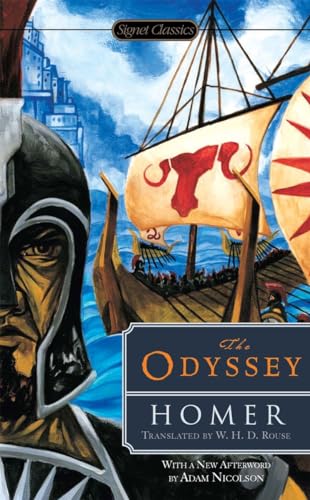
THE GREATEST ADVENTURE OF ALL TIME—NOW WITH A NEW AFTERWORD.
Homer’s Odyssey has been called “the first novel,” “the first expression of the mind in literary form,” and “the best story ever written.” Whether fans of suspense, fantasy or human drama, readers of all ages thrill to Homer’s vibrant picture of Odysseus on his decade-long journey, as he meets the lotus-eaters, cunningly flees Cyclops, angers his gods, resists the sexy Sirens, narrowly escapes Scylla and Charybdis, averts his eyes from Medusa, docks in exotic cities—all the while struggling to make it home to his wife and son.
Adventure on the high seas, legendary romance, tests of endurance, betrayal, heroism—the saga has all these and more, imagined by the most famous bard of all time. But, as Aristotle pointed out, “his greatness was that he himself was nowhere to be found in his story. His characters were everywhere.” Blind and possibly illiterate, Homer has still “in loftiness of thought surpass’d”* any storyteller since 900 B.C.E.
*John Dryden
Die Inhaltsangabe kann sich auf eine andere Ausgabe dieses Titels beziehen.
Über die Autorin bzw. den Autor
Deborah Steiner is Professor of Greek at Columbia University. She was raised in England, holds degrees from Harvard, Oxford, and the University of California, Berkeley, and is the author of several books on Greek literature and culture of the archaic and classical period.
Auszug. © Genehmigter Nachdruck. Alle Rechte vorbehalten.
A Magnificent Saga
Title Page
Copyright
Note
Epigraph
Introduction
Preface
BOOK I: WHAT WENT ON IN THE HOUSE OF ODYSSEUS
BOOK II: HOW THE COUNCIL MET IN THE MARKETPLACE OF ITHACA; AND WHAT CAME OF IT
BOOK III: WHAT HAPPENED IN SANDY PYLOS
BOOK IV: WHAT HAPPENED IN LACEDAIMON
BOOK V: HERMÊS IS SENT TO CALYPSO’S ISLAND; ODYSSEUS MAKES A RAFT AND IS CARRIED TO THE COAST OF SCHERIA
BOOK VI: HOW ODYSSEUS APPEALED TO NAUSICAÄ, AND SHE BROUGHT HIM TO HER FATHER’S HOUSE
BOOK VII: WHAT HAPPENED TO ODYSSEUS IN THE PALACE OF ALCINOÖS
BOOK VIII: HOW THEY HELD GAMES AND SPORTS IN PHAIACIA
BOOK IX: HOW ODYSSEUS VISITED THE LOTUS-EATERS AND THE CYCLOPS
BOOK X: THE ISLAND OF THE WINDS; THE LAND OF THE MIDNIGHT SUN; CIRCÊ
BOOK XI: HOW ODYSSEUS VISITED THE KINGDOM OF THE DEAD
BOOK XII: THE SINGING SIRENS, AND THE TERRORS OF SCYLLA AND CHARYBDIS
BOOK XIII: HOW ODYSSEUS CAME TO ITHACA
BOOK XIV: ODYSSEUS AND THE SWINEHERD
BOOK XV: HOW TELEMACHOS SAILED BACK TO ITHACA
BOOK XVI: HOW TELEMACHOS MET HIS FATHER
BOOK XVII: HOW ODYSSEUS RETURNED TO HIS OWN HOME
BOOK XVIII: HOW ODYSSEUS FOUGHT THE STURDY BEGGAR
BOOK XIX: HOW THE OLD NURSE KNEW HER MASTER
BOOK XX: HOW GOD SENT OMENS OF THE WRATH TO COME
BOOK XXI: THE CONTEST WITH THE GREAT BOW
BOOK XXII: THE BATTLE IN THE HALL
BOOK XXIII: HOW ODYSSEUS FOUND HIS WIFE AGAIN
BOOK XXIV: HOW ODYSSEUS FOUND HIS OLD FATHER, AND HOW THE STORY ENDED
Afterword
I have to thank several friends for reading and commenting upon certain parts of this translation; and particularly Miss A. M. Croft, B.A., whose help has been indispensable.
Four Books were published in the New English Weekly (1935), for which I thank the Editor, Mr. P. Mairet.
To guard against possible mistakes I add that the translation was made before T. E. Lawrence’s Odyssey was published. Whenever I was in doubt as to the meaning I consulted the scholiasts, Merry and Riddell and Munro for the Odyssey, Walter Leaf for the Iliad, and the most careful and exact translation I know, that of A. T. Murray in the Loeb Library, to all of whom I return my sincere thanks.
Much have I travelled in the realms of gold,
And many goodly states and kingdoms seen;
Round many western islands have I been
Which bards in fealty to Apollo hold.
Oft of one wide expanse had I been told
That deep-browed Homer ruled as his demesne;
Yet did I never breathe its pure serene
Till I heard Chapman speak out loud and bold:
Then felt I like some watcher of the skies
When a new planet swims into his ken;
Or like stout Cortez when with eagle eyes
He stared at the Pacific—and all his men
Looked at each other with a wild surmise—
Silent, upon a peak in Darien.
—JOHN KEATS
HOMER’S ODYSSEY TELLS A SIMPLE AND FAMILIAR STORY: the return of a hero, a veteran of the Trojan War, who has spent ten trial-filled years wandering in exotic lands. Arriving at last in his homeland, Ithaca, he finds that domestic and community affairs have gone badly wrong in his absence. His wife, Penelopeia, is surrounded by aggressive suitors who presume her husband has perished abroad; his son, Telemachos, on the brink of manhood, lacks the authority to expel these unruly interlopers, who are eating him out of house and home. In this power vacuum, where lowly swineherds and housekeepers try to fill the roles vacated by their masters, Odysseus, slowly and painfully, begins to recover his position as master of his household and patrimony. Using first guile, and then force, he ultimately takes vengeance on those who are seeking to displace him, restores his household and reclaims his wife.
If the story is simple, Homer’s narrative is brilliantly complex. Its opening is a notorious tease, a deliberate play on audience expectations and a taste of what this convention-breaking song will offer. The poem’s first line springs a double surprise: where Homer’s Iliad, the predecessor and countermodel to the Odyssey, begins by announcing in resounding fashion both the name of its protagonist, “Achillês, son of Peleus,” and the prime mover of its story—the cosmic wrath that drives Achillês to destroy his nearest and dearest, and himself too—the second composition tells us only that it is about a man, “one who was never at a loss.” From the outset then, Odysseus is a hero with a difference; alone among those celebrated in epic by the ancient bards, he allows himself to remain incognito, and the suppression of his identity proves key to his resourceful nature and survival. It will be nine books before Odysseus declares who he is and the source of his renown: no Achillês-like rage or battle prowess, but a “readiness for any event.”
Nor do the novelties end there. Our poet has a supremely compelling story to tell: Odysseus’ adventures on his journey home include encounters with the one-eyed cannibal Polyphemos and a visit to a land where the mind-altering lotus is the food of choice: fresh dangers come in the form of the drug-dealing Circê, whose potions turn Odysseus’ crew into swine, a visit to the land of the dead, singers whose voices are so alluring that seafarers linger to listen until their bones rot, and battles with sea-swallowing monsters. But instead of leading with these famous episodes, which Homer’s audience would have been expecting, for the first four books of the poem, the poet says nothing of the travels that make Odysseus a paradigm for contemporary Greeks embarking on their first colonizing ventures. Instead we accompany Telemachos, a somewhat backward youth, on his own mini-odyssey; roused from inaction by a visit from his father’s patron goddess, Athena, he sets out to discover news of Odysseus, visiting veterans of the Trojan War in the hope of learning whether his father is alive or dead. In postponing the main event, the poet knows exactly what he is about. For a hero whose best hope of salvation depends on his remaining unknown, an oblique introduction is required, and we, members like Telemachos of the post-heroic age, must encounter Odysseus indirectly before meeting him face-to-face.
As we realize later on, Telemachos’ seemingly low-key journey also proves a dress rehearsal, in which the son’s experiences hold up a mirror to those that his father, in the poem’s multilayered chronology, simultaneously undergoes. Here too Homer flirts with audience expectations, making us think ourselves embarked on a typical coming-of-age story, where a young man achieves manhood and a sense of who he is by virtue of the ancient equivalent of a Grand Tour and his initiation into family lore. But ultimately the poet discards this first trajectory: were Telemachos fully to join the rank of heroes, what role would be left for his father? The Odyssey charts no Oedipal struggle in which the son displaces the paternal figure (although the poet occasionally nods toward that scenario); instead, when father and son do find each other in the poem’s second half, the youth gamely consents to play second fiddle to his illustrious progenitor.
The master story resumes in book V, when Athena engineers our hero’s release from the nymph Calypso’s too warm attentions (not for nothing does her name mean “the concealer”). Within this larger narrative, a smaller one is inscribed. Washed up naked and...
„Über diesen Titel“ kann sich auf eine andere Ausgabe dieses Titels beziehen.
Weitere beliebte Ausgaben desselben Titels

Suchergebnisse für The Odyssey (Signet Classics)

Foto des Verkäufers
The Odyssey (Signet Classics)
Anbieter: Greenworld Books, Arlington, TX, USA
Verkäuferbewertung 5 von 5 Sternen

Zustand: good. Fast Free Shipping â" Good condition. It may show normal signs of use, such as light writing, highlighting, or library markings, but all pages are intact and the book is fully readable. A solid, complete copy that's ready to enjoy. Bestandsnummer des Verkäufers GWV.0451474333.G
Gebraucht kaufen
EUR 4,43
Versand gratis
Versand innerhalb von USA
Versand innerhalb von USA
Anzahl: 2 verfügbar
Beispielbild für diese ISBN
The Odyssey (Signet Classics)
Anbieter: Half Price Books Inc., Dallas, TX, USA
Verkäuferbewertung 5 von 5 Sternen
Mass Market Paperback. Zustand: Very Good. Connecting readers with great books since 1972! Used books may not include companion materials, and may have some shelf wear or limited writing. We ship orders daily and Customer Service is our top priority! Bestandsnummer des Verkäufers S_471625664
Gebraucht kaufen
EUR 2,51
EUR 3,05 Versand
Versand innerhalb von USA
Versand innerhalb von USA
Anzahl: 1 verfügbar
Beispielbild für diese ISBN
The Odyssey (Signet Classics)
Anbieter: HPB-Emerald, Dallas, TX, USA
Verkäuferbewertung 5 von 5 Sternen
Mass Market Paperback. Zustand: Very Good. Connecting readers with great books since 1972! Used books may not include companion materials, and may have some shelf wear or limited writing. We ship orders daily and Customer Service is our top priority! Bestandsnummer des Verkäufers S_470922407
Gebraucht kaufen
EUR 2,51
EUR 3,28 Versand
Versand innerhalb von USA
Versand innerhalb von USA
Anzahl: 1 verfügbar
Foto des Verkäufers
Odyssey
Anbieter: GreatBookPrices, Columbia, MD, USA
Verkäuferbewertung 5 von 5 Sternen
Zustand: good. May show signs of wear, highlighting, writing, and previous use. This item may be a former library book with typical markings. No guarantee on products that contain supplements Your satisfaction is 100% guaranteed. Twenty-five year bookseller with shipments to over fifty million happy customers. Bestandsnummer des Verkäufers 23417306-5
Gebraucht kaufen
EUR 3,70
EUR 2,31 Versand
Versand innerhalb von USA
Versand innerhalb von USA
Anzahl: 14 verfügbar
Beispielbild für diese ISBN
The Odyssey (Signet Classics)
Anbieter: BookHolders, Towson, MD, USA
Verkäuferbewertung 5 von 5 Sternen
Zustand: Fair. [ No Hassle 30 Day Returns ][ Ships Daily ] [ Underlining/Highlighting: NONE ] [ Writing: NONE ] [ Edition: Reissue ] [ Water Damage: SLIGHT, doesn't affect use ] slightly bent pages on some. Publisher: Signet Pub Date: 12/1/2015 Binding: Mass Market Paperback Pages: 384 Reissue edition. Bestandsnummer des Verkäufers 6592940
Gebraucht kaufen
EUR 6,05
Versand gratis
Versand innerhalb von USA
Versand innerhalb von USA
Anzahl: 1 verfügbar
Beispielbild für diese ISBN
The Odyssey
Verlag:
Penguin Publishing Group, 2015
ISBN 10: 0451474333
ISBN 13: 9780451474339
Gebraucht
Softcover
Anbieter: Better World Books, Mishawaka, IN, USA
Verkäuferbewertung 5 von 5 Sternen
Zustand: Good. Pages intact with minimal writing/highlighting. The binding may be loose and creased. Dust jackets/supplements are not included. Stock photo provided. Product includes identifying sticker. Better World Books: Buy Books. Do Good. Bestandsnummer des Verkäufers 9315373-6
Gebraucht kaufen
EUR 6,06
Versand gratis
Versand innerhalb von USA
Versand innerhalb von USA
Anzahl: 4 verfügbar
Beispielbild für diese ISBN
The Odyssey (Signet Classics)
Anbieter: Hawking Books, Edgewood, TX, USA
Verkäuferbewertung 4 von 5 Sternen

Zustand: Good. Meets the good condition guidelines. Has a small amount of writing/highlighting. Has wear. Five star seller - Buy with confidence! Bestandsnummer des Verkäufers X0451474333X3
Gebraucht kaufen
EUR 6,08
Versand gratis
Versand innerhalb von USA
Versand innerhalb von USA
Anzahl: 1 verfügbar
Beispielbild für diese ISBN
The Odyssey (Signet Classics)
Anbieter: ThriftBooks-Atlanta, AUSTELL, GA, USA
Verkäuferbewertung 5 von 5 Sternen
Unknown. Zustand: Fair. No Jacket. Readable copy. Pages may have considerable notes/highlighting. ~ ThriftBooks: Read More, Spend Less. Bestandsnummer des Verkäufers G0451474333I5N00
Gebraucht kaufen
EUR 6,25
Versand gratis
Versand innerhalb von USA
Versand innerhalb von USA
Anzahl: 3 verfügbar
Beispielbild für diese ISBN
The Odyssey (Signet Classics)
Anbieter: ThriftBooks-Phoenix, Phoenix, AZ, USA
Verkäuferbewertung 5 von 5 Sternen
Unknown. Zustand: Good. No Jacket. Pages can have notes/highlighting. Spine may show signs of wear. ~ ThriftBooks: Read More, Spend Less. Bestandsnummer des Verkäufers G0451474333I3N00
Gebraucht kaufen
EUR 6,25
Versand gratis
Versand innerhalb von USA
Versand innerhalb von USA
Anzahl: 2 verfügbar
Beispielbild für diese ISBN
The Odyssey (Signet Classics)
Anbieter: ThriftBooks-Atlanta, AUSTELL, GA, USA
Verkäuferbewertung 5 von 5 Sternen
Unknown. Zustand: Good. No Jacket. Former library book; Pages can have notes/highlighting. Spine may show signs of wear. ~ ThriftBooks: Read More, Spend Less. Bestandsnummer des Verkäufers G0451474333I3N10
Gebraucht kaufen
EUR 6,25
Versand gratis
Versand innerhalb von USA
Versand innerhalb von USA
Anzahl: 1 verfügbar