
Verwandte Artikel zu Clear and Present Danger (A Jack Ryan Novel, Band 4)
Inhaltsangabe
Don't Miss the Original Series Tom Clancy's Jack Ryan Starring John Krasinski!
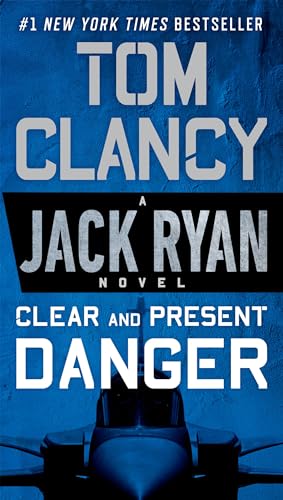
In this #1 New York Times bestselling thriller from Tom Clancy, Jack Ryan gets caught in a war between the United States and a Colombian drug cartel and uncovers a shocking conspiracy.
When Colombian drug lords assassinate both the U.S. ambassador and the visiting head of the FBI, their actions trigger a covert response from the American government—a response that goes horribly wrong...
As the newly named Deputy Director of Intelligence for the CIA, Jack Ryan should be privy to operations like the one in Colombia, but he’s been left completely in the dark. With the help of field officer John Clark, Ryan intends to find out what’s really going on. But while they expect danger from without, the greatest threat of all may come from within.
Die Inhaltsangabe kann sich auf eine andere Ausgabe dieses Titels beziehen.
Über die Autorin bzw. den Autor
A little more than thirty years ago Tom Clancy was a Maryland insurance broker with a passion for naval history. Years before, he had been an English major at Baltimore’s Loyola College and had always dreamed of writing a novel. His first effort, The Hunt for Red October—the first of the phenomenally successful Jack Ryan novels—sold briskly as a result of rave reviews, then catapulted onto the New York Times bestseller list after President Reagan pronounced it “the perfect yarn.” From that day forward, Clancy established himself as an undisputed master at blending exceptional realism and authenticity, intricate plotting, and razor-sharp suspense. He passed away in October 2013.
Auszug. © Genehmigter Nachdruck. Alle Rechte vorbehalten.
The room was still empty. The Oval Office is in the southeast corner of the White House West Wing. Three doors lead into it: one from the office of the President's personal secretary, another from a small kitchen which leads in turn to the President's study, and a third into a corridor, directly opposite the entrance to the Roosevelt Room. The room itself is of only medium size for a senior executive, and visitors always remark afterward that it seemed smaller than they expected. The President's desk, set just in front of thick windows of bullet-resistant polycarbonate that distort the view of the White House lawn, is made from the wood of HMS Resolute, a British ship that sank in American waters during the 1850s. Americans salvaged and returned it to the United Kingdom, and a grateful Queen Victoria ordered a desk made from its oaken timbers by way of official thanks. Made in an age when men were shorter than today, the desk was increased somewhat in height during the Reagan presidency. The President's desk was laden with folders and position papers capped with a printout of his appointment schedule, plus an intercom box, a conventional push-button multi-line telephone, and another ordinary-looking but high sophisticated secure instrument for sensitive conversations.
The President's chair was custom-made to fit its user, and its high back included sheets of DuPont Kevlar -- lighter and tougher than steel -- as additional protection against bullets that some madman might fire through the heavy windows. There were, of course, about a dozen Secret Service agents on duty in this part of the Presidential Mansion during business hours. To get here most people had to pass through a metal detector -- in fact all did, since the obvious ones were a little too obvious -- and everyone had to pass the quite serious scrutiny of the Secret Service detail, whose identity was plain from the flesh-toned earpieces that coiled out from under their suit jackets, and whose politeness was secondary to their real mission of keeping the President alive. Beneath the jacket of each was a powerful handgun, and each of these agents was trained to view everyone and everything as a potential threat to WRANGLER, which was the President's current code-name. It had no meaning beyond being easy to say and easily recognizable on a radio circuit.
Vice Admiral James Cutter, USN, was in an office on the opposite, northwest corner of the West Wing and had been since 6:15 that morning. The job of Special Assistant to the President for National Security Affairs requires a man to be an early riser. At a quarter to eight he finished off his second cup of morning coffee -- it was good here -- and tucked his briefing papers into a leather folder. He walked through the empty office of his vacationing deputy, turned right down the corridor past the similarly vaCant office of the Vice President, who was in Seoul at the moment, and turned left past the office of the President's Chief of Staff. Cutter was one of the handful of real Washington insiders -- the Vice President was not among them -- who didn't need the permission of the Chief of Staff to walk into the Oval Office whenever he felt the need, though he'd generally call ahead first to give the secretaries a heads-up. The Chief of Staff didn't like anyone to have that privilege, but that made his unlimited access all the more pleasant for Cutter to exercise. Along the way four security personnel nodded good morning to the Admiral, who returned the gestures as he would greet any skilled menial. Cutter's official code-name was LUMBERJACK, and though he knew that the Secret Service agents called him something else among themselves, Cutter was past caring what little people thought of him. The secretaries' anteroom was already up and running, with three secretaries and a Secret Service agent sitting in their appointed places.
"Chief on time?" he asked.
"WRANGLER is on the way down, sir," Special Agent Connor said. He was forty, a section chief of the Presidential Detail, didn't give a goddamn who Cutter was, and could care less what Cutter thought of him. Presidents and aides came and went, some liked, some loathed, but the professionals of the Secret Service served and protected them all. His trained eyes swept over the leather folder and Cutter's suit. No guns there today. He was not being paranoid. A king of Saudi Arabia had been killed by a family member, and a former prime minister of Italy had been betrayed by a daughter to the terrorist kidnappers who'd ultimately murdered him. It wasn't just kooks he had to worry about. Anyone could be a threat to the President. Connor was fortunate, of course, that he only had to worry about physical security. There were other sorts; those were the concerns of others less professional than he.
Everyone stood when the President arrived, of course, followed by his personal bodyguard, a lithe, thirtyish woman whose dark tresses neatly concealed the fact that she was one of the best pistol shots in government service. "Daga" -- her Service nickname -- smiled good morning at Pete. It would be an easy day. The President wasn't going anywhere. His appointment list had been thoroughly checked -- the Social Security numbers of all nonregulars are run through the FBI's crime computers -- and the visitors themselves would, of course, be subjected to the most thorough searches that can be made without an actual pat-down. The President waved for Admiral Cutter to follow him in. The two agents went over the appointment list again. It was routine, and the senior agent didn't mind that a man's job had been taken by a woman. Daga had earned her job on the street. If she were a man, everyone agreed, she'd have two big brass ones, and if any would-be assassin mistook her for a secretarial type, that was his bad luck. Every few minutes, until Cutter left, one or the other of the agents would peer through the spy-hole in the white-painted door to make sure that nothing untoward was happening. The President had held office for over three years and was used to the constant observation. It hardly occurred to the agents that a normal man might find it oppressive. It was their job to know everything there was to know about the President, from how often he visited the bathroom to those with whom he slept. They didn't call the agency the Secret Service for nothing. Their antecedents had concealed all manner of peccadillos. The President's wife was not entitled to know what he did every hour of the day -- at least, some presidents had so decided -- but his security detail was.
Behind the closed door, the President took his seat. From the side door a Filipino mess steward carried in a tray with coffee and croissants and came to attention before leaving. With this the morning's preliminary routine was complete, and Cutter began his morning intelligence briefing. This had been delivered from CIA to his Fort Myer, Virginia, home before dawn, which allowed the Admiral to paraphrase it. The brief didn't take long. It was late spring, and the world was a relatively quiet place. Those wars underway in Africa and elsewhere were not of great import to AmeriCan interests, and the Middle East was as tranquil as it ever seemed to be. That left time for other issues.
"What about SHOWBOAT?" the President asked while buttering his croissant.
"It's underway, sir. Ritter's people are already at work," Cutter replied.
"I'm still worried about security on the operation."
"Mr. President, it's as tight as one could reasonably expect. There are risks -- you Can't avoid them all -- but we're keeping the number of people involved to an absolute minimum, and those people have been carefully selected and recruited."
That earned the National Security Adviser a grunt. The President was trapped -- and as with nearly every president, it had come about from...
„Über diesen Titel“ kann sich auf eine andere Ausgabe dieses Titels beziehen.
Suchergebnisse für Clear and Present Danger (A Jack Ryan Novel, Band 4)

Foto des Verkäufers
Clear and Present Danger (A Jack Ryan Novel)
Anbieter: Dream Books Co., Denver, CO, USA
Verkäuferbewertung 5 von 5 Sternen

Zustand: acceptable. This copy has clearly been enjoyedâ"expect noticeable shelf wear and some minor creases to the cover. Binding is strong, and all pages are legible. May contain previous library markings or stamps. Bestandsnummer des Verkäufers 4EKTGN002N3G_ns
Gebraucht kaufen
EUR 3,94
Versand gratis
Versand innerhalb von USA
Versand innerhalb von USA
Anzahl: 1 verfügbar
Beispielbild für diese ISBN
Clear and Present Danger (A Jack Ryan Novel)
Verlag:
G.P. Putnam's Sons (edition ), 2018
ISBN 10: 0451489829
ISBN 13: 9780451489821
Gebraucht
Paperback
Anbieter: BooksRun, Philadelphia, PA, USA
Verkäuferbewertung 5 von 5 Sternen
Paperback. Zustand: Fair. The item might be beaten up but readable. May contain markings or highlighting, as well as stains, bent corners, or any other major defect, but the text is not obscured in any way. Bestandsnummer des Verkäufers 0451489829-7-1
Gebraucht kaufen
EUR 4,78
Versand gratis
Versand innerhalb von USA
Versand innerhalb von USA
Anzahl: 1 verfügbar
Beispielbild für diese ISBN
Clear and Present Danger (A Jack Ryan Novel)
Verlag:
G.P. Putnam's Sons (edition ), 2018
ISBN 10: 0451489829
ISBN 13: 9780451489821
Gebraucht
Paperback
Anbieter: BooksRun, Philadelphia, PA, USA
Verkäuferbewertung 5 von 5 Sternen
Paperback. Zustand: Very Good. It's a well-cared-for item that has seen limited use. The item may show minor signs of wear. All the text is legible, with all pages included. It may have slight markings and/or highlighting. Bestandsnummer des Verkäufers 0451489829-11-1
Gebraucht kaufen
EUR 5,17
Versand gratis
Versand innerhalb von USA
Versand innerhalb von USA
Anzahl: 1 verfügbar
Foto des Verkäufers
Clear and Present Danger (A Jack Ryan Novel)
Anbieter: Greenworld Books, Arlington, TX, USA
Verkäuferbewertung 5 von 5 Sternen
Zustand: good. Fast Free Shipping â" Good condition. It may show normal signs of use, such as light writing, highlighting, or library markings, but all pages are intact and the book is fully readable. A solid, complete copy that's ready to enjoy. Bestandsnummer des Verkäufers GWV.0451489829.G
Gebraucht kaufen
EUR 5,29
Versand gratis
Versand innerhalb von USA
Versand innerhalb von USA
Anzahl: 1 verfügbar
Beispielbild für diese ISBN
Clear and Present Danger (A Jack Ryan Novel)
Anbieter: HPB-Diamond, Dallas, TX, USA
Verkäuferbewertung 5 von 5 Sternen
Paperback. Zustand: Very Good. Connecting readers with great books since 1972! Used books may not include companion materials, and may have some shelf wear or limited writing. We ship orders daily and Customer Service is our top priority! Bestandsnummer des Verkäufers S_467974487
Gebraucht kaufen
EUR 2,33
EUR 3,27 Versand
Versand innerhalb von USA
Versand innerhalb von USA
Anzahl: 1 verfügbar
Beispielbild für diese ISBN
Clear and Present Danger (A Jack Ryan Novel)
Anbieter: HPB-Ruby, Dallas, TX, USA
Verkäuferbewertung 5 von 5 Sternen
Paperback. Zustand: Very Good. Connecting readers with great books since 1972! Used books may not include companion materials, and may have some shelf wear or limited writing. We ship orders daily and Customer Service is our top priority! Bestandsnummer des Verkäufers S_473085004
Gebraucht kaufen
EUR 2,38
EUR 3,27 Versand
Versand innerhalb von USA
Versand innerhalb von USA
Anzahl: 1 verfügbar
Beispielbild für diese ISBN
Clear and Present Danger
Verlag:
G.P. Putnam's Sons, 2018
ISBN 10: 0451489829
ISBN 13: 9780451489821
Gebraucht
Mass Market Paperback
Anbieter: ThriftBooks-Atlanta, AUSTELL, GA, USA
Verkäuferbewertung 5 von 5 Sternen
Mass Market Paperback. Zustand: Fair. No Jacket. Readable copy. Pages may have considerable notes/highlighting. ~ ThriftBooks: Read More, Spend Less. Bestandsnummer des Verkäufers G0451489829I5N00
Gebraucht kaufen
EUR 5,91
Versand gratis
Versand innerhalb von USA
Versand innerhalb von USA
Anzahl: 3 verfügbar
Beispielbild für diese ISBN
Clear and Present Danger
Verlag:
G.P. Putnam's Sons, 2018
ISBN 10: 0451489829
ISBN 13: 9780451489821
Gebraucht
Mass Market Paperback
Anbieter: ThriftBooks-Phoenix, Phoenix, AZ, USA
Verkäuferbewertung 5 von 5 Sternen
Mass Market Paperback. Zustand: Fair. No Jacket. Readable copy. Pages may have considerable notes/highlighting. ~ ThriftBooks: Read More, Spend Less. Bestandsnummer des Verkäufers G0451489829I5N00
Gebraucht kaufen
EUR 5,91
Versand gratis
Versand innerhalb von USA
Versand innerhalb von USA
Anzahl: 2 verfügbar
Beispielbild für diese ISBN
Clear and Present Danger
Verlag:
G.P. Putnam's Sons, 2018
ISBN 10: 0451489829
ISBN 13: 9780451489821
Gebraucht
Mass Market Paperback
Anbieter: ThriftBooks-Dallas, Dallas, TX, USA
Verkäuferbewertung 5 von 5 Sternen
Mass Market Paperback. Zustand: Very Good. No Jacket. May have limited writing in cover pages. Pages are unmarked. ~ ThriftBooks: Read More, Spend Less. Bestandsnummer des Verkäufers G0451489829I4N00
Gebraucht kaufen
EUR 5,91
Versand gratis
Versand innerhalb von USA
Versand innerhalb von USA
Anzahl: 1 verfügbar
Beispielbild für diese ISBN
Clear and Present Danger
Verlag:
G.P. Putnam's Sons, 2018
ISBN 10: 0451489829
ISBN 13: 9780451489821
Gebraucht
Mass Market Paperback
Anbieter: ThriftBooks-Reno, Reno, NV, USA
Verkäuferbewertung 5 von 5 Sternen
Mass Market Paperback. Zustand: Fair. No Jacket. Readable copy. Pages may have considerable notes/highlighting. ~ ThriftBooks: Read More, Spend Less. Bestandsnummer des Verkäufers G0451489829I5N00
Gebraucht kaufen
EUR 5,91
Versand gratis
Versand innerhalb von USA
Versand innerhalb von USA
Anzahl: 2 verfügbar