
Verwandte Artikel zu The Salt Fix: Why the Experts Got It All Wrong--and...
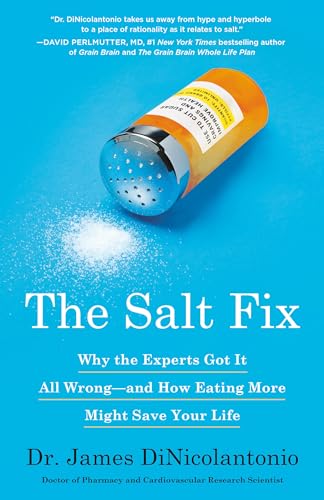
The Salt Fix: Why the Experts Got It All Wrong--and How Eating More Might Save Your Life - Softcover
Inhaltsangabe
What if everything you know about salt is wrong? A leading cardiovascular research scientist explains how this vital crystal got a negative reputation, and shows how to lower blood pressure and experience weight loss using salt. The Salt Fix is essential reading for everyone on the keto diet!
We’ve all heard the recommendation: eat no more than a teaspoon of salt a day for a healthy heart. Health-conscious Americans have hewn to the conventional wisdom that your salt shaker can put you on the fast track to a heart attack, and have suffered through bland but “heart-healthy” dinners as a result.
What if the low-salt dogma is wrong?
Dr. James DiNicolantonio has reviewed more than five hundred publications to unravel the impact of salt on blood pressure and heart disease. He’s reached a startling conclusion: The vast majority of us don’t need to watch our salt intake. In fact, for most of us, more salt would be advantageous to our nutrition—especially for those of us on the keto diet, as keto depletes this important mineral from our bodies. The Salt Fix tells the remarkable story of how salt became unfairly demonized—a never-before-told drama of competing egos and interests—and took the fall for another white crystal: sugar.
According to The Salt Fix, too little salt can:
• Make you crave sugar and refined carbs
• Send the body into semistarvation mode
• Lead to weight gain, insulin resistance, type 2 diabetes, cardiovascular disease, chronic kidney disease, and increased blood pressure and heart rate
But eating the salt you desire can improve everything, from your sleep, energy, and mental focus to your fitness, fertility, and sexual performance. It can even stave off common chronic illnesses, including heart disease.
The Salt Fix shows the best ways to add salt back into your diet, offering his transformative five-step program for recalibrating your salt thermostat to achieve your unique, ideal salt intake. Science has moved on from the low-salt dogma, and so should you—your life may depend on it.
Die Inhaltsangabe kann sich auf eine andere Ausgabe dieses Titels beziehen.
Über die Autorin bzw. den Autor
James J. DiNcolantonio, Pharm. D., is a cardiovascular research scientist and doctor of pharmacy at Saint Luke's Mid America Heart Institute in Kansas City, Missouri. A well-respected and internationally known scientist, and expert on health and nutrition, he has contributed extensively to health policy and has even testified in front of the Canadian Senate regarding the harms of added sugars. He serves as the Associate Editor of British Medical Journal's (BMJ) Open Heart, a journal published in partnership with the British Cardiovascular Society. He is the author or coauthor of approximately 200 publications in the medical literature. He is also on the Editorial Advisory Board of several other medical journals, including Progress in Cardiovascular Diseases and International Journal of Clinical Pharmacology & Toxicology (IJCPT).
Auszug. © Genehmigter Nachdruck. Alle Rechte vorbehalten.
1
But Doesn’t Salt Cause High Blood Pressure?
For more than forty years, our doctors, the government, and the nation’s leading health associations have told us that consuming salt increases blood pressure and thus causes chronic high blood pressure.
Here’s the truth: there was never any sound scientific evidence to support this idea. Even back in 1977, when the government’s Dietary Goals for the United States recommended that Americans restrict their salt intake, a report from the U.S. Surgeon General admitted there was no evidence that a low-salt diet would prevent the increases in blood pressure that often occur with advancing age.1 The first systematic review and meta-analysis of the effects of sodium restriction on blood pressure did not occur until 1991, and it was almost entirely based on weak, nonrandomized scientific data--but by then, we had already been telling Americans to cut their salt intake for nearly fifteen years. By that point, those white crystals had already been ingrained into the public’s mind as a primary cause of high blood pressure--a message that remains today.
The advice stemmed largely from the most basic of scientific explanations: the “salt–blood pressure hypothesis.” This hypothesis held that eating higher levels of salt leads to higher levels of blood pressure--end of story. But that wasn’t the full story, of course. As with so many old medical theories, the real story was a bit more complex.
The hypothesis went like this: In the body, we measure blood pressure in two different ways. The top number of a typical blood pressure reading is your systolic blood pressure, the pressure in your arteries during contraction of your heart. The bottom number is your diastolic blood pressure, the pressure in your arteries when your heart is relaxed. When we eat salt, so the theory goes, we also get thirsty--so we drink more water. In the salt–high blood pressure hypothesis, that excess salt then causes the body to hold on to that increased water, in order to dilute the saltiness of the blood. Then, the resulting increased blood volume would automatically lead to higher blood pressure.
That’s the theory, anyway. Makes sense, right?
All of this did make sense, in theory, and for a while there was some circumstantial evidence supporting this claim. Data was gathered on salt intake and blood pressures in various populations, and correlations were seen in some cases. But even if those correlations were consistent, as we all know, correlation does not equal causation--just because one thing (salt) may sometimes lead to another thing (higher blood pressure), which happens to correlate with another thing (cardiovascular events), that does not necessarily prove that the first thing caused the third thing.
Sure enough, data that conflicted with the salt–blood pressure theory continued to be published right along with data that supported it. A heated debate raged in the scientific community about whether salt induced chronically elevated blood pressure (hypertension) versus a fleeting, inconsequential rise in blood pressure, with advocates and skeptics on both sides. In fact, compared to any other nutrient, even cholesterol or saturated fat, salt has caused the most controversy. And once we got on that salt–high blood pressure train, it was hard to get off. Governments and health agencies had taken a stance on salt, and to admit that they were wrong would cause them to lose face. They continued the same low-salt mantra, refusing to overturn their premature verdict on salt until they were presented with overwhelming evidence to the contrary. No one was willing to get off the train until there was definitive evidence that their presumptions were wrong--instead of asking, “Did we ever have any evidence to recommend sodium restriction in the first place?”
We believed so strongly in sodium restriction because we believed so strongly in blood pressure as a metric of health. Low-salt advocates posit that even a one-point reduction in blood pressure (if translated to millions of people) would actually equal a reduction in strokes and heart attacks. But evidence in the medical literature suggests that approximately 80 percent of people with normal blood pressure (less than 120/80 mmHg) are not sensitive to the blood-pressure-raising effects of salt at all. Among those with prehypertension (a precursor to high blood pressure), roughly 75 percent are not sensitive to salt. And even among those with full-blown hypertension, about 55 percent are totally immune to salt’s effects on blood pressure.2
That’s right: even among those with the highest blood pressure, about half are not at all affected by salt.
The stringent low-salt guidelines were based on a guess: we essentially gambled that the small benefits to blood pressure that we see in some patients would extend to large benefits for the whole population. And while taking that gamble, we glossed over the most important point: why salt may increase blood pressure in some people but not in others. Had we focused on that, we would’ve realized that fixing the underlying issue--which has nothing to do with eating too much salt--completely fixes one’s “salt sensitivity.” We also presumed that blood pressure, a fleeting measurement known to fluctuate depending on many health factors, was always impacted by salt. And because of that baseless certainty, we presumed that overconsumption of salt would logically result in dire health outcomes, such as strokes and heart attacks.
Our mistake came from taking such a small sample of people--unethically small!--and wildly extrapolating their benefits from low-salt eating without ever mentioning the risks. Instead, we focused on those extremely minuscule reductions in blood pressure, completely disregarding the numerous other health risks caused by low salt intake--including several side effects that actually magnify our risk of heart disease--such as increased heart rate; compromised kidney function and adrenal insufficiency; hypothyroidism; higher triglyceride, cholesterol, and insulin levels; and, ultimately, insulin resistance, obesity, and type 2 diabetes.
Perhaps most illustrative of this willful disregard for risk is the case of heart rate. Heart rate is proven to increase on a low-salt diet. This harmful effect occurs in nearly everyone who restricts his or her salt intake. Although this effect is documented more thoroughly in the medical literature, no food ad or dietary guideline says, “A low-salt diet can increase your risk of elevated heart rate.” And what has a bigger impact on your health: a one-point reduction in blood pressure or a four-beat-per-minute increase in heart rate? (In chapter 4, I’ll take a closer look at what these metrics mean and I’ll let you decide.)
If our bodies allowed us to isolate each of these risks, we might be able to say for certain that one or another is most important. But when you combine all of the known dangers of salt restriction, it’s easy to see that the harms far outweigh any possible benefits. In other words, we’ve focused on just one metric that might change with a low-salt diet--blood pressure--but completely disregarded all the other harmful effects in the process.
Now that we can recognize our folly, we’ve come to a moment in our nation’s public health when we need to ask ourselves: Have we subjected generations of people--especially those whose health was already compromised--to a “treatment” that may have escalated their health decline?
This question becomes increasingly urgent as the stresses of the modern world inflict a compounded toll on our bodies. In addition to the salt we lose by following our low-carb, ketogenic, or paleo...
„Über diesen Titel“ kann sich auf eine andere Ausgabe dieses Titels beziehen.
Suchergebnisse für The Salt Fix: Why the Experts Got It All Wrong--and...

Foto des Verkäufers
The Salt Fix: Why the Experts Got It All Wrong--and How Eating More Might Save Your Life
Anbieter: Dream Books Co., Denver, CO, USA
Verkäuferbewertung 5 von 5 Sternen

Zustand: acceptable. This copy has clearly been enjoyedâ"expect noticeable shelf wear and some minor creases to the cover. Binding is strong, and all pages are legible. May contain previous library markings or stamps. Bestandsnummer des Verkäufers DBV.0451496981.A
Gebraucht kaufen
EUR 6,32
Versand gratis
Versand innerhalb von USA
Versand innerhalb von USA
Anzahl: 1 verfügbar
Beispielbild für diese ISBN
The Salt Fix: Why the Experts Got It All Wrong--and How Eating More Might Save Your Life
Anbieter: Bookmans, Tucson, AZ, USA
Verkäuferbewertung 5 von 5 Sternen
paperback. Zustand: Good. Satisfaction 100% guaranteed. Bestandsnummer des Verkäufers mon0002634784
Gebraucht kaufen
EUR 4,72
EUR 3,56 Versand
Versand innerhalb von USA
Versand innerhalb von USA
Anzahl: 1 verfügbar
Foto des Verkäufers
The Salt Fix: Why the Experts Got It All Wrong--and How Eating More Might Save Your Life
Anbieter: Goodwill Industries, Spokane, WA, USA
Verkäuferbewertung 5 von 5 Sternen
Zustand: good. Condition: Good â" Used book with some visible wear. May include stickers on the cover, wear or absence of the dust jacket, wear to the spine or inside cover, slight corner curling, minor staining, and wear along the fore edge. All orders are shipped via UPS Mail Innovations and may take up to 10 business days from the initial scan to be delivered. Bestandsnummer des Verkäufers INWV.0451496981.G
Gebraucht kaufen
EUR 5,50
EUR 3,56 Versand
Versand innerhalb von USA
Versand innerhalb von USA
Anzahl: 1 verfügbar
Beispielbild für diese ISBN
The Salt Fix : Why the Experts Got It All Wrong--And How Eating More Might Save Your Life
Verlag:
Potter/Ten Speed/Harmony/Rodale, 2020
ISBN 10: 0451496981
ISBN 13: 9780451496980
Gebraucht
Softcover
Anbieter: Better World Books, Mishawaka, IN, USA
Verkäuferbewertung 5 von 5 Sternen
Zustand: Good. Former library copy. Pages intact with minimal writing/highlighting. The binding may be loose and creased. Dust jackets/supplements are not included. Includes library markings. Stock photo provided. Product includes identifying sticker. Better World Books: Buy Books. Do Good. Bestandsnummer des Verkäufers 41809030-6
Gebraucht kaufen
EUR 10,10
Versand gratis
Versand innerhalb von USA
Versand innerhalb von USA
Anzahl: 1 verfügbar
Beispielbild für diese ISBN
The Salt Fix : Why the Experts Got It All Wrong--And How Eating More Might Save Your Life
Verlag:
Potter/Ten Speed/Harmony/Rodale, 2020
ISBN 10: 0451496981
ISBN 13: 9780451496980
Gebraucht
Softcover
Anbieter: Better World Books, Mishawaka, IN, USA
Verkäuferbewertung 5 von 5 Sternen
Zustand: Very Good. Pages intact with possible writing/highlighting. Binding strong with minor wear. Dust jackets/supplements may not be included. Stock photo provided. Product includes identifying sticker. Better World Books: Buy Books. Do Good. Bestandsnummer des Verkäufers 39153054-6
Gebraucht kaufen
EUR 10,10
Versand gratis
Versand innerhalb von USA
Versand innerhalb von USA
Anzahl: 1 verfügbar
Beispielbild für diese ISBN
The Salt Fix: Why the Experts Got It All Wrong--and How Eating More Might Save Your Life
Anbieter: Half Price Books Inc., Dallas, TX, USA
Verkäuferbewertung 5 von 5 Sternen
Paperback. Zustand: Very Good. Connecting readers with great books since 1972! Used books may not include companion materials, and may have some shelf wear or limited writing. We ship orders daily and Customer Service is our top priority! Bestandsnummer des Verkäufers S_486291805
Gebraucht kaufen
EUR 7,79
EUR 3,34 Versand
Versand innerhalb von USA
Versand innerhalb von USA
Anzahl: 1 verfügbar
Beispielbild für diese ISBN
The Salt Fix: Why the Experts Got It All Wrong--and How Eating More Might Save Your Life
Anbieter: World of Books (was SecondSale), Montgomery, IL, USA
Verkäuferbewertung 5 von 5 Sternen
Paperback. Zustand: Good. What if everything you know about salt is wrong? A leading cardiovascular research scientist explains how this vital crystal got a negative reputation, and shows how to lower blood pressure and experience weight loss using salt. The Salt Fix is essential reading for everyone on the keto diet! We've all heard the recommendation: eat no more than a teaspoon of salt a day for a healthy heart. Health-conscious Americans have hewn to the conventional wisdom that your salt shaker can put you on the fast track to a heart attack, and have suffered through bland but "heart-healthy" dinners as a result. What if the low-salt dogma is wrong? Dr. James DiNicolantonio has reviewed more than five hundred publications to unravel the impact of salt on blood pressure and heart disease. He's reached a startling conclusion: The vast majority of us don't need to watch our salt intake. In fact, for most of us, more salt would be advantageous to our nutrition--especially for those of us on the keto diet, as keto depletes this important mineral from our bodies. The Salt Fix tells the remarkable story of how salt became unfairly demonized--a never-before-told drama of competing egos and interests--and took the fall for another white crystal: sugar. According to The Salt Fix, too little salt can: * Make you crave sugar and refined carbs * Send the body into semistarvation mode * Lead to weight gain, insulin resistance, type 2 diabetes, cardiovascular disease, chronic kidney disease, and increased blood pressure and heart rate But eating the salt you desire can improve everything, from your sleep, energy, and mental focus to your fitness, fertility, and sexual performance. It can even stave off common chronic illnesses, including heart disease. The Salt Fix shows the best ways to add salt back into your diet, offering his transformative five-step program for recalibrating your salt thermostat to achieve your unique, ideal salt intake. Science has moved on from the low-salt dogma, and so should you--your life may depend on it. Bestandsnummer des Verkäufers 00108075521
Gebraucht kaufen
EUR 11,72
Versand gratis
Versand innerhalb von USA
Versand innerhalb von USA
Anzahl: 1 verfügbar
Beispielbild für diese ISBN
The Salt Fix: Why the Experts Got It All Wrong--and How Eating More Might Save Your Life
Anbieter: St Vincent de Paul of Lane County, Eugene, OR, USA
Verkäuferbewertung 5 von 5 Sternen
Zustand: Very Good. paperback 100% of proceeds go to charity! May have signs of use, wear and minor cosmetic defects. Bestandsnummer des Verkäufers 2AA-01-3511
Gebraucht kaufen
EUR 8,26
EUR 3,56 Versand
Versand innerhalb von USA
Versand innerhalb von USA
Anzahl: 1 verfügbar
Beispielbild für diese ISBN
The Salt Fix: Why the Experts Got It All Wrong--and How Eating More Might Save Your Life
Anbieter: World of Books Inc, Montgomery, IL, USA
Verkäuferbewertung 4 von 5 Sternen

Paperback. Zustand: Good. What if everything you know about salt is wrong? A leading cardiovascular research scientist explains how this vital crystal got a negative reputation, and shows how to lower blood pressure and experience weight loss using salt. The Salt Fix is essential reading for everyone on the keto diet! We've all heard the recommendation: eat no more than a teaspoon of salt a day for a healthy heart. Health-conscious Americans have hewn to the conventional wisdom that your salt shaker can put you on the fast track to a heart attack, and have suffered through bland but "heart-healthy" dinners as a result. What if the low-salt dogma is wrong? Dr. James DiNicolantonio has reviewed more than five hundred publications to unravel the impact of salt on blood pressure and heart disease. He's reached a startling conclusion: The vast majority of us don't need to watch our salt intake. In fact, for most of us, more salt would be advantageous to our nutrition--especially for those of us on the keto diet, as keto depletes this important mineral from our bodies. The Salt Fix tells the remarkable story of how salt became unfairly demonized--a never-before-told drama of competing egos and interests--and took the fall for another white crystal: sugar. According to The Salt Fix, too little salt can: * Make you crave sugar and refined carbs * Send the body into semistarvation mode * Lead to weight gain, insulin resistance, type 2 diabetes, cardiovascular disease, chronic kidney disease, and increased blood pressure and heart rate But eating the salt you desire can improve everything, from your sleep, energy, and mental focus to your fitness, fertility, and sexual performance. It can even stave off common chronic illnesses, including heart disease. The Salt Fix shows the best ways to add salt back into your diet, offering his transformative five-step program for recalibrating your salt thermostat to achieve your unique, ideal salt intake. Science has moved on from the low-salt dogma, and so should you--your life may depend on it. Bestandsnummer des Verkäufers CIN0451496981G
Gebraucht kaufen
EUR 13,56
Versand gratis
Versand innerhalb von USA
Versand innerhalb von USA
Anzahl: 1 verfügbar
Beispielbild für diese ISBN
The Salt Fix: Why the Experts Got It All Wrong--and How Eating More Might Save Your Life
Anbieter: Deadstock Gear, Fort Oglethorpe, GA, USA
Verkäuferbewertung 5 von 5 Sternen
paperback. Zustand: Very Good. Item may have minor cosmetic defects (such as marks, wears, cuts, bends, or crushes) on the cover, spine, pages, or dust cover. Shrink wrap, dust covers, or boxed set case may be missing. Item may contain remainder marks on outside edges. Item may be missing bundled media. Satisfaction guaranteed. Thank you! Bestandsnummer des Verkäufers 09-09-2026-Bulk-Shelf 44/G078
Gebraucht kaufen
EUR 11,54
EUR 2,67 Versand
Versand innerhalb von USA
Versand innerhalb von USA
Anzahl: 1 verfügbar