Inhaltsangabe
FROM ONE OF TODAY'S FOREMOST INNOVATION LEADERS, AN INSPIRING, PERSONAL APPROACH TO MASTERING CHANGE IN THE FACE OF UNCERTAINTY.
NAMED A 2018 BEST BUSINESS BOOK PICK BY FAST COMPANY AND WIRED UK.
Confronting change is incredibly hard, both organizationally and personally. People become resistant. They are afraid. Yet the pace of change in our world will never be slower than it is right now, says Beth Comstock, the former Vice Chair and head of marketing and innovation at GE.
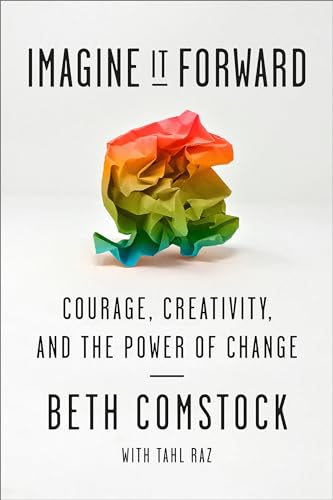
Imagine It Forward is an inspiring, fresh, candid, and deeply personal book about how to grapple with the challenges to change we face every day. It is a different kind of narrative, a big picture book that combines Comstock’s personal story in leading change with vital lessons on overcoming the inevitable roadblocks. One of the most successful women in business, Comstock shares her own transformation story from introverted publicist to GE’s first woman Vice Chair, and her hard-won lessons in shifting GE, a 125 year old American institution, toward a new digital future and a more innovative culture.
As the woman who initiated GE's Ecomagination clean-energy and its (and NBC’s) digital transformations, Comstock challenged a global organization to not wait for perfection, but to seek out emerging trends, embrace smart risks and test ideas boldly, and often. She shows how each one of us can become a “change maker” by leading with imagination.
“Ideas are rarely the problem,” writes Comstock. “What holds all of us back, really—is fear. It’s the attachment to the old, to ‘What We Know.’”
As Comstock makes clear, transforming the mindset and culture of a company is messy. There is no easy checklist. It is fraught with uncertainty, tension and too often failure. It calls for the courage to defy convention, go around corporate gatekeepers when necessary, and reinvent what is possible.
For all those looking to spearhead change in their companies and careers, and reinvent “the way things are done,” Imagine It Forward masterfully points the way.
Die Inhaltsangabe kann sich auf eine andere Ausgabe dieses Titels beziehen.
Über die Autorin bzw. den Autor
Beth Comstock is the former Vice Chair of GE, where for twenty-five years she led GE's efforts to accelerate new growth. She built GE's Business Innovations and GE Ventures, which develops new businesses, and oversaw the reinvention of GE Lighting. She was named GE’s Chief Marketing Officer in 2003. She served as President of Integrated Media at NBC Universal, from 2006-08, overseeing the company's digital efforts, including the early formation of Hulu. She is a corporate director of Nike. Written about and profiled extensively in the media, from the New York Times to Forbes, Fortune and Fast Company, she has been named to the Fortune and Forbes lists of the World's Most Powerful women.
Auszug. © Genehmigter Nachdruck. Alle Rechte vorbehalten.
Chapter 1
Reinvention
Taking Ownership of My Life
I was leading East Coast entertainment publicity at CBS—the “Tiffany Network”—when I got the call offering me the job as vice president of NBC News Media Relations.
People’s resistance to me taking the job—to even considering it—started immediately after I got the call. Totally crazy! Career suicide!
It was late at night as I considered the job, and the resistance from colleagues and friends to my taking it. I know it was late because that’s always the time when I try to create the logical rationale for a decision I’ve already made on instinct. The pros, the cons, every possible scenario. Morning came and the only clarity I had was emotional. I felt it in an almost spiritual way. I’m taking the job. I’m going back to NBC, where my career had started.
Only this time, in the fall of 1993, the network was a national disgrace.
We are hardwired to flee ambiguity, chaos, and the unknown. And yet here I was, running toward a disaster, embracing it. My colleagues and friends were sure it was professional ruin.
Not long before, the NBC news division’s Dateline program had aired “Waiting to Explode,” an investigative report that showed a sedan T-boning a Chevy pickup truck, with the truck erupting in a fiery explosion.
The problem was, the whole thing was a fake. An investigation revealed that NBC News had duct-taped model rocket engines to the truck’s frame and initiated the blast with a remote-control device. It took anchors Jane Pauley and Stone Phillips three and a half minutes to issue a full on-air apology—an eternity in TV time—and promise that “unscientific demonstrations” would never again be conducted by NBC.
But the Dateline crisis was just the latest in a string of NBC failures that included the highly public and embarrassing departure of David Letterman for CBS, and a ratings dive to third place among the networks. “Morale is in the toilet,” a veteran NBC producer told Entertainment Weekly at the time, in what became a months-long public flaying. “There’s nobody at the rudder.”
CBS was the ratings leader. Friends and colleagues thought I was crazy to leave. “I’m worried about you,” someone confided. A reporter from the Wall Street Journal was even more blunt: “NBC News is washed up.” Why would I leave the “Tiffany Network” for a demoralized number three?
And yet, in my gut, I knew this was the job I was meant to take.
Well-meaning colleagues will try to stop you from making these bravely instinctive choices. That’s just how it is. Change-making creates resistance. It is against the rules. Change is seen as loss. It is scary.
But you have to learn not to stop yourself. You have to learn to give yourself permission to imagine a better way, to envision opportunity where others see only risk.
It’s something I had to learn for myself.
Perhaps the best way to explain why I took the NBC job is to take you back to 1985, to tell you the kind of deeply personal story that doesn’t often appear in business books. In this story, I’m hiding behind a closed bedroom door, listening as my husband conveyed my first truly life-changing decision to my mother.
At the time I was in my midtwenties. I’d always followed the rules in my life, kept to the straight and narrow. I did very well in school, got involved in all kinds of clubs and community activities, and I astutely protected my “good girl” reputation. But I’d been beset by the growing realization that, like so many people, I had been keeping myself “small” by pleasing others and fitting in, by looking to see what everyone else was doing before acting, by making sure all I attempted was sanctioned, what nice girls do.
Conformity had created in me an insurmountable fear of being different, of putting myself out there. Every day I was killing off my true self with compromises.
The door was cold against my ear. My mother, at our house for the weekend to visit and care for our daughter, Katie, was sitting in the kitchen with my husband, Dave, as he told her something that I knew wouldn’t register: Dave and I were getting divorced. I had decided I needed to leave—without being able to say exactly why.
I was the woman who seemed to have it all at the time: a fancy new home near DC, a seemingly happy marriage to a handsome man of means, a new job as the NBC publicity coordinator, and a beautiful baby daughter. By every normal measure of success, I’d made it. Underneath that success, however, I was filled with despair.
Up to that moment, I’d lived my life more or less by someone else’s narrative. A simple story, with defined roles, that led to a simple happy ending. Elegant, without complications. But with every day that passed, I realized just how large the gap was between the story I was expected to follow and the life I actually wanted to live. While I had ideas—I wanted to be a television reporter, specifically a science reporter—mostly, I dreamed of setting out in the world. Once my father, who was a dentist then, convinced a patient, a news producer who commuted to DC, to have me shadow a reporter. (My dad, a big supporter of my future career, was not afraid to use his unique advantage of extracting promises for his kid while extracting a patient’s back molar.) As it turns out, I spent two hours with Diane Sawyer, then a young State Department reporter for CBS, just back from Chad. A few years later, sitting in the auditorium at my sister’s high school graduation soon after I graduated from college, I daydreamed of the career I’d surely have by the time she graduated from college. In my mind’s eye, I had the sophisticated worldliness of Diane Sawyer. What big city would I be living in? Would it be New York, where Diane had recently moved? What travel would I be returning from? Keep in mind that at this point I was working two jobs in Richmond—one as a Mexican-restaurant waitress to pay for my second, barely paying job as Jackie of all trades (and on-camera reporter) in a small news service covering the Virginia House of Delegates, which I had landed via a friend of a friend’s friend.
I was the daughter of a small-town dentist and a schoolteacher, and while my parents did well and afforded my sister, brother, and me opportunities, we were not wealthy, and certainly not well-connected. My father’s other aching-molar patients didn’t work in media. I jokingly call my mother “the mayor,” because she knows and talks to everyone; our town was our world. While working in the news service, I continued to seek out bigger jobs, perusing the want ads of Broadcasting magazine. That’s how I came to apply for TV meteorologist in Salisbury, Maryland, where I horribly mispronounced the name of the town as I did the on-set interview. In Richmond, I hounded a local TV station’s news director with my videotapes, calling him so relentlessly that he lost control. “You look like you’re 12,” Mr. Rant barked. “Why would I put anyone like you on camera?” My confidence was shaken, and my fear of striking out into the unknown had held me back. I was happy to say yes to getting married. I was in love and lacked the maturity to ask what that meant beyond saying no to pushing for jobs that would jump-start my career—jobs in TV markets beyond Richmond or Salisbury or locations as exotic as, well, Tulsa, where I had in fact been offered a job.
Dave’s outlook didn’t change as much as mine did after Katie was born. He still went out, had...
„Über diesen Titel“ kann sich auf eine andere Ausgabe dieses Titels beziehen.
Weitere beliebte Ausgaben desselben Titels

Suchergebnisse für Imagine It Forward: Courage, Creativity, and the Power...

Beispielbild für diese ISBN
Imagine It Forward: Courage, Creativity, and the Power of Change
Anbieter: World of Books (was SecondSale), Montgomery, IL, USA
Verkäuferbewertung 5 von 5 Sternen

Zustand: Good. Item in good condition. Textbooks may not include supplemental items i.e. CDs, access codes etc. Bestandsnummer des Verkäufers 00066045577
Beispielbild für diese ISBN
Imagine It Forward: Courage, Creativity, and the Power of Change
Anbieter: Gulf Coast Books, Cypress, TX, USA
Verkäuferbewertung 5 von 5 Sternen
hardcover. Zustand: Good. Bestandsnummer des Verkäufers 0451498291-3-34998529
Beispielbild für diese ISBN
Imagine It Forward: Courage, Creativity, and the Power of Change
Anbieter: Your Online Bookstore, Houston, TX, USA
Verkäuferbewertung 5 von 5 Sternen
hardcover. Zustand: Good. Bestandsnummer des Verkäufers 0451498291-3-27798451
Beispielbild für diese ISBN
Imagine It Forward: Courage, Creativity, and the Power of Change
Anbieter: Orion Tech, Kingwood, TX, USA
Verkäuferbewertung 5 von 5 Sternen
Hardcover. Zustand: Good. Bestandsnummer des Verkäufers 0451498291-3-26741173
Beispielbild für diese ISBN
Imagine It Forward: Courage, Creativity, and the Power of Change
Anbieter: Giant Giant, Reston, VA, USA
Verkäuferbewertung 5 von 5 Sternen
hardcover. Zustand: UsedGood. Good condition.No marking/highlighting.Cover and pages may show some wear.Not Satisfied? Contact us to get a refund. Bestandsnummer des Verkäufers BRG-38_4_559
Foto des Verkäufers
Imagine It Forward: Courage, Creativity, and the Power of Change
Anbieter: Books for Life, LAUREL, MD, USA
Verkäuferbewertung 5 von 5 Sternen
Zustand: good. Book is in good condition. Minimal signs of wear. It May have markings or highlights, but kept to only a few pages. May not come with supplemental materials if applicable. Bestandsnummer des Verkäufers LFM.43DE
Beispielbild für diese ISBN
Imagine It Forward: Courage, Creativity, and the Power of Change
Anbieter: More Than Words, Waltham, MA, USA
Verkäuferbewertung 5 von 5 Sternen
Zustand: Good. . . All orders guaranteed and ship within 24 hours. Before placing your order for please contact us for confirmation on the book's binding. Check out our other listings to add to your order for discounted shipping.7070706374. Bestandsnummer des Verkäufers BOS-R-13a-01162
Beispielbild für diese ISBN
Imagine It Forward: Courage, Creativity, and the Power of Change
Anbieter: Books-FYI, Inc., Cadiz, KY, USA
Verkäuferbewertung 5 von 5 Sternen
hardcover. Zustand: Good. Bestandsnummer des Verkäufers mon0000001619
Foto des Verkäufers
Imagine It Forward: Courage, Creativity, and the Power of Change
Anbieter: Off The Shelf, Antonia, MO, USA
Verkäuferbewertung 4 von 5 Sternen

Zustand: good. The item shows wear from consistent use, but it remains in good condition and works perfectly. All pages and cover are intact including the dust cover, if applicable . Spine may show signs of wear. Pages may include limited notes and highlighting. May NOT include discs, access code or other supplemental materials. Bestandsnummer des Verkäufers 4WILKM00M3C2
Beispielbild für diese ISBN
Imagine It Forward: Courage, Creativity, and the Power of Change
Anbieter: ThriftBooks-Reno, Reno, NV, USA
Verkäuferbewertung 5 von 5 Sternen
Hardcover. Zustand: As New. No Jacket. Pages are clean and are not marred by notes or folds of any kind. ~ ThriftBooks: Read More, Spend Less. Bestandsnummer des Verkäufers G0451498291I2N00