
Verwandte Artikel zu Adam Bede: 150th Anniversary Edition
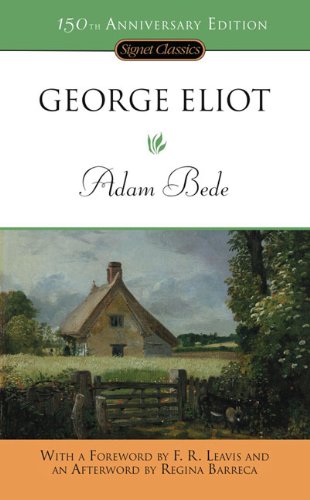
Inhaltsangabe
Jealousy and rivalry develop between a late-eighteenth-century English village carpenter, Adam Bede, and a squire, Arthur Donnithorne, when they both fall in love with the beautiful Hetty Sorrel, in this 150th anniversary edition of the classic novel. Reissue.
Die Inhaltsangabe kann sich auf eine andere Ausgabe dieses Titels beziehen.
Über die Autorinnen und Autoren
George Eliot (Mary Ann Evans Cross) was born on November 22, 1819 at Arbury Farm, Warwickshire, England. She received an ordinary education and, upon leaving school at the age of sixteen, embarked on a program of independent study to further her intellectual growth. In 1841 she moved with her father to Coventry, where the influences of “skeptics and rationalists” swayed her from an intense religious devoutness to an eventual break with the church. The death of her father in 1849 left her with a small legacy and the freedom to pursue her literary inclinations. In 1851 she became the assistant editor of the Westminster Review, a position she held for three years. In 1854 came the fated meeting with George Henry Lewes, the gifted editor of The Leader, who was to become her adviser and companion for the next twenty-four years. Her first book, Scenes of a Clerical Life (1858), was followed by Adam Bede (1859), The Mill on the Floss (1860), Silas Marner (1861), and Middlemarch (1872). The death of Lewes, in 1878, left her stricken and lonely. On May 6, 1880, she married John Cross, a friend of long standing, and after a brief illness she died on December 22 of that year, in London.
George Eliot (Mary Ann Evans Cross) was born on November 22, 1819 at Arbury Farm, Warwickshire, England. She received an ordinary education and, upon leaving school at the age of sixteen, embarked on a program of independent study to further her intellectual growth. In 1841 she moved with her father to Coventry, where the influences of “skeptics and rationalists” swayed her from an intense religious devoutness to an eventual break with the church. The death of her father in 1849 left her with a small legacy and the freedom to pursue her literary inclinations. In 1851 she became the assistant editor of the Westminster Review, a position she held for three years. In 1854 came the fated meeting with George Henry Lewes, the gifted editor of The Leader, who was to become her adviser and companion for the next twenty-four years. Her first book, Scenes of a Clerical Life (1858), was followed by Adam Bede (1859), The Mill on the Floss (1860), Silas Marner (1861), and Middlemarch (1872). The death of Lewes, in 1878, left her stricken and lonely. On May 6, 1880, she married John Cross, a friend of long standing, and after a brief illness she died on December 22 of that year, in London.
Auszug. © Genehmigter Nachdruck. Alle Rechte vorbehalten.
CHAPTER I
The Workshop
With a single drop of ink for a mirror, the Egyptian sorcerer undertakes to reveal to any chance comer far-reaching visions of the past. This is what I undertake to do for you, reader. With this drop of ink at the end of my pen I will show you the roomy workshop of Mr Jonathan Burge, carpenter and builder in the village of Hayslope, as it appeared on the eighteenth of June, in the year of our Lord 1799.
The afternoon sun was warm on the five workmen there, busy upon doors and window-frames and wainscoting. A scent of pine-wood from a tent-like pile of planks outside the open door mingled itself with the scent of the elder-bushes which were spreading their summer snow close to the open window opposite; the slanting sunbeams shone through the transparent shavings that flew before the steady plane, and lit up the fine grain of the oak panelling which stood propped against the wall. On a heap of those soft shavings a rough grey shepherd-dog had made himself a pleasant bed, and was lying with his nose between his fore-paws, occasionally wrinkling his brows to cast a glance at the tallest of the five workmen, who was carving a shield in the centre of a wooden mantelpiece. It was to this workman that the strong barytone belonged which was heard above the sound of plane and hammer singing— “Awake, my soul, and with the sun Thy daily stage of duty run; Shake off dull sloth. . . . .”
Here some measurement was to be taken which required more concentrated attention, and the sonorous voice subsided into a low whistle; but it presently broke out again with renewed vigour—
“Let all thy converse be sincere, Thy conscience as the noonday clear.”
Such a voice could only come from a broad chest, and the broad chest belonged to a large-boned muscular man nearly six feet high, with a back so flat and a head so well poised that when he drew himself up to take a more distant survey of his work, he had the air of a soldier standing at ease. The sleeve rolled up above the elbow showed an arm that was likely to win the prize for feats of strength; yet the long supple hand, with its broad finger-tips, looked ready for works of skill. In his tall stalwartness Adam Bede was a Saxon, and justified his name; but the jet-black hair, made the more noticeable by its contrast with the light paper cap, and the keen glance of the dark eyes that shone from under strongly marked, prominent, and mobile eyebrows, indicated a mixture of Celtic blood. The face was large and roughly hewn, and when in repose had no other beauty than such as belongs to an expression of good-humoured honest intelligence.
It is clear at a glance that the next workman is Adam’s brother. He is nearly as tall; he has the same type of features, the same hue of hair and complexion; but the strength of the family likeness seems only to render more conspicuous the remarkable difference of expression both in form and face. Seth’s broad shoulders have a slight stoop; his eyes are grey; his eyebrows have less prominence and more repose than his brother’s; and his glance, instead of being keen, is confiding and benignant. He has thrown off his paper cap, and you see that his hair is not thick and straight, like Adam’s, but thin and wavy, allowing you to discern the exact contour of a coronal arch that predominates very decidedly over the brow.
The idle tramps always felt sure they could get a copper from Seth; they scarcely ever spoke to Adam.
The concert of the tools and Adam’s voice was at last broken by Seth, who, lifting the door at which he had been working intently, placed it against the wall and said—
“There! I’ve finished my door to-day, anyhow.”
The workmen all looked up; Jim Salt, a burly red-haired man, known as Sandy Jim, paused from his planing, and Adam said to Seth, with a sharp glance of surprise—
“What! dost think thee’st finished the door?”
“Ay, sure,” said Seth, with answering surprise, “what’s awanting to’t?”
A loud roar of laughter from the other three workmen made Seth look round confusedly. Adam did not join in the laughter, but there was a slight smile on his face as he said, in a gentler tone than before—
“Why, thee’st forgot the panels.”
The laughter burst out afresh as Seth clapped his hands to his head, and coloured over brow and crown.
“Hoorray!” shouted a small lithe fellow, called Wiry Ben, running forward and seizing the door. “We’ll hang up th’ door at fur end o’ th’ shop an write on’t, ‘Seth Bede, the Methody, his work.’ Here, Jim, lend’s hould o th’ red-pot.”
“Nonsense!” said Adam. “Let it alone, Ben Cranage. You’ll mayhap be making such a slip yourself some day; you’ll laugh o’ th’ other side o’ your mouth then.”
“Catch me at it, Adam. It’ll be a good while afore my head’s full o’ th Methodies,” said Ben.
“Nay, but it’s often full o’ drink, and that’s worse.”
Ben, however, had now got the “red-pot” in his hand and was about to begin writing his inscription, making, by way of preliminary, an imaginary S in the air.
“Let it alone, will you?” Adam called out, laying down his tools, striding up to Ben, and seizing his right shoulder. “Let it alone, or I’ll shake the soul out o’ your body.”
Ben shook in Adam’s iron grasp, but, like a plucky small man as he was, he didn’t mean to give in. With his left hand he snatched the brush from his powerless right, and made a movement as if he would perform the feat of writing with his left. In a moment Adam turned him round, seized his other shoulder, and pushing him along, pinned him against the wall. But now Seth spoke.
“Let be, Addy, let be. Ben will be joking. Why, he’s i’ the right to laugh at me.—I canna help laughing at myself.”
“I shan’t loose him, till he promises to let the door alone,” said Adam.
“Come, Ben, lad,” said Seth in a persuasive tone, “don’t let’s have a quarrel about it. You know Adam will have his way. You may’s well try to turn a waggon in a narrow lane. Say you’ll leave the door alone, and make an end on’t.”
“I binna frighted at Adam,” said Ben, “but I donna mind sayin’ as I’ll let’t alone at yare askin’, Seth.”
“Come, that’s wise of you, Ben,” said Adam, laughing and relaxing his grasp.
They all returned to their work now; but Wiry Ben, having had the worst in the bodily contest, was bent on retrieving that humiliation by a success in sarcasm.
“Which was ye thinkin’ on, Seth,” he began—“the pretty parson’s face or her sarmunt, when ye forgot the panel?”
“Come and hear her, Ben,” said Seth, good-humouredly; “she’s going to preach on the Green to-night; happen ye’d get something to think on yourself then, instead o’ those wicked songs ye’re so fond on. Ye might get religion, and that ’ud be the best day’s earnings y’ ever made.”
“All i’ good time for that, Seth; I’ll think about that when I’m agoin’ to settle i’ life; bachelors doesn’t want such heavy earnins. Happen I shall do the coortin’ an’ the religion both together, as ye do, Seth; but ye wouldna ha’ me get converted an’ chop in atween ye an’ the pretty preacher,...
„Über diesen Titel“ kann sich auf eine andere Ausgabe dieses Titels beziehen.
Suchergebnisse für Adam Bede: 150th Anniversary Edition

Beispielbild für diese ISBN
Adam Bede
Verlag:
Signet (edition Anniversary), 2004
ISBN 10: 0451529421
ISBN 13: 9780451529428
Gebraucht
Mass Market Paperback
Anbieter: BooksRun, Philadelphia, PA, USA
Verkäuferbewertung 5 von 5 Sternen

Mass Market Paperback. Zustand: Very Good. Anniversary. It's a well-cared-for item that has seen limited use. The item may show minor signs of wear. All the text is legible, with all pages included. It may have slight markings and/or highlighting. Bestandsnummer des Verkäufers 0451529421-11-1
Gebraucht kaufen
EUR 4,57
Versand gratis
Versand innerhalb von USA
Versand innerhalb von USA
Anzahl: 1 verfügbar
Beispielbild für diese ISBN
Adam Bede: 150th Anniversary Edition
Anbieter: World of Books (was SecondSale), Montgomery, IL, USA
Verkäuferbewertung 5 von 5 Sternen
Zustand: Fair. Adam Bede is a hardy young carpenter who cares for his aging mother. His one weakness is the woman he loves blindly: the trifling town beauty, Hetty Sorrel, whose only delights are her baubles-and the delusion that the careless Captain Donnithorne may ask for her hand. Betrayed by their innocence, both Adam and Hetty allow their foolish hearts to trap them in a triangle of seduction, murder, and retribution. Bestandsnummer des Verkäufers 00107713890
Gebraucht kaufen
EUR 4,59
Versand gratis
Versand innerhalb von USA
Versand innerhalb von USA
Anzahl: 1 verfügbar
Beispielbild für diese ISBN
Adam Bede
Verlag:
Penguin Publishing Group, 2004
ISBN 10: 0451529421
ISBN 13: 9780451529428
Gebraucht
Softcover
Anbieter: Better World Books, Mishawaka, IN, USA
Verkäuferbewertung 5 von 5 Sternen
Zustand: Very Good. Reissue. Former library copy. Pages intact with possible writing/highlighting. Binding strong with minor wear. Dust jackets/supplements may not be included. Includes library markings. Stock photo provided. Product includes identifying sticker. Better World Books: Buy Books. Do Good. Bestandsnummer des Verkäufers 4793098-6
Gebraucht kaufen
EUR 6,19
Versand gratis
Versand innerhalb von USA
Versand innerhalb von USA
Anzahl: 1 verfügbar
Beispielbild für diese ISBN
Adam Bede
Verlag:
Penguin Publishing Group, 2004
ISBN 10: 0451529421
ISBN 13: 9780451529428
Gebraucht
Softcover
Anbieter: Better World Books, Mishawaka, IN, USA
Verkäuferbewertung 5 von 5 Sternen
Zustand: Very Good. Reissue. Pages intact with possible writing/highlighting. Binding strong with minor wear. Dust jackets/supplements may not be included. Stock photo provided. Product includes identifying sticker. Better World Books: Buy Books. Do Good. Bestandsnummer des Verkäufers 11053661-6
Gebraucht kaufen
EUR 6,19
Versand gratis
Versand innerhalb von USA
Versand innerhalb von USA
Anzahl: 1 verfügbar
Beispielbild für diese ISBN
Adam Bede
Anbieter: HPB Inc., Dallas, TX, USA
Verkäuferbewertung 5 von 5 Sternen
mass_market. Zustand: Very Good. Connecting readers with great books since 1972! Used books may not include companion materials, and may have some shelf wear or limited writing. We ship orders daily and Customer Service is our top priority! Bestandsnummer des Verkäufers S_439902503
Gebraucht kaufen
EUR 2,89
EUR 3,35 Versand
Versand innerhalb von USA
Versand innerhalb von USA
Anzahl: 1 verfügbar
Beispielbild für diese ISBN
Adam Bede (Signet Classics)
Anbieter: HPB-Diamond, Dallas, TX, USA
Verkäuferbewertung 5 von 5 Sternen
Mass Market Paperback. Zustand: Very Good. Connecting readers with great books since 1972! Used books may not include companion materials, and may have some shelf wear or limited writing. We ship orders daily and Customer Service is our top priority! Bestandsnummer des Verkäufers S_456438015
Gebraucht kaufen
EUR 2,89
EUR 3,35 Versand
Versand innerhalb von USA
Versand innerhalb von USA
Anzahl: 1 verfügbar
Beispielbild für diese ISBN
Adam Bede (Signet Classics)
Anbieter: HPB-Diamond, Dallas, TX, USA
Verkäuferbewertung 5 von 5 Sternen
Mass Market Paperback. Zustand: Good. Connecting readers with great books since 1972! Used books may not include companion materials, and may have some shelf wear or limited writing. We ship orders daily and Customer Service is our top priority! Bestandsnummer des Verkäufers S_302343403
Gebraucht kaufen
EUR 2,89
EUR 3,35 Versand
Versand innerhalb von USA
Versand innerhalb von USA
Anzahl: 1 verfügbar
Beispielbild für diese ISBN
Adam Bede: 150th Anniversary Edition
Anbieter: World of Books Inc, Montgomery, IL, USA
Verkäuferbewertung 4 von 5 Sternen

Zustand: Fair. Adam Bede is a hardy young carpenter who cares for his aging mother. His one weakness is the woman he loves blindly: the trifling town beauty, Hetty Sorrel, whose only delights are her baubles-and the delusion that the careless Captain Donnithorne may ask for her hand. Betrayed by their innocence, both Adam and Hetty allow their foolish hearts to trap them in a triangle of seduction, murder, and retribution. Bestandsnummer des Verkäufers CIN0451529421A
Gebraucht kaufen
EUR 6,43
Versand gratis
Versand innerhalb von USA
Versand innerhalb von USA
Anzahl: 1 verfügbar
Beispielbild für diese ISBN
Adam Bede
Verlag:
Signet Book, 2004
ISBN 10: 0451529421
ISBN 13: 9780451529428
Gebraucht
Mass Market Paperback
Anbieter: ThriftBooks-Dallas, Dallas, TX, USA
Verkäuferbewertung 5 von 5 Sternen
Mass Market Paperback. Zustand: Fair. No Jacket. Readable copy. Pages may have considerable notes/highlighting. ~ ThriftBooks: Read More, Spend Less. Bestandsnummer des Verkäufers G0451529421I5N00
Gebraucht kaufen
EUR 6,56
Versand gratis
Versand innerhalb von USA
Versand innerhalb von USA
Anzahl: 1 verfügbar
Beispielbild für diese ISBN
Adam Bede
Verlag:
Signet Book, 2004
ISBN 10: 0451529421
ISBN 13: 9780451529428
Gebraucht
Mass Market Paperback
Anbieter: ThriftBooks-Dallas, Dallas, TX, USA
Verkäuferbewertung 5 von 5 Sternen
Mass Market Paperback. Zustand: Good. No Jacket. Pages can have notes/highlighting. Spine may show signs of wear. ~ ThriftBooks: Read More, Spend Less. Bestandsnummer des Verkäufers G0451529421I3N00
Gebraucht kaufen
EUR 6,56
Versand gratis
Versand innerhalb von USA
Versand innerhalb von USA
Anzahl: 1 verfügbar