
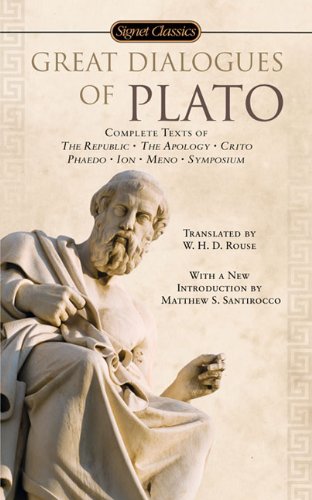
Great Dialogues of Plato: Complete Texts of the Republic - the Apololy - Crito - Phaedo - Ion - Meno - Symposium - Softcover
Inhaltsangabe
A new translation of the complete texts of The Republic, The Apology, Crito, Phaido, Ion, Meno, and Symposium reveals the genius of Plato as he struggled with education, justice, the "philosopher king," and utopian visions of society. Reprint.
Die Inhaltsangabe kann sich auf eine andere Ausgabe dieses Titels beziehen.
Über die Autorinnen und Autoren
Plato (c. 427–347 b.c.) founded the Academy in Athens, the prototype of all Western universities, and wrote more than twenty philosophical dialogues.
W.H.D. Rouse was one of the great 20th century experts on Ancient Greece, and headmaster of the Perse School, Cambridge, England, for 26 years. Under his leadership the school became widely known for the successful teaching of Greek and Latin as spoken languages. He derived his knowledge of the Greeks not only from his wide studies of classical literature, but also by travelling extensively in Greece. He died in 1950.
Plato (c. 427–347 b.c.) founded the Academy in Athens, the prototype of all Western universities, and wrote more than twenty philosophical dialogues.
W.H.D. Rouse was one of the great 20th century experts on Ancient Greece, and headmaster of the Perse School, Cambridge, England, for 26 years. Under his leadership the school became widely known for the successful teaching of Greek and Latin as spoken languages. He derived his knowledge of the Greeks not only from his wide studies of classical literature, but also by travelling extensively in Greece. He died in 1950.
Auszug. © Genehmigter Nachdruck. Alle Rechte vorbehalten.
INTRODUCTION
EDITORS’ NOTE
ION
MENO (Menon)
SYMPOSIUM (The Banquet)
THE REPUBLIC
Summary
Book I
Book II
Book III
Book IV
Book V
Book VI
Book VII
Book VIII
Book IX
Book X
THE APOLOGY (The Defence of Socrates)
CRITO (Criton)
PHAEDO (Phaidon)
Afterword
Pronouncing Index
Introduction:
Discovering Plato
Shortly before his death, Plato had a dream that he was a swan flitting from tree to tree and eluding the bird-catchers. When Simmias the Socratic heard this, he interpreted it to mean that all men would try to grasp Plato’s meaning but that none would succeed, and each would interpret him according to his own views.
—From an ancient commentator on Plato*
I. PLATO AND PHILOSOPHY
The Greek word philosophia means “love of wisdom”—“love” because what is at stake is not just intellectual interest but passionate engagement, and “wisdom” because the goal is not just to acquire expertise but to gain a deeper understanding of the world, of ourselves, and of our place in the world. There are, of course, other claimants to such wisdom—religion, mythology, the arts, and science, to name just a few. But philosophy makes a special claim, that it privileges neither revelation nor inspiration nor experimentation but, rather, rigorous logic and rational argument. And among philosophers, Plato has always held pride of place.
It may not be strictly accurate to say, as Alfred North Whitehead did, that “…the European philosophical tradition…consists of a series of footnotes to Plato.”† But Plato is arguably not only the first real philosopher of the West but also one of the greatest, since he set so much of the agenda for future thinkers. His writings range over most of the subfields in which philosophy is now practiced—from epistemology to metaphysics, and from ethics to aesthetics; and he ventured also into other disciplines such as political theory, psychology, linguistics, and education. True, it is not always clear how (or even if) the parts of his philosophy are meant to fit together systematically; his arguments are more than occasionally tendentious; and his own views (when they can be discerned) are sometimes unrealistic and even, some have said, dangerous. Nonetheless, Plato manages to identify so many of the important and perennial questions, and the artistic skill with which he explores them—the way in which his dialogues enact the thrilling play of ideas—sets him up as a standard of literature as well as of thought.
To appreciate the significance and beauty of Plato’s works, one needs to know something about their historical context (section II below), the intellectual milieu out of which they arose (section III), the importance of Socrates and Plato’s own philosophical project (section IV), and the literary style and form of the dialogues (section V).*
II. HISTORICAL BACKGROUND
Plato was born in Athens around 429 BCE and died in 347 BCE.† His family was aristocratic and politically prominent. Indeed, his relatives, Critias and Charmides (who appear in the dialogues), were leading members of the antidemocratic or oligarchic faction. Perhaps destined for a public career like theirs, Plato received a fine education, in the course of which he fell under the influence of Socrates. But this was a difficult time for Athens. When Plato was just a child, the Peloponnesian War broke out and pitted agains teach other Athens and Sparta (and their respective allies). When the war finally ended after more than two decades (431–404 BCE), Athens had been defeated. Although Plato and his contemporaries might not have realized it, the once-great city of Pericles had begun a slow and irreversible decline.
Things were so different just fifty years before Plato’s birth. In 490 BCE the Greek city-states were not fighting among themselves but had banded together against fierce odds to defeat two invasions launched by the powerful Persian empire. When the Persian Wars ended in 479 BCE, Athens, which had taken a leadership role, had itself become an empire. With the prestige, confidence, and riches it had thereby acquired, the Athenian democracy fostered a burst of intellectual and cultural activity with few parallels in history. This is the moment in which the great Greek tragedies were performed, when historiography was invented by Herodotus (who wrote about the Persian Wars), when the Parthenon was built, and when the Greek Enlightenment really took hold, freeing human minds to question old assumptions and to examine the world with fresh eyes.
We can get a sense of this creativity and excitement from Plato’s dialogues, which were written in the fourth century BCE but are mostly set in the second half of the fifth, before Athens’ defeat. They portray intellectual, cultural, and political leaders discussing such heady topics as the nature of justice, love, courage, beauty, and piety; the ideal form of the state; the best way to educate the young; the place of the arts in society; the objects of knowledge and ways of knowing; and the existence of the soul. The historian of the Peloponnesian War, Thucydides, reports that the great statesman Pericles characterized Athens at this time as rich, confident, open, and free—a city that nurtured creativity and whose citizens tempered self-interest with a concern for the common good. Athens, he said, was “an education to Greece” and a city with which all should “fall in love.”*
It is ironic that Pericles’ exposition of the ideology of the democracy was delivered as a funeral oration for those who had recently died in the first year of the Peloponnesian War. A year later Pericles himself was dead, a victim of a plague that descended on Athens as a result of wartime conditions. From then on, as Thucydides analyzes the situation, the war led to Athens’ moral and political deterioration.
Plato grew up in this time of insecurity and upheaval. Like other conservatives, he disapproved of the radical democracy whose demagoguery and adventurism had led to Athens’ defeat. But he also disapproved of the ruthless oligarchy, the Thirty Tyrants, who overthrew the democracy after the war, even though several of their leaders were his relatives. His disillusionment was complete when the democracy was restored in 401 BCE, and one of its first acts was to put his teacher Socrates on trial. The death of Socrates in 399 BCE was a watershed event for philosophy. Deciding not to pursue a political career, Plato left Athens to travel and reflect. When he returned over a decade later, he founded a school, the Academy (so named from its location by a grove sacred to the hero Academus). Here, in what was arguably the first university of Europe (it lasted until the Roman emperor Justinian closed the pagan schools in 529 CE), he spent the rest of his days studying, teaching (one of his pupils was Aristotle), and writing philosophical dialogues, all of which—remarkably—survive.†
III. INTELLECTUAL BACKGROUND
When Plato began to write he was reacting not only to political disappointments but also to intellectual provocation by prior or “pre-Socratic” thinkers—specifically, the natural philosophers and the sophists.
The Natural Philosophers
During the sixth century BCE, the prosperous cities of Greek Asia Minor saw the rise of a group of intellectuals (the physiologoi) who inquired into the nature (physis) of the physical...
„Über diesen Titel“ kann sich auf eine andere Ausgabe dieses Titels beziehen.
Weitere beliebte Ausgaben desselben Titels

Suchergebnisse für Great Dialogues of Plato: Complete Texts of the Republic...

Beispielbild für diese ISBN
Great Dialogues of Plato
Anbieter: Orion Tech, Kingwood, TX, USA
Verkäuferbewertung 5 von 5 Sternen

Mass Market Paperback. Zustand: Good. Bestandsnummer des Verkäufers 0451530853-3-19384305
Gebraucht kaufen
EUR 3,70
Versand gratis
Versand innerhalb von USA
Versand innerhalb von USA
Anzahl: 1 verfügbar
Beispielbild für diese ISBN
Great Dialogues Of Plato
Anbieter: World of Books (was SecondSale), Montgomery, IL, USA
Verkäuferbewertung 5 von 5 Sternen
Zustand: Good. Item in good condition. Textbooks may not include supplemental items i.e. CDs, access codes etc. Bestandsnummer des Verkäufers 00100447721
Gebraucht kaufen
EUR 3,70
Versand gratis
Versand innerhalb von USA
Versand innerhalb von USA
Anzahl: 1 verfügbar
Beispielbild für diese ISBN
Great Dialogues Of Plato
Anbieter: World of Books (was SecondSale), Montgomery, IL, USA
Verkäuferbewertung 5 von 5 Sternen
Zustand: Very Good. Item in very good condition! Textbooks may not include supplemental items i.e. CDs, access codes etc. Bestandsnummer des Verkäufers 00099551035
Gebraucht kaufen
EUR 3,70
Versand gratis
Versand innerhalb von USA
Versand innerhalb von USA
Anzahl: 1 verfügbar
Beispielbild für diese ISBN
Great Dialogues of Plato
Verlag:
Signet (edition ), 2008
ISBN 10: 0451530853
ISBN 13: 9780451530851
Gebraucht
Mass Market Paperback
Anbieter: BooksRun, Philadelphia, PA, USA
Verkäuferbewertung 5 von 5 Sternen
Mass Market Paperback. Zustand: Very Good. It's a well-cared-for item that has seen limited use. The item may show minor signs of wear. All the text is legible, with all pages included. It may have slight markings and/or highlighting. Bestandsnummer des Verkäufers 0451530853-11-1
Gebraucht kaufen
EUR 4,64
Versand gratis
Versand innerhalb von USA
Versand innerhalb von USA
Anzahl: 1 verfügbar
Foto des Verkäufers
Great Dialogues of Plato
Anbieter: Used Book Company, Egg Harbor Township, NJ, USA
Verkäuferbewertung 4 von 5 Sternen

Zustand: very_good. Shows minimal signs of wear and previous use. Can include notes highlighting. A portion of your purchase benefits nonprofits! - Note: Edition & format may differ from what is shown in stock photo & item details. May not include supplementary material such as toys, access code, dvds, etc. Bestandsnummer des Verkäufers 584UZG000DL3_ns
Gebraucht kaufen
EUR 5,01
Versand gratis
Versand innerhalb von USA
Versand innerhalb von USA
Anzahl: 1 verfügbar
Beispielbild für diese ISBN
Great Dialogues of Plato
Anbieter: HPB-Emerald, Dallas, TX, USA
Verkäuferbewertung 5 von 5 Sternen
Mass Market Paperback. Zustand: Very Good. Connecting readers with great books since 1972! Used books may not include companion materials, and may have some shelf wear or limited writing. We ship orders daily and Customer Service is our top priority! Bestandsnummer des Verkäufers S_464647009
Gebraucht kaufen
EUR 2,45
EUR 3,20 Versand
Versand innerhalb von USA
Versand innerhalb von USA
Anzahl: 1 verfügbar
Beispielbild für diese ISBN
Great Dialogues of Plato
Verlag:
Penguin Publishing Group, 2008
ISBN 10: 0451530853
ISBN 13: 9780451530851
Gebraucht
Softcover
Anbieter: Better World Books, Mishawaka, IN, USA
Verkäuferbewertung 5 von 5 Sternen
Zustand: Good. 1 Edition. Pages intact with minimal writing/highlighting. The binding may be loose and creased. Dust jackets/supplements are not included. Stock photo provided. Product includes identifying sticker. Better World Books: Buy Books. Do Good. Bestandsnummer des Verkäufers 3292105-6
Gebraucht kaufen
EUR 5,68
Versand gratis
Versand innerhalb von USA
Versand innerhalb von USA
Anzahl: 4 verfügbar
Beispielbild für diese ISBN
Great Dialogues of Plato
Anbieter: HPB-Diamond, Dallas, TX, USA
Verkäuferbewertung 5 von 5 Sternen
Mass Market Paperback. Zustand: Very Good. Connecting readers with great books since 1972! Used books may not include companion materials, and may have some shelf wear or limited writing. We ship orders daily and Customer Service is our top priority! Bestandsnummer des Verkäufers S_465139583
Gebraucht kaufen
EUR 3,06
EUR 3,20 Versand
Versand innerhalb von USA
Versand innerhalb von USA
Anzahl: 1 verfügbar
Beispielbild für diese ISBN
Great Dialogues of Plato (08) by Plato [Mass Market Paperback (2008)]
Anbieter: ThriftBooks-Dallas, Dallas, TX, USA
Verkäuferbewertung 5 von 5 Sternen
Paperback. Zustand: Good. No Jacket. Pages can have notes/highlighting. Spine may show signs of wear. ~ ThriftBooks: Read More, Spend Less. Bestandsnummer des Verkäufers G0451530853I3N00
Gebraucht kaufen
EUR 6,52
Versand gratis
Versand innerhalb von USA
Versand innerhalb von USA
Anzahl: 1 verfügbar
Beispielbild für diese ISBN
Great Dialogues of Plato (08) by Plato [Mass Market Paperback (2008)]
Anbieter: ThriftBooks-Dallas, Dallas, TX, USA
Verkäuferbewertung 5 von 5 Sternen
Paperback. Zustand: Fair. No Jacket. Missing dust jacket; Readable copy. Pages may have considerable notes/highlighting. ~ ThriftBooks: Read More, Spend Less. Bestandsnummer des Verkäufers G0451530853I5N01
Gebraucht kaufen
EUR 6,52
Versand gratis
Versand innerhalb von USA
Versand innerhalb von USA
Anzahl: 1 verfügbar