Inhaltsangabe
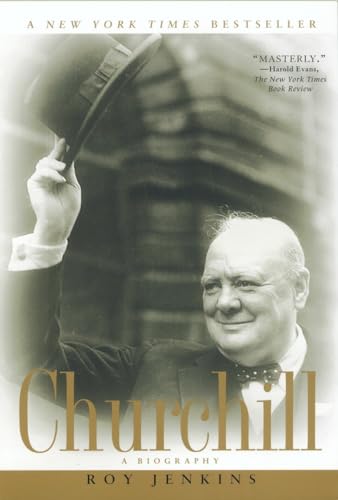
Acclaimed historian Roy Jenkins presents a comprehensive biography of Winston Churchill, an icon of modern history, from his childhood to the critical World War II period and beyond—a New York Times bestseller.
“This is a first class, well-sustained work of history and a masterpiece of biography… It will be a brave, not to say foolhardy, author who attempts to write another life of Churchill for at least a decade, perhaps longer.”—Andrew Roberts, Sunday Telegraph
Roy Jenkins combines unparalleled command of British political history and his own high-level government experience in a narrative account of Churchill's astounding career that is unmatched in its shrewd insights, its unforgettable anecdotes, the clarity of its overarching themes, and the author's nuanced appreciation of his extraordinary subject.
Exceptional in its breadth of knowledge and distinguished in its stylish wit and penetrating intelligence, Churchill is one of the finest political biographies of our time.
Die Inhaltsangabe kann sich auf eine andere Ausgabe dieses Titels beziehen.
Über die Autorin bzw. den Autor
Roy Jenkins was the author of 18 books, including Gladstone, which won the Whitbread Prize for Biography. Active in British politics for half a century, he entered the House of Commons in 1948 and subsequently served as Minister of Aviation, Home Secretary, and Chancellor of the Exchequer; he was also the President of the European Commission and Chancellor of Oxford University. He died in 2003.
Auszug. © Genehmigter Nachdruck. Alle Rechte vorbehalten.
Chapter One
A Doubtful Provenance
* * *
Churchill's provenance was aristocratic, indeed ducal, and some have seen this as the most important key to his whole career. That is unconvincing. Churchill was far too many faceted, idiosyncratic and unpredictable a character to allow himself to be imprisoned by the circumstances of his birth. His devotion to his career and his conviction that he was a man of destiny were far stronger than any class or tribal loyalty. There have been politicians of high duty and honour — Edward Halifax and Alec Douglas-Home immediately spring to mind — who did see life through spectacles much bounded by their landed background. But Churchill was emphatically not among them. Apart from anything else, he never had any land beyond his shaky ownership (and later only occupation) of the 300 acres surrounding Chartwell, the West Kent house only twenty-four miles from London which he bought in 1922 and just managed, with financial subventions from friends, to cling on to for the remaining four decades of his life.
The second reason was that the Marlborough heritage was not one which stood very high in esteem, record of public service or secure affluence. The family had a memorable swashbuckling founder in John Churchill, the victor in the first decade of the eighteenth century of the battles of Blenheim, Ramillies, Oudenaarde and Malplaquet, who acquired a fine mansion among other rewards. But even this first Duke, although he inspired Winston Churchill to write four resonant volumes of praise (and of refutation of the historian Thomas Babington Macaulay's criticism) just over 200 years after his death, was as famous for ruthless self-advancement as he was for martial prowess; and the house, as its name of Blenheim Palace implies and as its size-enhancing Vanburgh architecture was dedicated to achieving, was showy even by the standards of the time.
Subsequent holders of the dukedom contributed little distinction and much profligacy. In 1882, when the seventh in the line had been reached, Gladstone, who in general had an excessive respect for dukes, claimed that none of the Marlboroughs had shown either morals or principles. Certainly no lustre to the family name was added by the second, third or fourth Dukes. The fifth was a talented gardener, but he seriously dissipated the Marlborough fortune and had to abandon the fine subsidiary estate (now the site of Reading University) where he had exercised his botanical skills. The sixth was almost equally extravagant. The seventh, who was the father of Lord Randolph and hence the grandfather of Winston Churchill, made the nearest approach to respectability and a record of public service. He was an MP for ten years, Lord President of the Council under both Derby and Disraeli in 1867-8, and Lord Lieutenant of Ireland for the last four years of Disraeli's second government.
As a father this seventh Duke's record was at once more dramatic and more mixed. On the one hand he produced a two-generation dynasty which made the name of Churchill resound throughout Britain's national life in a way that it had not done since the death of the first Duke in 1722. On the other, the resonance, in the case of Lord Randolph, had a distinctly meretricious note to it. And Lord Randolph's elder brother was, in the words of an eminent modern historian, ‘one of the most disreputable men ever to have debased the highest rank in the British peerage’. He appropriately bore the name of Blandford, the title of the Marlborough heir, for most of his relatively short life, during which he was expelled from Eton, got caught up in two sexual scandals, one of which involved him in a violent quarrel with the Prince of Wales (in which quarrel the fault may not have been unilateral), and sold off, as a short-term staunching operation, the formidable Marlborough picture collection. About his only constructive act was to install electric light and a rudimentary form of central heating at Blenheim. That was paid for by his second wife, who as a rich American provided sustaining dollars and began a strong Churchill family tradition of looking matrimonially westward. This example was followed by both his son, the ninth Duke, Winston Churchill's cousin and near contemporary, who married two transatlantic heiresses, and by his younger brother (Lord Randolph Churchill), who married one (Winston Churchill's mother). The fortune of the father of Lady Randolph was however a little precarious. Furthermore he was unwilling to contribute much of it to the sustenance of the Churchill family.
Since the eighth Duke there have been another three Marlboroughs. Of these subsequent three, while they rose somewhat above the level of the eighth Duke, it is difficult to find much that is positive to say. Winston Churchill's family background, while nominally of the highest aristocracy, was subtly inferior to that of a Cavendish, a Russell, a Cecil or a Stanley.
He was born on 30 November 1874 and, mainly by accident, at the very core of this slightly doubtful purple — in Blenheim Palace, although in a singularly bleak-looking bedroom. The accident arose out of his being two months premature. He should have been born in January in the small but fashionable house in Charles Street, Mayfair which his father had rented to receive him, or more purposefully perhaps to use as a base for the somewhat rackety metropolitan life of which Lord Randolph and his bride of only seven and a half months' standing were equally fond. This house not being ready, they had taken autumn refuge in Blenheim, and, as Lord Randolph put it in a letter to his mother-in-law in Paris, ‘She [Lady Randolph] had a fall on Tuesday walking with the shooters, and a rather imprudent and rough drive in a pony carriage brought on the pains on Saturday night. We tried to stop them, but it was no use.’ Neither the London obstetrician nor his Oxford auxiliary could arrive in time, although it was over twenty-four hours to the birth from the onset of the labour pains, and the baby was born very early on the Monday morning with the assistance only of the Woodstock country doctor. Both mother and baby survived this paucity of attention perfectly healthily — as did the local doctor, who whether as a result or not was able himself to migrate to a London practice a decade or so later.
Everything to do with Winston Churchill's arrival in the world was done in a hurry. Perhaps Lord Randolph's most remembered phrase (and phrases were his strongest suit) was his description of Gladstone as ‘an old man in a hurry’. His own style was at least equally that of a young man in a hurry, almost in a constant frenzy of impatience, and perhaps rationally so, for, although thirty-nine years his junior, he predeceased Gladstone by three years. The hurry was pre-eminently true of his courtship of Miss Jennie Jerome. They first met at a Cowes regatta shipboard party on 12 August 1873 and became engaged to be married three days later.
There then intervened the only period of semi-stasis in the saga. The Jerome family were in fact a very suitable American family for a Marlborough alliance. Leonard Jerome was a New York financial buccaneer. Winston Churchill, in his still highly readable although hagiographic 1905 biography of his father, was to describe Jerome as having ‘founded and edited the New York Times’. This owed more to family piety than to truth. Jerome had briefly in the course of some financial deals been a part proprietor of the Times. But what he was strong in was not newspaper publishing but horse racing, having founded both the Jerome Park track and the Coney Island Jockey...
„Über diesen Titel“ kann sich auf eine andere Ausgabe dieses Titels beziehen.
Weitere beliebte Ausgaben desselben Titels

Suchergebnisse für Churchill: A Biography

Beispielbild für diese ISBN
Churchill: A Biography
Anbieter: World of Books (was SecondSale), Montgomery, IL, USA
Verkäuferbewertung 5 von 5 Sternen

Zustand: Acceptable. Item in acceptable condition including possible liquid damage. As well, answers may be filled in. Lastly, may be missing components, e.g. missing DVDs, CDs, Access Code, etc. Bestandsnummer des Verkäufers 00030051090
Gebraucht kaufen
EUR 4,05
Versand gratis
Versand innerhalb von USA
Versand innerhalb von USA
Anzahl: 3 verfügbar
Beispielbild für diese ISBN
Churchill: A Biography
Anbieter: World of Books (was SecondSale), Montgomery, IL, USA
Verkäuferbewertung 5 von 5 Sternen
Zustand: Very Good. Item in very good condition! Textbooks may not include supplemental items i.e. CDs, access codes etc. Bestandsnummer des Verkäufers 00084365804
Gebraucht kaufen
EUR 4,05
Versand gratis
Versand innerhalb von USA
Versand innerhalb von USA
Anzahl: 5 verfügbar
Beispielbild für diese ISBN
Churchill: A Biography
Anbieter: World of Books (was SecondSale), Montgomery, IL, USA
Verkäuferbewertung 5 von 5 Sternen
Zustand: Good. Item in good condition. Textbooks may not include supplemental items i.e. CDs, access codes etc. Bestandsnummer des Verkäufers 00084155183
Gebraucht kaufen
EUR 4,05
Versand gratis
Versand innerhalb von USA
Versand innerhalb von USA
Anzahl: 8 verfügbar
Beispielbild für diese ISBN
Churchill: A Biography
Anbieter: Orion Tech, Kingwood, TX, USA
Verkäuferbewertung 5 von 5 Sternen
Paperback. Zustand: Good. Bestandsnummer des Verkäufers 0452283523-3-19507104
Gebraucht kaufen
EUR 4,07
Versand gratis
Versand innerhalb von USA
Versand innerhalb von USA
Anzahl: 1 verfügbar
Beispielbild für diese ISBN
Churchill: A Biography
Anbieter: Used Book Company, Egg Harbor Township, NJ, USA
Verkäuferbewertung 5 von 5 Sternen
paperback. Zustand: VeryGood. Shows minimal signs of wear and previous use. Can include minimal notes/highlighting. A portion of your purchase benefits nonprofits! - Note: Edition & format may differ from what is shown in stock photo & item details. May not include supplementary material (toys, access code, dvds, etc). Bestandsnummer des Verkäufers 584ZST000D8X_ns
Gebraucht kaufen
EUR 4,22
Versand gratis
Versand innerhalb von USA
Versand innerhalb von USA
Anzahl: 2 verfügbar
Beispielbild für diese ISBN
Churchill: A Biography
Anbieter: Bookmonger.Ltd, HILLSIDE, NJ, USA
Verkäuferbewertung 4 von 5 Sternen

Paperback. Zustand: Very Good. Bumps on corners* Marks on edge *. Bestandsnummer des Verkäufers mon0000584168
Gebraucht kaufen
EUR 1,66
EUR 3,42 shipping
Versand innerhalb von USA
Versand innerhalb von USA
Anzahl: 7 verfügbar
Beispielbild für diese ISBN
Churchill: A Biography
Anbieter: More Than Words, Waltham, MA, USA
Verkäuferbewertung 5 von 5 Sternen
Zustand: Very Good. A bright, square, and overall a nice copy. Bestandsnummer des Verkäufers BOS-I-12b-01652
Gebraucht kaufen
EUR 1,99
EUR 3,41 shipping
Versand innerhalb von USA
Versand innerhalb von USA
Anzahl: 1 verfügbar
Beispielbild für diese ISBN
Churchill: A Biography
Anbieter: More Than Words, Waltham, MA, USA
Verkäuferbewertung 5 von 5 Sternen
Zustand: Good. A sound copy with only light wear. Overall a solid copy at a great price! Bestandsnummer des Verkäufers BOS-H-11f-01983
Gebraucht kaufen
EUR 1,99
EUR 3,41 shipping
Versand innerhalb von USA
Versand innerhalb von USA
Anzahl: 1 verfügbar
Beispielbild für diese ISBN
Churchill
Anbieter: BookHolders, Towson, MD, USA
Verkäuferbewertung 5 von 5 Sternen
Zustand: Fair. [ No Hassle 30 Day Returns ][ Ships Daily ] [ Underlining/Highlighting: NONE ] [ Writing: NONE ] [ Torn pages: YES ] [ Edition: Reprint ] Publisher: Plume Pub Date: 11/1/2002 Binding: Paperback Pages: 1024 Reprint edition. Bestandsnummer des Verkäufers 6758000
Gebraucht kaufen
EUR 2,13
EUR 3,63 shipping
Versand innerhalb von USA
Versand innerhalb von USA
Anzahl: 1 verfügbar
Beispielbild für diese ISBN
Churchill
Anbieter: ThriftBooks-Dallas, Dallas, TX, USA
Verkäuferbewertung 5 von 5 Sternen
Paperback. Zustand: Very Good. No Jacket. May have limited writing in cover pages. Pages are unmarked. ~ ThriftBooks: Read More, Spend Less. Bestandsnummer des Verkäufers G0452283523I4N00
Gebraucht kaufen
EUR 5,82
Versand gratis
Versand innerhalb von USA
Versand innerhalb von USA
Anzahl: 1 verfügbar