
Verwandte Artikel zu The Renewable City: A comprehensive guide to an urban...
Inhaltsangabe
Despite the intolerable costs of climate change and inevitably declining oil, natural gas and uranium reserves, the vast majority of cities and urban communities are planned and managed as if such existential crises did not exist. Hence the transition from fossil fuel dominated cities to an urban future marked by a radically new, renewable energy infrastructure requires entirely new tools and frames of decision-making.
This is an original guide to an entirely unprecedented urban transformation, to cities and towns powered by renewable energy. Squarely focused on action, it supports design, planning and management decisions and serves as a practical guide to practitioners, academics and political leaders in communities and cities worldwide, as a useful and well-structured reference text. It is built on the most successful of past and present urban sustainability trends and emerging infrastructure directions, presenting renewable energy applications as offering new and inevitable approaches to urban infrastructure planning and the design of cities.
Die Inhaltsangabe kann sich auf eine andere Ausgabe dieses Titels beziehen.
Von der hinteren Coverseite
Frequently the site of crisis or turmoil, individual cities can be fragile environments. For the first time in history, however, the future of the entire urban system is being thrown into doubt. Catastrophic climate changes threaten the life support of hundreds of millions, perhaps billions, of urban dwellers around the world. Supplies of fossil fuels, especially oil and natural gas, are declining worldwide. Modern cities not only depend on petroleum products for their power, but also for their goods and services – including the making and packaging of virtually all food. How might this precarious global condition be turned around? How can the energy infrastructure of cities, towns and rural settlements be restructured, to confront the environmental challenges of our time? Could a new, positive global vision emerge out of the impending, massive shift from unsustainable fuels to a renewable energy base?
Opening with a definition of renewable power, the book concisely sets out the fundamental logic and philosophical framework of the urban energy revolution. It then progresses to look at how cities best attempt adaptation to accelerating, anthropogenic climate change: by mitigating it and fighting its root causes. Two central chapters map the spatial implications of the urban renewable energy transformation and the new technologies that might be involved in successfully creating the renewable city. The guide not only compares different approaches to creating renewable cities, but also examines various sustainable building assessment and design tools. The volume concludes with an easy to use best-practice template for local governments and planners, applying lessons from advanced cities around the world
Aus dem Klappentext
Frequently the site of crisis or turmoil, individual cities can be fragile environments. For the first time in history, however, the future of the entire urban system is being thrown into doubt. Catastrophic climate changes threaten the life support of hundreds of millions, perhaps billions, of urban dwellers around the world. Supplies of fossil fuels, especially oil and natural gas, are declining worldwide. Modern cities not only depend on petroleum products for their power, but also for their goods and services – including the making and packaging of virtually all food. How might this precarious global condition be turned around? How can the energy infrastructure of cities, towns and rural settlements be restructured, to confront the environmental challenges of our time? Could a new, positive global vision emerge out of the impending, massive shift from unsustainable fuels to a renewable energy base?
Opening with a definition of renewable power, the book concisely sets out the fundamental logic and philosophical framework of the urban energy revolution. It then progresses to look at how cities best attempt adaptation to accelerating, anthropogenic climate change: by mitigating it and fighting its root causes. Two central chapters map the spatial implications of the urban renewable energy transformation and the new technologies that might be involved in successfully creating the renewable city. The guide not only compares different approaches to creating renewable cities, but also examines various sustainable building assessment and design tools. The volume concludes with an easy to use best-practice template for local governments and planners, applying lessons from advanced cities around the world
Auszug. © Genehmigter Nachdruck. Alle Rechte vorbehalten.
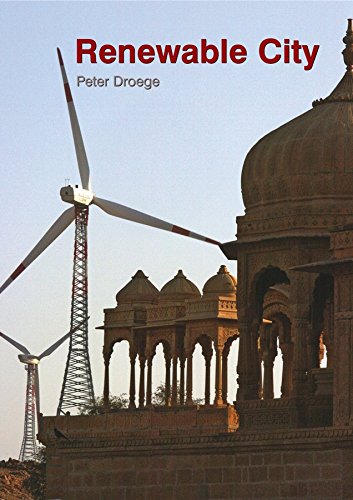
The Renewable City
A comprehensive guide to an urban revolution By Peter DroegeJohn Wiley & Sons
Copyright © 2006 Peter DroegeAll right reserved.
ISBN: 978-0-470-01926-9
Chapter One
In the hothouse, beyond the peak: the logic of the urban energy revolution
1.1 ENERGY AND URBAN SUSTAINABILITY IN THE 21ST CENTURY
The secret of great wealth with no obvious source is some forgotten crime, forgotten because it was done neatly. Balzac (in Manning 2004)
Our time has been declared the age of the city. Urban centres are heralded as the engines of the global economy. A large library of books and articles hails cities as drivers of national prosperity and home of the leaders in creativity and innovation (Castells 2000; Florida 2002; Friedmann and Wulff 1976; Hall 1977; Hall 1998; Jacobs 1985; Mazza 1988; Sassen 1991, 1994/2000). The city-giddy genre has fuelled a worldwide urban marketing frenzy, while sparing not a thought for the most basic and most tenuous of all present growth drivers: cheap and abundant fossil fuel. Among the best researched and most thoughtful of these texts is Saskia Sassen's Cities in a World Economy (Sassen 1994/2000) which attempts to describe the global economic system without reference to its underlying fossil energy economy: it ignores the very engine that propels the much-admired global financial industry. Examined critically, the financial sector is but the froth on the churning, petroleum-rich global resource consumption and value-adding streams. And while Peter Hall's definitive tome on Western Cities in Civilisation (Hall 1998) did describe the electrification of Berlin as contributing to its cultural ascent, it misses altogether the larger nexus of the 20th-century fossil fuel revolution and the rise of contemporary urbanity and urbanism. There are, however, several soberer and specialised studies emerging, on cities, energy and greenhouse gas emissions, that provide an insight into broader urban policy and institutional change, such as a study examining urban energy use and greenhouse gas emissions in Tokyo, Seoul, Beijing and Shanghai, produced at the Japan-based Institute for Global Environment Strategies (IGES) (Dhakal 2004).
But in general, dreams about attaining city salvation in the nirvana of comparative advantage - the obssession of many city governments with achieving economic superiority - have distracted urban observers from facing the sobering reality that the urban world thrives on a rich Petri dish of only temporarily plentiful petroleum nutrients. Conceptually, both the modern ideal and its post-modern critique drift blindly on the vast, warm ocean of wasteful abundance that has been engendered by the empowering regime of coal, petroleum, natural gas and uranium combustion during the 20th century. The amplifying force of these new power facilitators helped to accelerate dramatically the exploitation of natural resources, feeding the present dogma of massive and conspicuous consumption as the global religion of progress (Sloterdijk 2005). The energy blindness of current urban literature is understandable, given that fossil fuels have had an overwhelming role in defining and determining virtually all aspects of contemporary social, technological and cultural reality. Ironically the energy question has been largely ignored within infrastructure engineering or urban economics, too.
Understandable it may be, but not forgivable given the enormously erroneous conclusions that can be drawn from a partial understanding of the world. A favoured soundbite featured in urban policy conferences holds that close to half the earth's population 'lives in cities' or, more accurately, in areas defined as urban or urbanised in one form or another. This reinforces the truism that virtually all of the present global population increase is registered in urban areas. Yet no migrational phenomenon - the impetus of a rural exodus or the massive pull by the electrified metropolises of the developing world - supports the suggestion that higher cultural destinies or basic evolutionary principles are being fulfilled in the urbanisation phenomenon. No new or eternal age of cities is upon us as a preordained crowning of human civilisation. There is also considerable lack of clarity, to say the least, about the root causes of urbanisation: some argue that it is triggered by changes in global and regional economies; others point to structural adjustment policies eroding the viability of rural productivity and places; and quite a few have taken the compelling statistics as cultural epiphany: they sincerely believe that the world's population is waking up to the fact that universal human progress and destiny lie in cities. Some of these and other factors are certainly at work but these alone could not exert a powerful force for urbanisation without the 20th-century's fossil energy regime having performed as the primary architect and driver of urban evolution.
Modern cities thrive on petroleum
There would be no modern form of globalisation without global, fossil-fuel charged supply chains, trade routes or military hardware. It can be argued - however moot and meaningless such fascinating speculation might be - that had the Industrial Revolution led to a path of renewable technological innovation, there would be no modern cities, no internet, no global shipping industry, no air traffic, no modern weaponry - certainly not in the form that these are known and understood today. Renewable energy optimists would argue that today civilisation would be far more advanced, could expect superior survival prospects, substantially less pollution and exist on a far smaller ecological footprint within a general realm of ecological equilibrium. Pessimistic fossil apologists would insist that humanity would either be stuck in renewably charged quasi-tribal, proto-democratic territorial skirmishes, or have arrived at a solar doomsday machine by now, given its most powerful nations' well-established appetite for and meticulously honed skills in conquest and destruction. Whatever the type of retrospective futurism in which one wishes to indulge, it is difficult to overstate the significance of black gold in defining virtually everything that cities are today: spatially, economically and culturally.
It is also important to remember that the fossil fuel regime creates an enormous drag on global and local prosperity. Trillions of dollars in damages are incurred annually - including social and environmental costs - in warfare, human exploitation, oil spills, soil and groundwater pollution, freshwater depletion, and wide-spread disease and deaths due to cancer and respiratory ailments triggered by toxic gases and airborne particles. The rising insurance and reinsurance claims arising from climate-change prompted weather events alone are staggering. Storm damage cover in the United States grew sixty-fold between the 1950s and 1990s, to US$ 6 billion annually (Mills 2005). World Bank studies show that China's fossil air pollution is responsible for US$ 50 billion in health costs every year: in the European Union these costs are estimated as US$ 70 billion (Geller 2002). This gargantuan cost of doing business is disregarded in planning the energy systems of new urban areas, industries or infrastructure investments. The promising City of Tomorrow is heavily discounted: its intrinsic value substantially diminished by the enormous price to be paid.
In contrast, the prospect of a pervasive global renewable-energy matrix...
„Über diesen Titel“ kann sich auf eine andere Ausgabe dieses Titels beziehen.
Suchergebnisse für The Renewable City: A comprehensive guide to an urban...

Foto des Verkäufers
The Renewable City: A comprehensive guide to an urban revolution (English and Italian Edition)
Anbieter: Bay State Book Company, North Smithfield, RI, USA
Verkäuferbewertung 5 von 5 Sternen

Zustand: very_good. Bestandsnummer des Verkäufers BSM.189D8
Gebraucht kaufen
EUR 5,97
Versand gratis
Versand innerhalb von USA
Versand innerhalb von USA
Anzahl: 1 verfügbar
Beispielbild für diese ISBN
The Renewable City: A comprehensive guide to an urban revolution (English and Italian Edition)
Anbieter: Wonder Book, Frederick, MD, USA
Verkäuferbewertung 5 von 5 Sternen
Zustand: Good. Good condition. English and Italian Edition. A copy that has been read but remains intact. May contain markings such as bookplates, stamps, limited notes and highlighting, or a few light stains. Bestandsnummer des Verkäufers V18A-05362
Gebraucht kaufen
EUR 6,28
Versand gratis
Versand innerhalb von USA
Versand innerhalb von USA
Anzahl: 1 verfügbar
Beispielbild für diese ISBN
The Renewable City: A Comprehensive Guide to an Urban Revolution
Anbieter: ThriftBooks-Atlanta, AUSTELL, GA, USA
Verkäuferbewertung 5 von 5 Sternen
Paperback. Zustand: Very Good. No Jacket. May have limited writing in cover pages. Pages are unmarked. ~ ThriftBooks: Read More, Spend Less. Bestandsnummer des Verkäufers G0470019263I4N00
Gebraucht kaufen
EUR 7,58
Versand gratis
Versand innerhalb von USA
Versand innerhalb von USA
Anzahl: 1 verfügbar
Beispielbild für diese ISBN
The Renewable City: A Comprehensive Guide to An Urban Revolution
Anbieter: Anybook.com, Lincoln, Vereinigtes Königreich
Verkäuferbewertung 5 von 5 Sternen
Zustand: Good. This is an ex-library book and may have the usual library/used-book markings inside.This book has soft covers. In good all round condition. Please note the Image in this listing is a stock photo and may not match the covers of the actual item,700grams, ISBN:9780470019269. Bestandsnummer des Verkäufers 8832254
Gebraucht kaufen
EUR 3,01
EUR 15,86 Versand
Versand von Vereinigtes Königreich nach USA
Versand von Vereinigtes Königreich nach USA
Anzahl: 1 verfügbar
Beispielbild für diese ISBN
The Renewable City: A Comprehensive Guide to An Urban Revolution
Anbieter: Anybook.com, Lincoln, Vereinigtes Königreich
Verkäuferbewertung 5 von 5 Sternen
Zustand: Fair. This is an ex-library book and may have the usual library/used-book markings inside.This book has soft covers. In fair condition, suitable as a study copy. Please note the Image in this listing is a stock photo and may not match the covers of the actual item,700grams, ISBN:9780470019269. Bestandsnummer des Verkäufers 8832253
Gebraucht kaufen
EUR 3,01
EUR 15,86 Versand
Versand von Vereinigtes Königreich nach USA
Versand von Vereinigtes Königreich nach USA
Anzahl: 1 verfügbar
Beispielbild für diese ISBN
The Renewable City: A comprehensive guide to an urban revolution (English and Italian Edition)
Anbieter: Phatpocket Limited, Waltham Abbey, HERTS, Vereinigtes Königreich
Verkäuferbewertung 5 von 5 Sternen
Zustand: Good. Your purchase helps support Sri Lankan Children's Charity 'The Rainbow Centre'. Ex-library, so some stamps and wear, but in good overall condition. Our donations to The Rainbow Centre have helped provide an education and a safe haven to hundreds of children who live in appalling conditions. Bestandsnummer des Verkäufers Z1-U-014-01990
Gebraucht kaufen
EUR 19,58
EUR 12,41 Versand
Versand von Vereinigtes Königreich nach USA
Versand von Vereinigtes Königreich nach USA
Anzahl: 1 verfügbar
Beispielbild für diese ISBN
The Renewable City : A Comprehensive Guide to an Urban Revolution
Verlag:
John Wiley & Sons, West Sussex UK, 2008
ISBN 10: 0470019263
ISBN 13: 9780470019269
Gebraucht
Soft cover
Anbieter: Ripponlea Books, Melbourne, VIC, Australien
Verkäuferbewertung 4 von 5 Sternen

Soft cover. Zustand: Near Fine. Reprinted. Pictorial covers, b/w plts., illust., diag., gloss., ref., index. Slight crease along spine, light shelf wear, o/w NF. Opening with a definition of renewable power, the book concisely sets out the fundamental logic and philosophical framework of the urban energy revolution. The volume concludes with an easy to use best-practised template for local governments and planners, applying lessons from advanced cities around the world. Size: Octavo. Book. Bestandsnummer des Verkäufers 000135
Gebraucht kaufen
EUR 30,06
EUR 15,70 Versand
Versand von Australien nach USA
Versand von Australien nach USA
Anzahl: 1 verfügbar
Beispielbild für diese ISBN
The Renewable City: A comprehensive guide to an urban revolution
Verlag:
Wiley-Academy, Chichester, West Sussex, 2008
ISBN 10: 0470019263
ISBN 13: 9780470019269
Gebraucht
Soft cover
Anbieter: Teapot Books and Records, St Arnaud, VIC, Australien
Verkäuferbewertung 4 von 5 Sternen
Soft cover. Zustand: Near Fine. Reprint. Condition: Near Fine. 21.5 x 17 cm. 310 pp. Bestandsnummer des Verkäufers 000172
Gebraucht kaufen
EUR 25,58
EUR 21,81 Versand
Versand von Australien nach USA
Versand von Australien nach USA
Anzahl: 1 verfügbar
Foto des Verkäufers
Renewable City : A Comprehensive Guide to an Urban Revolution
Anbieter: GreatBookPrices, Columbia, MD, USA
Verkäuferbewertung 5 von 5 Sternen
Zustand: As New. Unread book in perfect condition. Bestandsnummer des Verkäufers 3469290
Gebraucht kaufen
EUR 52,64
EUR 2,30 Versand
Versand innerhalb von USA
Versand innerhalb von USA
Anzahl: Mehr als 20 verfügbar
Beispielbild für diese ISBN
The Renewable City
Anbieter: PBShop.store UK, Fairford, GLOS, Vereinigtes Königreich
Verkäuferbewertung 5 von 5 Sternen
PAP. Zustand: New. New Book. Shipped from UK. Established seller since 2000. Bestandsnummer des Verkäufers FW-9780470019269
Neu kaufen
EUR 50,07
EUR 5,85 Versand
Versand von Vereinigtes Königreich nach USA
Versand von Vereinigtes Königreich nach USA
Anzahl: 15 verfügbar