
Verwandte Artikel zu Common Sense on Mutual Funds, Updated 10th Anniversary...
Common Sense on Mutual Funds, Updated 10th Anniversary Edition: New Imperatives for the Intelligent Investor. Forew. by David Swensen - Hardcover
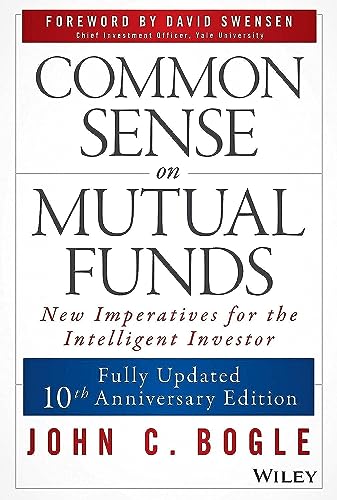
Inhaltsangabe
John C. Bogle shares his extensive insights on investing in mutual funds
Since the first edition of Common Sense on Mutual Funds was published in 1999, much has changed, and no one is more aware of this than mutual fund pioneer John Bogle. Now, in this completely updated Second Edition, Bogle returns to take another critical look at the mutual fund industry and help investors navigate their way through the staggering array of investment alternatives that are available to them.
Written in a straightforward and accessible style, this reliable resource examines the fundamentals of mutual fund investing in today's turbulent market environment and offers timeless advice in building an investment portfolio. Along the way, Bogle shows you how simplicity and common sense invariably trump costly complexity, and how a low cost, broadly diversified portfolio is virtually assured of outperforming the vast majority of Wall Street professionals over the long-term.
- Written by respected mutual fund industry legend John C. Bogle
- Discusses the timeless fundamentals of investing that apply in any type of market
- Reflects on the structural and regulatory changes in the mutual fund industry
- Other titles by Bogle: The Little Book of Common Sense Investing and Enough.
Securing your financial future has never seemed more difficult, but you'll be a better investor for having read the Second Edition of Common Sense on Mutual Funds.
Die Inhaltsangabe kann sich auf eine andere Ausgabe dieses Titels beziehen.
Über die Autorin bzw. den Autor
John C. Bogle is founder of the Vanguard Mutual Fund Group and President of its Bogle Financial Markets Research Center. He created Vanguard in 1974 and served as chairman and chief executive officer until 1996 and senior chairman until 2000. In 1999, Fortune magazine named Mr. Bogle as one of the four "Investment Giants" of the twentieth century; in 2004, Time named him one of the world's 100 most powerful and influential people; and Institutional Investor presented him with its Lifetime Achievement Award. Bogle is also the author of Enough. and The Little Book of Common Sense Investing, both published by Wiley.
Von der hinteren Coverseite
Praise for The Original 1998 Edition
"Cogent, honest, and hard-hitting―a must read-for every investor."
―Warren E. Buffett
Praise for Common Sense On Mutual Funds fully updated 10th anniversary edition
"The only thing better than Bogle's original book is its improved revision. Bon appetit!"
―Paul A. Samuelson, Nobel Laureate, Economics
"Were I allowed to recommend only one investment volume to friends and family, the updated edition of Common Sense on Mutual Funds would be it―it is even better than the first edition was ten years ago."
―William J. Bernstein, author of The Investor's Manifesto, A Splendid Exchange, The Birth of Plenty, and The Four Pillars of Investing
"How do you improve upon perfection? Well, with this tenth anniversary edition of Common Sense on Mutual Funds, the best mutual fund primer just got better."
―Don Phillips, Managing Director, Morningstar
"In this timely update of Common Sense on Mutual Funds, John Bogle improves on what was the finest book on mutual funds ever written."
―Jane Bryant Quinn, financial columnist and author of Smart and Simple Financial Strategies for Busy People
"Jack Bogle cares passionately about everyday Americans―and that passion is palpable in these pages. This new edition of Common Sense on Mutual Funds will send you marching into the financial markets with a sense of mission."
―Jonathan Clements, author of The Little Book of Main Street Money
"When the history of modern investment management is written, John Bogle will stand out as one of its towering figures."
―Byron R. Wien, Vice Chairman, Blackstone Advisory Services
"A powerful no-nonsense prescription for how individual investors should structure their portfolios in the current market environment."
―Martin Leibowitz, Managing Director, Morgan Stanley
Aus dem Klappentext
John Bogle―founder of the Vanguard Mutual Fund Group and creator of the first index mutual fund―is an industry pioneer. Over the years, he has single-handedly transformed the mutual fund business, and today, his vision continues to inspire investors.
It has been over a decade since the original edition of Common Sense on Mutual Funds was first published. While much has changed during this time, the importance of investing and the issues addressed in the original edition of this book have not. Now, in the Fully Updated 10th Anniversary Edition of Common Sense on Mutual Funds, Bogle returns to update his in-depth look at mutual funds and the business of investing―helping you navigate through the staggering array of investment options found in today's evolving investment landscape.
Timely and timeless, this important book examines the fundamentals of mutual fund investing in turbulent market environments and offers valuable guidance for building an investment portfolio. Along the way, Bogle shows you that simplicity and common sense still trump costly complexity, and that a low cost, broadly diversified portfolio continues to be the best way to build wealth at the lowest cost and risk―and will almost always outperform more expensive, actively managed mutual funds.
Throughout these pages, Bogle skillfully presents a platform for intelligent investing as he analyzes costs, exposes tax inefficiencies, and warns of the mutual fund industry's conflicting interests. Emphasizing long-term investing and asset allocation, Bogle offers sensible solutions to the fund selection process and reveals what it will take to make it in today's chaotic market. Updated charts, which also show original data, as well as new commentary and analysis provide timely guidance in light of recent changes in investment vehicles and market performance.
Securing your financial future has never seemed more difficult, but after reading this revised and updated edition of Common Sense on Mutual Funds, you will become a better investor. From stock and bond funds to global investing and index funds, this book will help you regain your financial footing and make more informed investment decisions.
Auszug. © Genehmigter Nachdruck. Alle Rechte vorbehalten.
Common Sense on Mutual Funds
By John C. Bogle David F. SwensenJohn Wiley & Sons
Copyright © 2010 John Wiley & Sons, LtdAll right reserved.
ISBN: 978-0-470-13813-7
Chapter One
On Long-Term InvestingChance and the Garden
Investing is an act of faith. We entrust our capital to corporate stewards in the faith-at least with the hope-that their efforts will generate high rates of return on our investments. When we purchase corporate America's stocks and bonds, we are professing our faith that the long-term success of the U.S. economy and the nation's financial markets will continue in the future.
When we invest in a mutual fund, we are expressing our faith that the professional managers of the fund will be vigilant stewards of the assets we entrust to them. We are also recognizing the value of diversification by spreading our investments over a large number of stocks and bonds. A diversified portfolio minimizes the risk inherent in owning any individual security by shifting that risk to the level of the stock and bond markets.
Americans' faith in investing has waxed and waned, kindled by bull markets and chilled by bear markets, but it has remained intact. It has survived the Great Depression, two world wars, the rise and fall of communism, and a barrage of unnerving changes: booms and bankruptcies, inflation and deflation, shocks in commodity prices, the revolution in information technology, and the globalization of financial markets. In recent years, our faith has been enhanced-perhaps excessively so-by the bull market in stocks that began in 1982 and has accelerated, without significant interruption, toward the century's end. As we approach the millennium, confidence in equities is at an all-time high.
Chance, the Garden, and Long-Term Investing
Might some unforeseeable economic shock trigger another depression so severe that it would destroy our faith in the promise of investing? Perhaps. Excessive confidence in smooth seas can blind us to the risk of storms. History is replete with episodes in which the enthusiasm of investors has driven equity prices to-and even beyond-the point at which they are swept into a whirlwind of speculation, leading to unexpected losses. There is little certainty in investing. As long-term investors, however, we cannot afford to let the apocalyptic possibilities frighten us away from the markets. For without risk there is no return.
Another word for "risk" is "chance." And in today's high-f lying, fast-changing, complex world, the story of Chance the gardener contains an inspirational message for long-term investors. The seasons of his garden find a parallel in the cycles of the economy and the financial markets, and we can emulate his faith that their patterns of the past will define their course in the future.
Chance is a man who has grown to middle age living in a solitary room in a rich man's mansion, bereft of contact with other human beings. He has two all-consuming interests: watching television and tending the garden outside his room. When the mansion's owner dies, Chance wanders out on his first foray into the world. He is hit by the limousine of a powerful industrialist who is an adviser to the President. When he is rushed to the industrialist's estate for medical care, he identifies himself only as "Chance the gardener." In the confusion, his name quickly becomes "Chauncey Gardiner."
When the President visits the industrialist, the recuperating Chance sits in on the meeting. The economy is slumping; America's blue-chip corporations are under stress; the stock market is crashing. Unexpectedly, Chance is asked for his advice:
Chance shrank. He felt the roots of his thoughts had been suddenly yanked out of their wet earth and thrust, tangled, into the unfriendly air. He stared at the carpet. Finally, he spoke: "In a garden," he said, "growth has its season. There are spring and summer, but there are also fall and winter. And then spring and summer again. As long as the roots are not severed, all is well and all will be well."
He slowly raises his eyes, and sees that the President seems quietly pleased-indeed, delighted-by his response.
"I must admit, Mr. Gardiner, that is one of the most refreshing and optimistic statements I've heard in a very, very long time. Many of us forget that nature and society are one. Like nature, our economic system remains, in the long run, stable and rational, and that's why we must not fear to be at its mercy.... We welcome the inevitable seasons of nature, yet we are upset by the seasons of our economy! How foolish of us."
This story is not of my making. It is a brief summary of the early chapters of Jerzy Kosinski's novel Being There, which was made into a memorable film starring the late Peter Sellers. Like Chance, I am basically an optimist. I see our economy as healthy and stable. It is still marked by seasons of growth and seasons of decline, but its roots have remained strong. Despite the changing seasons, our economy has persisted in an upward course, rebounding from the blackest calamities.
Figure 1.1 chronicles our economy's growth in the twentieth century. Even in the darkest days of the Great Depression, faith in the future has been rewarded. From 1929 to 1933, the nation's economic output declined by a cumulative 27 percent. Recovery followed, however, and our economy expanded by a cumulative 50 percent through the rest of the 1930s. From 1944 to 1947, when the economic infrastructure designed for the Second World War had to be adapted to the peace-time production of goods and services, the U.S. economy tumbled into a short but sharp period of contraction, with output shrinking by 13 percent. But we then entered a season of growth, and within four years had recovered all of the lost output. In the next five decades, our economy evolved from a capital-intensive industrial economy, keenly sensitive to the rhythms of the business cycle, to an enormous service economy, less susceptible to extremes of boom and bust.
Long-term growth, at least in the United States, seems to have defined the course of economic events. Our real gross national product (GNP) has risen, on average, 3 percent annually during the twentieth century, and 2.9 percent annually in the half-century following the end of World War II-what might be called the modern economic era. We will inevitably continue to experience seasons of decline, but we can be confident that they will be succeeded by the reappearance of the long-term pattern of growth.
Within the repeated cycle of colorful autumns, barren winters, verdant springs, and warm summers, the stock market has also traced a rising secular trajectory. In this chapter, I review the long-term returns and risks of the most important investment assets: stocks and bonds. The historical record contains lessons that form the basis of successful investment strategy. I hope to show that the historical data support one conclusion with unusual force: To invest with success, you must be a long-term investor. The stock and bond markets are unpredictable on a short-term basis, but their long-term patterns of risk and return have proved durable enough to serve as the basis for a long-term strategy that leads to investment success. Although there is no guarantee that these patterns of the past, no matter how deeply ingrained in the historical record, will prevail in the future, a study of the past, accompanied by a self-administered dose of...
„Über diesen Titel“ kann sich auf eine andere Ausgabe dieses Titels beziehen.
Suchergebnisse für Common Sense on Mutual Funds, Updated 10th Anniversary...

Beispielbild für diese ISBN
Common Sense on Mutual Funds: Fully Updated 10th Anniversary Edition
Anbieter: More Than Words, Waltham, MA, USA
Verkäuferbewertung 5 von 5 Sternen

Zustand: Good. . . Before placing your order for please contact us for confirmation on the book's binding. Check out our other listings to add to your order for discounted shipping. All orders guaranteed and ship within 24 hours. Bestandsnummer des Verkäufers BOS-I-13d-02095
Gebraucht kaufen
EUR 2,08
EUR 3,56 Versand
Versand innerhalb von USA
Versand innerhalb von USA
Anzahl: 1 verfügbar
Beispielbild für diese ISBN
Common Sense on Mutual Funds, Updated 10th Anniversary Edition
Anbieter: World of Books (was SecondSale), Montgomery, IL, USA
Verkäuferbewertung 5 von 5 Sternen
Hardback. Zustand: Fair. John Bogle is a revolutionary pioneer of championing better funds at lower costs to investors. This Second Edition is updated to fully reflect structural and regulatory changes in the industry since he published his first edition of Common Sense on Mutual Funds. Bestandsnummer des Verkäufers 00109310384
Gebraucht kaufen
EUR 5,74
Versand gratis
Versand innerhalb von USA
Versand innerhalb von USA
Anzahl: 2 verfügbar
Beispielbild für diese ISBN
Common Sense on Mutual Funds, Updated 10th Anniversary Edition
Anbieter: World of Books (was SecondSale), Montgomery, IL, USA
Verkäuferbewertung 5 von 5 Sternen
Hardback. Zustand: Good. John Bogle is a revolutionary pioneer of championing better funds at lower costs to investors. This Second Edition is updated to fully reflect structural and regulatory changes in the industry since he published his first edition of Common Sense on Mutual Funds. Bestandsnummer des Verkäufers 00103205445
Gebraucht kaufen
EUR 5,74
Versand gratis
Versand innerhalb von USA
Versand innerhalb von USA
Anzahl: 13 verfügbar
Foto des Verkäufers
Common Sense on Mutual Funds, Updated 10th Anniversary Edition
Anbieter: -OnTimeBooks-, Phoenix, AZ, USA
Verkäuferbewertung 5 von 5 Sternen
Zustand: very_good. Gently read. May have name of previous ownership, or ex-library edition. Binding tight; spine straight and smooth, with no creasing; covers clean and crisp. Minimal signs of handling or shelving. 100% GUARANTEE! Shipped with delivery confirmation, if you're not satisfied with purchase please return item! Ships USPS Media Mail. Bestandsnummer des Verkäufers OTV.0470138130.VG
Gebraucht kaufen
EUR 6,43
Versand gratis
Versand innerhalb von USA
Versand innerhalb von USA
Anzahl: 3 verfügbar
Beispielbild für diese ISBN
Common Sense on Mutual Funds, Updated 10th Anniversary Edition
Anbieter: ThriftBooks-Atlanta, AUSTELL, GA, USA
Verkäuferbewertung 5 von 5 Sternen
Hardcover. Zustand: Good. No Jacket. Former library book; Pages can have notes/highlighting. Spine may show signs of wear. ~ ThriftBooks: Read More, Spend Less. Bestandsnummer des Verkäufers G0470138130I3N10
Gebraucht kaufen
EUR 6,46
Versand gratis
Versand innerhalb von USA
Versand innerhalb von USA
Anzahl: 1 verfügbar
Beispielbild für diese ISBN
Common Sense on Mutual Funds, Updated 10th Anniversary Edition
Anbieter: ThriftBooks-Reno, Reno, NV, USA
Verkäuferbewertung 5 von 5 Sternen
Hardcover. Zustand: Good. No Jacket. Missing dust jacket; Pages can have notes/highlighting. Spine may show signs of wear. ~ ThriftBooks: Read More, Spend Less. Bestandsnummer des Verkäufers G0470138130I3N01
Gebraucht kaufen
EUR 6,46
Versand gratis
Versand innerhalb von USA
Versand innerhalb von USA
Anzahl: 1 verfügbar
Beispielbild für diese ISBN
Common Sense on Mutual Funds, Updated 10th Anniversary Edition
Anbieter: ThriftBooks-Atlanta, AUSTELL, GA, USA
Verkäuferbewertung 5 von 5 Sternen
Hardcover. Zustand: Good. No Jacket. Missing dust jacket; Pages can have notes/highlighting. Spine may show signs of wear. ~ ThriftBooks: Read More, Spend Less. Bestandsnummer des Verkäufers G0470138130I3N01
Gebraucht kaufen
EUR 6,46
Versand gratis
Versand innerhalb von USA
Versand innerhalb von USA
Anzahl: 1 verfügbar
Beispielbild für diese ISBN
Common Sense on Mutual Funds, Updated 10th Anniversary Edition
Anbieter: ThriftBooks-Reno, Reno, NV, USA
Verkäuferbewertung 5 von 5 Sternen
Hardcover. Zustand: Very Good. No Jacket. Former library book; May have limited writing in cover pages. Pages are unmarked. ~ ThriftBooks: Read More, Spend Less. Bestandsnummer des Verkäufers G0470138130I4N10
Gebraucht kaufen
EUR 6,46
Versand gratis
Versand innerhalb von USA
Versand innerhalb von USA
Anzahl: 2 verfügbar
Beispielbild für diese ISBN
Common Sense on Mutual Funds, Updated 10th Anniversary Edition
Anbieter: ThriftBooks-Atlanta, AUSTELL, GA, USA
Verkäuferbewertung 5 von 5 Sternen
Hardcover. Zustand: Fair. No Jacket. Former library book; Readable copy. Pages may have considerable notes/highlighting. ~ ThriftBooks: Read More, Spend Less. Bestandsnummer des Verkäufers G0470138130I5N10
Gebraucht kaufen
EUR 6,46
Versand gratis
Versand innerhalb von USA
Versand innerhalb von USA
Anzahl: 2 verfügbar
Beispielbild für diese ISBN
Common Sense on Mutual Funds, Updated 10th Anniversary Edition
Anbieter: ThriftBooks-Dallas, Dallas, TX, USA
Verkäuferbewertung 5 von 5 Sternen
Hardcover. Zustand: Very Good. No Jacket. Missing dust jacket; May have limited writing in cover pages. Pages are unmarked. ~ ThriftBooks: Read More, Spend Less. Bestandsnummer des Verkäufers G0470138130I4N01
Gebraucht kaufen
EUR 6,46
Versand gratis
Versand innerhalb von USA
Versand innerhalb von USA
Anzahl: 2 verfügbar