
Verwandte Artikel zu The ADD / ADHD Checklist: A Practical Reference for...
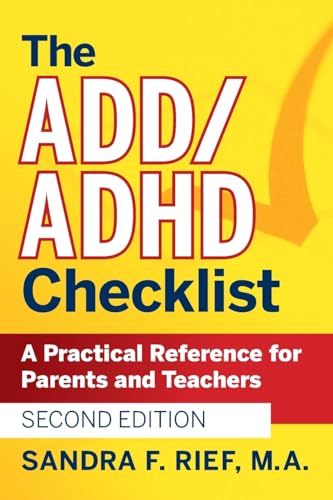
The ADD / ADHD Checklist: A Practical Reference for Parents and Teachers (J-B Ed: Checklist) - Softcover
Inhaltsangabe
The bestselling guide, fully revised and updated, offering practical information and tips to help every child with ADHD succeed
The ADD/ADHD Checklist helps parents and teachers to better understand children and teenagers with attention problems and provide the kind of support and intervention that is crucial to kids' success. Presented in a concise, easy-to-read checklist format, the book is packed with practical advice and information on a wide range of topics, including what we do and don't know about ADHD, probable causes, critical elements for school success, the most commonly prescribed medications, what children with ADHD need at home, effective behavioral strategies, how to help kids stay organized, and advocating for an ADHD child.
Die Inhaltsangabe kann sich auf eine andere Ausgabe dieses Titels beziehen.
Über die Autorin bzw. den Autor
Sandra F. Rief, M.A., is an internationally known speaker, teacher trainer, educational consultant, and author or coauthor of several bestselling books including How to Reach and Teach Children with ADD/ADHD and How to Reach and Teach All Children in the Inclusive Classroom. For more information, go to www.sandrarief.com.
Von der hinteren Coverseite
The ADD/ADHD Checklist
The "go to" reference for parents and teachers―fully revised and updated! Whether you are a parent of a child with attention problems or a classroom teacher, this book will help you better understand children and teenagers with ADD/ADHD and give you tools to help them succeed. Sandra Rief, an internationally known expert on ADD/ADHD, offers you the most current information available on the disorder and practical advice on a wide range of topics:
- General information about ADD/ADHD
- The most common treatments for ADD/ADHD
- Practical suggestions for managing ADD/ADHD at home
- Strategies to help kids with ADD/ADHD succeed at school
- Techniques and supports that teachers can use with all students in the classroom,including those with ADD/ADHD
- Helpful tips to boost memory, relaxation, and social skills in kids with ADD/ADHD
The book follows a simple, concise, easy-to-read checklist format and is filled with valuable information and helpful advice. With the help of The ADD/ADHD Checklist, you can provide the interventions, appropriate strategies, encouragement, and support necessary to help children with attention problems succeed.
Praise for The ADD/ADHD Checklist
"One of the most comprehensive ADHD reference guides ever compiled . . . this book belongs in your ADHD resource library."
―Kathleen Nadeau, Ph.D., co-publisher, ADDvance magazine and coauthor of Learning to Slow Down and Pay Attention and Understanding Girls with AD/HD
"This exceptional book has so many lists brimming with helpful tips, valuable insights, and useful strategies that it deserves to be on everyone's short list of great ADHD books!"
―Dr. Andrew Adesman, chief, Developmental & Behavioral Pediatrics, Schneider Children's Hospital, New York
"An extremely valuable and user-friendly guide for parents, teachers, and professionals to understand, treat, parent, and educate children with ADHD."
―Sam Goldstein, Ph.D., co-author of Raising Resilient Children and Raising a Self-Disciplined Child
Aus dem Klappentext
The ADD/ADHD Checklist
The "go to" reference for parents and teachers—fully revised and updated! Whether you are a parent of a child with attention problems or a classroom teacher, this book will help you better understand children and teenagers with ADD/ADHD and give you tools to help them succeed. Sandra Rief, an internationally known expert on ADD/ADHD, offers you the most current information available on the disorder and practical advice on a wide range of topics:
- General information about ADD/ADHD
- The most common treatments for ADD/ADHD
- Practical suggestions for managing ADD/ADHD at home
- Strategies to help kids with ADD/ADHD succeed at school
- Techniques and supports that teachers can use with all students in the classroom,including those with ADD/ADHD
- Helpful tips to boost memory, relaxation, and social skills in kids with ADD/ADHD
The book follows a simple, concise, easy-to-read checklist format and is filled with valuable information and helpful advice. With the help of The ADD/ADHD Checklist, you can provide the interventions, appropriate strategies, encouragement, and support necessary to help children with attention problems succeed.
Praise for The ADD/ADHD Checklist
"One of the most comprehensive ADHD reference guides ever compiled . . . this book belongs in your ADHD resource library."
—Kathleen Nadeau, Ph.D., co-publisher, ADDvance magazine and coauthor of Learning to Slow Down and Pay Attention and Understanding Girls with AD/HD
"This exceptional book has so many lists brimming with helpful tips, valuable insights, and useful strategies that it deserves to be on everyone's short list of great ADHD books!"
—Dr. Andrew Adesman, chief, Developmental & Behavioral Pediatrics, Schneider Children's Hospital, New York
"An extremely valuable and user-friendly guide for parents, teachers, and professionals to understand, treat, parent, and educate children with ADHD."
—Sam Goldstein, Ph.D., co-author of Raising Resilient Children and Raising a Self-Disciplined Child
Auszug. © Genehmigter Nachdruck. Alle Rechte vorbehalten.
The ADD/ADHD Checklist
A Practical Reference for Parents and TeachersBy Sandra F. RiefJohn Wiley & Sons
Copyright © 2008 Sandra F. RiefAll right reserved.
ISBN: 978-0-470-18970-2
Chapter One
Basic Information on ADHD
1.1 ADD, ADHD, AD/HD: WHAT'S THE DIFFERENCE?
AD/HD stands for Attention Deficit/Hyperactivity Disorder. Sometimes it is written with the slash mark (AD/HD) and sometimes without (ADHD). This is the current and official term that is used when referring to this disorder, and it is the umbrella term for the three types of AD/HD: the Predominantly Inattentive type (AD/HD-I), the Predominantly Hyperactive and Impulsive type (AD/HD-HI), and the Combined type (AD/HD-C). Most people diagnosed with ADHD have the combined type of the disorder with significant symptoms in inattention, impulsivity, and hyperactivity.
ADD stands for Attention Deficit Disorder and has been a term associated with this disorder for many years. Many people use ADD interchangeably with ADHD when referring to all types of the disorder, and it is also the term of choice by many when referring to the Predominantly Inattentive type of ADHD, that is, individuals without hyperactivity.
The federal special education law (Individuals with Disabilities Education Act, IDEA) regulations that govern educational rights of children with disabilities refer to both ADD and ADHD among the "other health impairments" that may qualify a student for special education and related services (if they meet all of the other eligibility criteria).
It is likely that there will be changes in the name and abbreviation of this disorder (or among some types of the disorder) in the future.
Throughout the remainder of this book, I just use ADHD (without the slash mark), which is inclusive of all three types.
1.2 DEFINITIONS AND DESCRIPTIONS OF ADHD
There are several descriptions or definitions of ADHD based on the research evidence and most widely held belief of the scientific community at this time, including the following from leading experts and researchers in the field:
ADHD is a neurobiological behavioral disorder characterized by chronic and developmentally inappropriate degrees of inattention, impulsivity, and in some cases hyperactivity.
ADHD is a chronic biochemical, neurodevelopmental disorder that interferes with a person's capacity to regulate and inhibit behavior and sustain attention to tasks in developmentally appropriate ways.
ADHD is a neurological inefficiency in the area of the brain that controls impulses and is the center of executive functions-the self-regulation and self-management functions of the brain.
ADHD is a developmental delay or lag in inhibition, self-control, and self-management.
ADHD is a brain-based disorder that arises out of differences in the central nervous system in both structural and neurochemical areas.
ADHD is a pattern or constellation of behaviors that are so pervasive and persistent that they interfere with daily life.
ADHD is a dimensional disorder of human behaviors that all people exhibit at times to certain degrees. Those with ADHD display the symptoms to a significant degree that is maladaptive and developmentally inappropriate compared to others that age.
ADHD is a developmental disorder of self-control. It consists of problems with regulating attention, impulse control, and activity level. ADHD represents a condition that leads individuals to fall to the bottom of a normal distribution in their capacity to demonstrate and develop self-control and self-regulatory skills.
ADHD is a disorder of inhibition (being able to wait, stop responding, and not respond to an event). Inhibition involves motor inhibition, delaying gratification, and turning off or resisting distractions in the environment while engaged in thinking.
ADHD is a neurobiological behavioral disorder causing a high degree of variability and inconsistency in performance, output, and production.
ADHD is a common although highly varied condition. One element of this heterogeneity is the frequent co-occurrence of other conditions.
1.3 RISK FACTORS ASSOCIATED WITH ADHD
ADHD places those who have this disorder at risk for a host of serious consequences. Numerous studies have shown the negative impact of this disorder without early identification, diagnosis, and proper treatment. Compared to their peers of the same age, youth with ADHD (those untreated for their disorder) experience:
More serious accidents, hospitalizations, and significantly higher medical costs
More school failure and dropout
More delinquency and altercations with the law
More engagement in antisocial activities
More teen pregnancy and sexually transmitted diseases
Earlier experimentation with and higher use of alcohol, tobacco, and illicit drugs
More trouble socially and emotionally
More rejection, ridicule, and punishment
More underachievement and underperformance at school or work
Prevalence of ADHD
Estimates of the prevalence in school-age children range from 3 percent to 12 percent. Most sources agree that somewhere between 5 and 9 percent of children are affected.
Approximately 2 to 4 percent of adults are believed to have ADHD.
The worldwide prevalence of ADHD in children is estimated at approximately 5 percent. The U.S. prevalence rate falls somewhere in the middle range of other reporting countries.
Although this disorder can have serious negative outcomes affecting millions of people when untreated, it is estimated that at least half of the children with ADHD are not receiving treatment, and far more adults remain unidentified and untreated.
More Statistics Associated with ADHD
Between 50 and 75 percent of individuals with ADHD have at least one other disorder or coexisting condition such as anxiety, depression, oppositional defiant disorder, learning disabilities, or speech and language impairments. See checklist 1.7.
Barkley (2000), a leading researcher in the field, cites these statistics:
Almost 35 percent of children with ADHD quit school before completion.
Up to 58 percent have failed at least one grade in school.
At least three times as many teens with ADHD as those without ADHD have failed a grade, been suspended, or been expelled from school.
For at least half of the children with ADHD, social relationships are seriously impaired.
Within their first two years of independent driving, adolescents with a diagnosis of ADHD have nearly four times as many auto accidents and three times as many citations for speeding as young drivers without ADHD (Barkley & Murphy, 1996).
For more information, go to the Web sites of CHADD (Children and Adults with Attention Deficit/Hyperactivity; www.chadd.org), the National Resource Center on ADHD (www.help4adhd.org), and the National Institute of Mental Health (www.nimh.nih.gov/ health/).
1.4 BEHAVIORAL CHARACTERISTICS OF ADHD
The fourth edition of the Diagnostic and Statistical Manual of Mental Disorders (DSM-IV) and the text revised edition (DSM-IV-TR), published by the American Psychiatric...
„Über diesen Titel“ kann sich auf eine andere Ausgabe dieses Titels beziehen.
Suchergebnisse für The ADD / ADHD Checklist: A Practical Reference for...

Beispielbild für diese ISBN
The ADD / ADHD Checklist: A Practical Reference for Parents and Teachers (J-B Ed: Checklist)
Anbieter: World of Books (was SecondSale), Montgomery, IL, USA
Verkäuferbewertung 5 von 5 Sternen

Zustand: Good. Item in good condition. Textbooks may not include supplemental items i.e. CDs, access codes etc. Bestandsnummer des Verkäufers 00101744241
Gebraucht kaufen
EUR 3,99
Versand gratis
Versand innerhalb von USA
Versand innerhalb von USA
Anzahl: 3 verfügbar
Beispielbild für diese ISBN
The ADD / ADHD Checklist: A Practical Reference for Parents and Teachers (J-B Ed: Checklist)
Anbieter: World of Books (was SecondSale), Montgomery, IL, USA
Verkäuferbewertung 5 von 5 Sternen
Zustand: Acceptable. Item in acceptable condition! Textbooks may not include supplemental items i.e. CDs, access codes etc. Bestandsnummer des Verkäufers 00108140005
Gebraucht kaufen
EUR 3,99
Versand gratis
Versand innerhalb von USA
Versand innerhalb von USA
Anzahl: 2 verfügbar
Beispielbild für diese ISBN
The ADD / ADHD Checklist: A Practical Reference for Parents and Teachers (J-B Ed: Checklist)
Anbieter: World of Books (was SecondSale), Montgomery, IL, USA
Verkäuferbewertung 5 von 5 Sternen
Zustand: Very Good. Item in very good condition! Textbooks may not include supplemental items i.e. CDs, access codes etc. Bestandsnummer des Verkäufers 00098028401
Gebraucht kaufen
EUR 3,99
Versand gratis
Versand innerhalb von USA
Versand innerhalb von USA
Anzahl: 2 verfügbar
Foto des Verkäufers
The ADD / ADHD Checklist: A Practical Reference for Parents and Teachers (J-B Ed: Checklist)
Anbieter: Zoom Books East, Glendale Heights, IL, USA
Verkäuferbewertung 5 von 5 Sternen
Zustand: good. Book is in good condition and may include underlining highlighting and minimal wear. The book can also include "From the library of" labels. May not contain miscellaneous items toys, dvds, etc. . We offer 100% money back guarantee and 24 7 customer service. Bestandsnummer des Verkäufers ZEV.0470189703.G
Gebraucht kaufen
EUR 3,99
Versand gratis
Versand innerhalb von USA
Versand innerhalb von USA
Anzahl: 1 verfügbar
Foto des Verkäufers
The ADD / ADHD Checklist: A Practical Reference for Parents and Teachers (J-B Ed: Checklist)
Anbieter: Zoom Books Company, Lynden, WA, USA
Verkäuferbewertung 5 von 5 Sternen
Zustand: very_good. Book is in very good condition and may include minimal underlining highlighting. The book can also include "From the library of" labels. May not contain miscellaneous items toys, dvds, etc. . We offer 100% money back guarantee and 24 7 customer service. Bestandsnummer des Verkäufers ZBV.0470189703.VG
Gebraucht kaufen
EUR 3,99
Versand gratis
Versand innerhalb von USA
Versand innerhalb von USA
Anzahl: 1 verfügbar
Foto des Verkäufers
The ADD / ADHD Checklist: A Practical Reference for Parents and Teachers (J-B Ed: Checklist)
Anbieter: 3Brothers Bookstore, Egg harbor township, NJ, USA
Verkäuferbewertung 5 von 5 Sternen
Zustand: acceptable. Books may contain multiple pages with notes and highlighting. Supplements such as Access Codes, Cd's, etc. are not guaranteed with used book purchases. Bestandsnummer des Verkäufers EVV.0470189703.A
Gebraucht kaufen
EUR 4,05
Versand gratis
Versand innerhalb von USA
Versand innerhalb von USA
Anzahl: 1 verfügbar
Beispielbild für diese ISBN
The ADD / ADHD Checklist: A Practical Reference for Parents and Teachers (J-B Ed: Checklist)
Anbieter: Used Book Company, Egg Harbor Township, NJ, USA
Verkäuferbewertung 5 von 5 Sternen
Zustand: Good. Shows moderate signs of wear and previous use. Can include notes/highlighting. A portion of your purchase benefits nonprofits! - Note: Edition & format may differ from what is shown in stock photo & item details. May not include supplementary material (toys, access code, dvds, etc). Bestandsnummer des Verkäufers ubc.0470189703.G
Gebraucht kaufen
EUR 4,07
Versand gratis
Versand innerhalb von USA
Versand innerhalb von USA
Anzahl: 1 verfügbar
Foto des Verkäufers
The ADD / ADHD Checklist: A Practical Reference for Parents and Teachers (J-B Ed: Checklist)
Anbieter: Greenworld Books, Arlington, TX, USA
Verkäuferbewertung 5 von 5 Sternen
Zustand: good. Fast Free Shipping â" Good condition. It may show normal signs of use, such as light writing, highlighting, or library markings, but all pages are intact and the book is fully readable. A solid, complete copy that's ready to enjoy. Bestandsnummer des Verkäufers GWV.0470189703.G
Gebraucht kaufen
EUR 4,63
Versand gratis
Versand innerhalb von USA
Versand innerhalb von USA
Anzahl: 3 verfügbar
Beispielbild für diese ISBN
The ADD / ADHD Checklist: A Practical Reference for Parents and Teachers (J-B Ed: Checklist)
Verlag:
Jossey-Bass (edition 2), 2009
ISBN 10: 0470189703
ISBN 13: 9780470189702
Gebraucht
Paperback
Anbieter: BooksRun, Philadelphia, PA, USA
Verkäuferbewertung 5 von 5 Sternen
Paperback. Zustand: Very Good. 2. It's a well-cared-for item that has seen limited use. The item may show minor signs of wear. All the text is legible, with all pages included. It may have slight markings and/or highlighting. Bestandsnummer des Verkäufers 0470189703-11-1
Gebraucht kaufen
EUR 4,99
Versand gratis
Versand innerhalb von USA
Versand innerhalb von USA
Anzahl: 1 verfügbar
Foto des Verkäufers
The ADD / ADHD Checklist: A Practical Reference for Parents and Teachers (J-B Ed: Checklist)
Anbieter: Zoom Books Company, Lynden, WA, USA
Verkäuferbewertung 5 von 5 Sternen
Zustand: like_new. Bestandsnummer des Verkäufers ZBV.0470189703.LN
Gebraucht kaufen
EUR 5,01
Versand gratis
Versand innerhalb von USA
Versand innerhalb von USA
Anzahl: 1 verfügbar