
Verwandte Artikel zu Reminiscences of a Stock Operator
Inhaltsangabe
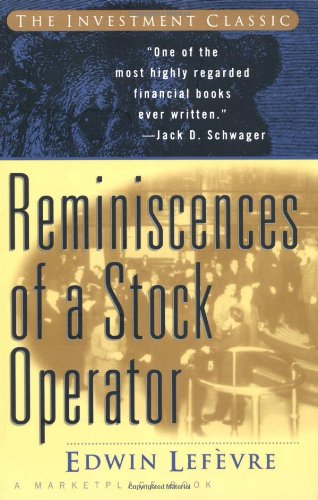
Critical Praise. "In my interviews with over 30 of the best traders of our time, there were some questions that I raised in each conversation. One of these was: Are there any books that you found particularly valuable and would recommend to aspiring traders? By far, the most frequent response was Reminiscences of a Stock Operator-a book that was over 70 years old!" -from the Foreword by Jack Schwager Author of Market Wizards and The New Market Wizards "Although Reminiscences.was first published some 70 years ago, its take on crowd psychology and market timing is as timely as last summer's frenzy on the foreign exchange markets." -Worth magazine "The most entertaining book written on investing is Reminiscences of a Stock Operator, by Edwin Lefevre, first published in 1923." -The Seattle Times "The best book I've read is Reminiscences of a Stock Operator. I keep a supply for people who come to work for me." -Martin Zweig "After 20 years and many re-reads, Reminiscences is still one of my all-time favorites." -Kenneth L. Fisher Forbes First published in 1923, Reminiscences of a Stock Operator is the fictionalized biography of Jesse Livermore, one of the greatest speculators ever. Reminiscences remains the most widely read, highly recommended investment book ever written. Generations of investors have found that it has more to teach them about themselves and other investors than years of experience in the market. This is a timeless tale that will enrich the lives-and portfolios-of today's investors as it has those of generations past.
Die Inhaltsangabe kann sich auf eine andere Ausgabe dieses Titels beziehen.
Über die Autorin bzw. den Autor
EDWIN LEFEVRE was trained as a mining engineer, but became a journalist at age 19. He produced eight books, including The Making of a Stockbroker, during his 53--year writing career.
Auszug. © Genehmigter Nachdruck. Alle Rechte vorbehalten.
Chapter One
I went to work when I was just out of grammar school. I got a job as quotation-board boy in a stock-brokerage office. I was quick at figures. At school I did three years of arithmetic in one. I was particularly good at mental arithmetic. As quotation-board boy I posted the numbers on the big board in the customers' room. One of the customers usually sat by the ticker and called out the prices. They couldn't come too fast for me. I have always remembered figures. No trouble at all.
There were plenty of other employees in that office. Of course I made friends with the other fellows, but the work I did, if the market was active, kept me too busy from ten a.m. to three p.m. to let me do much talking. I don't care for it, anyhow, during business hours.
But a busy market did not keep me from thinking about the work. Those quotations did not represent prices of stocks to me, so many dollars per share. They were numbers. Of course, they meant something. They were always changing. It was all I had to be interested in - the changes. Why did they change? I didn't know. I didn't care. I didn't think about that. I simply saw that they changed. That was all I had to think about five hours every day and two on Saturdays: that they were always changing.
That is how I first came to be interested in the behaviour of prices. I had a very good memory for figures. I could remember in detail how the prices had acted on the previous day, just before they went up or down. My fondness for mental arithmetic came in very handy.
I noticed that in advances as well as declines, stock prices were apt to show certain habits, so to speak. There was no end of parallel cases and these made precedents to guide me. I was only fourteen, but after I had taken hundreds of observations in my mind I found myself testing their accuracy, comparing the behaviour of stocks today with other days. It was not long before I was anticipating movements in prices. My only guide, as I say, was their past performances. I carried the "dope sheets" in my mind. I looked for stock prices to run on form. I had "clocked" them. You know what I mean.
You can spot, for instance, where the buying is only a trifle better than the selling. A battle goes on in the stock market and the tape is your telescope. You can depend upon it seven out of ten cases.
Another lesson I learned early is that there is nothing new in Wall Street. There can't be because speculation is as old as the hills. Whatever happens in the stock market today has happened before and will happen again. I've never forgotten that. I suppose I really manage to remember when and how it happened. The fact that I remember that way is my way of capitalizing experience.
I got so interested in my game and so anxious to anticipate advances and declines in all the active stocks that I got a little book. I put down my observations in it. It was not a record of imaginary transactions such as so many people keep merely to make or lose millions of dollars without getting the swelled head or going to the poorhouse. It was rather a sort of record of my hits and misses, and next to the determination of probable movements I was most interested in verifying whether I had observed accurately; in other words, whether I was right.
Say that after studying every fluctuation of the day in an active stock I would conclude that it was behaving as it always did before it broke eight or ten points. Well, I would jot down the stock and the price on Monday, and remembering past performances I would write down what it ought to do on Tuesday and Wednesday. Later I would cheek up with actual transcriptions from the tape.
That is how I first came to take an interest in the message of the tape. The fluctuations were from the first associated in my mind with upward or downward movements. Of course there is always a reason for fluctuations, but the tape does not concern itself with the why and wherefore. It doesn't go into explanations. I didn't ask the tape why when I was fourteen, and I don't ask it today, at forty. The reason for what a certain stock does today may not be known for two or three days, or weeks, or months. But what the dickens does that matter? Your business with the tape is now - not tomorrow. The reason can wait. But you must act instantly or be left. Time and again I see this happen. You'll remember that Hollow Tube went down three points the other day while the rest of the market rallied sharply. That was fact. On the following Monday you saw that the direct passed the dividend. That was the reason. They knew what they were going to do, and even if they didn't sell the stock themselves they at least didn't buy it. There was no inside buying; no reason why it should not break.
Well, I kept up my little memorandum book perhaps months. Instead of leaving for home the moment I was through with my work, I'd jot down the figures I wanted: would study the changes, always looking for the repetitions and parallelisms of behaviour-learning to read the tape, although I was not aware of it at the time.
„Über diesen Titel“ kann sich auf eine andere Ausgabe dieses Titels beziehen.
Suchergebnisse für Reminiscences of a Stock Operator

Beispielbild für diese ISBN
Reminiscences of a Stock Operator
Verlag:
John Wiley and Sons Ltd, 1994
ISBN 10: 0471059706
ISBN 13: 9780471059707
Gebraucht
Paperback
Anbieter: World of Books (was SecondSale), Montgomery, IL, USA
Verkäuferbewertung 5 von 5 Sternen

Paperback. Zustand: Very Good. Chronicles the experiences of an American stock-market trader from his first job as a quotation boy in a Boston brokerage firm to his influential position on Wall Street in the 1920s. The author provides his observations about the markets and the minds and motivations of a typical trader. Bestandsnummer des Verkäufers 00110460484
Gebraucht kaufen
EUR 5,59
Versand gratis
Versand innerhalb von USA
Versand innerhalb von USA
Anzahl: 2 verfügbar
Beispielbild für diese ISBN
Reminiscences of a Stock Operator
Verlag:
John Wiley and Sons Ltd, 1994
ISBN 10: 0471059706
ISBN 13: 9780471059707
Gebraucht
Paperback
Anbieter: World of Books (was SecondSale), Montgomery, IL, USA
Verkäuferbewertung 5 von 5 Sternen
Paperback. Zustand: Good. Chronicles the experiences of an American stock-market trader from his first job as a quotation boy in a Boston brokerage firm to his influential position on Wall Street in the 1920s. The author provides his observations about the markets and the minds and motivations of a typical trader. Bestandsnummer des Verkäufers 00110058920
Gebraucht kaufen
EUR 5,59
Versand gratis
Versand innerhalb von USA
Versand innerhalb von USA
Anzahl: 4 verfügbar
Beispielbild für diese ISBN
Reminiscences of a Stock Operator
Verlag:
John Wiley and Sons Ltd, 1994
ISBN 10: 0471059706
ISBN 13: 9780471059707
Gebraucht
Paperback
Anbieter: World of Books (was SecondSale), Montgomery, IL, USA
Verkäuferbewertung 5 von 5 Sternen
Paperback. Zustand: Fair. Chronicles the experiences of an American stock-market trader from his first job as a quotation boy in a Boston brokerage firm to his influential position on Wall Street in the 1920s. The author provides his observations about the markets and the minds and motivations of a typical trader. Bestandsnummer des Verkäufers 00109376505
Gebraucht kaufen
EUR 5,59
Versand gratis
Versand innerhalb von USA
Versand innerhalb von USA
Anzahl: 4 verfügbar
Foto des Verkäufers
Reminiscences of a Stock Operator
Anbieter: Greenworld Books, Arlington, TX, USA
Verkäuferbewertung 5 von 5 Sternen
Zustand: very_good. Fast Free Shipping â" Very Good condition book with a firm cover and clean pages. Shows normal use and some light wear or limited notes markings. A solid, nice copy to enjoy. Bestandsnummer des Verkäufers GWV.0471059706.VG
Gebraucht kaufen
EUR 5,60
Versand gratis
Versand innerhalb von USA
Versand innerhalb von USA
Anzahl: 1 verfügbar
Beispielbild für diese ISBN
Reminiscences of a Stock Operator
Verlag:
John Wiley & Sons (edition 1), 1994
ISBN 10: 0471059706
ISBN 13: 9780471059707
Gebraucht
Paperback
Anbieter: BooksRun, Philadelphia, PA, USA
Verkäuferbewertung 5 von 5 Sternen
Paperback. Zustand: Very Good. 1. It's a well-cared-for item that has seen limited use. The item may show minor signs of wear. All the text is legible, with all pages included. It may have slight markings and/or highlighting. Bestandsnummer des Verkäufers 0471059706-11-1
Gebraucht kaufen
EUR 5,94
Versand gratis
Versand innerhalb von USA
Versand innerhalb von USA
Anzahl: 1 verfügbar
Beispielbild für diese ISBN
Reminiscences of a Stock Operator
Anbieter: ThriftBooks-Dallas, Dallas, TX, USA
Verkäuferbewertung 5 von 5 Sternen
Paperback. Zustand: Fair. No Jacket. Former library book; Readable copy. Pages may have considerable notes/highlighting. ~ ThriftBooks: Read More, Spend Less. Bestandsnummer des Verkäufers G0471059706I5N10
Gebraucht kaufen
EUR 6,16
Versand gratis
Versand innerhalb von USA
Versand innerhalb von USA
Anzahl: 1 verfügbar
Beispielbild für diese ISBN
Reminiscences of a Stock Operator
Anbieter: ThriftBooks-Phoenix, Phoenix, AZ, USA
Verkäuferbewertung 5 von 5 Sternen
Paperback. Zustand: Good. No Jacket. Pages can have notes/highlighting. Spine may show signs of wear. ~ ThriftBooks: Read More, Spend Less. Bestandsnummer des Verkäufers G0471059706I3N00
Gebraucht kaufen
EUR 6,16
Versand gratis
Versand innerhalb von USA
Versand innerhalb von USA
Anzahl: 6 verfügbar
Beispielbild für diese ISBN
Reminiscences of a Stock Operator
Anbieter: ThriftBooks-Atlanta, AUSTELL, GA, USA
Verkäuferbewertung 5 von 5 Sternen
Paperback. Zustand: Fair. No Jacket. Readable copy. Pages may have considerable notes/highlighting. ~ ThriftBooks: Read More, Spend Less. Bestandsnummer des Verkäufers G0471059706I5N00
Gebraucht kaufen
EUR 6,16
Versand gratis
Versand innerhalb von USA
Versand innerhalb von USA
Anzahl: 1 verfügbar
Beispielbild für diese ISBN
Reminiscences of a Stock Operator
Anbieter: ThriftBooks-Dallas, Dallas, TX, USA
Verkäuferbewertung 5 von 5 Sternen
Paperback. Zustand: Very Good. No Jacket. Former library book; May have limited writing in cover pages. Pages are unmarked. ~ ThriftBooks: Read More, Spend Less. Bestandsnummer des Verkäufers G0471059706I4N10
Gebraucht kaufen
EUR 6,16
Versand gratis
Versand innerhalb von USA
Versand innerhalb von USA
Anzahl: 1 verfügbar
Beispielbild für diese ISBN
Reminiscences of a Stock Operator
Anbieter: ThriftBooks-Dallas, Dallas, TX, USA
Verkäuferbewertung 5 von 5 Sternen
Paperback. Zustand: Good. No Jacket. Pages can have notes/highlighting. Spine may show signs of wear. ~ ThriftBooks: Read More, Spend Less. Bestandsnummer des Verkäufers G0471059706I3N00
Gebraucht kaufen
EUR 6,16
Versand gratis
Versand innerhalb von USA
Versand innerhalb von USA
Anzahl: 6 verfügbar