
Verwandte Artikel zu Rating Scales and Checklists: Evaluating Behavior,...
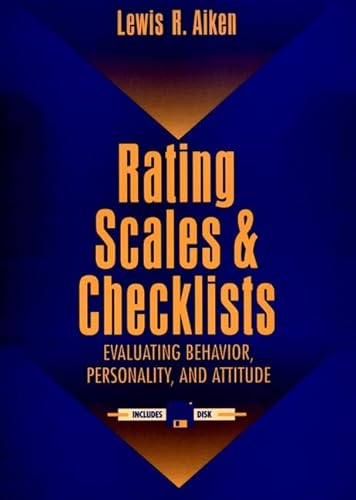
Rating Scales and Checklists: Evaluating Behavior, Personality, and Attitudes: Evaluating Attitudes, Behavior and Personality - Hardcover
Inhaltsangabe
"The philosopher Immanuel Kant believed that psychology could never become a science, because science is concerned with objectively observable phenomena and psychology deals with subjective matters. It is often maintained that the research of Gustav Fechner, Francis Galton, and other pioneers in psychometrics refuted Kant's assertion—and so it may be. However, it would be foolish to claim that psychologists are 'out of the woods' in maintaining that their discipline is a science. The subject matter of psychology still entails human judgment and evaluation, and our ultimate measuring instrument is the brain itself. We may try to make those judgments more objective by operationally defining what we are looking for, by training observers or evaluators to be more aware of their personal biases and their limited abilities to make accurate judgments, and by developing measuring instruments that are easy to use and reliable and valid indices of whatever we want them to assess. Still, it is not an easy task, and there are many critiques of our attempts at science-making
"This book focuses on rating scales and their derivatives—checklists, rankings, attitude scales, inventories, and other psychometric devices and procedures designed to make the assessment of people, objects, and events more objective and meaningful." — Lewis R. Aike
In the late 1900s Charles Darwin's cousin, Sir Francis Galton, introduced what is now considered the first rating scale. Over the next several decades various landmark tests appeared—most notably, the Binet-Simon, Army Alpha and Beta, Rorschach, and TAT tests. With the outbreak of World War II and the U.S. War Department's large-scale investment in the development of reliable instruments with which to measure inductees' personalities and aptitudes for various tasks, rating scales and checklists came into their own. Since then, rating scales have been used regularly in government, education, and industry, and an array of "paper and pencil" tests has been developed to quantify and qualify people's attitudes, aptitudes, performances, and personalities
Rating Scales and Checklists is the first comprehensive guide to constructing, scoring, validating, and applying these potent investigative and diagnostic tools. Written by a well-known authority in the field, it provides many valuable insights into the theoretical/psychometric aspects of measurement and scaling, as well as helpful practical guidelines for test construction and administration in a wide range of research and applied situations. In addition, the enclosed DOS-formatted computer diskette contains several dozen programs concerned with the construction, analysis, and applications of checklists, rating scales, attitude scales, and other psychometric instruments accompanying the text.
The first four chapters, which constitute the conceptual core of the book, deal extensively with the underlying theory and design of rating scales and checklists. The focus then shifts to the individual instruments and their applications in a wide range of specific areas. Descriptive lists of standardized and nonstandardized rating scales, checklists, and attitude scales are supplied, and Dr. Aiken provides expert insights and suggestions on how best to evaluate and improve the psychometric characteristics of these instruments. He also offers many valuable insights into the advantages and shortcomings of psychological, social, and educational measurement by means of rating scales, checklists, and attitude scales.
Rating Scales and Checklists is an important tool for practitioners in the behavioral and social sciences as well as for market research professionals, attitude and product researchers, and political pollsters. It is also an excellent supplemental text for upper level courses in psychology, education, sociology, political science, and other related disciplines
Die Inhaltsangabe kann sich auf eine andere Ausgabe dieses Titels beziehen.
Über die Autorin bzw. den Autor
LEWIS R. AIKEN, PhD, is Professor of Psychology at Pepperdine University. He received his doctorate in psychometrics from the University of North Carolina. His other books include Assessment of Intellectual Functioning, Personality Assessment Methods and Practices, and Psychological Testing and Assessment, Eighth Edition.
Von der hinteren Coverseite
"The philosopher Immanuel Kant believed that psychology could never become a science, because science is concerned with objectively observable phenomena and psychology deals with subjective matters. It is often maintained that the research of Gustav Fechner, Francis Galton, and other pioneers in psychometrics refuted Kant′s assertion and so it may be. However, it would be foolish to claim that psychologists are ′out of the woods′ in maintaining that their discipline is a science. The subject matter of psychology still entails human judgment and evaluation, and our ultimate measuring instrument is the brain itself. We may try to make those judgments more objective by operationally defining what we are looking for, by training observers or evaluators to be more aware of their personal biases and their limited abilities to make accurate judgments, and by developing measuring instruments that are easy to use and reliable and valid indices of whatever we want them to assess. Still, it is not an easy task, and there are many critiques of our attempts at science–making.
"This book focuses on rating scales and their derivatives checklists, rankings, attitude scales, inventories, and other psychometric devices and procedures designed to make the assessment of people, objects, and events more objective and meaningful." Lewis R. Aiken
In the late 1900s Charles Darwin′s cousin, Sir Francis Galton, introduced what is now considered the first rating scale. Over the next several decades various landmark tests appeared most notably, the Binet–Simon, Army Alpha and Beta, Rorschach, and TAT tests. With the outbreak of World War II and the U.S. War Department′s large–scale investment in the development of reliable instruments with which to measure inductees′ personalities and aptitudes for various tasks, rating scales and checklists came into their own. Since then, rating scales have been used regularly in government, education, and industry, and an array of "paper and pencil" tests has been developed to quantify and qualify people′s attitudes, aptitudes, performances, and personalities.
Rating Scales and Checklists is the first comprehensive guide to constructing, scoring, validating, and applying these potent investigative and diagnostic tools. Written by a well–known authority in the field, it provides many valuable insights into the theoretical/psychometric aspects of measurement and scaling, as well as helpful practical guidelines for test construction and administration in a wide range of research and applied situations. In addition, the enclosed DOS–formatted computer diskette contains several dozen programs concerned with the construction, analysis, and applications of checklists, rating scales, attitude scales, and other psychometric instruments accompanying the text.
The first four chapters, which constitute the conceptual core of the book, deal extensively with the underlying theory and design of rating scales and checklists. The focus then shifts to the individual instruments and their applications in a wide range of specific areas. Descriptive lists of standardized and nonstandardized rating scales, checklists, and attitude scales are supplied, and Dr. Aiken provides expert insights and suggestions on how best to evaluate and improve the psychometric characteristics of these instruments. He also offers many valuable insights into the advantages and shortcomings of psychological, social, and educational measurement by means of rating scales, checklists, and attitude scales.
Rating Scales and Checklists is an important tool for practitioners in the behavioral and social sciences as well as for market research professionals, attitude and product researchers, and political pollsters. It is also an excellent supplemental text for upper level courses in psychology, education, sociology, political science, and other related disciplines.
Aus dem Klappentext
In the late 1900s Charles Darwin’s cousin, Sir Francis Galton, introduced what is now considered the first rating scale. Over the next several decades various landmark tests appeared—most notably, the Binet-Simon, Army Alpha and Beta, Rorschach, and TAT tests. With the outbreak of World War II and the U.S. War Department’s large-scale investment in the development of reliable instruments with which to measure inductees’ personalities and aptitudes for various tasks, rating scales and checklists came into their own. Since then, rating scales have been used regularly in government, education, and industry, and an array of "paper and pencil" tests has been developed to quantify and qualify people’s attitudes, aptitudes, performances, and personalities. Rating Scales and Checklists is the first comprehensive guide to constructing, scoring, validating, and applying these potent investigative and diagnostic tools. Written by a well-known authority in the field, it provides many valuable insights into the theoretical/psychometric aspects of measurement and scaling, as well as helpful practical guidelines for test construction and administration in a wide range of research and applied situations. In addition, the enclosed DOS-formatted computer diskette contains several dozen programs concerned with the construction, analysis, and applications of checklists, rating scales, attitude scales, and other psychometric instruments accompanying the text. The first four chapters, which constitute the conceptual core of the book, deal extensively with the underlying theory and design of rating scales and checklists. The focus then shifts to the individual instruments and their applications in a wide range of specific areas. Descriptive lists of standardized and nonstandardized rating scales, checklists, and attitude scales are supplied, and Dr. Aiken provides expert insights and suggestions on how best to evaluate and improve the psychometric characteristics of these instruments. He also offers many valuable insights into the advantages and shortcomings of psychological, social, and educational measurement by means of rating scales, checklists, and attitude scales. Rating Scales and Checklists is an important tool for practitioners in the behavioral and social sciences as well as for market research professionals, attitude and product researchers, and political pollsters. It is also an excellent supplemental text for upper level courses in psychology, education, sociology, political science, and other related disciplines.
„Über diesen Titel“ kann sich auf eine andere Ausgabe dieses Titels beziehen.
Suchergebnisse für Rating Scales and Checklists: Evaluating Behavior,...

Beispielbild für diese ISBN
Rating Scales and Checklists: Evaluating Attitudes, Behavior and Personality
Anbieter: AwesomeBooks, Wallingford, Vereinigtes Königreich
Verkäuferbewertung 5 von 5 Sternen

Hardcover. Zustand: Very Good. Rating Scales and Checklists: Evaluating Attitudes, Behavior and Personality This book is in very good condition and will be shipped within 24 hours of ordering. The cover may have some limited signs of wear but the pages are clean, intact and the spine remains undamaged. This book has clearly been well maintained and looked after thus far. Money back guarantee if you are not satisfied. See all our books here, order more than 1 book and get discounted shipping. Bestandsnummer des Verkäufers 7719-9780471127871
Gebraucht kaufen
EUR 5,70
EUR 4,92 Versand
Versand von Vereinigtes Königreich nach USA
Versand von Vereinigtes Königreich nach USA
Anzahl: 2 verfügbar
Beispielbild für diese ISBN
Rating Scales and Checklists : Evaluating Behavior, Personality, and Attitudes
Verlag:
Wiley & Sons, Incorporated, John, 1996
ISBN 10: 0471127876
ISBN 13: 9780471127871
Gebraucht
Hardcover
Erstausgabe
Anbieter: Better World Books, Mishawaka, IN, USA
Verkäuferbewertung 5 von 5 Sternen
Zustand: Good. 1st Edition. Pages intact with minimal writing/highlighting. The binding may be loose and creased. Dust jackets/supplements are not included. Stock photo provided. Product includes identifying sticker. Better World Books: Buy Books. Do Good. Bestandsnummer des Verkäufers 2891960-6
Gebraucht kaufen
EUR 11,48
Versand gratis
Versand innerhalb von USA
Versand innerhalb von USA
Anzahl: 1 verfügbar
Beispielbild für diese ISBN
Rating Scales and Checklists : Evaluating Behavior, Personality, and Attitudes
Verlag:
Wiley & Sons, Incorporated, John, 1996
ISBN 10: 0471127876
ISBN 13: 9780471127871
Gebraucht
Hardcover
Erstausgabe
Anbieter: Better World Books Ltd, Dunfermline, Vereinigtes Königreich
Verkäuferbewertung 5 von 5 Sternen
Zustand: Good. 1st Edition. Pages intact with minimal writing/highlighting. The binding may be loose and creased. Dust jackets/supplements are not included. Stock photo provided. Product includes identifying sticker. Better World Books: Buy Books. Do Good. Bestandsnummer des Verkäufers 2891960-6
Gebraucht kaufen
EUR 6,09
EUR 5,97 Versand
Versand von Vereinigtes Königreich nach USA
Versand von Vereinigtes Königreich nach USA
Anzahl: 1 verfügbar
Beispielbild für diese ISBN
Rating Scales and Checklists: Evaluating Attitudes, Behavior and Personality
Anbieter: Bahamut Media, Reading, Vereinigtes Königreich
Verkäuferbewertung 4 von 5 Sternen

Hardcover. Zustand: Very Good. This book is in very good condition and will be shipped within 24 hours of ordering. The cover may have some limited signs of wear but the pages are clean, intact and the spine remains undamaged. This book has clearly been well maintained and looked after thus far. Money back guarantee if you are not satisfied. See all our books here, order more than 1 book and get discounted shipping. Bestandsnummer des Verkäufers 6545-9780471127871
Gebraucht kaufen
EUR 5,97
EUR 8,33 Versand
Versand von Vereinigtes Königreich nach USA
Versand von Vereinigtes Königreich nach USA
Anzahl: 2 verfügbar
Beispielbild für diese ISBN
Rating Scales and Checklists; Evaluating Behavior, Personality, and Attitudes
Anbieter: Skoob-ebooks, Pontiac, QC, Kanada
Verkäuferbewertung 5 von 5 Sternen
Hardcover. Zustand: Very Good. Zustand des Schutzumschlags: Very Good-. The book has minor wear. The dust jacket has moderate shelf wear with cuts, crushes and/or bends on the edges. No highlighting or writing detected on any pages. 30-day return policy. Free shipping within Canada. For shipments outside of Canada, custom duties or other charges may be levied on receipt.; 161 X 29.3 X 236.5 millimeters; 320 pages. Bestandsnummer des Verkäufers 7042
Gebraucht kaufen
EUR 37,33
EUR 11,59 Versand
Versand von Kanada nach USA
Versand von Kanada nach USA
Anzahl: 1 verfügbar
Beispielbild für diese ISBN
Rating Scales and Checklists: Evaluating Behavior, Personality, and Attitudes
Anbieter: GoldBooks, Denver, CO, USA
Verkäuferbewertung 5 von 5 Sternen
Hardcover. Zustand: new. New Copy. Customer Service Guaranteed. Bestandsnummer des Verkäufers 22M35_95_0471127876
Neu kaufen
EUR 1.810,85
EUR 4,91 Versand
Versand innerhalb von USA
Versand innerhalb von USA
Anzahl: 1 verfügbar
Beispielbild für diese ISBN
Rating Scales and Checklists: Evaluating Behavior, Personality, and Attitudes (Includes Floppy Disk)
ISBN 10: 0471127876
ISBN 13: 9780471127871
Neu
Hardcover
Anbieter: BWS BKS, Ferndale, NY, USA
Verkäuferbewertung 2 von 5 Sternen

Hardcover. Zustand: New. T-Aikel; Aiken, Lewis R. Rating Scales and Checklists: Evaluating Behavior, Personality, and Attitudes (Includes CD) PSYCHOMETRICS PSYCHOLOGICAL TESTS PSYCHOLOGY STATISTICS "This book focuses on rating scales and their derivativesâ"checklists, rankings, attitude scales, inventories, and other psychometric devices and procedures designed to make the assessment of people, objects, and events more objective and meaningful.". Bestandsnummer des Verkäufers 59763
Neu kaufen
EUR 1.816,69
EUR 2,68 Versand
Versand innerhalb von USA
Versand innerhalb von USA
Anzahl: 1 verfügbar