
Verwandte Artikel zu Value Investing in Commodity Futures: How to Profit...
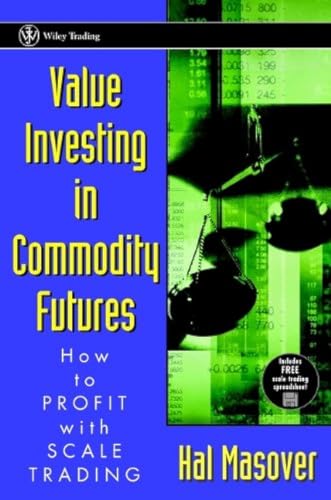
Value Investing in Commodity Futures: How to Profit with Scale Trading: How to Profit with Scales Trading (Wiley Trading) - Hardcover
Inhaltsangabe
The only complete guide to an increasingly popular approach to futures trading
This book outlines a highly successful alternative approach to trading commodity futures, specially tailored to today's low-priced commodities markets. Unlike technical analysis, which uses statistics to inform trading decisions, scale trading is a form of fundamental analysis in which a trader slowly buys prices as they reach bottom and sells them as they climb back up. Hal Masover describes scaling techniques that work in every commodity market, including metals, energies, utilities, and agriculture. And he supplies readers with a scale trading system that generates a complete rundown of how much money will be needed, when, and where.
* Satisfies the growing demand for guides to fundamental analysis-based futures trading
Hal Masover (Fairfield, IA) is cofounder of Crown Futures, a top trading firm with offices in Fairfield, Iowa, Boulder, Colorado, and Cleveland, Ohio. He has been successfully trading futures since 1985.
Die Inhaltsangabe kann sich auf eine andere Ausgabe dieses Titels beziehen.
Über die Autorin bzw. den Autor
HAL MASOVER is cofounder of Crown Futures, a top trading firm with offices in Fairfield, Iowa; Boulder, Colorado; and Cleveland, Ohio. He has been success-fully trading futures since 1987.
Von der hinteren Coverseite
Buy Low, Sell High
This one-of-a-kind book outlines a highly successful alternative approach to trading commodity futures that is specifically tailored to today's low-priced commodities markets. Unlike technical analysis, which uses statistics to derive trading strategies, scale trading utilizes fundamental analysis to make a plan to slowly buy as prices reach bottom and sell as they climb back up. Here, top trader and author Hal Masover describes scaling techniques that work in every commodity market and supplies you with a scale trading system that generates a complete rundown of how much money will be needed, when, and where. Learn when to begin a scale-down buying program, how to choose a broker, and the facts and benefits of scale trading.
* Scaling works in every kind of commodity, including metals, energies, and agricultural commodities
* Scale trading is a fairly conservative methodology that uses big trader strategies but on a much smaller scale
* Value Investing in Commodity Futures includes a disk with the scale program-
...all you have to do is input the data and the program will show how much money is needed, when, and where
Take advantage of the only complete guide to an increasingly popular approach to futures trading. In these times of amazingly low commodity prices, the method presented in this comprehensive and invaluable book works best.
Aus dem Klappentext
Successful commodities trading requires knowledge, skill, a healthy dose of optimism-and a logical and effective trading approach. Scale trading offers just such an approach, and this realistic and informative book tells you why.
One of the simplest and most versatile methods of trading, scale trading involves buying a commodity at progressively lower prices until it ceases to decline, then selling it at progressively higher prices as it rises. One of the greatest benefits of scale trading is that it gives small individual traders the ability to emulate a trading method used by megatraders. Originally developed as an adaptation of a gambling system, this method ultimately offers individuals an accessible yet sophisticated tool that does not require familiarity with advanced mathematical calculations or complex indicators. What is required is the knowledge of how a market behaves.
Presenting an explanation of the sound principles upon which scale trading is based-and why it lends itself particularly well to commodities-top trader Hal Masover shares his wisdom and extensive experience to answer questions, such as when to begin a program of scale-down buying, and how much capital is required. Also included are numerous examples, illustrations, charts, and tables covering everything from the fundamentals of different markets to how to construct a scale, choose a broker, and more to get you profiting from this practical methodology for long-term trading success.
Auszug. © Genehmigter Nachdruck. Alle Rechte vorbehalten.
ELEGANCE IN TRADING
Scale trading is one of the simplest, easiest, and most elegant methods of trading I have ever seen. I have searched for years trying to come up with something better. Although I have found a few good things and a lot of promising ideas, I have still not found anything that has proved better. Scale trading offers a way for individuals, even those with relatively modest amounts of capital, to use some of the same methods the big boys use.
Have you ever imagined what it would be like to be one of the big boys? Can you see yourself wading into the trading pit, with everyone's eyes on you to see what you're going to do? Or do you see yourself trading from a large, richly appointed office atop some urban skyscraper? Did you ever see the movie Trading Places with Eddie Murphy? Murphy plays a street beggar who magically winds up living our fantasy of trading big time in the pits and in a fancy downtown office. And, son of a gun, he's good at it (only in the movies)!
I mention this fantasy because I have seen one trader after another seduced by it. Commodity trading can be an exhilarating and highly profitable experience, but it can also bring financial ruin on the unprepared or foolhardy. Although most people are aware of the possibility of ruin, they don't really believe it can happen to them. Because they don't really believe that, they never make plans to avoid it. Instead, they try to pull off some sort of real-life Trading Places, taking huge risks in the hope (always a bad word in trading) of reaping a huge profit. Often they find that instead of leaping into the big time, they fall into deep losses.
The reality of trading is usually quite different from the fantasies. I'm not aware of any big traders who really trade like the individuals in our fantasy. Although they do have a wide variety of styles, from long-term systematic commodity fund managers (whose trades last months or even years) to short-term pit traders (who never hold positions for more than 30 seconds), the successful ones I have come to know are very sober. No matter what kind of approach they use, they are realistic about their chances in the commodity markets, and they have a definite plan to make money.
TAKING A CUE FROM THE BIG TRADERS
We want to discuss one very sane and sober way that many large traders trade. This method was first developed as an adaptation of gambling methods used in Las Vegas. It can be used for gambling, stocks, and commodities. Although the method can work in all three areas as well as other areas of investment, it is particularly effective in commodity futures for a number of reasons that we will discuss shortly.
But first, to help you understand the method, let's fantasize a little more. Imagine that you work for a company with a huge fleet of cars and delivery trucks. Perhaps it's one of the delivery companies, like FedEx or UPS. Your job is to help the company control fuel costs. A critical part of your job involves buying futures contracts of unleaded gas to protect the company against a rise in prices (the process called hedging that we discuss in Appendix I, "Getting a Handle on Commodity Futures"). If you only needed to buy one contract, your job would be simple. You call a broker and buy at a time when you believe prices are cheap to lock in a low price for your company. This is a very large company, and one contract equals only 42,000 gallons. I have no idea how long it would take a nationwide fleet of trucks to use 42,000 gallons, but I wouldn't be surprised if it were less than an hour.
To implement your program adequately, you might need to buy thousands of contracts. As I write this, the most active contract for unleaded gas is the February 2000 contract. There are approximately 16,000 contracts of open interest (the number of contracts being held overnight). On January 26, 2000, approximately 16,500 contracts traded during the trading session (Figure 1.1). if you were going to go into this market and attempt to buy, say, 2,000 contracts all at once, you might shock the market because your one order would represent almost 12.5 percent of the contracts traded all day. Because you probably wouldn't find one individual seller who would want to sell you that much, you'd have to keep bidding up the price to coax more traders to sell. In the end you would have created your own minirally in which your company would be chasing its own tail, paying ever higher prices for its gasoline contracts. At least in the short term, you would not have protected your company from higher prices. You actually would have created an artificially high price for your company to pay.
SCALING IN AND OUT
The way you might solve this problem is to do exactly what many large traders usually do: scale in your purchases. Once you have determined the approximate price at which you would like to buy, you would begin to buy at (you hope) progressively lower prices within a target range. When you buy small allotments at a time, it is usually much easier to find a seller for each buy order. You thereby may avoid the possibility of scaring the market higher. Scaling in your purchases also has the advantage of helping you buy at progressively lower prices if the market continues to decline after your initial purchases.
You might also implement the same program in reverse when it comes time to liquidate your position, and for the same reasons--if you sell all your contracts at once, you can have a temporarily depressing effect on the market, and you might find yourself getting filled at progressively lower prices...
„Über diesen Titel“ kann sich auf eine andere Ausgabe dieses Titels beziehen.
Suchergebnisse für Value Investing in Commodity Futures: How to Profit...

Foto des Verkäufers
Value Investing in Commodity Futures
Anbieter: -OnTimeBooks-, Phoenix, AZ, USA
Verkäuferbewertung 5 von 5 Sternen

Zustand: very_good. Gently read. May have name of previous ownership, or ex-library edition. Binding tight; spine straight and smooth, with no creasing; covers clean and crisp. Minimal signs of handling or shelving. 100% GUARANTEE! Shipped with delivery confirmation, if you're not satisfied with purchase please return item! Ships USPS Media Mail. Bestandsnummer des Verkäufers OTV.0471348813.VG
Gebraucht kaufen
EUR 12,57
Versand gratis
Versand innerhalb von USA
Versand innerhalb von USA
Anzahl: 1 verfügbar
Beispielbild für diese ISBN
Value Investing in Commodity Futures
Anbieter: Jenson Books Inc, Logan, UT, USA
Verkäuferbewertung 5 von 5 Sternen
hardcover. Zustand: Good. The item is in good condition and works perfectly, however it is showing some signs of previous ownership which could include: small tears, scuffing, notes, highlighting, gift inscriptions, and library markings. Bestandsnummer des Verkäufers 4BQGBJ014WVU
Gebraucht kaufen
EUR 42,46
Versand gratis
Versand innerhalb von USA
Versand innerhalb von USA
Anzahl: 1 verfügbar
Beispielbild für diese ISBN
Value Investing In Commodity Futures: How To Profit With Scale Trading
Anbieter: Romtrade Corp., STERLING HEIGHTS, MI, USA
Verkäuferbewertung 5 von 5 Sternen
Zustand: New. This is a Brand-new US Edition. This Item may be shipped from US or any other country as we have multiple locations worldwide. Bestandsnummer des Verkäufers ABBB-110901
Beispielbild für diese ISBN
Value Investing In Commodity Futures: How To Profit With Scale Trading
Anbieter: Basi6 International, Irving, TX, USA
Verkäuferbewertung 5 von 5 Sternen
Zustand: Brand New. New. US edition. Expediting shipping for all USA and Europe orders excluding PO Box. Excellent Customer Service. Bestandsnummer des Verkäufers ABEOCT25-94033
Beispielbild für diese ISBN
Value Investing in Commodity Futures
Anbieter: Books Puddle, New York, NY, USA
Verkäuferbewertung 4 von 5 Sternen

Zustand: Used. pp. xviii + 202 1st Edition. Bestandsnummer des Verkäufers 26435627
Gebraucht kaufen
EUR 63,03
EUR 3,45 Versand
Versand innerhalb von USA
Versand innerhalb von USA
Anzahl: 1 verfügbar
Beispielbild für diese ISBN
Value Investing in Commodity Futures
Anbieter: Majestic Books, Hounslow, Vereinigtes Königreich
Verkäuferbewertung 4 von 5 Sternen
Zustand: Used. pp. xviii + 202 Illus. Bestandsnummer des Verkäufers 7412340
Gebraucht kaufen
EUR 60,68
EUR 7,58 Versand
Versand von Vereinigtes Königreich nach USA
Versand von Vereinigtes Königreich nach USA
Anzahl: 1 verfügbar
Beispielbild für diese ISBN
Value Investing in Commodity Futures
Anbieter: Biblios, Frankfurt am main, HESSE, Deutschland
Verkäuferbewertung 4 von 5 Sternen
Zustand: Used. pp. xviii + 202. Bestandsnummer des Verkäufers 18435617
Gebraucht kaufen
EUR 62,01
EUR 9,95 Versand
Versand von Deutschland nach USA
Versand von Deutschland nach USA
Anzahl: 1 verfügbar
Foto des Verkäufers
Value Investing in Commodity Futures: How to Profit with Scale Trading: How to Profit with Scales Trading (Wiley Trading)
Verlag:
John Wiley & Sons, 2001
ISBN 10: 0471348813
ISBN 13: 9780471348818
Gebraucht
Hardcover
Erstausgabe
Anbieter: Book Broker, Berlin, Deutschland
Verkäuferbewertung 5 von 5 Sternen
Zustand: Gut. 1. Auflage. 224 S. Alle Bücher & Medienartikel von Book Broker sind stets in gutem & sehr gutem gebrauchsfähigen Zustand. Unser Produktfoto entspricht dem hier angebotenen Artikel, dieser weist folgende Merkmale auf: Helle/saubere Seiten in fester Bindung. Leichte Gebrauchsspuren. Schutzumschlag weist Gebrauchsspuren auf. Mit Beilage (Diskette). Sprache: Englisch Gewicht in Gramm: 510 Gebundene Ausgabe, Maße: 15.85 cm x 2.86 cm x 23.85 cm. Bestandsnummer des Verkäufers 661110607
Gebraucht kaufen
EUR 58,27
EUR 35,01 Versand
Versand von Deutschland nach USA
Versand von Deutschland nach USA
Anzahl: 1 verfügbar

Internationale Ausgabe
VALUE INVESTING IN COMMODITY FUTURES (HB 2001)
Internationale AusgabeAnbieter: UK BOOKS STORE, London, LONDO, Vereinigtes Königreich
Verkäuferbewertung 5 von 5 Sternen
Zustand: New Books. Brand New! Fast Delivery This is an International Edition and ship within 24-48 hours. Deliver by FedEx and Dhl, & Aramex, UPS, & USPS and we do accept APO and PO BOX Addresses. Order can be delivered worldwide within 6-10 days and we do have flat rate for up to 2LB. Extra shipping charges will be requested if the Book weight is more than 5 LB. This Item May be shipped from India, United states & United Kingdom. Depending on your location and availability. Bestandsnummer des Verkäufers CBS 9780471348818
Gebraucht kaufen
EUR 114,68
Versand gratis
Versand von Vereinigtes Königreich nach USA
Versand von Vereinigtes Königreich nach USA
Anzahl: 1 verfügbar
Beispielbild für diese ISBN
Value Investing in Commodity Futures: How to Profit with Scale Trading: How to Profit with Scales Trading (Wiley Trading) Hal Masover
Anbieter: BUCHSERVICE / ANTIQUARIAT Lars Lutzer, Wahlstedt, Deutschland
Verkäuferbewertung 5 von 5 Sternen
Zustand: gut. 2001. Value Investing in Commodity Futures: How to Profit with Scale Trading: How to Profit with Scales Trading (Wiley Trading) In englischer Sprache. pages. Bestandsnummer des Verkäufers BN537671
Gebraucht kaufen
EUR 249,90
EUR 39,95 Versand
Versand von Deutschland nach USA
Versand von Deutschland nach USA
Anzahl: 1 verfügbar