Inhaltsangabe
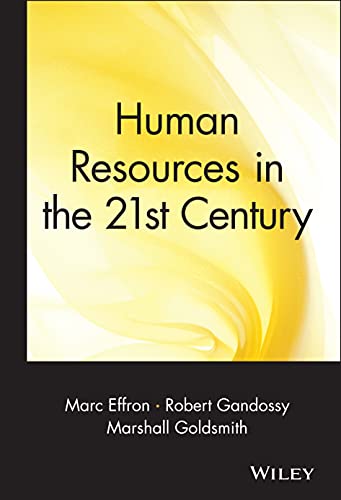
New and faster technology, redefined values, and shifting customer demands are changing the way businesses operate in the twenty-first century. Human resources and business leaders are faced with the challenge of redefining their strategies on leadership, talent, and diversity, while evaluating their operational effectiveness. This book presents the compelling contributions of thought leaders-such as David Ulrich, Rosabeth Moss Kanter, and Jeffrey Pfeffer-who offer a road map for what these leaders can expect. Renowned HR executives also provide their expert advice and prescriptions for the future. The nature of human resources will continue to evolve as the new century progresses-with this book, HR professionals can change with it.
Marc Effron (Darien, CT) is the Global Practice Leader for Hewitt Associates Leadership Practice. His leadership work centers on helping organizations attract, develop and retain top leadership talent. Robert Gandossy (Redding, CT) heads Hewitt's Global Practice Leaders for Talent and has over twenty years' experience in human resources, leadership, and change management. Marshall Goldsmith (Santa Fe, CA) is a founding Director of The Alliance for Strategic Leadership, a consulting organization.
Die Inhaltsangabe kann sich auf eine andere Ausgabe dieses Titels beziehen.
Über die Autorin bzw. den Autor
Marc Effron (Darien, CT) is the Global Practice Leader for Hewitt Associates' Leadership Practice (http://was.hewitt.com/hewitt/), and is based in Hewitt's Connecticut Center. His leadership work centers on helping organizations attract, develop and retain top leadership talent. Hehas an M.B.A. with Honors Letters from the Yale School of Management. Robert Gandossy (Redding, CT) is Hewitt's Global Practice Leaders for Talent and has over 20 years experience in human resources, leadership, and change management. He has written numerous articles and papers. He holds a Ph.D. from Yale University. Marshall Goldsmith (Rancho Santa Fe, CA) is one of the world's foremost authorities in helping leaders achieve positive, measurable change in behavior: for themselves, their people and their teams. Marshall is a founding director of A4SL-The Alliance for Strategic Leadership, a consulting organization that includes over 100 top professionals in the field of leadership development. He is on the faculty of the global executive education program for Dartmouth and Oxford (UK) Universities. Marshall is a partner in Duke Corporate Education's Personal Learning Systems. He is an emeritus member of the Board of the Peter Drucker Foundation. He has a Ph.D. from UCLA. Foreword by Rosabeth Moss Kanter, Harvard Business School and author of the best-selling book Evolve!
Von der hinteren Coverseite
Praise for Human Resources in the 21st Century
“An all-star cast of authors makes this book a must-read!”
—Edward E. Lawler III, author of Treat People Right!
“Leaders in all three sectors will find Human Resources in the 21st Century a valuable companion in redefining the future of the function and the organization.”
—Frances Hesselbein, Chairman, Leader to Leader Institute
“Imagine cherry-picking the latest thoughts from some of the best minds in the field of Human Resources and then amalgamating it into a book. What an amazing gift to our field! Better yet, the subjects span the thorniest issues facing all of us.”
—John H. Zenger, Vice Chairman, Novations Group, Inc.
“Whip out your pen, write notes in the margin—and armed with the insights in this book—get ready to debate with your HR colleagues and line manager customers the future of the HR activity and your personal contribution.”
—Jim Belasco, bestselling author, consultant, business owner; Co-Executive Director, Knowledge Dialogue
“Human Resources in the 21st Century is part handbook, part manifesto, and part guide to the revolution. It will make you think, and think differently, about what you do and how you do it. And that’s the way it should be. Welcome to the end of Human Resources as we know it.”
—James M. Kouzes, coauthor of The Leadership Challenge; Chairman Emeritus of the Tom Peters Company
“Practical, powerful, and comprehensive, Human Resources in the 21st Century provides the means for leaders to not just morph to meet the challenges of the future of Human Resources—but to adapt with style and integrity. This is an important book for HR leaders and for all working to help people and organizations thrive.”
—Dr. Paul Hersey, Chairman & CEO, Center for Leadership Studies
Auszug. © Genehmigter Nachdruck. Alle Rechte vorbehalten.
Human Resources in the 21st Century
John Wiley & Sons
Copyright © 2003 Marc EffronAll right reserved.
ISBN: 978-0-471-43421-4
Chapter One
The HR Head as Trusted CEO AdvisorSix Strategies for Becoming a Valued Partner to Senior Management
ROBERT GANDOSSY and ANDREW SOBEL
In the aftermath of the September 11, 2001, terrorist attacks, American Airlines' CEO Don Carty faced a crisis that few corporate leaders have ever confronted. During this difficult period, Carty's executive vice president of human resources, Sue Oliver, served not just as a functional expert representing HR but as a trusted top-management advisor. She participated, as part of American's executive team, in virtually every major business decision affecting American's people, from the difficult layoffs and cost-cutting that followed the decline in air travel to the revamping of security, and she was instrumental in working with the rest of the management team to restore morale to a devastated organization.
In a very different industry that has faced its own difficult challenges, J. Randall (Randy) MacDonald, senior vice president of human resources at IBM, has played a similar role with recently retired CEO Lou Gerstner, one of the smartest and toughest bosses in corporate America. "You don't become an advisor who can inf luence the CEO overnight," MacDonald says with understatement. "At first, you do a lot of listening, get the lay of the land, observe, learn the business, and then deliver with great quality. You focus on the business issues. You always act with persistence and determination, but you learn when to hold them and when to fold them and walk away."
Behind every great leader you'll probably find at least one great advisor. Alexander the Great's tutor and counselor was Aristotle, ancient Greece's famed philosopher and scientist. King Henry VIII chose as his chief advisor Thomas More, who precipitated his own demise when he stood by his principles and publicly defied his royal client; President Franklin D. Roosevelt had the services of the trustworthy Harry Hopkins as well as the great General George Marshall. Today's CEOs have an equal or greater need for trusted individuals who can act as sage counselors and discreet sounding boards. Even compared to just 10 years ago, the pace of decision making is faster, there are more strategic choices available, and the amount of information executives have to absorb has grown dramatically.
Ironically, it's not easy for CEOs to find individuals who can fulfill this role. Outside professionals must tread a thin line between their own and their client's interests; corporate insiders also have their own biases and agendas. Bob Galvin, the former chairman of Motorola, comments that "When it comes to the CEO's direct reports, where you sit is where you stand. It is difficult to find truly objective insiders who can serve this important trusted advisor role to the CEO."
Human resources executives are in an ideal position to play the role of trusted counselor to top management. In fact, if you want to truly stand out from the pack, you've got to learn to play this role and do a standout job of managing the HR function itself. The HR head does not represent a particular business unit, nor is it a highly specialized staff function like investor relations. By dint of training and experience, he or she is also uniquely equipped to help the CEO with one of their most important and difficult tasks-identifying and cultivating leaders. Mike D'Ambrose, executive vice president of human resources for Toys 'R Us, echoes other top HR executives in saying, "One of my key roles is to help the CEO make judgments about people and develop our leaders."
How do you build this type of relationship and become a trusted advisor to the CEO? How do you go beyond your "HR expert" label and become viewed by top management as a critical partner in making the corporation's most important decisions? To find out, we spoke with a dozen of the world's top HR heads. They have advised some of the smartest, most demanding CEOs in business today-Lou Gerstner of IBM, John Reed and Sandy Weil of Citigroup, Ivan Seidenberg of Verizon, Chuck Lee formerly of GTE and Verizon, Michael Capellas at Compaq, and Don Carty at American Airlines-and they have both the scars and the wisdom to show for it. In addition, co-author Andrew Sobel interviewed 30 leading CEOs about their most valued, trusted advisors, during the research for his book, Clients for Life. Together, these conversations have given us a unique understanding of the ingredients of the trusted advisor role.
The bottom line is that HR "experts" are a dime a dozen. Professionals who have great expertise and who are able to bring wisdom, insight, and perspective to bear in the context of a trusted personal relationship, on the other hand, are irreplaceable resources who are highly valued by top executives.
The secret to the success of these leading HR executives, we discovered, lies in a blend of six strategies that can be developed and cultivated by other HR professionals. It's not an easy prescription, but it is one that will serve you well if you aspire to evolve from an HR "expert" to a trusted partner to senior management. These experienced hands talk about advising the CEO, but the principles they exemplify have served them throughout their entire careers, whether their "client" was an assistant plant manager, a division executive, or the chairman.
These top HR heads also acknowledge that developing these relationships is a never-ending process. They must be continuously worked to add value and to maintain the appropriate balance of CEO confidant versus member of the CEO's team, of directness and challenge versus respect and deference.
Strategy One: Become a Deep Generalist-A Business Advisor as Well as an HR Professional
America has become a nation of specialists, and we revere the "expert." It's no surprise, then, that some human resources professionals spend their entire careers digging deeper into their core specialty, driven by a corporate emphasis on specialization and a perception that this is how you get ahead. If you want to manage the HR function effectively and also be a trusted advisor to top management, however, you need depth and breadth-you need to become a deep generalist.
Randy MacDonald at IBM, for example, has always assiduously cultivated his business breadth: "I was always protective of my generalist background," he says, "and I managed my career to acquire a breadth of experience. When I was the VP of organization development at GTE, for example, I also had responsibility for HR in several business units. I wouldn't accept certain positions if they weren't broad enough."
Steve King, head of HR for Hewitt Associates (not an easy job-being the HR chief for a firm of HR consultants!), says, "I don't really think of myself as an 'HR guy.' I actually have a master 's in economics. My interest in the business itself, and how we really make money, helps me win credibility from business leaders. By understanding the business, you will get your best clues about your people issues."
How do you become a deep generalist? Fight hard to get broad exposure early in your career. Invest time to become intimately familiar with your company's strategy, organization, and operations. Read general business publications, not just HR magazines, and get out of your office-make sure you spend ample time in the field. One HR leader requires HR staff to be out of the office-in the trenches-at least 50 percent of the time, "If you're not out of the office 50 percent of the time meeting with leaders, managers, employees-even our customers, then you're not doing your job. It's the only way to really understand the business."
Strategy Two: Listen Deeply-Then Act
When a journalist asked the great Spanish artist Picasso what he thought of mainframe computers, Picasso replied, "Computers are useless. They can only give you answers." Indeed, when we think of ourselves as experts possessing an authoritative body of knowledge, we are inclined to tell and to provide answers. Trusted advisors, however, begin by asking great questions and listening. Ezra Singer, executive vice president of human resources for Verizon, puts it this way: "You have to listen well and let people air their views. Try to understand the reasoning for an initial 'No' and see if there is a way to reach common ground. Remember that an initial 'No' doesn't mean no forever."
Several of our HR heads recalled their early days as labor negotiators, and how those experiences trained them in the art of listening. "I can remember sitting through the first four hours of a meeting without saying a word, just listening and trying to understand the other side's point of view," recalls IBM's MacDonald. Yvonne Jackson, former senior vice president of HR at Compaq, used listening as an important means of building her knowledge base about the company: "I hold frequent meetings with employees at our field locations. I ask three questions: What do you do? What's the one thing that keeps you up at night? What do you like about Compaq? These sessions, in conjunction with survey data, give me a clear sense of the culture and of what works and doesn't work."
To listen well you need self-knowledge, a bit of humility, and a learning attitude. If you don't understand your own hot buttons and biases, you'll never be able to accurately tune in and listen empathetically. If you don't feel you truly have something to learn from others, you'll shut them out.
Once you've listened, however, you've then got to formulate a strong, well-reasoned point of view. As Toys 'R Us' D'Ambrose says, "A trusted advisor is not neutral-you're more than just a sounding board. In the end, you have to have an opinion and the courage and the ability to express it."
Strategy Three: Always Make the Business Case
"Value-added" and "measurable results" have become mantras for CEOs who are under ever-more pressure from shareholders to deliver revenue and profit growth. Not surprisingly, our top HR heads have all learned to put HR programs and policies solidly in the context of how they will help achieve business results.
Mike D'Ambrose, currently executive vice president of human resources for Toys 'R Us, was previously Citigroup's HR chief under John Reed and Sandy Weil. He says, "At Citigroup I developed a real bottom-line orientation-I learned to quickly focus on those things that would improve our financial performance and drive the business forward." He adds, "Some students of HR don't understand how companies make money. They don't know how to read a balance sheet." Verizon's Singer comments, "My job is not to introduce lots of new programs, but to tie everything I want to do to our business objectives." John Raffaeli, senior vice president of human resources for The Thomson Corporation, a global e-information and solutions company with 40,000 employees, echoes these comments, adding, "I recall once I hadn't yet understood the bottom-line impact of a benefits proposal I made in a large budget meeting-I hadn't put it firmly in the context of a business case. It didn't fly because I hadn't yet done the necessary homework. When I came back with solid facts about the positive business impact, however, it was easily approved. What gives me credibility are the facts."
How do you ground yourself in the business? Tom Bouchard, who recently retired as IBM's HR head under Lou Gerstner, says flatly, "You have to really work to stay in touch with the business. All corporate HR staff, for example, should regularly be rotated into the field." A good start is to give yourself a solid grounding in your company's strategic, operational, and financial objectives, and to thoroughly examine both the hard and soft impacts of every recommendation that you make to management.
Strategy Four: Straight with Integrity and Conviction
Walter Wriston, Citibank's legendary CEO during the 1970s and now a member of half a dozen boards, talks about the role of the trusted advisor as honest broker and grounding agent: "The CEOs of large corporations tend to get insulated from reality. You have your own jet, people make your coffee, and those around you hesitate to give you the tough messages. You need advisors who will tell you exactly how things really are." Another CEO, the head of a large bank, commented that "I divide all the professionals I work with into two groups: those who do exactly what I tell them to, and those who are truly independent. Those are the ones I really value."
Toys 'R Us' D'Ambrose recalls a seminal experience in this regard: "Right after college I worked for Ingersoll-Rand at a major nonunion site. I learned quickly that the only way I could have influence was if I was very direct-if I always told the truth and was direct with it. People liked to talk to me because of this. 'Straight talk' became my secret weapon." Many people mistakenly believe that shooting straight will hinder your progress inside the organization. Most of these HR leaders believe the opposite is true. Shooting straight and having bold confidence is a prerequisite to being a trusted advisor. Thomson's Raffaeli says, "In your relationship with the CEO you must have the freedom to say what you need to say-what you want to say not what he wants you to say." You also have to be willing to admit your mistakes. Tom Bouchard adds, "You also must have the guts to walk in and say, 'Hey, we screwed up in Peoria.'"
What enables you to be a straight-shooter? You have to be willing to take risks. Underneath your straight talk has to be integrity and conviction-you have to be clear about your principles and willing to stick to them. Senior corporate executives can be pretty strong-minded individuals, and convincing them of your point of view requires dynamic communications, persistence, and a rock-solid belief system.
By being open and honest with your boss, and demonstrating consistent integrity-reliability, discretion, and strong values-you'll also build trust, which is the foundation of any successful advisory relationship.
Strategy Five: Be the CEO's and the Team's Confidant
When asked to describe the characteristics of their most trusted advisors, many corporate leaders we have spoken to first mention discretion. Big-picture thinking skills and objectivity are high on their lists, but often not as high as the ability to keep confidences. HR heads face a dilemma in this regard: They must simultaneously be the trusted confidant of the CEO and also of other line executives. How else can they understand the organizational dynamics and politics that are at work or the developmental needs of these top managers? If they don't have strong relationships with the CEO's direct reports, how can they be helpful to the CEO when it comes to questions of succession planning and leadership development?
Gerrit Klaassen, the head of HR for Philips Electronics' $6 billion medical systems business, gives us some wise advice in this regard: "You are in a peculiar role here-as a member of the management committee you have to have good relationships with the other executives, yet there are times when you also have to talk about them with the CEO. It works if you have complete integrity. In any conversation I have, both sides know that I cannot repeat what is said. Sometimes I will add, 'Did we have this discussion or not?' If it's an issue that I feel must eventually reach the CEO, I will say, 'I advise you to open this up now.' But it's their decision."
The head of HR cannot be a lone-ranger advisor to the CEO-to be truly effective, they have to build trusted relationships upward, laterally with peers, and below with subordinates. They can only do this if they have consistently demonstrated rock-solid integrity and discretion.
(Continues...)
Excerpted from Human Resources in the 21st Century Copyright © 2003 by Marc Effron. Excerpted by permission.
All rights reserved. No part of this excerpt may be reproduced or reprinted without permission in writing from the publisher.
Excerpts are provided by Dial-A-Book Inc. solely for the personal use of visitors to this web site.
„Über diesen Titel“ kann sich auf eine andere Ausgabe dieses Titels beziehen.
Suchergebnisse für Human Resources in the 21st Century

Beispielbild für diese ISBN
Human Resources in the 21st Century
Anbieter: Wonder Book, Frederick, MD, USA
Verkäuferbewertung 5 von 5 Sternen

Zustand: Good. Good condition. A copy that has been read but remains intact. May contain markings such as bookplates, stamps, limited notes and highlighting, or a few light stains. Bestandsnummer des Verkäufers K04D-00970
Beispielbild für diese ISBN
Human Resources in the 21st Century
Anbieter: ThriftBooks-Atlanta, AUSTELL, GA, USA
Verkäuferbewertung 5 von 5 Sternen
Hardcover. Zustand: Good. No Jacket. Pages can have notes/highlighting. Spine may show signs of wear. ~ ThriftBooks: Read More, Spend Less 1.35. Bestandsnummer des Verkäufers G0471434213I3N00
Beispielbild für diese ISBN
Human Resources in the 21st Century
Anbieter: ThriftBooks-Atlanta, AUSTELL, GA, USA
Verkäuferbewertung 5 von 5 Sternen
Hardcover. Zustand: As New. No Jacket. Pages are clean and are not marred by notes or folds of any kind. ~ ThriftBooks: Read More, Spend Less 1.35. Bestandsnummer des Verkäufers G0471434213I2N00
Beispielbild für diese ISBN
Human Resources in the 21st Century
Verlag:
Wiley & Sons, Incorporated, John, 2003
ISBN 10: 0471434213
ISBN 13: 9780471434214
Gebraucht
Hardcover
Erstausgabe
Anbieter: Better World Books, Mishawaka, IN, USA
Verkäuferbewertung 5 von 5 Sternen
Zustand: Good. 1st Edition. Former library book; may include library markings. Used book that is in clean, average condition without any missing pages. Bestandsnummer des Verkäufers GRP10216715
Beispielbild für diese ISBN
Human Resources in the 21st Century
Verlag:
Wiley & Sons, Incorporated, John, 2003
ISBN 10: 0471434213
ISBN 13: 9780471434214
Gebraucht
Hardcover
Erstausgabe
Anbieter: Better World Books: West, Reno, NV, USA
Verkäuferbewertung 5 von 5 Sternen
Zustand: Good. 1st Edition. Used book that is in clean, average condition without any missing pages. Bestandsnummer des Verkäufers 3301326-6
Beispielbild für diese ISBN
Human Resources in the 21st Century (Business)
Anbieter: AwesomeBooks, Wallingford, Vereinigtes Königreich
Verkäuferbewertung 5 von 5 Sternen
Hardcover. Zustand: Very Good. Human Resources in the 21st Century (Business) This book is in very good condition and will be shipped within 24 hours of ordering. The cover may have some limited signs of wear but the pages are clean, intact and the spine remains undamaged. This book has clearly been well maintained and looked after thus far. Money back guarantee if you are not satisfied. See all our books here, order more than 1 book and get discounted shipping. Bestandsnummer des Verkäufers 7719-9780471434214
Gebraucht kaufen
EUR 4,95
Versand:
EUR 5,71
Von Vereinigtes Königreich nach USA
Anzahl: 1 verfügbar
Beispielbild für diese ISBN
Human Resources in the 21st Century (Business)
Anbieter: Bahamut Media, Reading, Vereinigtes Königreich
Verkäuferbewertung 5 von 5 Sternen
Hardcover. Zustand: Very Good. This book is in very good condition and will be shipped within 24 hours of ordering. The cover may have some limited signs of wear but the pages are clean, intact and the spine remains undamaged. This book has clearly been well maintained and looked after thus far. Money back guarantee if you are not satisfied. See all our books here, order more than 1 book and get discounted shipping. Bestandsnummer des Verkäufers 6545-9780471434214
Gebraucht kaufen
EUR 4,95
Versand:
EUR 7,99
Von Vereinigtes Königreich nach USA
Anzahl: 1 verfügbar
Beispielbild für diese ISBN
Human Resources in the 21st Century
Verlag:
Wiley & Sons, Incorporated, John, 2003
ISBN 10: 0471434213
ISBN 13: 9780471434214
Gebraucht
Hardcover
Erstausgabe
Anbieter: Better World Books Ltd, Dunfermline, Vereinigtes Königreich
Verkäuferbewertung 5 von 5 Sternen
Zustand: Very Good. 1st Edition. Ships from the UK. Former library book; may include library markings. Used book that is in excellent condition. May show signs of wear or have minor defects. Bestandsnummer des Verkäufers 39893061-6
Gebraucht kaufen
EUR 5,39
Versand:
EUR 9,16
Von Vereinigtes Königreich nach USA
Anzahl: 1 verfügbar
Beispielbild für diese ISBN
Human Resources in the 21st Century
Verlag:
John Wiley & Sons, Incorporated, 2003
ISBN 10: 0471434213
ISBN 13: 9780471434214
Gebraucht
Hardcover
Anbieter: TextbookRush, Grandview Heights, OH, USA
Verkäuferbewertung 4 von 5 Sternen

Zustand: Good. Expedited orders RECEIVED in 1-5 business days within the United States. Orders ship SAME or NEXT business day. We proudly ship to APO/FPO addresses. 100% Satisfaction Guaranteed! Bestandsnummer des Verkäufers 44034750
Beispielbild für diese ISBN
Human Resources in the 21st Century
Anbieter: Anybook.com, Lincoln, Vereinigtes Königreich
Verkäuferbewertung 5 von 5 Sternen
Zustand: Good. This is an ex-library book and may have the usual library/used-book markings inside.This book has hardback covers. In good all round condition. Dust jacket in good condition. Please note the Image in this listing is a stock photo and may not match the covers of the actual item,650grams, ISBN:0471434213. Bestandsnummer des Verkäufers 9385572
Gebraucht kaufen
EUR 2,95
Versand:
EUR 15,34
Von Vereinigtes Königreich nach USA
Anzahl: 1 verfügbar