
Verwandte Artikel zu Wiley Pathways Introduction to Emergency Management
Inhaltsangabe
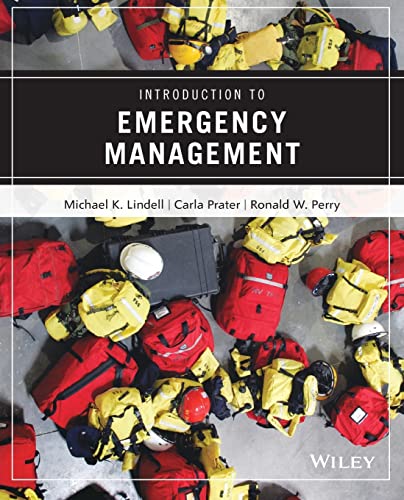
The recent devastation caused by tsunamis, hurricanes and wildfires highlights the need for highly trained professionals who can develop effective strategies in response to these disasters. This invaluable resource arms readers with the tools to address all phases of emergency management. It covers everything from the social and environmental processes that generate hazards to vulnerability analysis, hazard mitigation, emergency response, and disaster recovery.
Die Inhaltsangabe kann sich auf eine andere Ausgabe dieses Titels beziehen.
Über die Autorin bzw. den Autor
Dr. Michael K. Lindell is Professor of Landscape Architecture and Urban Planning, Texas A&M University; Senior Scholar, Hazard Reduction and Recovery Center, Texas A&M University; Adjunct Professor, Department of Psychology, Texas A&M University
Dr. Lindell has over 30 years of experience in the field of emergency management, during which time he has conducted a long term program of research on the processes by which individuals and organizations respond to natural and technological hazards. Much of his research, especially that supported by the National Science Foundation (NSF), has examined the processes by which affected populations respond to warnings of the imminent threat of a hazard. This research has been conducted in communities affected by hazards as diverse as flooding, volcanic eruption, hazardous materials, and hurricanes. Professor Lindell also has had extensive experience in providing technical assistance to government agencies, industry groups and private corporations in developing emergency plans and procedures. He has served six times as a consultant to the International Atomic Energy Agency in developing planning guidance for response to nuclear and radiological incidents, has made three presentations in National Academy of Sciences panels, and is currently a member of two National Academy of Sciences panels - Disasters Research in Social Sciences and Assessing Vulnerabilities Related to the Nation's Chemical Infrastructure. Professor Lindell has written extensively on emergency management and is the author of 70 technical reports, 70 journal articles and book chapters, and six books/monographs.
Von der hinteren Coverseite
You can get there
Where do you want to go? You might already be working in the emergency management field, and may be looking to expand your skills. You might be setting out on a new career path. Or, you might want to learn more about exciting opportunities in emergency management.
Wherever you want to go, Hazard Mitigation and Preparedness will help you get there. Easy-to-read, practical, and up-to-date, this text not only helps you learn fundamental hazard mitigation concepts, it also helps you master the core competencies and skills you need to succeed in the classroom and beyond. The book’s brief, modular format and variety of built-in learning resources enable you to learn at your own pace and focus your studies.
With this book, you will be able to:
- Learn how to build resilience at the community level.
- Examine the major categories of hazards, including meteorological and hydrological hazards, geological hazards, and manmade hazards.
- Understand the practice and politics of mitigation policy at the federal, state, and local government levels.
- Explore how the private sector can contribute to strong local economies through wise land use and business protection planning.
- Assess risk and vulnerability and identify hazards.
- Apply appropriate mitigation tools and techniques to reduce vulnerability.
- Prepare for potential hazards with preparedness activities.
- Follow the process of hazard mitigation planning.
- Foster a culture of prevention by applying the principles of sustainable development.
Wiley Pathways helps you achieve your goals
When it comes to learning about emergency management, not everyone is on the same path. But everyone wants to succeed. The new Wiley Pathways series in Emergency Management helps you achieve your goals with its brief, inviting format, clear language, and focus on core competencies and skills.
The books in this series––Introduction to Emergency Management, Hazard Mitigation and Preparedness, Emergency Planning, Technology in Emergency Management, and Disaster Response and Recovery––offer a coordinated curriculum for learning emergency management. Learn more at www.wiley.com/go/pathways.
Aus dem Klappentext
You can get there
Where do you want to go? You might already be working in the emergency management field, and may be looking to expand your skills. You might be setting out on a new career path. Or, you might want to learn more about exciting opportunities in emergency management.
Wherever you want to go, Hazard Mitigation and Preparedness will help you get there. Easy-to-read, practical, and up-to-date, this text not only helps you learn fundamental hazard mitigation concepts, it also helps you master the core competencies and skills you need to succeed in the classroom and beyond. The book’s brief, modular format and variety of built-in learning resources enable you to learn at your own pace and focus your studies.
With this book, you will be able to:
- Learn how to build resilience at the community level.
- Examine the major categories of hazards, including meteorological and hydrological hazards, geological hazards, and manmade hazards.
- Understand the practice and politics of mitigation policy at the federal, state, and local government levels.
- Explore how the private sector can contribute to strong local economies through wise land use and business protection planning.
- Assess risk and vulnerability and identify hazards.
- Apply appropriate mitigation tools and techniques to reduce vulnerability.
- Prepare for potential hazards with preparedness activities.
- Follow the process of hazard mitigation planning.
- Foster a culture of prevention by applying the principles of sustainable development.
Wiley Pathways helps you achieve your goals
When it comes to learning about emergency management, not everyone is on the same path. But everyone wants to succeed. The new Wiley Pathways series in Emergency Management helps you achieve your goals with its brief, inviting format, clear language, and focus on core competencies and skills.
The books in this series––Introduction to Emergency Management, Hazard Mitigation and Preparedness, Emergency Planning, Technology in Emergency Management, and Disaster Response and Recovery––offer a coordinated curriculum for learning emergency management. Learn more at www.wiley.com/go/pathways.
Auszug. © Genehmigter Nachdruck. Alle Rechte vorbehalten.
Wiley Pathways Introduction to Emergency Management
By Michael K. Lindell Carla Prater Ronald W. PerryJossey-Bass
Copyright © 2006 Michael K. Lindell .All right reserved.
ISBN: 978-0-471-77260-6
Chapter One
RISK PERCEPTION AND COMMUNICATIONSaving Lives
Starting Point
Go to www.wiley.com/college/Lindell to assess your knowledge of the basics of risk perception and communication.
Determine where you need to concentrate your effort.
What You'll Learn in This Chapter
* Responses to warnings
* Risk communication during the hazard phase
* Risk communication during crisis and emergency response
After Studying This Chapter, You'll Be Able To
* Analyze how people respond to warnings
* Involve the media and the public in risk communication
* Experiment using local and national information channels
Goals and Outcomes
* Design a risk communication plan
* Create and implement a risk communication plan
* Perform a protective action assessment
INTRODUCTION
As we have seen in many hurricanes, floods, and other disasters, people will not protect themselves if they don't believe their lives are at risk. Changing the way people perceive danger is an important way to save lives. To change the way people think, you must have specific plans for communicating the risks they face.
Risk is the possibility that people or property could be hurt. Risk is defined as the likelihood that an event will occur at a given location within a given time period and will inflict casualties and damage. This risk must be effectively communicated to the people who are likely to be affected. You must share information about hazards and hazard adjustments. Sharing is important because you must find out from different population segments how they think about hazards. Regardless of whether a hazard is natural, technological, or terrorist, the same basic principles of risk communication apply.
This chapter examines how people respond to warnings and includes an outline and discussion of the eight stages of information processing. It also shows how you influence perceptions by building credibility with those you need to influence. This chapter also discusses risk communication during the continuing hazard phase and during a crisis. This chapter shows you how to save lives by communicating. The best communication involves clarity, trust, and timing.
4.1 Household Response to Warnings
A warning is a risk communication about an imminent event and is intended to produce an appropriate disaster response. Examples of disaster responses include evacuating and sheltering in-place (Drabek, 1986; Mileti, Drabek and Haas, 1975). There are eight stages of a person's information processing during a warning. However, before these stages begin, people must receive, heed, and comprehend information about the risks. Let's take the case of an approaching tornado and examine what needs to happen before people seek shelter.
1. People must receive information. Warnings transmitted through television and radio are only effective if people receive them. Consequently, these warning mechanisms are much less effective between 11:00 pm and 6:00 am when most people are asleep. Of course, most televisions and radios are completely ineffective when power is lost.
2. People must heed (pay attention to) available information. Many people in tornado-prone areas know spring is the peak season for tornado activity. During those months, they should check weather forecasts more frequently. They should look for environmental cues, such as cloud formations. However, others may not pay attention to their environment. People who engage in tasks requiring intense concentration are less likely to notice gathering storm clouds and might not notice warnings.
3. People must comprehend the information. Environmental cues must be correctly processed; that is, people must know a funnel cloud is a sign of a tornado. Warnings and communication efforts must be understood as well. Warnings given in English will not help Spanish speakers. A tornado siren will not mean anything to someone who doesn't understand what the signal means. Only a few people will understand highly specialized technical terms such as millirem and pyroclastic flow.
4.1.1 Step 1: Risk Identification
Decisions about how to respond to a hazard begin with risk identification. As noted earlier, this process begins with the detection of environmental cues. However, the most important sources of risk identification are warning messages from authorities, the media, and peers. The first step you must take is to disseminate your message widely. Try to attract the attention of those at risk and inform them of the potential for disaster that threatens their health, safety and property.
Those at risk must answer the basic question of risk identification, "Is there a real threat that I need to pay attention to?" Those who do not believe the threat is real are likely to continue their normal activities.
4.1.2 Step 2: Risk Assessment
Risk assessment involves evaluating the personal consequences if the disaster occurs (Otway, 1973; Perry, 1979a). The primary question at this stage is "Do I need to take protective action?" A positive response to this question results in protection motivation. People's personal risk assessment-their risk perception-is critical in understanding their disaster response (Mileti and Sorensen, 1987). If people think they are in danger, then they are more likely to protect themselves.
Peoples' risk assessments include the perceived probability, magnitude, and immediacy of the disaster impact. Perceived probability of impact affects people's judgments of the likelihood that they will be affected, whereas perceptions of event magnitude increase their perceptions of the severity of personal consequences, including death, injury, and property damage. As perceived probability and magnitude increase, so do a person's likelihood of taking protective action. The perceived immediacy of disaster impact affects people in a different way. Instead of affecting a person's likelihood of acting, perceived immediacy increases a person's urgency to act.
4.1.3 Step 3: Protective Action Search
The primary question in protective action search is "How can I protect myself?" Residents' first attempts to answer this question often involve a search for what can be done by someone else to protect them against the hazard. However, when disaster impact is imminent, household owners must rely mostly on their own resources to achieve protection. In many instances, an individual's knowledge of the hazard suggests what type of protection to seek. People are likely to recall actions they have taken on previous occasions if they have had experience with that hazard. Alternatively, they might consider actions they took in similar hazards. For example, they might recognize that the impact of a volcanic mudflow is similar to that of a flood and, thus, they might take the protective responses that they took for a flood during a mudflow.
Information is also received from outside sources. For example, people might observe neighbors packing their cars in preparation for a hurricane evacuation. People also are likely to consider actions they have...
„Über diesen Titel“ kann sich auf eine andere Ausgabe dieses Titels beziehen.
Suchergebnisse für Wiley Pathways Introduction to Emergency Management

Beispielbild für diese ISBN
Introduction to Emergency Management
Anbieter: BooksRun, Philadelphia, PA, USA
Verkäuferbewertung 5 von 5 Sternen

Paperback. Zustand: Fair. 1. The item might be beaten up but readable. May contain markings or highlighting, as well as stains, bent corners, or any other major defect, but the text is not obscured in any way. Bestandsnummer des Verkäufers 0471772607-7-1-13
Gebraucht kaufen
EUR 11,68
Versand gratis
Versand innerhalb von USA
Versand innerhalb von USA
Anzahl: 1 verfügbar
Beispielbild für diese ISBN
Introduction to Emergency Management
Anbieter: Textbook Bookie, Little Rock, AR, USA
Verkäuferbewertung 5 von 5 Sternen
Paperback. Zustand: Good. Book in Good condition. Bestandsnummer des Verkäufers 9780471772606-good
Gebraucht kaufen
EUR 13,76
EUR 3,79 Versand
Versand innerhalb von USA
Versand innerhalb von USA
Anzahl: 3 verfügbar
Beispielbild für diese ISBN
Introduction to Emergency Management
Anbieter: Textbooks_Source, Columbia, MO, USA
Verkäuferbewertung 5 von 5 Sternen
paperback. Zustand: Good. 1st Edition. Ships in a BOX from Central Missouri! May not include working access code. Will not include dust jacket. Has used sticker(s) and some writing or highlighting. UPS shipping for most packages, (Priority Mail for AK/HI/APO/PO Boxes). Bestandsnummer des Verkäufers 000793144U
Gebraucht kaufen
EUR 23,23
EUR 3,56 Versand
Versand innerhalb von USA
Versand innerhalb von USA
Anzahl: 4 verfügbar
Beispielbild für diese ISBN
Wiley Pathways Introduction to Emergency Management
Anbieter: GoldBooks, Denver, CO, USA
Verkäuferbewertung 5 von 5 Sternen
Paperback. Zustand: new. New Copy. Customer Service Guaranteed. Bestandsnummer des Verkäufers 53X27_83_0471772607
Neu kaufen
EUR 37,65
EUR 4,90 Versand
Versand innerhalb von USA
Versand innerhalb von USA
Anzahl: 1 verfügbar
Beispielbild für diese ISBN
Introduction to Emergency Management
Anbieter: Textbooks_Source, Columbia, MO, USA
Verkäuferbewertung 5 von 5 Sternen
paperback. Zustand: New. 1st Edition. Ships in a BOX from Central Missouri! UPS shipping for most packages, (Priority Mail for AK/HI/APO/PO Boxes). Bestandsnummer des Verkäufers 000793144N
Neu kaufen
EUR 73,51
EUR 3,56 Versand
Versand innerhalb von USA
Versand innerhalb von USA
Anzahl: 1 verfügbar
Beispielbild für diese ISBN
Introduction to Emergency Management
Anbieter: BennettBooksLtd, Los Angeles, CA, USA
Verkäuferbewertung 5 von 5 Sternen
paperback. Zustand: New. In shrink wrap. Looks like an interesting title! Bestandsnummer des Verkäufers Q-0471772607
Neu kaufen
EUR 82,23
EUR 6,20 Versand
Versand innerhalb von USA
Versand innerhalb von USA
Anzahl: 1 verfügbar
Foto des Verkäufers
Introduction to Emergency Management
Anbieter: GreatBookPrices, Columbia, MD, USA
Verkäuferbewertung 5 von 5 Sternen
Zustand: New. Bestandsnummer des Verkäufers 3522848-n
Neu kaufen
EUR 86,18
EUR 2,35 Versand
Versand innerhalb von USA
Versand innerhalb von USA
Anzahl: 1 verfügbar
Foto des Verkäufers
Introduction to Emergency Management
Anbieter: GreatBookPricesUK, Woodford Green, Vereinigtes Königreich
Verkäuferbewertung 5 von 5 Sternen
Zustand: good. May show signs of wear, highlighting, writing, and previous use. This item may be a former library book with typical markings. No guarantee on products that contain supplements Your satisfaction is 100% guaranteed. Twenty-five year bookseller with shipments to over fifty million happy customers. Bestandsnummer des Verkäufers 3522848-5
Gebraucht kaufen
EUR 80,42
EUR 17,89 Versand
Versand von Vereinigtes Königreich nach USA
Versand von Vereinigtes Königreich nach USA
Anzahl: 4 verfügbar
Foto des Verkäufers
Introduction to Emergency Management
Anbieter: GreatBookPrices, Columbia, MD, USA
Verkäuferbewertung 5 von 5 Sternen
Zustand: As New. Unread book in perfect condition. Bestandsnummer des Verkäufers 3522848
Gebraucht kaufen
EUR 97,06
EUR 2,35 Versand
Versand innerhalb von USA
Versand innerhalb von USA
Anzahl: 1 verfügbar
Beispielbild für diese ISBN
Wiley Pathways Introduction to Emergency Management
Anbieter: PBShop.store UK, Fairford, GLOS, Vereinigtes Königreich
Verkäuferbewertung 5 von 5 Sternen
PAP. Zustand: New. New Book. Shipped from UK. Established seller since 2000. Bestandsnummer des Verkäufers FW-9780471772606
Neu kaufen
EUR 107,36
EUR 8,06 Versand
Versand von Vereinigtes Königreich nach USA
Versand von Vereinigtes Königreich nach USA
Anzahl: 1 verfügbar