
Verwandte Artikel zu Managing Derivative Risks: The Use and Abuse of Leverage
Inhaltsangabe
The collapse of Barings Bank is the latest in a long line of financial disasters which have been blamed on derivatives. Promoters of these instruments argue that they provide a useful service, helping to manage risk in an increasingly volatile market. Misuse has occurred through a combination of greed, a lack of understanding of their unique risk and the failure of management to control those who have to deal in them. This guide explains in simple, non-technical terms the benefits and risks of derivatives. Through extensive discussion of recent high-profile losses, it demonstrates how derivatives have been misused and shares proven strategies for their successful management.
Die Inhaltsangabe kann sich auf eine andere Ausgabe dieses Titels beziehen.
Über die Autorin bzw. den Autor
Lilian Chew is a former editor of Risk Magazine, the leading international magazine for the derivatives industry. She has also been editor of Euromoney Corporate Finance, and worked as a dealer for the Monetary Authority of Singapore. She currently freelances for a variety of leading finance magazines.
Von der hinteren Coverseite
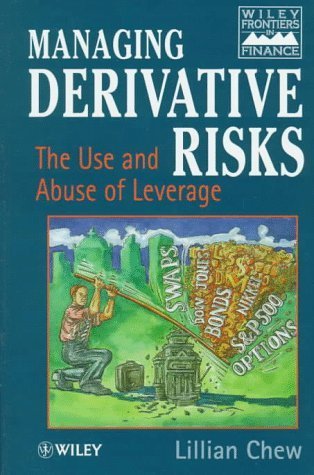
Managing Derivative Risks The Use and Abuse of Leverage Lillian Chew When Barings, the oldest merchant bank in the United Kingdom, collapsed it joined the long list of financial disasters that have involved derivatives. Procter & Gamble, Metallgesellschaft and Orange County have all fallen famously foul of these instruments. But are they really so dangerous? Promoters of derivatives rightly argue that they provide a service, helping to manage risk in increasingly volatile markets. Where large losses have occurred, it is because derivatives have been misused through greed, a lack of understanding of their risks and the failure of management to control properly those who deal in them, or all three. This book cuts through the hysteria and hype and explains in non–technical terms the unique risks of derivatives. These risks are discussed using actual examples, particularly the high–profile cases of the early 1990s. Managing Derivative Risks also discusses topical issues such as Value at Risk and the latest Bank for International Settlements capital requirements for market risk. It will prove a valuable source of information for finance directors, treasurers, institutional investors, fund managers, bankers, regulators, and anyone who sits on a corporate board.
Aus dem Klappentext
Managing Derivative Risks uses familiar analogies to explain the complex risks of derivatives, and how to manage them. Derivatives are sold to consumers as risk-management tools, but they bring their own risks. This point seems to be ignored by some end users, blinded as they are by the brilliance of a structure that promises them something for nothing. At the other end of the spectrum are those who doggedly refuse to see the virtues of such instruments and thus deprive their shareholders of the demonstrable benefits of such tools. Managing Derivative Risks seeks to help both groups understand the risks and rewards of instruments which will shape finance in the coming millennium.
„Über diesen Titel“ kann sich auf eine andere Ausgabe dieses Titels beziehen.
Suchergebnisse für Managing Derivative Risks: The Use and Abuse of Leverage

Foto des Verkäufers
Managing Derivative Risks: The Use and Abuse of Leverage (Frontiers in Finance Series)
Anbieter: Greenworld Books, Arlington, TX, USA
Verkäuferbewertung 5 von 5 Sternen

Zustand: good. Fast Free Shipping â" Good condition. It may show normal signs of use, such as light writing, highlighting, or library markings, but all pages are intact and the book is fully readable. A solid, complete copy that's ready to enjoy. Bestandsnummer des Verkäufers GWV.0471956228.G
Gebraucht kaufen
EUR 12,37
Versand gratis
Versand innerhalb von USA
Versand innerhalb von USA
Anzahl: 1 verfügbar
Beispielbild für diese ISBN
Managing Derivative Risks: The Use and Abuse of Leverage (Frontiers in Finance Series)
Anbieter: HPB-Red, Dallas, TX, USA
Verkäuferbewertung 5 von 5 Sternen
hardcover. Zustand: Good. Connecting readers with great books since 1972! Used textbooks may not include companion materials such as access codes, etc. May have some wear or writing/highlighting. We ship orders daily and Customer Service is our top priority! Bestandsnummer des Verkäufers S_442242297
Gebraucht kaufen
EUR 9,48
EUR 3,24 Versand
Versand innerhalb von USA
Versand innerhalb von USA
Anzahl: 1 verfügbar
Beispielbild für diese ISBN
Managing Derivative Risks: The Use and Abuse of Leverage (Frontiers in Finance Series)
Anbieter: ThriftBooks-Atlanta, AUSTELL, GA, USA
Verkäuferbewertung 5 von 5 Sternen
Hardcover. Zustand: Very Good. No Jacket. May have limited writing in cover pages. Pages are unmarked. ~ ThriftBooks: Read More, Spend Less. Bestandsnummer des Verkäufers G0471956228I4N00
Gebraucht kaufen
EUR 13,04
Versand gratis
Versand innerhalb von USA
Versand innerhalb von USA
Anzahl: 1 verfügbar
Beispielbild für diese ISBN
Managing Derivative Risk
Verlag:
Wiley & Sons, Incorporated, John, 1996
ISBN 10: 0471956228
ISBN 13: 9780471956228
Gebraucht
Hardcover
Erstausgabe
Anbieter: Better World Books, Mishawaka, IN, USA
Verkäuferbewertung 5 von 5 Sternen
Zustand: Very Good. 1st Edition. Pages intact with possible writing/highlighting. Binding strong with minor wear. Dust jackets/supplements may not be included. Stock photo provided. Product includes identifying sticker. Better World Books: Buy Books. Do Good. Bestandsnummer des Verkäufers 590456-6
Gebraucht kaufen
EUR 13,20
Versand gratis
Versand innerhalb von USA
Versand innerhalb von USA
Anzahl: 1 verfügbar
Beispielbild für diese ISBN
Managing Derivatives Risks: The Use and Abuse of Leverage
Anbieter: Anybook.com, Lincoln, Vereinigtes Königreich
Verkäuferbewertung 5 von 5 Sternen
Zustand: Good. This is an ex-library book and may have the usual library/used-book markings inside.This book has hardback covers. In good all round condition. Please note the Image in this listing is a stock photo and may not match the covers of the actual item,750grams, ISBN:9780471956228. Bestandsnummer des Verkäufers 9552971
Gebraucht kaufen
EUR 7,69
EUR 15,91 Versand
Versand von Vereinigtes Königreich nach USA
Versand von Vereinigtes Königreich nach USA
Anzahl: 1 verfügbar
Foto des Verkäufers
Managing Derivative Risks. The Use and Abuse of Leverage
Verlag:
John Wiley & Sons, Chichester, 1996
ISBN 10: 0471956228
ISBN 13: 9780471956228
Gebraucht
Hardcover
Anbieter: MAUTALOS LIBRERÍA, Madrid, M, Spanien
Verkäuferbewertung 5 von 5 Sternen
Encuadernación de tapa dura. Zustand: Como Nuevo. Zustand des Schutzumschlags: Como Nuevo. Economía. Ensayo. Bestandsnummer des Verkäufers 105467
Gebraucht kaufen
EUR 20,25
EUR 25,00 Versand
Versand von Spanien nach USA
Versand von Spanien nach USA
Anzahl: 1 verfügbar
Beispielbild für diese ISBN
Managing Derivative Risks. The Use and Abuse of Leverage. Wiley Frontiers in Finance.
Verlag:
Chichester, Wiley, 1996., 1996
ISBN 10: 0471956228
ISBN 13: 9780471956228
Gebraucht
Hardcover
Erstausgabe
Anbieter: Antiquariat Hohmann, Schemmerhofen, Deutschland
Verkäuferbewertung 5 von 5 Sternen
XVIII 313 S., mehr. Fig., gr.okt., KLdr., OU.- [ Wirtschaftswissenschaft Betriebswirtschaft Börse SpracheEN J| 1996 N| Lillian Chew | 65015 ]. Bestandsnummer des Verkäufers 65015-1
Gebraucht kaufen
EUR 30,00
EUR 24,50 Versand
Versand von Deutschland nach USA
Versand von Deutschland nach USA
Anzahl: 1 verfügbar