
Verwandte Artikel zu Poetics of Relation
Inhaltsangabe
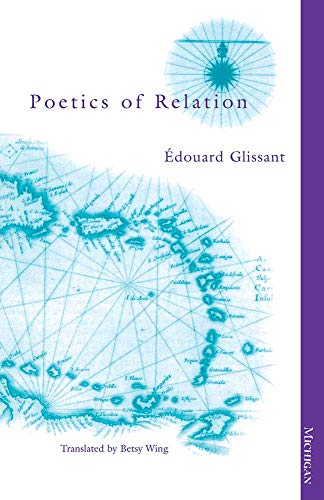
Édouard Glissant, long recognized in the French and francophone world as one of the greatest writers and thinkers of our times, is increasingly attracting attention from English-speaking readers. Born in Martinique in 1928, Glissant earned a doctorate from the Sorbonne. When he returned to his native land in the mid-sixties, his writing began to focus on the idea of a "relational poetics," which laid the groundwork for the "créolité" movement, fueled by the understanding that Caribbean culture and identity are the positive products of a complex and multiple set of local historical circumstances. Some of the metaphors of local identity Glissant favored--the hinterland (or lack of it), the maroon (or runaway slave), the creole language--proved lasting and influential.
In Poetics of Relation, Glissant turns the concrete particulars of Caribbean reality into a complex, energetic vision of a world in transformation. He sees the Antilles as enduring suffering imposed by history, yet as a place whose unique interactions will one day produce an emerging global consensus. Arguing that the writer alone can tap the unconscious of a people and apprehend its multiform culture to provide forms of memory capable of transcending "nonhistory," Glissant defines his "poetics of relation"--both aesthetic and political--as a transformative mode of history, capable of enunciating and making concrete a French-Caribbean reality with a self-defined past and future. Glissant's notions of identity as constructed in relation and not in isolation are germane not only to discussions of Caribbean creolization but also to our understanding of U.S. multiculturalism. In Glissant's view, we come to see that relation in all its senses--telling, listening, connecting, and the parallel consciousness of self and surroundings--is the key to transforming mentalities and reshaping societies.
This translation of Glissant's work preserves the resonating quality of his prose and makes the richness and ambiguities of his voice accessible to readers in English.
"The most important theoretician from the Caribbean writing today. . . . He is central not only to the burgeoning field of Caribbean studies, but also to the newly flourishing literary scene in the French West Indies." --Judith Graves Miller, University of Wisconsin, Madison
Édouard Glissant is Distinguished Professor of French at City University of New York, Graduate Center. Betsy Wing's recent translations include Lucie Aubrac's Outwitting the Gestapo (with Konrad Bieber), Didier Eribon's Michel Foucault and Hélêne Cixous's The Book of Promethea.
Die Inhaltsangabe kann sich auf eine andere Ausgabe dieses Titels beziehen.
Über die Autorinnen und Autoren
Édouard Glissant is Distinguished Professor of French at City University of New York, Graduate Center.
Betsy Wing's recent translations include Lucie Aubrac's Outwitting the Gestapo (with Konrad Bieber), Didier Eribon's Michel Foucault and Hélêne Cixous's The Book of Promethea.
Édouard Glissant is Distinguished Professor of French at City University of New York, Graduate Center.
Betsy Wing's recent translations include Lucie Aubrac's Outwitting the Gestapo (with Konrad Bieber), Didier Eribon's Michel Foucault and Hélêne Cixous's The Book of Promethea.
Von der hinteren Coverseite
In Poetics of Relation, French-Caribbean writer and philosopher Edouard Glissant turns the concrete particulars of Caribbean reality into a complex, energetic vision of a world in transformation. He sees the islands of the Antilles as enduring an "invalid" suffering imposed by history, yet also as a place whose unique interactions will one day produce an emerging global consensus. Arguing that the writer alone can tap the unconscious of a people and apprehend its multiform culture in order to provide forms of memory and intent capable of transcending "nonhistory", Glissant therefore defines his "poetics of relation" - both aesthetic and political - as a transformative mode of history, capable of enunciating and making concrete a French-Caribbean reality with a self-defined past and future. In Poetics of Relation, we come to see that relation in all its senses - telling, listening, connecting, and the parallel consciousness of self and surroundings - is the key to transforming mentalities and reshaping societies. The issues raised about identity as built in relation and not in isolation are central to current discussions not only of Caribbean creolization but of U.S. multiculturalism as well.
Auszug. © Genehmigter Nachdruck. Alle Rechte vorbehalten.
Poetics of Relation
By ÉDOUARD GLISSANTThe University Of Michigan Press
Copyright © 1997University of MichiganAll right reserved.
ISBN: 978-0-472-06629-2
Contents
Translator's Introduction, Betsy Wing........................xiGlossary.....................................................xxiThe Open Boat................................................5Errantry, Exile..............................................11Poetics......................................................23A Rooted Errantry............................................37Repetitions..................................................45Expanse and Filiation........................................47Closed Place, Open Word......................................63Concerning a Baroque Abroad in the World.....................77Concerning the Poem's Information............................81Creolizations................................................89Dictate, Decree..............................................91To Build the Tower...........................................103Transparency and Opacity.....................................111The Black Beach..............................................121Relation.....................................................131The Relative and Chaos.......................................133Distancing, Determining......................................141That That....................................................159Relinked, (Relayed), Related.................................169Generalization...............................................183That Those Beings Be Not Being...............................185For Opacity..................................................189Open Circle, Lived Relation..................................195The Burning Beach............................................205Notes........................................................211References...................................................225
Chapter One
The Open Boat
For the Africans who lived through the experience of deportation to the Americas, confronting the unknown with neither preparation nor challenge was no doubt petrifying.
The first dark shadow was cast by being wrenched from their everyday, familiar land, away from protecting gods and a tutelary community. But that is nothing yet. Exile can be borne, even when it comes as a bolt from the blue. The second dark of night fell as tortures and the deterioration of person, the result of so many incredible Gehennas. Imagine two hundred human beings crammed into a space barely capable of containing a third of them. Imagine vomit, naked flesh, swarming lice, the dead slumped, the dying crouched. Imagine, if you can, the swirling red of mounting to the deck, the ramp they climbed, the black sun on the horizon, vertigo, this dizzying sky plastered to the waves. Over the course of more than two centuries, twenty, thirty million people deported. Worn down, in a debasement more eternal than apocalypse. But that is nothing yet.
What is terrifying partakes of the abyss, three times linked to the unknown. First, the time you fell into the belly of the boat. For, in your poetic vision, a boat has no belly; a boat does not swallow up, does not devour; a boat is steered by open skies. Yet, the belly of this boat dissolves you, precipitates you into a nonworld from which you cry out. This boat is a womb, a womb abyss. It generates the clamor of your protests; it also produces all the coming unanimity. Although you are alone in this suffering, you share in the unknown with others whom you have yet to know. This boat is your womb, a matrix, and yet it expels you. This boat: pregnant with as many dead as living under sentence of death.
The next abyss was the depths of the sea. Whenever a fleet of ships gave chase to slave ships, it was easiest just to lighten the boat by throwing cargo overboard, weighing it down with balls and chains. These underwater signposts mark the course between the Gold Coast and the Leeward Islands. Navigating the green splendor of the sea—whether in melancholic transatlantic crossings or glorious regattas or traditional races of yoles and gommiers—still brings to mind, coming to light like seaweed, these lowest depths, these deeps, with their punctuation of scarcely corroded balls and chains. In actual fact the abyss is a tautology: the entire ocean, the entire sea gently collapsing in the end into the pleasures of sand, make one vast beginning, but a beginning whose time is marked by these balls and chains gone green.
But for these shores to take shape, even before they could be contemplated, before they were yet visible, what sufferings came from the unknown! Indeed, the most petrifying face of the abyss lies far ahead of the slave ship's bow, a pale murmur; you do not know if it is a storm cloud, rain or drizzle, or smoke from a comforting fire. The banks of the river have vanished on both sides of the boat. What kind of river, then, has no middle? Is nothing there but straight ahead? Is this boat sailing into eternity toward the edges of a nonworld that no ancestor will haunt?
Paralleling this mass of water, the third metamorphosis of the abyss thus projects a reverse image of all that had been left behind, not to be regained for generations except—more and more threadbare—in the blue savannas of memory or imagination.
The asceticism of crossing this way the land-sea that, unknown to you, is the planet Earth, feeling a language vanish, the word of the gods vanish, and the sealed image of even the most everyday object, of even the most familiar animal, vanish. The evanescent taste of what you ate. The hounded scent of ochre earth and savannas.
"Je te salue, vieil Océan!" You still preserve on your crests the silent boat of our births, your chasms are our own unconscious, furrowed with fugitive memories. Then you lay out these new shores, where we hook our tar-streaked wounds, our reddened mouths and stifled outcries.
Experience of the abyss lies inside and outside the abyss. The torment of those who never escaped it: straight from the belly of the slave ship into the violet belly of the ocean depths they went. But their ordeal did not die; it quickened into this continuous/discontinuous thing: the panic of the new land, the haunting of the former land, finally the alliance with the imposed land, suffered and redeemed. The unconscious memory of the abyss served as the alluvium for these metamorphoses. The populations that then formed, despite having forgotten the chasm, despite being unable to imagine the passion of those who foundered there, nonetheless wove this sail (a veil). They did not use it to return to the Former Land but rose up on this unexpected, dumbfounded land. They met the first inhabitants, who had also been deported by permanent havoc; or perhaps they only caught a whiff of the ravaged trail of these people. The land-beyond turned into land-in-itself. And this undreamt of sail, finally now spread, is watered by the white wind of the abyss. Thus, the absolute unknown, projected by the abyss and bearing into eternity the womb abyss and the infinite abyss, in the end became knowledge.
Not just a specific knowledge, appetite, suffering, and delight of one particular people, not only that, but knowledge of the Whole, greater from having been at the abyss and freeing knowledge of Relation within the Whole.
Just as the first uprooting was not marked by any defiance, in the same way the prescience and actual experience of Relation have nothing to do with vanity. Peoples who have been...
„Über diesen Titel“ kann sich auf eine andere Ausgabe dieses Titels beziehen.
Suchergebnisse für Poetics of Relation

Foto des Verkäufers
Poetics of Relation
Anbieter: GreatBookPrices, Columbia, MD, USA
Verkäuferbewertung 5 von 5 Sternen

Zustand: New. Bestandsnummer des Verkäufers 444856-n
Neu kaufen
EUR 23,51
EUR 2,30 Versand
Versand innerhalb von USA
Versand innerhalb von USA
Anzahl: 9 verfügbar
Beispielbild für diese ISBN
Poetics of Relation Format: Paperback
Anbieter: INDOO, Avenel, NJ, USA
Verkäuferbewertung 5 von 5 Sternen
Zustand: New. Brand New. Bestandsnummer des Verkäufers 9780472066292
Neu kaufen
EUR 25,89
Versand gratis
Versand innerhalb von USA
Versand innerhalb von USA
Anzahl: Mehr als 20 verfügbar
Foto des Verkäufers
Poetics of Relation
Anbieter: eCampus, Lexington, KY, USA
Verkäuferbewertung 4 von 5 Sternen

Zustand: New. Bestandsnummer des Verkäufers N:9780472066292:ONHAND
Neu kaufen
EUR 24,15
EUR 3,48 Versand
Versand innerhalb von USA
Versand innerhalb von USA
Anzahl: 9 verfügbar
Foto des Verkäufers
Poetics of Relation
Verlag:
University of Michigan Press, 1997
ISBN 10: 0472066293
ISBN 13: 9780472066292
Gebraucht
Softcover
Anbieter: GreatBookPrices, Columbia, MD, USA
Verkäuferbewertung 5 von 5 Sternen
Zustand: As New. Unread book in perfect condition. Bestandsnummer des Verkäufers 444856
Gebraucht kaufen
EUR 25,86
EUR 2,30 Versand
Versand innerhalb von USA
Versand innerhalb von USA
Anzahl: 9 verfügbar
Foto des Verkäufers
Poetics of Relation (Paperback or Softback)
Verlag:
University of Michigan Press 9/29/1997, 1997
ISBN 10: 0472066293
ISBN 13: 9780472066292
Neu
Paperback or Softback
Anbieter: BargainBookStores, Grand Rapids, MI, USA
Verkäuferbewertung 5 von 5 Sternen
Paperback or Softback. Zustand: New. Poetics of Relation. Book. Bestandsnummer des Verkäufers BBS-9780472066292
Foto des Verkäufers
Poetics of Relation
Verlag:
The University of Michigan Press, US, 1997
ISBN 10: 0472066293
ISBN 13: 9780472066292
Neu
Paperback
Anbieter: Rarewaves USA, HEBRON, KY, USA
Verkäuferbewertung 5 von 5 Sternen
Paperback. Zustand: New. Édouard Glissant, long recognized in the French and francophone world as one of the greatest writers and thinkers of our times, is increasingly attracting attention from English-speaking readers. Born in Martinique in 1928, Glissant earned a doctorate from the Sorbonne. When he returned to his native land in the mid-sixties, his writing began to focus on the idea of a "relational poetics," which laid the groundwork for the "créolité" movement, fueled by the understanding that Caribbean culture and identity are the positive products of a complex and multiple set of local historical circumstances. Some of the metaphors of local identity Glissant favored--the hinterland (or lack of it), the maroon (or runaway slave), the creole language--proved lasting and influential. In Poetics of Relation, Glissant turns the concrete particulars of Caribbean reality into a complex, energetic vision of a world in transformation. He sees the Antilles as enduring suffering imposed by history, yet as a place whose unique interactions will one day produce an emerging global consensus. Arguing that the writer alone can tap the unconscious of a people and apprehend its multiform culture to provide forms of memory capable of transcending "nonhistory," Glissant defines his "poetics of relation"--both aesthetic and political--as a transformative mode of history, capable of enunciating and making concrete a French-Caribbean reality with a self-defined past and future. Glissant's notions of identity as constructed in relation and not in isolation are germane not only to discussions of Caribbean creolization but also to our understanding of U.S. multiculturalism. In Glissant's view, we come to see that relation in all its senses--telling, listening, connecting, and the parallel consciousness of self and surroundings--is the key to transforming mentalities and reshaping societies.This translation of Glissant's work preserves the resonating quality of his prose and makes the richness and ambiguities of his voice accessible to readers in English. "The most important theoretician from the Caribbean writing today. . . . He is central not only to the burgeoning field of Caribbean studies, but also to the newly flourishing literary scene in the French West Indies." --Judith Graves Miller, University of Wisconsin, MadisonÉdouard Glissant is Distinguished Professor of French at City University of New York, Graduate Center. Betsy Wing's recent translations include Lucie Aubrac's Outwitting the Gestapo (with Konrad Bieber), Didier Eribon's Michel Foucault and Hélêne Cixous's The Book of Promethea. Bestandsnummer des Verkäufers LU-9780472066292
Beispielbild für diese ISBN
Poetics of Relation
Verlag:
University of Michigan Press, c.2010,, 2010
ISBN 10: 0472066293
ISBN 13: 9780472066292
Gebraucht
paperback,
Anbieter: Harry Alter, Sylva, NC, USA
Verkäuferbewertung 5 von 5 Sternen
paperback, Zustand: Very Good, University of Michigan Press, c.2010, 6th.trade paperbk.prtg., 226pp., VG $. Bestandsnummer des Verkäufers 106832
Gebraucht kaufen
EUR 26,92
EUR 3,44 Versand
Versand innerhalb von USA
Versand innerhalb von USA
Anzahl: 1 verfügbar
Beispielbild für diese ISBN
Poetics of Relation
Verlag:
University of Michigan Press, 1997
ISBN 10: 0472066293
ISBN 13: 9780472066292
Gebraucht
paperback
Anbieter: Webster's Bookstore Cafe, Inc., State College, PA, USA
Verkäuferbewertung 5 von 5 Sternen
paperback. Zustand: Very Good. A clean and tight copy. Bestandsnummer des Verkäufers mon0000151761
Gebraucht kaufen
EUR 25,96
EUR 4,78 Versand
Versand innerhalb von USA
Versand innerhalb von USA
Anzahl: 1 verfügbar
Beispielbild für diese ISBN
Poetics of Relation
Verlag:
Univ. of Michigan Press, 1997
ISBN 10: 0472066293
ISBN 13: 9780472066292
Gebraucht
PAPERBACK
Anbieter: City Lights Bookstore, Sylva, NC, USA
Verkäuferbewertung 5 von 5 Sternen
PAPERBACK. Zustand: Near Fine. Univ. of Michigan Press. PAPERBACK. 1997. 0472066293 :Mild shelfwear, else like new. Translated by Betsy Wing. 226pp. . Near Fine. Bestandsnummer des Verkäufers 0472066293-01
Gebraucht kaufen
EUR 26,90
EUR 4,79 Versand
Versand innerhalb von USA
Versand innerhalb von USA
Anzahl: 1 verfügbar
Foto des Verkäufers
Poetics of Relation (Paperback)
Verlag:
The University of Michigan Press, Ann Arbor, 1997
ISBN 10: 0472066293
ISBN 13: 9780472066292
Neu
Paperback
Anbieter: Grand Eagle Retail, Bensenville, IL, USA
Verkäuferbewertung 5 von 5 Sternen
Paperback. Zustand: new. Paperback. Edouard Glissant, long recognized in the French and francophone world as one of the greatest writers and thinkers of our times, is increasingly attracting attention from English-speaking readers. Born in Martinique in 1928, Glissant earned a doctorate from the Sorbonne. When he returned to his native land in the mid-sixties, his writing began to focus on the idea of a "relational poetics," which laid the groundwork for the "creolite" movement, fueled by the understanding that Caribbean culture and identity are the positive products of a complex and multiple set of local historical circumstances. Some of the metaphors of local identity Glissant favored--the hinterland (or lack of it), the maroon (or runaway slave), the creole language--proved lasting and influential. In Poetics of Relation, Glissant turns the concrete particulars of Caribbean reality into a complex, energetic vision of a world in transformation. He sees the Antilles as enduring suffering imposed by history, yet as a place whose unique interactions will one day produce an emerging global consensus. Arguing that the writer alone can tap the unconscious of a people and apprehend its multiform culture to provide forms of memory capable of transcending "nonhistory," Glissant defines his "poetics of relation"--both aesthetic and political--as a transformative mode of history, capable of enunciating and making concrete a French-Caribbean reality with a self-defined past and future. Glissant's notions of identity as constructed in relation and not in isolation are germane not only to discussions of Caribbean creolization but also to our understanding of U.S. multiculturalism. In Glissant's view, we come to see that relation in all its senses--telling, listening, connecting, and the parallel consciousness of self and surroundings--is the key to transforming mentalities and reshaping societies.This translation of Glissant's work preserves the resonating quality of his prose and makes the richness and ambiguities of his voice accessible to readers in English. "The most important theoretician from the Caribbean writing today. . . . He is central not only to the burgeoning field of Caribbean studies, but also to the newly flourishing literary scene in the French West Indies." --Judith Graves Miller, University of Wisconsin, MadisonEdouard Glissant is Distinguished Professor of French at City University of New York, Graduate Center. Betsy Wing's recent translations include Lucie Aubrac's Outwitting the Gestapo (with Konrad Bieber), Didier Eribon's Michel Foucault and Helene Cixous's The Book of Promethea. A major work by this prominent Caribbean author and philosopher, available for the first time in English Shipping may be from multiple locations in the US or from the UK, depending on stock availability. Bestandsnummer des Verkäufers 9780472066292