
Verwandte Artikel zu Principles Of Orchestration. Arbeitsheft.: Paperback...
Inhaltsangabe
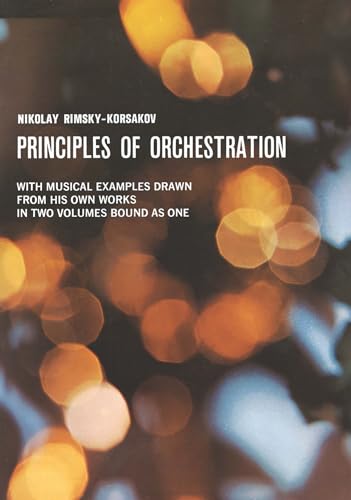
Nikolay Rimsky-Korsakov. The fundamental principles of modern orchestration, the study of tonal resonance and orchestral combination. Uses musical examples from his own works.
Die Inhaltsangabe kann sich auf eine andere Ausgabe dieses Titels beziehen.
Über die Autorin bzw. den Autor
Nikolai Rimsky-Korsakov (1844-1908) was a prolific composer of orchestral works and many other forms of music, including chamber works and art songs. He also wrote many operas, excerpts from which are featured in this collection; most notably, "The Flight of the Bumblebee" from The Tale of Tsar Saltan.
Von der hinteren Coverseite
"To orchestrate is to create, and this cannot be taught," wrote Nikolay Rimsky-Korsakov, the great Russian composer whose genius for brilliant, highly colored orchestration is unsurpassed. But invention, in all art, is closely allied to technique, and technique can be taught. This book, therefore, which differs from most other texts on the subject because of its tremendous wealth of musical examples and its systematic arrangement of material according to each constituent of the orchestra, will undoubtedly be of value to any music student. It is a music classic, perhaps the only book on classical orchestration written by a major composer.
In it, the composer aims to provide the reader with the fundamental principles of modern orchestration from the standpoint of brilliance and imagination, and he devotes considerable space to the study of tonal resonance and orchestral combination. In his course, he demonstrates such things as how to produce a good-sounding chord of certain tone-quality, uniformly distributed; how to detach a melody from its harmonic setting; correct progression of parts; and other similar problems.
The first chapter is a general review of orchestral groups, with an instrument-by-instrument breakdown and material on such technical questions as fingering, range, emission of sound, etc. There follows two chapters on melody and harmony in strings, winds, brasses, and combined groups. Chapter IV, Composition of the Orchestra, covers different ways of orchestrating the same music; effects that can be achieved with full tutti; tutti in winds, tutti pizzicato, soli in the strings, etc.; chords; progressions; and so on. The last two chapters deal with opera and include discussion of solo and choral accompaniment, instruments on stage or in the wings, technical terms, soloists (range, register, vocalization, vowels, etc.), voices in combination, and choral singing.
Immediately following this text are some 330 pages of musical examples drawn from "Sheherazade," the "Antar Symphony," "Capriccio Espagnol," "Sadko," "Ivan the Terrible," "Le Coq d'Or," "Mlada," "The Tsar's Bride," and others of Rimsky-Korsakov's works. These excerpts are all referred to in the text itself, where they illustrate, far better than words, particular points of theory and actual musical practice. They are largely responsible for making this book the very special (and very useful) publication it is.
This single-volume edition also includes a brief preface by the editor and extracts from Rimsky-Korsakov's 1891 draft and final versions of his own preface, as well as an appendixed chart of single tutti chords in the composer's works.
„Über diesen Titel“ kann sich auf eine andere Ausgabe dieses Titels beziehen.
Suchergebnisse für Principles Of Orchestration. Arbeitsheft.: Paperback...

Foto des Verkäufers
Principles of Orchestration (Dover Books On Music: Analysis)
Anbieter: Goodwill Books, Hillsboro, OR, USA
Verkäuferbewertung 5 von 5 Sternen

Zustand: acceptable. Fairly worn, but readable and intact. If applicable: Dust jacket, disc or access code may not be included. Bestandsnummer des Verkäufers GICWV.0486212661.A
Gebraucht kaufen
EUR 3,60
EUR 3,55 Versand
Versand innerhalb von USA
Versand innerhalb von USA
Anzahl: 1 verfügbar
Beispielbild für diese ISBN
Principles of Orchestration
Anbieter: ThriftBooks-Dallas, Dallas, TX, USA
Verkäuferbewertung 5 von 5 Sternen
Paperback. Zustand: Very Good. No Jacket. May have limited writing in cover pages. Pages are unmarked. ~ ThriftBooks: Read More, Spend Less. Bestandsnummer des Verkäufers G0486212661I4N00
Gebraucht kaufen
EUR 7,22
Versand gratis
Versand innerhalb von USA
Versand innerhalb von USA
Anzahl: 1 verfügbar
Beispielbild für diese ISBN
Principles of Orchestration (Dover Books on Music)
Anbieter: Wonder Book, Frederick, MD, USA
Verkäuferbewertung 5 von 5 Sternen
Zustand: Good. Good condition. 2 Volumes in 1. A copy that has been read but remains intact. May contain markings such as bookplates, stamps, limited notes and highlighting, or a few light stains. Bestandsnummer des Verkäufers P10K-00076
Gebraucht kaufen
EUR 8,39
Versand gratis
Versand innerhalb von USA
Versand innerhalb von USA
Anzahl: 1 verfügbar
Beispielbild für diese ISBN
Principles of Orchestration (Dover Books on Music)
Anbieter: Half Price Books Inc., Dallas, TX, USA
Verkäuferbewertung 5 von 5 Sternen
Paperback. Zustand: Very Good. Connecting readers with great books since 1972! Used books may not include companion materials, and may have some shelf wear or limited writing. We ship orders daily and Customer Service is our top priority! Bestandsnummer des Verkäufers S_476334246
Gebraucht kaufen
EUR 5,27
EUR 3,34 Versand
Versand innerhalb von USA
Versand innerhalb von USA
Anzahl: 1 verfügbar
Beispielbild für diese ISBN
Principles of Orchestration (Dover Books on Music)
Anbieter: HPB-Diamond, Dallas, TX, USA
Verkäuferbewertung 5 von 5 Sternen
Paperback. Zustand: Very Good. Connecting readers with great books since 1972! Used books may not include companion materials, and may have some shelf wear or limited writing. We ship orders daily and Customer Service is our top priority! Bestandsnummer des Verkäufers S_480999254
Gebraucht kaufen
EUR 6,85
EUR 3,34 Versand
Versand innerhalb von USA
Versand innerhalb von USA
Anzahl: 1 verfügbar
Beispielbild für diese ISBN
Principles of Orchestration
Verlag:
Dover Publications, Incorporated, 1964
ISBN 10: 0486212661
ISBN 13: 9780486212661
Gebraucht
Softcover
Anbieter: Better World Books, Mishawaka, IN, USA
Verkäuferbewertung 5 von 5 Sternen
Zustand: Good. Pages intact with minimal writing/highlighting. The binding may be loose and creased. Dust jackets/supplements are not included. Stock photo provided. Product includes identifying sticker. Better World Books: Buy Books. Do Good. Bestandsnummer des Verkäufers 5955491-6
Gebraucht kaufen
EUR 10,76
Versand gratis
Versand innerhalb von USA
Versand innerhalb von USA
Anzahl: 1 verfügbar
Foto des Verkäufers
Principles of Orchestration (Dover Books On Music: Analysis)
Anbieter: Goodwill of Silicon Valley, SAN JOSE, CA, USA
Verkäuferbewertung 4 von 5 Sternen

Zustand: good. Supports Goodwill of Silicon Valley job training programs. The cover and pages are in Good condition! Any other included accessories are also in Good condition showing use. Use can include some highlighting and writing, page and cover creases as well as other types visible wear. Bestandsnummer des Verkäufers GWSVV.0486212661.G
Gebraucht kaufen
EUR 7,26
EUR 3,55 Versand
Versand innerhalb von USA
Versand innerhalb von USA
Anzahl: 1 verfügbar
Beispielbild für diese ISBN
Principles Of Orchestration: Paperback
Verlag:
Dover Publications Inc., 1964
ISBN 10: 0486212661
ISBN 13: 9780486212661
Gebraucht
Softcover
Anbieter: World of Books (was SecondSale), Montgomery, IL, USA
Verkäuferbewertung 5 von 5 Sternen
Zustand: Fair. To orchestrate is to create, and this cannot be taught, wrote Nikolay Rimsky-Korsakov, the great Russian composer whose genius for brilliant, highly colored orchestration is unsurpassed. But invention, in all art, is closely allied to technique, and technique can be taught. This book, therefore, which differs from most other texts on the subject because of its tremendous wealth of musical examples and its systematic arrangement of material according to each constituent of the orchestra, will undoubtedly be of value to any music student. It is a music classic, perhaps the only book on classical orchestration written by a major composer.In it, the composer aims to provide the reader with the fundamental principles of modern orchestration from the standpoint of brilliance and imagination, and he devotes considerable space to the study of tonal resonance and orchestral combination. In his course, he demonstrates such things as how to produce a good-sounding chord of certain tone-quality, uniformly distributed; how to detach a melody from its harmonic setting; correct progression of parts; and other similar problems.The first chapter is a general review of orchestral groups, with an instrument-by-instrument breakdown and material on such technical questions as fingering, range, emission of sound, etc. There follows two chapters on melody and harmony in strings, winds, brasses, and combined groups. Chapter IV, Composition of the Orchestra, covers different ways of orchestrating the same music; effects that can be achieved with full tutti; tutti in winds, tutti pizzicato, soli in the strings, etc.; chords; progressions; and so on. The last two chapters deal with opera and include discussion of solo and choral accompaniment, instruments on stage or in the wings, technical terms, soloists (range, register, vocalization, vowels, etc.), voices in combination, and choral singing. Immediately following this text are some 330 pages of musical examples drawn from Sheherazade, the Antar Symphony, Capriccio Espagnol, Sadko, Ivan the Terrible, Le Coq d'Or, Mlada, The Tsar's Bride, and others of Rimsky-Korsakov's works. These excerpts are all referred to in the text itself, where they illustrate, far better than words, particular points of theory and actual musical practice. They are largely responsible for making this book the very special (and very useful) publication it is.This single-volume edition also includes a brief preface by the editor and extracts from Rimsky-Korsakov's 1891 draft and final versions of his own preface, as well as an appendixed chart of single tutti chords in the composer's works. Bestandsnummer des Verkäufers 00107165017
Gebraucht kaufen
EUR 11,57
Versand gratis
Versand innerhalb von USA
Versand innerhalb von USA
Anzahl: 4 verfügbar
Beispielbild für diese ISBN
Principles Of Orchestration: Paperback
Verlag:
Dover Publications Inc., 1964
ISBN 10: 0486212661
ISBN 13: 9780486212661
Gebraucht
Softcover
Anbieter: World of Books (was SecondSale), Montgomery, IL, USA
Verkäuferbewertung 5 von 5 Sternen
Zustand: Good. To orchestrate is to create, and this cannot be taught, wrote Nikolay Rimsky-Korsakov, the great Russian composer whose genius for brilliant, highly colored orchestration is unsurpassed. But invention, in all art, is closely allied to technique, and technique can be taught. This book, therefore, which differs from most other texts on the subject because of its tremendous wealth of musical examples and its systematic arrangement of material according to each constituent of the orchestra, will undoubtedly be of value to any music student. It is a music classic, perhaps the only book on classical orchestration written by a major composer.In it, the composer aims to provide the reader with the fundamental principles of modern orchestration from the standpoint of brilliance and imagination, and he devotes considerable space to the study of tonal resonance and orchestral combination. In his course, he demonstrates such things as how to produce a good-sounding chord of certain tone-quality, uniformly distributed; how to detach a melody from its harmonic setting; correct progression of parts; and other similar problems.The first chapter is a general review of orchestral groups, with an instrument-by-instrument breakdown and material on such technical questions as fingering, range, emission of sound, etc. There follows two chapters on melody and harmony in strings, winds, brasses, and combined groups. Chapter IV, Composition of the Orchestra, covers different ways of orchestrating the same music; effects that can be achieved with full tutti; tutti in winds, tutti pizzicato, soli in the strings, etc.; chords; progressions; and so on. The last two chapters deal with opera and include discussion of solo and choral accompaniment, instruments on stage or in the wings, technical terms, soloists (range, register, vocalization, vowels, etc.), voices in combination, and choral singing. Immediately following this text are some 330 pages of musical examples drawn from Sheherazade, the Antar Symphony, Capriccio Espagnol, Sadko, Ivan the Terrible, Le Coq d'Or, Mlada, The Tsar's Bride, and others of Rimsky-Korsakov's works. These excerpts are all referred to in the text itself, where they illustrate, far better than words, particular points of theory and actual musical practice. They are largely responsible for making this book the very special (and very useful) publication it is.This single-volume edition also includes a brief preface by the editor and extracts from Rimsky-Korsakov's 1891 draft and final versions of his own preface, as well as an appendixed chart of single tutti chords in the composer's works. Bestandsnummer des Verkäufers 00106161661
Gebraucht kaufen
EUR 11,57
Versand gratis
Versand innerhalb von USA
Versand innerhalb von USA
Anzahl: 4 verfügbar
Beispielbild für diese ISBN
Principles Of Orchestration: Paperback
Verlag:
Dover Publications Inc., 1964
ISBN 10: 0486212661
ISBN 13: 9780486212661
Gebraucht
Softcover
Anbieter: World of Books Inc, Montgomery, IL, USA
Verkäuferbewertung 4 von 5 Sternen
Zustand: Fair. To orchestrate is to create, and this cannot be taught, wrote Nikolay Rimsky-Korsakov, the great Russian composer whose genius for brilliant, highly colored orchestration is unsurpassed. But invention, in all art, is closely allied to technique, and technique can be taught. This book, therefore, which differs from most other texts on the subject because of its tremendous wealth of musical examples and its systematic arrangement of material according to each constituent of the orchestra, will undoubtedly be of value to any music student. It is a music classic, perhaps the only book on classical orchestration written by a major composer.In it, the composer aims to provide the reader with the fundamental principles of modern orchestration from the standpoint of brilliance and imagination, and he devotes considerable space to the study of tonal resonance and orchestral combination. In his course, he demonstrates such things as how to produce a good-sounding chord of certain tone-quality, uniformly distributed; how to detach a melody from its harmonic setting; correct progression of parts; and other similar problems.The first chapter is a general review of orchestral groups, with an instrument-by-instrument breakdown and material on such technical questions as fingering, range, emission of sound, etc. There follows two chapters on melody and harmony in strings, winds, brasses, and combined groups. Chapter IV, Composition of the Orchestra, covers different ways of orchestrating the same music; effects that can be achieved with full tutti; tutti in winds, tutti pizzicato, soli in the strings, etc.; chords; progressions; and so on. The last two chapters deal with opera and include discussion of solo and choral accompaniment, instruments on stage or in the wings, technical terms, soloists (range, register, vocalization, vowels, etc.), voices in combination, and choral singing. Immediately following this text are some 330 pages of musical examples drawn from Sheherazade, the Antar Symphony, Capriccio Espagnol, Sadko, Ivan the Terrible, Le Coq d'Or, Mlada, The Tsar's Bride, and others of Rimsky-Korsakov's works. These excerpts are all referred to in the text itself, where they illustrate, far better than words, particular points of theory and actual musical practice. They are largely responsible for making this book the very special (and very useful) publication it is.This single-volume edition also includes a brief preface by the editor and extracts from Rimsky-Korsakov's 1891 draft and final versions of his own preface, as well as an appendixed chart of single tutti chords in the composer's works. Bestandsnummer des Verkäufers CIN0486212661A
Gebraucht kaufen
EUR 13,41
Versand gratis
Versand innerhalb von USA
Versand innerhalb von USA
Anzahl: 4 verfügbar