
Verwandte Artikel zu 100 Best-Loved Poems: Shakespeare, Poe, Tennyson, Whitman,...
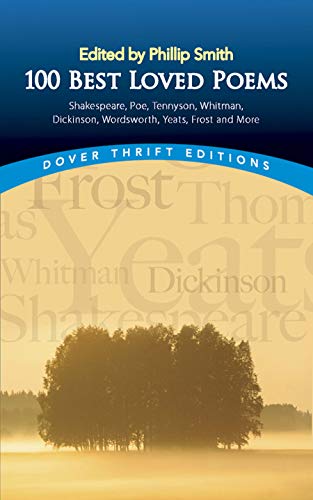
100 Best-Loved Poems: Shakespeare, Poe, Tennyson, Whitman, Dickinson, Wordsworth, Yeats, Frost and More (Dover Thrift Editions: Poetry) - Softcover
Inhaltsangabe
Here are some of the most-loved poems in the English language, chosen not merely for their popularity, but for their literary quality as well. Dating from the Middle Ages to the 20th century, these splendid poems remain evergreen in their capacity to engage our minds and refresh our spirits.
Among them are Marlowe: "The Passionate Shepherd to His Love"; Shakespeare: "Sonnet XVIII" ("Shall I compare thee to a summer's day?"); Donne: "Holy Sonnet X" ("Death, be not proud"); Marvell: "To His Coy Mistress"; Wordsworth: "I Wandered Lonely as a Cloud"; Shelley: "Ode to the West Wind"; Longfellow: "The Children's Hour"; Poe: "The Raven"; Tennyson: "The Charge of the Light Brigade"; Whitman: "O Captain! My Captain!"; Dickinson: "This Is My Letter to the World"; Yeats: "When You Are Old"; Frost: "The Road Not Taken"; Millay: "First Fig."
Works by many other poets — Milton, Blake, Burns, Coleridge, Byron, Keats, Emerson, the Brownings, Hardy, Housman, Kipling, Pound, and Auden among them — are included in this treasury, a perfect companion for quiet moments of reflection.
Die Inhaltsangabe kann sich auf eine andere Ausgabe dieses Titels beziehen.
Von der hinteren Coverseite
Here are some of the most-loved poems in the English language, chosen not merely for their popularity, but for their literary quality as well. Dating from the Middle Ages to the 20th century, these splendid poems remain evergreen in their capacity to engage our minds and refresh our spirits.
Among them are Marlowe: "The Passionate Shepherd to His Love"; Shakespeare: "Sonnet XVIII" ("Shall I compare thee to a summer's day?"); Donne: "Holy Sonnet X" ("Death, be not proud"); Shelley: "Ode to the West Wind"; Longfellow: "The Children's Hour"; Poe: "The Raven"; Tennyson: "The Charge of the Light Brigade"; Whitman: "O Captain! My Captain!"; Dickinson: "This Is My Letter to the World"; Frost: "The Road Not Taken." Works by many other poets—Milton, Blake, Burns, Coleridge, Byron, Keats, Emerson, the Brownings, Hardy, Housman, Kipling, Pound, and Auden among them—are included in this treasury, a perfect companion for quiet moments of reflection.
Auszug. © Genehmigter Nachdruck. Alle Rechte vorbehalten.
100 Best-Loved Poems
By Philip SmithDover Publications, Inc.
Copyright © 1995 Dover Publications, Inc.
All rights reserved.
ISBN: 978-0-486-28553-5All rights reserved.
CHAPTER 1
100 BEST-LOVED POEMS
BALLADS
Ballads are anonymous, frequently tragic, storytelling songs that often developed for centuries before being recorded in writing. The following are two of the most famous English ballads, dating probably from the late Middle Ages.
Lord Randal
"O where hae ye been, Lord Randal, my son?
O where hae ye been, my handsome young man?"
"I hae been to the wild wood; mother, make my bed soon,
For Em weary wi' hunting, and fain wald he down."
"Where gat ye your dinner, Lord Randal, my son?
Where gat ye your dinner, my handsome young man?"
"I din'd wi' my true-love; mother, make my bed soon,
For I'm weary wi' hunting, and fain wald he down."
"What gat ye to your dinner, Lord Randal, my son?
What gat ye to your dinner, my handsome young man?"
"I gat eels boil'd in broo; mother, make my bed soon,
For I'm weary wi' hunting, and fain wald lie down."
"What became of your bloodhounds, Lord Randal, my son?
What became of your bloodhounds, my handsome young man?"
"O they swell'd and they died; mother, make my bed soon,
For I'm weary wi' hunting, and fain wald he down."
"O I fear ye are poison'd, Lord Randal, my son!
I fear ye are poison'd, my handsome young man!"
"O yes! I am poison'd; mother, make my bed soon,
For I'm sick at the heart, and I fain wald lie down."
Sir Patrick Spens
I. The Sailing
The king sits in Dunfermline town
Drinking the blude-red wine;
"O whare will I get a skeely skipper
To sail this new ship o' mine?"
O up and spak an eldern knight,
Sat at the king's right knee;
"Sir Patrick Spens is the best sailor
That ever sail'd the sea."
Our king has written a braid letter,
And seal'd it with his hand,
And sent it to Sir Patrick Spens,
Was walking on the strand.
"To Noroway, to Noroway,
To Noroway o'er the faem;
The king's daughter o' Noroway,
'Tis thou must bring her hame."
The first word that Sir Patrick read
So loud, loud laugh'd he;
The neist word that Sir Patrick read
The tear blinded his e'e.
"O wha is this has done this deed
And tauld the king o' me,
To send us out, at this time o' year,
To sail upon the sea?
"Be it wind, be it weet, be it hail, be it sleet,
Our ship must sail the faem;
The king's daughter o' Noroway,
'Tis we must fetch her hame."
They hoysed their sails on Monenday morn
Wi' a' the speed they may;
They hae landed in Noroway
Upon a Wodensday.
II. The Return
"Mak ready, mak ready, my merry men a'!
Our gude ship sails the morn."
"Now ever alack, my master dear,
I fear a deadly storm.
"I saw the new moon late yestreen
Wi' the auld moon in her arm;
And if we gang to sea, master,
I fear we'll come to harm."
They hadna sail'd a league, a league,
A league but barely three,
When the lift grew dark, and the wind blew loud,
And gurly grew the sea.
The ankers brak, and the topmast lap,
It was sic a deadly storm:
And the waves cam owre the broken ship
Till a' her sides were torn.
"Go fetch a web o' the silken claith,
Another o' the twine,
And wap them into our ship's side,
And let nae the sea come in."
They fetch'd a web o' the silken claith,
Another o' the twine,
And they wapp'd them round that gude ship's side,
But still the sea came in.
O laith, laith were our gude Scots lords
To wet their cork-heel'd shoon;
But lang or a' the play was play'd
They wat their hats aboon.
And mony was the feather bed
That flatter'd on the faem;
And mony was the gude lord's son
That never mair cam hame.
O lang, lang may the ladies sit,
Wi' their fans into their hand,
Before they see Sir Patrick Spens
Come sailing to the strand!
And lang, lang may the maidens sit
Wi' their gowd kames in their hair,
A-waiting for their ain dear loves!
For them they'll see nae mair.
Half-owre, half-owre to Aberdour,
'Tis fifty fathoms deep;
And there lies gude Sir Patrick Spens,
Wi' the Scots lords at his feet!
SIR THOMAS WYATT(1503–1542)
A courtier and diplomat active in the court of King Henry VIII, Wyatt is credited with introducing Italian sonnet forms to English literature in the 1530s.
The Lover Showeth How He Is Forsaken of
Such as He Sometime Enjoyed
They flee from me that sometime did me seek,
With naked foot stalking in my chamber.
I have seen them gentle, tame, and meek,
That now are wild, and do not once remember
That sometime they have put themselves in danger
To take bread at my hand; and now they range,
Busily seeking with a continual change.
Thank'd be fortune, it hath been otherwise
Twenty times better; but once, in special,
In thin array, after a pleasant guise,
When her loose gown from her shoulders did fall,
And she me caught in her arms long and small,
Therewith all sweetly did me kiss,
And softly said, 'Dear heart, how like you this?'
It was no dream; I lay broad waking:
But all is turn'd, thorough my gentleness,
Into a strange fashion of forsaking;
And I have leave to go, of her goodness;
And she also to use new-fangleness.
But since that I so unkindly am served,
I fain would know what she hath deserved.
CHRISTOPHER MARLOWE(1564–1593)
Second only to Shakespeare (whom he inspired) as an Elizabethan dramatist, Marlowe penned some of the earliest and greatest English-language tragedies before being killed in a tavern at age 29.
The Passionate Shepherd to His Love
Come live with me and be my Love,
And we will all the pleasures prove
That hills and valleys, dales and fields,
Or woods or steepy mountain yields.
And we will sit upon the rocks,
And see the shepherds feed their flocks
By shallow rivers, to whose falls
Melodious birds sing madrigals.
And I will make thee beds of roses
And a thousand fragrant posies;
A cap of flowers, and a kirtle
Embroider'd all with leaves of myrtle.
A gown made of the finest wool
Which from our pretty lambs we pull;
Fair-lined slippers for the cold,
With buckles of the purest gold.
A belt of straw and ivy-buds
With coral clasps and amber studs:
And if these pleasures may thee move,
Come live with me and be my Love.
The shepherd swains shall dance and sing
For thy delight each May morning:
If these delights thy mind may move,
Then live with me and be my Love:
WILLIAM SHAKESPEARE(1564–1616)
The preeminent English poet and playwright, Shakespeare published a sequence of 154 sonnets in 1609 that continue to be regarded as the highest perfection of the form in English.
Sonnet XVIII
Shall I compare thee to a summer's day?
Thou art more lovely and more temperate:
Rough winds do shake the darling buds of May,
And summer's lease hath all too short a date:
Sometime too hot the eye of heaven shines,
And often is his gold complexion dimm'd;
And every fair from fair sometime declines,
By chance or nature's changing course untrimm'd;
But thy eternal summer shall...
„Über diesen Titel“ kann sich auf eine andere Ausgabe dieses Titels beziehen.
Suchergebnisse für 100 Best-Loved Poems: Shakespeare, Poe, Tennyson, Whitman,...

Beispielbild für diese ISBN
100 Best-Loved Poems (Thrift Editions)
Verlag:
Dover Publications Inc., 2000
ISBN 10: 0486285537
ISBN 13: 9780486285535
Gebraucht
Softcover
Anbieter: World of Books (was SecondSale), Montgomery, IL, USA
Verkäuferbewertung 5 von 5 Sternen

Zustand: Good. Item in good condition. Textbooks may not include supplemental items i.e. CDs, access codes etc. Bestandsnummer des Verkäufers 00047545787
Gebraucht kaufen
EUR 3,56
Versand gratis
Versand innerhalb von USA
Versand innerhalb von USA
Anzahl: Mehr als 20 verfügbar
Beispielbild für diese ISBN
100 Best-Loved Poems (Thrift Editions)
Verlag:
Dover Publications Inc., 2000
ISBN 10: 0486285537
ISBN 13: 9780486285535
Gebraucht
Softcover
Anbieter: World of Books (was SecondSale), Montgomery, IL, USA
Verkäuferbewertung 5 von 5 Sternen
Zustand: Acceptable. Item in acceptable condition! Textbooks may not include supplemental items i.e. CDs, access codes etc. Bestandsnummer des Verkäufers 00096680418
Gebraucht kaufen
EUR 3,56
Versand gratis
Versand innerhalb von USA
Versand innerhalb von USA
Anzahl: 19 verfügbar
Beispielbild für diese ISBN
100 Best-Loved Poems (Dover Thrift Editions)
Anbieter: Your Online Bookstore, Houston, TX, USA
Verkäuferbewertung 5 von 5 Sternen
Paperback. Zustand: Fair. Bestandsnummer des Verkäufers 0486285537-4-23499346
Gebraucht kaufen
EUR 3,57
Versand gratis
Versand innerhalb von USA
Versand innerhalb von USA
Anzahl: 4 verfügbar
Beispielbild für diese ISBN
100 Best-Loved Poems (Dover Thrift Editions)
Anbieter: Orion Tech, Kingwood, TX, USA
Verkäuferbewertung 5 von 5 Sternen
Paperback. Zustand: Fair. Bestandsnummer des Verkäufers 0486285537-4-18987270
Gebraucht kaufen
EUR 3,57
Versand gratis
Versand innerhalb von USA
Versand innerhalb von USA
Anzahl: 1 verfügbar
Beispielbild für diese ISBN
100 Best-Loved Poems (Dover Thrift Editions)
Anbieter: Your Online Bookstore, Houston, TX, USA
Verkäuferbewertung 5 von 5 Sternen
Paperback. Zustand: Good. Bestandsnummer des Verkäufers 0486285537-3-13182014
Gebraucht kaufen
EUR 3,57
Versand gratis
Versand innerhalb von USA
Versand innerhalb von USA
Anzahl: 9 verfügbar
Beispielbild für diese ISBN
100 Best-Loved Poems (Dover Thrift Editions)
Anbieter: Gulf Coast Books, Cypress, TX, USA
Verkäuferbewertung 5 von 5 Sternen
Paperback. Zustand: Fair. Bestandsnummer des Verkäufers 0486285537-4-20612787
Gebraucht kaufen
EUR 3,57
Versand gratis
Versand innerhalb von USA
Versand innerhalb von USA
Anzahl: 1 verfügbar
Beispielbild für diese ISBN
100 Best-Loved Poems (Dover Thrift Editions)
Anbieter: Gulf Coast Books, Cypress, TX, USA
Verkäuferbewertung 5 von 5 Sternen
Paperback. Zustand: Good. Bestandsnummer des Verkäufers 0486285537-3-18358794
Gebraucht kaufen
EUR 3,57
Versand gratis
Versand innerhalb von USA
Versand innerhalb von USA
Anzahl: 9 verfügbar
Beispielbild für diese ISBN
100 Best-Loved Poems (Dover Thrift Editions)
Anbieter: Orion Tech, Kingwood, TX, USA
Verkäuferbewertung 5 von 5 Sternen
Paperback. Zustand: Good. Bestandsnummer des Verkäufers 0486285537-3-18895628
Gebraucht kaufen
EUR 3,57
Versand gratis
Versand innerhalb von USA
Versand innerhalb von USA
Anzahl: 11 verfügbar
Beispielbild für diese ISBN
100 Best-Loved Poems (Thrift Editions)
Verlag:
Dover Publications Inc., 2000
ISBN 10: 0486285537
ISBN 13: 9780486285535
Gebraucht
Softcover
Anbieter: SustainableBooks.com, Amherst, NY, USA
Verkäuferbewertung 5 von 5 Sternen
Zustand: Good. Book is in Used-Good condition. Pages and cover are clean and intact. Used items may not include supplementary materials such as CDs or access codes. May show signs of minor shelf wear and contain limited notes and highlighting. Bestandsnummer des Verkäufers 0486285537-2-4
Gebraucht kaufen
EUR 4,69
Versand gratis
Versand innerhalb von USA
Versand innerhalb von USA
Anzahl: 1 verfügbar
Beispielbild für diese ISBN
100 Best-Loved Poems (Dover Thrift Editions)
Anbieter: PlumCircle, West Mifflin, PA, USA
Verkäuferbewertung 5 von 5 Sternen
Paperback. Zustand: Good. Somewhat damaged. May have bumped corner, torn dust cover, folded pages, light dust soil, remainder mark, price sticker, other damage, or be bent. 99% of orders arrive in 4-10 days. Discounted shipping on multiple books. Bestandsnummer des Verkäufers mon0001327751
Gebraucht kaufen
EUR 0,88
EUR 4,27 Versand
Versand innerhalb von USA
Versand innerhalb von USA
Anzahl: 2 verfügbar