
Verwandte Artikel zu Aircraft Structures (Dover Books on Aeronautical Engineering...
Aircraft Structures (Dover Books on Aeronautical Engineering) - Softcover
Buch 17 von 26: Dover Books on Aeronautical Engineering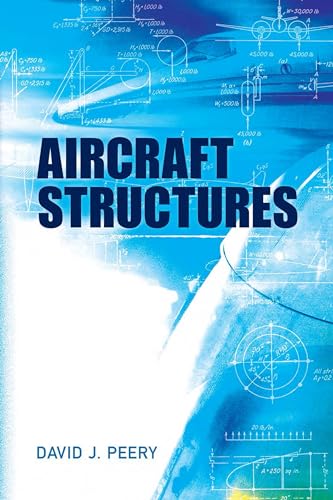
Inhaltsangabe
Still relevant decades after its 1950 publication, this legendary reference text on aircraft stress analysis is considered the best book on the subject. It emphasizes basic structural theory, which remains unchanged with the development of new materials and construction methods, and the application of the elementary principles of mechanics to the analysis of aircraft structures.
Suitable for undergraduate students, this volume covers equilibrium of forces, space structures, inertia forces and load factors, shear and bending stresses, and beams with unsymmetrical cross sections. Additional topics include spanwise air-load distribution, external loads on the airplane, joints and fittings, deflections of structures, and special methods of analysis. Topics involving a knowledge of aerodynamics appear in final chapters, allowing students to study the prerequisite aerodynamics topics in concurrent courses.
Suitable for undergraduate students, this volume covers equilibrium of forces, space structures, inertia forces and load factors, shear and bending stresses, and beams with unsymmetrical cross sections. Additional topics include spanwise air-load distribution, external loads on the airplane, joints and fittings, deflections of structures, and special methods of analysis. Topics involving a knowledge of aerodynamics appear in final chapters, allowing students to study the prerequisite aerodynamics topics in concurrent courses.
Die Inhaltsangabe kann sich auf eine andere Ausgabe dieses Titels beziehen.
Über die Autorin bzw. den Autor
The late David J. Peery was an Aeronautical Engineering Professor at Penn State University.
Auszug. © Genehmigter Nachdruck. Alle Rechte vorbehalten.
AIRCRAFT STRUCTURES
By David J. PeeryDover Publications, Inc.
Copyright © 2014 Dover Publications, Inc.
All rights reserved.
ISBN: 978-0-486-48580-5All rights reserved.
Contents
PREFACE,
1. EQUILIBRIUM OF FORCES,
2. SPACE STRUCTURES,
3. INERTIA FORCES AND LOAD FACTORS,
4. MOMENTS OF INERTIA, MOHR'S CIRCLE,
5. SHEAR AND BENDING-MOMENT DIAGRAMS,
6. SHEAR AND BENDING STRESSES IN SYMMETRICAL BEAMS,
7. BEAMS WITH UNSYMMETRICAL CROSS SECTIONS,
8. ANALYSIS OF TYPICAL MEMBERS OF SEMIMONOCOQUE STRUCTURES,
9. SPANWISE AIR-LOAD DISTRIBUTION,
10. EXTERNAL LOADS ON THE AIRPLANE,
11. MECHANICAL PROPERTIES OF AIRCRAFT MATERIALS,
12. JOINTS AND FITTINGS,
13. DESIGN OF MEMBERS IN TENSION, BENDING, OR TORSION,
14. DESIGN OF COMPRESSION MEMBERS,
15. DESIGN OF WEBS IN SHEAR,
16. DEFLECTIONS OF STRUCTURES,
17. STATICALLY INDETERMINATE STRUCTURES,
18. SPECIAL METHODS OF ANALYSIS,
APPENDIX,
INDEX,
CHAPTER 1
EQUILIBRIUM OF FORCES
1.1. Equations of Equilibrium. One of the first steps in the design of a machine or structure is the determination of the loads acting on each member. The loads acting on an airplane may occur in various landing or flight conditions. The loads may be produced by ground reactions on the wheels, by aerodynamic forces on the wings and other surfaces, or by forces exerted on the propeller. The loads are resisted by the weight or inertia of the various parts of the airplane. Several loading conditions must be considered, and each member must be designed for the combination of conditions which produces the highest stress in the member. For practically all members of the airplane structure the maximum loads occur when the airplane is in an accelerated flight or landing condition and the external loads are not in equilibrium. If, however, the inertia loads are also considered, they will form a system of forces which are in equilibrium with the external loads. In the design of any member it is necessary to find all the forces acting on the member, including inertia forces. Where these forces are in the same plane, as is often the case, the following equations of static equilibrium apply to any isolated portion of the structure:
[MATHEMATICAL EXPRESSION NOT REPRODUCIBLE IN ASCII] (1.1)
The terms [summation]Fx and [summation]Fy represent the summations of the components of forces along x and y axes, which may be taken in any two arbitrary directions. The term [summation]M represents the sum of the moments of all forces about any arbitrarily chosen point in the plane. Each of these equations may be set up in an infinite number of ways for any problem, since the directions of the axes and the center of moments may be chosen arbitrarily. Only three independent equations exist for any free body, however, and only three unknown forces may be found from the equations. If, for example, an attempt is made to find four unknown forces by using the two force equations and moment equations about two points, the four equations cannot be solved because they are not independent, i.e., one of the equations can be derived from the other three. The following equations cannot be solved for the numerical values of the three unknowns because they are not independent.
x + y + z = 3
x + y + 2z = 4
2x + 2y + 3z = 7
The third equation may be obtained by adding the first two equations, and consequently does not represent an independent condition.
In the analysis of a structure containing several members it is necessary to draw a free-body diagram for each member, showing all the forces acting on that member. It is not possible to show these forces on a composite sketch of the entire structure, since equal and opposite forces act at all joints and an attempt to designate the correct direction of the force on each member will be confusing. In applying the equations of statics it is desirable to choose the axes and centers of moments so that only one unknown appears in each equation.
Many structural joints are made with a single bolt or pin. Such joints are assumed to have no resistance to rotation. The force at such a joint must pass through the center of the pin, as shown in Fig. 1.1, since the moment about the center of the pin must be zero. The force at the pin joint has two unknown quantities, the magnitude F and the direction θ. It is usually more convenient to find the two unknown components, Fx and Fy, from which F and θ can be found by the equations:
F = √ F2x + F2y (1.2)
tan θ = Fy/Fx (1.3)
The statics problem is considered as solved when the components Fx and Fy at each joint are obtained.
1.2. Two-force Members. When a structural member has forces acting at only two points, these forces must be equal and opposite, as shown in Fig. 1.2. Since moments about point A must be zero, the force FB must pass through point A. Similarly the force FA must pass through point B for moments about point B to be zero. From a summation of forces, the forces FB and FA must have equal magnitudes but opposite directions. Two-force members are frequently used in aircraft and other structures, since simple tension or compression members are usually the lightest members for transmitting forces. Where possible, two-force members are straight, rather than curved as shown in Fig. 1.2. Structures made up entirely of two-force members are called trusses and are frequently used in fuselages, engine mounts, and other aircraft structures, as well as in bridge and building structures. Trusses represent an important special type of structure and will be treated in detail in the following articles.
Many structures contain some two-force members, as well as some members which resist more than two forces. These structures must first be examined carefully in order to determine which members are two-force members. Students frequently make the serious mistake of assuming that forces act in the direction of a member, when the member resists forces at three or more points. In the case of curved two-force members such as shown in Fig. 1.2, it is important to assume that the forces act along the line between pins, rather than along the axis of the members.
While Eqs. 1.1 are simple and well known, it is very important for a student to acquire proficiency in the application of these equations to various types of structures. A typical structure will be analyzed as an example problem.
Example. Find the forces acting at all joints of the structure shown in Fig. 1.3.
Solution. First draw free-body diagrams of all members, as shown in Fig. 1.4. Since AB and GD are two-force members, the forces in these members are along the line joining the pin joints of these members, and free-body diagrams of these members are not shown. The directions of forces are assumed, but care must be taken to show the forces at any joint in opposite directions on the two members, that is, Cx is assumed to act to the right on the horizontal member, and therefore must act to the left on the vertical member. If forces are assumed in the wrong direction, the calculated magnitudes will be negative.
For the pulley,
[MATHEMATICAL EXPRESSION NOT REPRODUCIBLE IN ASCII]
Once the numerical values of these forces are...
„Über diesen Titel“ kann sich auf eine andere Ausgabe dieses Titels beziehen.
Suchergebnisse für Aircraft Structures (Dover Books on Aeronautical Engineering...

Beispielbild für diese ISBN
Aircraft Structures Format: Paperback
Anbieter: INDOO, Avenel, NJ, USA
Verkäuferbewertung 5 von 5 Sternen

Zustand: New. Brand New. Bestandsnummer des Verkäufers 9780486485805
Neu kaufen
EUR 26,79
Versand gratis
Versand innerhalb von USA
Versand innerhalb von USA
Anzahl: Mehr als 20 verfügbar
Beispielbild für diese ISBN
Aircraft Structures (Dover Books on Aeronautical Engineering)
Anbieter: WorldofBooks, Goring-By-Sea, WS, Vereinigtes Königreich
Verkäuferbewertung 5 von 5 Sternen
Paperback. Zustand: Very Good. The book has been read, but is in excellent condition. Pages are intact and not marred by notes or highlighting. The spine remains undamaged. Bestandsnummer des Verkäufers GOR005641444
Gebraucht kaufen
EUR 34,51
EUR 6,59 Versand
Versand von Vereinigtes Königreich nach USA
Versand von Vereinigtes Königreich nach USA
Anzahl: 1 verfügbar
Beispielbild für diese ISBN
AIRCRAFT STRUCTURES
Anbieter: BOOK IN BAR AIX, AIX EN PROVENCE, PACA, Frankreich
Verkäuferbewertung 2 von 5 Sternen

Couverture souple. Zustand: Neuf. NEW. Bestandsnummer des Verkäufers ABE-1775321754270
Neu kaufen
EUR 20,00
EUR 25,00 Versand
Versand von Frankreich nach USA
Versand von Frankreich nach USA
Anzahl: 1 verfügbar
Beispielbild für diese ISBN
Aircraft Structures (Dover Books on Aeronautical Engineering)
Verlag:
Dover Publications, Incorporated, 2011
ISBN 10: 0486485803
ISBN 13: 9780486485805
Neu
Softcover
Anbieter: Books Puddle, Woodside, NY, USA
Verkäuferbewertung 4 von 5 Sternen

Zustand: New. pp. vii + 566. Bestandsnummer des Verkäufers 263556877
Neu kaufen
EUR 47,30
EUR 3,55 Versand
Versand innerhalb von USA
Versand innerhalb von USA
Anzahl: 1 verfügbar
Beispielbild für diese ISBN
Aircraft Structures (Dover Books on Aeronautical Engineering)
Verlag:
Dover Publications, Incorporated, 2011
ISBN 10: 0486485803
ISBN 13: 9780486485805
Neu
Softcover
Anbieter: Majestic Books, Hounslow, Vereinigtes Königreich
Verkäuferbewertung 4 von 5 Sternen
Zustand: New. pp. vii + 566 Illus. This item is printed on demand. Bestandsnummer des Verkäufers 4323794
Neu kaufen
EUR 44,58
EUR 7,65 Versand
Versand von Vereinigtes Königreich nach USA
Versand von Vereinigtes Königreich nach USA
Anzahl: 1 verfügbar
Beispielbild für diese ISBN
Aircraft Structures
Anbieter: Revaluation Books, Exeter, Vereinigtes Königreich
Verkäuferbewertung 5 von 5 Sternen
Paperback. Zustand: Brand New. 576 pages. 9.21x6.14x1.18 inches. In Stock. Bestandsnummer des Verkäufers __0486485803
Neu kaufen
EUR 40,58
EUR 14,71 Versand
Versand von Vereinigtes Königreich nach USA
Versand von Vereinigtes Königreich nach USA
Anzahl: 1 verfügbar
Foto des Verkäufers
Aircraft Structures (Paperback)
Verlag:
Dover Publications Inc., New York, 2012
ISBN 10: 0486485803
ISBN 13: 9780486485805
Neu
Paperback
Anbieter: Grand Eagle Retail, Bensenville, IL, USA
Verkäuferbewertung 5 von 5 Sternen
Paperback. Zustand: new. Paperback. Still relevant decades after its 1950 publication, this legendary reference text on aircraft stress analysis is considered the best book on the subject. It emphasizes basic structural theory, which remains unchanged with the development of new materials and construction methods, and the application of the elementary principles of mechanics to the analysis of aircraft structures. Suitable for undergraduate students, this volume covers equilibrium of forces, space structures, inertia forces and load factors, shear and bending stresses, and beams with unsymmetrical cross sections. Additional topics include spanwise air-load distribution, external loads on the airplane, joints and fittings, deflections of structures, and special methods of analysis. Topics involving a knowledge of aerodynamics appear in final chapters, allowing students to study the prerequisite aerodynamics topics in concurrent courses. This legendary, still-relevant reference text on aircraft stress analysis discusses basic structural theory and the application of the elementary principles of mechanics to the analysis of aircraft structures. 1950 edition. Shipping may be from multiple locations in the US or from the UK, depending on stock availability. Bestandsnummer des Verkäufers 9780486485805
Beispielbild für diese ISBN
Aircraft Structures
Anbieter: Revaluation Books, Exeter, Vereinigtes Königreich
Verkäuferbewertung 5 von 5 Sternen
Paperback. Zustand: Brand New. 576 pages. 9.21x6.14x1.18 inches. In Stock. Bestandsnummer des Verkäufers zk0486485803
Neu kaufen
EUR 54,77
EUR 14,71 Versand
Versand von Vereinigtes Königreich nach USA
Versand von Vereinigtes Königreich nach USA
Anzahl: 1 verfügbar
Beispielbild für diese ISBN
Aircraft Structures (Paperback)
Verlag:
Dover Publications Inc., New York, 2012
ISBN 10: 0486485803
ISBN 13: 9780486485805
Neu
Paperback
Anbieter: CitiRetail, Stevenage, Vereinigtes Königreich
Verkäuferbewertung 5 von 5 Sternen
Paperback. Zustand: new. Paperback. Still relevant decades after its 1950 publication, this legendary reference text on aircraft stress analysis is considered the best book on the subject. It emphasizes basic structural theory, which remains unchanged with the development of new materials and construction methods, and the application of the elementary principles of mechanics to the analysis of aircraft structures. Suitable for undergraduate students, this volume covers equilibrium of forces, space structures, inertia forces and load factors, shear and bending stresses, and beams with unsymmetrical cross sections. Additional topics include spanwise air-load distribution, external loads on the airplane, joints and fittings, deflections of structures, and special methods of analysis. Topics involving a knowledge of aerodynamics appear in final chapters, allowing students to study the prerequisite aerodynamics topics in concurrent courses. This legendary, still-relevant reference text on aircraft stress analysis discusses basic structural theory and the application of the elementary principles of mechanics to the analysis of aircraft structures. 1950 edition. Shipping may be from our UK warehouse or from our Australian or US warehouses, depending on stock availability. Bestandsnummer des Verkäufers 9780486485805
Neu kaufen
EUR 64,82
EUR 43,54 Versand
Versand von Vereinigtes Königreich nach USA
Versand von Vereinigtes Königreich nach USA
Anzahl: 1 verfügbar
Beispielbild für diese ISBN
Aircraft Structures (Paperback)
Verlag:
Dover Publications Inc., New York, 2012
ISBN 10: 0486485803
ISBN 13: 9780486485805
Neu
Paperback
Anbieter: AussieBookSeller, Truganina, VIC, Australien
Verkäuferbewertung 5 von 5 Sternen
Paperback. Zustand: new. Paperback. Still relevant decades after its 1950 publication, this legendary reference text on aircraft stress analysis is considered the best book on the subject. It emphasizes basic structural theory, which remains unchanged with the development of new materials and construction methods, and the application of the elementary principles of mechanics to the analysis of aircraft structures. Suitable for undergraduate students, this volume covers equilibrium of forces, space structures, inertia forces and load factors, shear and bending stresses, and beams with unsymmetrical cross sections. Additional topics include spanwise air-load distribution, external loads on the airplane, joints and fittings, deflections of structures, and special methods of analysis. Topics involving a knowledge of aerodynamics appear in final chapters, allowing students to study the prerequisite aerodynamics topics in concurrent courses. This legendary, still-relevant reference text on aircraft stress analysis discusses basic structural theory and the application of the elementary principles of mechanics to the analysis of aircraft structures. 1950 edition. Shipping may be from our Sydney, NSW warehouse or from our UK or US warehouse, depending on stock availability. Bestandsnummer des Verkäufers 9780486485805
Neu kaufen
EUR 77,91
EUR 32,88 Versand
Versand von Australien nach USA
Versand von Australien nach USA
Anzahl: 1 verfügbar