
Verwandte Artikel zu The Magic Island
Inhaltsangabe
"The best and most thrilling book of exploration that we have ever read … [an] immensely important book." — New York Evening Post
"A series of excellent stories about one of the most interesting corners of the American world, told by a keen and sensitive person who knows how to write." — American Journal of Sociology
"It can be said of many travelers that they have traveled widely. Of Mr. Seabrook a much finer thing may be said — he has traveled deeply." — The New York Times Book Review
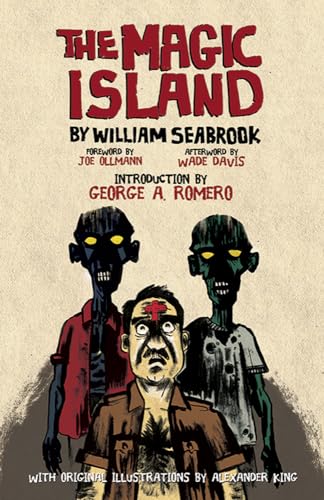
This fascinating book, first published in 1929, offers firsthand accounts of Haitian voodoo and witchcraft rituals. Journalist and adventurer William Seabrook introduced the concept of the walking dead ? zombies ? to the West with his illustrated travelogue. He relates his experiences with the voodoo priestess who initiated him into the religion's rituals, from soul transference to resurrection. In addition to twenty evocative line drawings by Alexander King, this edition features a new Foreword by cartoonist and graphic novelist Joe Ollmann, a new Introduction by George A. Romero, legendary director of Night of the Living Dead, and a new Afterword by Wade Davis, Explorer in Residence at the National Geographic Society.
Die Inhaltsangabe kann sich auf eine andere Ausgabe dieses Titels beziehen.
Über die Autorin bzw. den Autor
Journalist and explorer William Seabrook (1884–1945) possessed a fascination with the occult that led him across the globe to study magic rituals, train as a witch doctor, and sample human flesh. In addition to publishing more than a dozen books, he wrote for The New York Times, Cosmopolitan, Reader's Digest, and Vanity Fair.
Von der hinteren Coverseite
"The best and most thrilling book of exploration that we have ever read … [an] immensely important book."—New York Evening Post
"A series of excellent stories about one of the most interesting corners of the American world, told by a keen and sensitive person who knows how to write."—American Journal of Sociology
"It can be said of many travelers that they have traveled widely. Of Mr. Seabrook a much finer thing may be said—he has traveled deeply."—The New York Times Book Review
This fascinating book, first published in 1929, offers firsthand accounts of Haitian voodoo and witchcraft rituals. Journalist and adventurer William Seabrook introduced the concept of the walking dead?zombies?to the West with his illustrated travelogue. He relates his experiences with the voodoo priestess who initiated him into the religion's rituals, from soul transference to resurrection. In addition to twenty evocative line drawings by Alexander King, this edition features a new Foreword by cartoonist and graphic novelist Joe Ollmann and a new Introduction by George A. Romero, director of Night of the Living Dead.
Auszug. © Genehmigter Nachdruck. Alle Rechte vorbehalten.
The Magic Island
By William Seabrook, Alexander KingDover Publications, Inc.
Copyright © 2016 Joe Ollmann
All rights reserved.
ISBN: 978-0-486-79962-9All rights reserved.
Contents
Foreword by Joe Ollmann, xi,
Introduction by George A. Romero, xv,
Foreword to the 1929 Edition, 3,
Part One The Voodoo Rites,
I. Secret Fires, 7,
II. The Way Is Opened and Closed, 16,
III. The Petro Sacrifice, 28,
IV. The "Ouanga" Charm, 45,
V. Goat-Cry Girl-Cry, 54,
VI. The God Incarnate, 70,
Part Two Black Sorcery,
I. The Altar of Skulls, 81,
II. "... Dead Men Working in the Cane Fields", 92,
III. Toussel's Pale Bride, 104,
IV. Célestine with a Silver Dish, 115,
Part Three The Tragic Comedy,
I. A Blind Man Walking on Eggs, 127,
II. A Nymph in Bronze, 134,
III. "The Truth Is a Beautiful Thing", 142,
IV. "Ladies and Gentlemen, the President!", 150,
V. But the Truth Becomes Somewhat Tangled, 162,
Part Four Trails Winding,
I. The White King of La Gonave, 171,
II. The Black Queen's Court, 185,
III. A Torn Scrap of Paper, 194,
IV. Portrait of a "Gros Nègre", 203,
V. "Polynice and His White", 207,
VI. The "Danse Congo", 219,
VII. "No White Man Could Be As Dumb As That", 227,
VIII. Portrait of a Scientist, 239,
IX. Morne la Selle Adventure, 247,
X. The Soul of Haiti, 270,
From the Author's Notebook, 283,
Afterword by Wade Davis, 337,
CHAPTER 1
SECRET FIRES
Louis, son of Catherine Ozias of Orblanche, paternity unknown — and thus without a surname was he inscribed in the Haitian civil register — reminded me always of that proverb out of hell in which Blake said, "He whose face gives no light shall never become a star."
It was not because Louis' black face, frequently perspiring, shone like patent leather ; it glowed also with a mystic light that was not always heavenly.
For Louis belonged to the chimeric company of saints, monsters, poets, and divine idiots. He used to get besotted drunk in a comer, and then would hold long converse with seraphim and demons, also from time to time with his dead grandmother who had been a sorceress.
In addition to these qualities, Louis was our devoted yard boy. He served us, in the intervals of his sobriety, with a passionate and all-consuming zeal.
We had not chosen Louis for our yard boy. He had chosen us. He had also chosen the house we lived in. These two things had happened while we were still at the Hotel Montagne. And they had seemed to us slightly miraculous, though the grapevine telegraph of servants in Port-au-Prince might adequately have explained both. Katie and I had been house-hunting. We had been shown unlivably ostentatious plaster palaces with magnificent gardens, and livable wooden villas with inadequate gardens or no gardens at all, until we had begun to despair. One afternoon as we left the hotel gate, strolling down the hill to Ash Pay Davis's, a black boy, barefooted and so ragged that we thought he was a beggar, stopped us and said in creole with affectionate assurance, as if he had known us all our lives, "I have found the house for you." Not a house, mind you. Nor was there any emphasis on the the; there couldn't be in creole. He said literally, "M' té joined' caille ou" (I have found your house).
What we did may sound absurd. We returned to the hotel, got out our car, took Louis inside — he had wanted to ride the running-board — and submitted to his guidance. He directed us into the fashionable Rue Turgeau toward the American club and colony, but before reaching that exclusive quarter, we turned unfamiliarly left and then up a lane that ran into the jungle valley toward Pétionville, and there where city and jungle joined was a dilapidated but beautiful garden of several acres and in its midst a low, rambling, faded pink one-story house with enormous verandas on a level with the ground.
Some of the doors were locked; the rest were nailed up. Behind the house were stone-built servants' quarters and a kitchen, also locked. There was a bassin (swimming-pool) choked with débris and leaves.
Who owned this little dilapidated paradise, whether it was for rent, how much the rent might be — these were matters outside the scope of Louis' genius. He had not inquired before coming to find us, and he made no offers or suggestions now.
We thanked Louis, dropped him at Sacré Cœur, told him to come see us at the hotel next morning, then drove to Ash Pay's and discovered after considerable telephoning that the place belonged to Maître Morel and might be rented for thirty dollars a month. Toussaint, black interpreter for the brigade who dabbled helpfully in everything, would get us the keys on Wednesday afternoon when Maître Morel returned from Saint Marc.
Louis did not come to the hotel next morning, nor the morning after, but when we went with Toussaipt three days later to open the house, we were received blandly by Louis, who was already at home in a corner of the brick-paved veranda to which he had in the interval transported all his earthly possessions, consisting of a pallet, an old blanket, an iron cooking-pot, a candle-stub, and a small wooden box containing doubtless his more intimate treasures. In the pot were the remains of some boiled plantain, apparently his sole sustenance.
Neither he nor we ever mentioned the matter of employing him. Several days were going to elapse before we could move in, but I gave him the keys to the house then and there. I also gave him ten gourdes, the equivalent of two dollars, which was a large sum of money, and told him to buy for himself what was needful, suggesting a new shirt and a supply of food. He was undernourished, and with that new wealth he could feast for a week; the price of a chicken in Haiti is twenty cents.
Returning some days later, I found him with a new pair of tennis shoes, a magnificently gaudy new scarf knotted round his neck, lying on his back in the grass beneath the shade of a mango tree, blissfully and inoffensively drunk, singing a little happy tune which he made as it went, inviting the birds to come and admire his new clothes. His shirt was as before. His whole shoulder protruded from a rent in it. I examined the cook-pot. It contained the remains of some boiled plantain, and it had apparently contained nothing else in the interval. I have told you, I think, that Louis was a saint. Even so, I fear it is going to be difficult to make you understand Louis, unless you have read sympathetically the lives of the less reputable saints and have also lived in a tropical country like Haiti.
Of course when we furnished the house and moved in, we had additional servants — the dull, competent butler, a middle-aged woman cook, and for blanchisseuse a plump little wench with flashing teeth and roving eyes who promptly fell in love with Louis, gave him money, and more intimate favors when he permitted it. Having four servants was not ostentatious in Port-au-Prince, even for us who in New York habitually have none. It was the general custom. We paid the four of them a grand sum total of thirty-one dollars monthly, and they found their own food. The last three were reasonably efficient, as servants, doing generally what they were told; but Louis, who never did what he was told, was nevertheless in actual fact, putting quite aside his fantastic power of holding our affection, the most efficient servant of them all. The things he wanted to...
„Über diesen Titel“ kann sich auf eine andere Ausgabe dieses Titels beziehen.
Suchergebnisse für The Magic Island

Foto des Verkäufers
The Magic Island
Anbieter: Solr Books, Lincolnwood, IL, USA
Verkäuferbewertung 5 von 5 Sternen

Zustand: like_new. King, Alexander (illustrator). This book is in Like New condition. It appears to be NEW, but might have a minor defect. Bestandsnummer des Verkäufers BCV.048679962X.LN
Gebraucht kaufen
EUR 14,34
EUR 7,09 Versand
Versand innerhalb von USA
Versand innerhalb von USA
Anzahl: 1 verfügbar
Foto des Verkäufers
Magic Island
Anbieter: GreatBookPrices, Columbia, MD, USA
Verkäuferbewertung 5 von 5 Sternen
Zustand: New. King, Alexander (illustrator). Bestandsnummer des Verkäufers 25211590-n
Neu kaufen
EUR 19,36
EUR 2,35 Versand
Versand innerhalb von USA
Versand innerhalb von USA
Anzahl: 3 verfügbar
Beispielbild für diese ISBN
The Magic Island Format: Paperback
Anbieter: INDOO, Avenel, NJ, USA
Verkäuferbewertung 5 von 5 Sternen
Zustand: New. King, Alexander (illustrator). Brand New. Bestandsnummer des Verkäufers 9780486799629
Neu kaufen
EUR 21,78
Versand gratis
Versand innerhalb von USA
Versand innerhalb von USA
Anzahl: Mehr als 20 verfügbar
Beispielbild für diese ISBN
The Magic Island
Anbieter: Lakeside Books, Benton Harbor, MI, USA
Verkäuferbewertung 5 von 5 Sternen
Zustand: New. King, Alexander (illustrator). Brand New! Not Overstocks or Low Quality Book Club Editions! Direct From the Publisher! We're not a giant, faceless warehouse organization! We're a small town bookstore that loves books and loves it's customers! Buy from Lakeside Books! Bestandsnummer des Verkäufers OTF-S-9780486799629
Neu kaufen
EUR 18,68
EUR 3,55 Versand
Versand innerhalb von USA
Versand innerhalb von USA
Anzahl: 2 verfügbar
Beispielbild für diese ISBN
The Magic Island
Verlag:
Dover Publications, 2016
ISBN 10: 048679962X
ISBN 13: 9780486799629
Gebraucht
Soft cover
Erstausgabe
Anbieter: Thylacine Books, Fort Worth, TX, USA
Verkäuferbewertung 5 von 5 Sternen
Soft cover. Zustand: As New. No Jacket. King, Alexander (illustrator). 1st Edition. dj: none. book: as new. Bestandsnummer des Verkäufers 42243b
Gebraucht kaufen
EUR 17,85
EUR 5,33 Versand
Versand innerhalb von USA
Versand innerhalb von USA
Anzahl: 1 verfügbar
Foto des Verkäufers
The Magic Island (Paperback or Softback)
Verlag:
Dover Publications 4/21/2016, 2016
ISBN 10: 048679962X
ISBN 13: 9780486799629
Neu
Paperback or Softback
Anbieter: BargainBookStores, Grand Rapids, MI, USA
Verkäuferbewertung 5 von 5 Sternen
Paperback or Softback. Zustand: New. King, Alexander (illustrator). The Magic Island. Book. Bestandsnummer des Verkäufers BBS-9780486799629
Foto des Verkäufers
Magic Island
Anbieter: GreatBookPrices, Columbia, MD, USA
Verkäuferbewertung 5 von 5 Sternen
Zustand: As New. King, Alexander (illustrator). Unread book in perfect condition. Bestandsnummer des Verkäufers 25211590
Gebraucht kaufen
EUR 20,92
EUR 2,35 Versand
Versand innerhalb von USA
Versand innerhalb von USA
Anzahl: 3 verfügbar
Beispielbild für diese ISBN
The Magic Island
Anbieter: Textbooks_Source, Columbia, MO, USA
Verkäuferbewertung 5 von 5 Sternen
Paperback. Zustand: New. King, Alexander (illustrator). First Edition, First. Ships in a BOX from Central Missouri! UPS shipping for most packages, (Priority Mail for AK/HI/APO/PO Boxes). Bestandsnummer des Verkäufers 002013136N
Neu kaufen
EUR 22,46
EUR 3,55 Versand
Versand innerhalb von USA
Versand innerhalb von USA
Anzahl: 2 verfügbar
Foto des Verkäufers
The Magic Island
Anbieter: Rarewaves USA, HEBRON, KY, USA
Verkäuferbewertung 5 von 5 Sternen
Paperback. Zustand: New. King, Alexander (illustrator). Praised by the New York Evening Post as "the best and most thrilling book of exploration," this 1929 volume offers firsthand accounts of Haitian voodoo and witchcraft rituals. Journalist and adventurer William Seabrook introduced the concept of the walking dead ? zombies ? to the West with this illustrated travelogue. Includes 20 line drawings by Alexander King, a new Foreword by George A. Romero (legendary director of Night of the Living Dead), and a new Introduction by Joe Ollmann. Bestandsnummer des Verkäufers LU-9780486799629
Beispielbild für diese ISBN
The Magic Island (Paperback)
Verlag:
Dover Publications Inc., New York, 2016
ISBN 10: 048679962X
ISBN 13: 9780486799629
Neu
Paperback
Anbieter: Grand Eagle Retail, Bensenville, IL, USA
Verkäuferbewertung 5 von 5 Sternen
Paperback. Zustand: new. King, Alexander (illustrator). Paperback. "The best and most thrilling book of exploration that we have ever read - an immensely important book." - New York Evening Post "A series of excellent stories about one of the most interesting corners of the American world, told by a keen and sensitive person who knows how to write." - American Journal of Sociology "It can be said of many travellers that they have travelled widely. Of Mr. Seabrook a much finer thing may be said - he has travelled deeply." - The New York Times Book Review This fascinating book, first published in 1929, offers firsthand accounts of Haitian voodoo and witchcraft rituals. Journalist and adventurer William Seabrook introduced the concept of the walking dead ? zombies ? to the West with his illustrated travelogue. He relates his experiences with the voodoo priestess who initiated him into the religion's rituals, from soul transference to resurrection. In addition to twenty evocative line drawings by Alexander King, this edition features a new Foreword by cartoonist and graphic novelist Joe Ollmann, a new Introduction by George A. Romero, legendary director of Night of the Living Dead, and a new Afterword by Wade Davis, Explorer in Residence at the National Geographic Society. AUTHOR: Journalist and explorer William Seabrook (18841945) possessed a fascination with the occult that led him across the globe to study magic rituals, train as a witch doctor, and sample human flesh. In addition to publishing more than a dozen books, he wrote for The New York Times, Cosmopolitan, Reader's Digest, and Vanity Fair. This 1929 volume offers firsthand accounts of Haitian voodoo and witchcraft rituals. Author William Seabrook introduced the concept of the walking dead to the West with this illustrated travelogue. Shipping may be from multiple locations in the US or from the UK, depending on stock availability. Bestandsnummer des Verkäufers 9780486799629