
Verwandte Artikel zu Death Ritual in Late Imperial and Modern China: Volume...
Inhaltsangabe
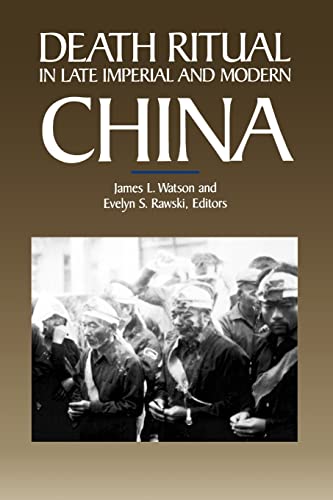
No detailed description available for "Death Ritual in Late Imperial and Modern China".
Die Inhaltsangabe kann sich auf eine andere Ausgabe dieses Titels beziehen.
Über die Autorin bzw. den Autor
James L. Watson is Professor of Anthropology at Harvard University and Evelyn S. Rawski is Professor of History at the University of Pittsburgh.
Auszug. © Genehmigter Nachdruck. Alle Rechte vorbehalten.
Death Ritual in Late Imperial and Modern China
By Evelyn Sakakida RawskiUniversity of California Press
Copyright © 1990 Evelyn Sakakida RawskiAll right reserved.
ISBN: 9780520071292
The Structure of Chinese Funerary Rites: Elementary Forms, Ritual Sequence, and the Primacy of Performance
James L. Watson
In one important respect this collection of essays is the sequel to an earlier volume entitled Popular Culture in Late Imperial China. 1 The popular-culture conference (held in 1980) considered the general theme of Chinese cultural diversity and uniformity, looking specifically at the question What held Chinese society together? There were, of course, many institutions and social processes that led to the creation of a unified, centrally organized culture in late imperial China. One of the most obvious was control over the written word as expressed in literature and religious texts;2 equally important was the subtle manipulation of oral performing arts, notably opera and public storytelling.3 The authors of Popular Culture approached the problem of diversity within unity from many angles, but conference discussions made it clear that one important dimension was missing, namely, ritual.
If anything is central to the creation and maintenance of a unified Chinese culture, it is the standardization of ritual. To be Chinese is to understand, and accept the view, that there is a correct way to perform rites associated with the life-cycle, the most important being weddings and funerals. By following accepted ritual routines ordinary citizens participated in the process of cultural unification. In most cases they did so voluntarily,
David Johnson, Andrew Nathan, and Evelyn Rawski, eds., Popular Culture in Late Imperial China (Berkeley and Los Angeles: University of California Press, 1985).
David Johnson, "Communication, Class, and Consciousness in Late Imperial China," in Johnson et al., Popular Culture , pp. 34-72; James Hayes, "Specialists and Written Materials in the Village World," in Johnson et al., Popular Culture , pp. 75-111.
Tanaka Issei, "The Social and Historical Context of Ming-Ch'ing Local Drama," in Johnson et al., Popular Culture , pp. 143-160; Barbara E. Ward, "Regional Operas and Their Audiences," in Johnson et al., Popular Culture , pp. 161-187; and "Not Merely Players: Drama, Act, and Ritual in Traditional China," Man n.s. 14 (1979): 18-39.
without the necessity of enforcement by state authorities. What we accept today as "Chinese" is in large part the product of a centuries-long process of ritual standardization.
This volume, therefore, is more than a set of essays about death and mortuary ritual: It is a study in cultural homogenization as expressed in performance, practice, and beliefs regarding the dead. The essays that follow demonstrate that there was a uniform structure of funerary rites in late imperial China. The elements of this structure are outlined below. It is my contention that the proper performance of the rites, in the accepted sequence, was of paramount importance in determining who was and who was not deemed to be fully "Chinese." Performance, in other words, took precedence over beliefb it mattered little what one believed about death or the afterlife as long as the rites were performed properly. The polemical tone of this essay is deliberate. It is hoped that others will take up the cause of belief, thereby leading to an exchange of views regarding the role of ritual in Chinese society.
Given that this volume focuses on funeral rites and mortuary practices, it seems appropriate to begin with a general discussion of ritual. There is, of course, a vast literature on this problem, and I do not propose to review all aspects of the topic here. Suffice it to note that anthropologists have long debated the meaning and definition of ritual; unfortunately, little agreement has been reached among contending schools, and there is still no generally accepted definition.4 However, in all studies of the subject it is generally assumed that ritual is about transformationb in particular it relates to the transformation of one being or state into another, changed being or state. Most anthropologists would agree that it is this transformative aspect that sets ritual apart from other social actions. That which is merely repeated is not necessarily ritual. Rather, rituals are repeated because they are expected to have transformative powers.5 Rituals change people and things; the ritual process is active, not merely passive.
Victor Turner, The Ritual Process (Chicago: Aldine, 1969); Jean La Fontaine, ed., The Interpretation of Ritual (London: Tavistock, 1972); Clyde Kluckhohn, "Myths and Rituals: A General Theory," Harvard Theological Review 35 (1942): 45-79; S. J. Tambiah, "A Per-formative Approach to Ritual" (Radcliffe-Brown Lecture, 1979), Proceedings of the British Academy 65 (1979): 113-169; Sally Falk Moore and Barbara Myerhoff, eds., Secular Ritual (Assen, Netherlands: Van Gorcum, 1977); Edmund Leach, Culture and Communication (Cambridge: Cambridge University Press, 1976); Ronald Grimes, "Ritual Studies: Two Models," Religious Studies Review 2, no. 4 (1976): 13-24.
Fred W. Clothey, Rhythm and Intent: Ritual Studies from South India (Bombay: Blackie and Son, 1983), pp. 1-5.
One of the most insightful studies of ritual to appear in recent years is Gilbert Lewis's Day of Shining Red. 6 This study is a minute "unpacking" of a puberty rite practiced by New Guinea villagers. The author works his way through the received definitions of ritual only to find them wanting. He concludes: "What is clear and explicit about ritual is how to do itb rather than its meaning."7 The people he worked among knew how to perform rites, and they knew when something was performed incorrectly, but they could not provide ready explanations (in words) for what was being expressed, communicated, or symbolized. This, of course, is a Familiar problem to all fieldworkers, not just those who work in New Guinea.
Lewis raises a Fundamental question that, at one time or another, has haunted most scholars who attempt to analyze rituals: How can we go beyond what we are told by informants, texts, or documentary sources?8 Many anthropologists try to create meaning by reassembling symbols, metaphors, and actions into a coherent set of messagesb thereby engaging in structural analyses of various types. Lewis is not alone in questioning such procedures.9 Whose meaning are we constructing when rituals are interpreted: our informants' or our own? Nor is it possible, as some have suggested, to present "value free" or "pure" descriptions of ritual, devoid of contaminating interpretations by the observer. The very act of description involves multiple judgments regarding the behavior being performed. Even the most detailed description demands that one isolate certain actions as being more significant than others.
Films and photographs of ritual present equally complicated problems of analysis. During the conference that preceded this volume participants observed nearly twenty hours of slides and films dealing with Chinese funerary ritual. It was fascinating, and enlightening, to learn that everyone present "saw" something different in the visual records of Chinese rites. Historians and anthropologists, in particular, did not even appear to be witnessing the same events, to judge From their comments (the historians were preoccupied with written messages and...
„Über diesen Titel“ kann sich auf eine andere Ausgabe dieses Titels beziehen.
Suchergebnisse für Death Ritual in Late Imperial and Modern China: Volume...

Beispielbild für diese ISBN
Death Ritual in Late Imperial and Modern China (Studies on China) (Volume 8)
Verlag:
University of California Press, 1990
ISBN 10: 0520071298
ISBN 13: 9780520071292
Gebraucht
paperback
Anbieter: Half Price Books Inc., Dallas, TX, USA
Verkäuferbewertung 5 von 5 Sternen

paperback. Zustand: Very Good. Connecting readers with great books since 1972! Used books may not include companion materials, and may have some shelf wear or limited writing. We ship orders daily and Customer Service is our top priority! Bestandsnummer des Verkäufers S_440733086
Gebraucht kaufen
EUR 3,62
EUR 3,30 Versand
Versand innerhalb von USA
Versand innerhalb von USA
Anzahl: 1 verfügbar
Beispielbild für diese ISBN
Death Ritual in Late Imperial and Modern China: Volume 8
Verlag:
University of California Press, 1990
ISBN 10: 0520071298
ISBN 13: 9780520071292
Gebraucht
Paperback
Anbieter: ThriftBooks-Dallas, Dallas, TX, USA
Verkäuferbewertung 5 von 5 Sternen
Paperback. Zustand: Good. No Jacket. Pages can have notes/highlighting. Spine may show signs of wear. ~ ThriftBooks: Read More, Spend Less. Bestandsnummer des Verkäufers G0520071298I3N00
Gebraucht kaufen
EUR 7,16
Versand gratis
Versand innerhalb von USA
Versand innerhalb von USA
Anzahl: 1 verfügbar
Beispielbild für diese ISBN
Death Ritual in Late Imperial and Modern China: Volume 8
Verlag:
University of California Press, 1990
ISBN 10: 0520071298
ISBN 13: 9780520071292
Gebraucht
Paperback
Anbieter: ThriftBooks-Dallas, Dallas, TX, USA
Verkäuferbewertung 5 von 5 Sternen
Paperback. Zustand: Very Good. No Jacket. May have limited writing in cover pages. Pages are unmarked. ~ ThriftBooks: Read More, Spend Less. Bestandsnummer des Verkäufers G0520071298I4N00
Gebraucht kaufen
EUR 7,16
Versand gratis
Versand innerhalb von USA
Versand innerhalb von USA
Anzahl: 1 verfügbar
Beispielbild für diese ISBN
Death Ritual in Late Imperial and Modern China (Volume 8) (Studies on China)
Verlag:
University of California Press, 1990
ISBN 10: 0520071298
ISBN 13: 9780520071292
Gebraucht
Paperback
Anbieter: Midtown Scholar Bookstore, Harrisburg, PA, USA
Verkäuferbewertung 5 von 5 Sternen
Paperback. Zustand: Good. Good - Bumped and creased book with tears to the extremities, but not affecting the text block, may have remainder mark or previous owner's name - GOOD PAPERBACK Standard-sized. Bestandsnummer des Verkäufers M0520071298Z3
Gebraucht kaufen
EUR 3,58
EUR 5,28 Versand
Versand innerhalb von USA
Versand innerhalb von USA
Anzahl: 4 verfügbar
Foto des Verkäufers
Death Ritual in Late Imperial and Modern China (Studies on China) (Volume 8)
Verlag:
University of California Press, 1990
ISBN 10: 0520071298
ISBN 13: 9780520071292
Gebraucht
paperback
Anbieter: Book House in Dinkytown, IOBA, Minneapolis, MN, USA
Verkäuferbewertung 5 von 5 Sternen
paperback. Zustand: Very Good. 2010 reprint. Spine is uncreased, binding tight and sturdy; text very good; very minor wear to edges of wraps; small remainder dot on bottom edge of page block. Ships same or next business day from Dinkytown in Minneapolis, Minnesota. Bestandsnummer des Verkäufers 315006
Gebraucht kaufen
EUR 11,33
EUR 5,72 Versand
Versand innerhalb von USA
Versand innerhalb von USA
Anzahl: 1 verfügbar
Foto des Verkäufers
DEATH RITUAL IN LATE IMPERIAL AND MODERN CHINA
Verlag:
University of California Press, Berkeley, 1988
ISBN 10: 0520071298
ISBN 13: 9780520071292
Gebraucht
Paperback
Erstausgabe
Anbieter: Kubik Fine Books Ltd., ABAA, Dayton, OH, USA
Verkäuferbewertung 5 von 5 Sternen
Paperback. First Edition, First Printing. 334p. A softcover book in fine condition, except for an old price stamp inside. Clean and tight. Bestandsnummer des Verkäufers 177921
Gebraucht kaufen
EUR 18,12
EUR 6,60 Versand
Versand innerhalb von USA
Versand innerhalb von USA
Anzahl: 1 verfügbar
Beispielbild für diese ISBN
Death Ritual in Late Imperial and Modern China (Studies on China)
Verlag:
University of California Press, 1990
ISBN 10: 0520071298
ISBN 13: 9780520071292
Gebraucht
Softcover
Anbieter: medimops, Berlin, Deutschland
Verkäuferbewertung 5 von 5 Sternen
Zustand: good. Befriedigend/Good: Durchschnittlich erhaltenes Buch bzw. Schutzumschlag mit Gebrauchsspuren, aber vollständigen Seiten. / Describes the average WORN book or dust jacket that has all the pages present. Bestandsnummer des Verkäufers M00520071298-G
Gebraucht kaufen
EUR 26,51
EUR 10,00 Versand
Versand von Deutschland nach USA
Versand von Deutschland nach USA
Anzahl: 1 verfügbar
Beispielbild für diese ISBN
Death Ritual in Late Imperial and Modern China
Anbieter: PBShop.store US, Wood Dale, IL, USA
Verkäuferbewertung 5 von 5 Sternen
PAP. Zustand: New. New Book. Shipped from UK. Established seller since 2000. Bestandsnummer des Verkäufers L2-9780520071292
Neu kaufen
EUR 40,64
Versand gratis
Versand innerhalb von USA
Versand innerhalb von USA
Anzahl: Mehr als 20 verfügbar
Foto des Verkäufers
Death Ritual in Late Imperial and Modern China
Verlag:
University of California Press, US, 1990
ISBN 10: 0520071298
ISBN 13: 9780520071292
Neu
Paperback
Anbieter: Rarewaves USA, HEBRON, KY, USA
Verkäuferbewertung 5 von 5 Sternen
Paperback. Zustand: New. During the late imperial era (1500-1911), China, though divided by ethnic, linguistic, and regional differences at least as great as those prevailing in Europe, enjoyed a remarkable solidarity. What held Chinese society together for so many centuries? Some scholars have pointed to the institutional control over the written word as instrumental in promoting cultural homogenization; others, the manipulation of the performing arts. This volume, comprised of essays by both anthropologists and historians, furthers this important discussion by examining the role of death rituals in the unification of Chinese culture. Bestandsnummer des Verkäufers LU-9780520071292
Neu kaufen
EUR 40,83
Versand gratis
Versand innerhalb von USA
Versand innerhalb von USA
Anzahl: Mehr als 20 verfügbar
Beispielbild für diese ISBN
Death Ritual in Late Imperial and Modern China
Anbieter: PBShop.store UK, Fairford, GLOS, Vereinigtes Königreich
Verkäuferbewertung 5 von 5 Sternen
PAP. Zustand: New. New Book. Shipped from UK. Established seller since 2000. Bestandsnummer des Verkäufers L2-9780520071292
Neu kaufen
EUR 37,09
EUR 5,85 Versand
Versand von Vereinigtes Königreich nach USA
Versand von Vereinigtes Königreich nach USA
Anzahl: Mehr als 20 verfügbar