
Verwandte Artikel zu Respectable Lives: Social Standing in Rural New Zealand
Inhaltsangabe
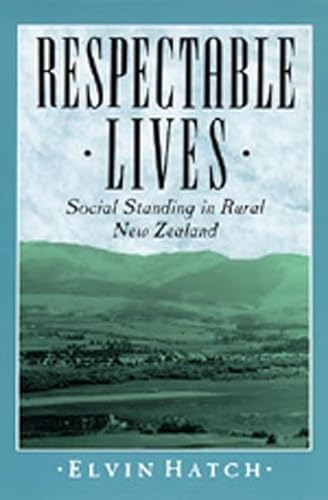
Where do we get our notions of social hierarchy and personal worth? What underlies our beliefs about the goals worth aiming for, the persons we hope to become? Elvin Hatch addresses these questions in his ethnography of a small New Zealand farming community, articulating the cultural system beneath the social hierarchy.
Hatch describes a cultural theory of social hierarchy that defines not only the local system of social rank, but personhood as well. Because people define respectability differently, a crucial part of Hatch's approach is to examine how these differences are worked out over time.
The concept of occupation is central to Hatch's analysis, since the work that people do provides the skeletal framework of the hierarchical order. He focuses in particular on sheep farming and compares his New Zealand community with one in California. Wealth and respectability are defined differently in the two places, with the result that California landholders perceive a social hierarchy different from the New Zealanders'. Thus the distinctive "shape" that characterizes the hierarchy among these New Zealand landholders and their conceptions of self reflect the distinctive cultural theory by which they live.
Hatch describes a cultural theory of social hierarchy that defines not only the local system of social rank, but personhood as well. Because people define respectability differently, a crucial part of Hatch's approach is to examine how these differences are worked out over time.
The concept of occupation is central to Hatch's analysis, since the work that people do provides the skeletal framework of the hierarchical order. He focuses in particular on sheep farming and compares his New Zealand community with one in California. Wealth and respectability are defined differently in the two places, with the result that California landholders perceive a social hierarchy different from the New Zealanders'. Thus the distinctive "shape" that characterizes the hierarchy among these New Zealand landholders and their conceptions of self reflect the distinctive cultural theory by which they live.
Die Inhaltsangabe kann sich auf eine andere Ausgabe dieses Titels beziehen.
Über die Autorin bzw. den Autor
Elvin Hatch is Professor of Anthropology at the University of California, Santa Barbara, and the author of several books, including Culture and Morality: The Relativity of Values in Anthropology (1983).
Von der hinteren Coverseite
"Trees of the California Landscape combines in a single volume just about everything landscape design professionals or home gardeners need to know about California trees. This excellent reference book/field guide will be particularly welcomed by landscape architects, as it pulls together a range of information about trees currently scattered throughout a number of older reference works. The heart of the book is a compendium of trees and includes essential information about individual species. The supporting sections on taxonomy, climate, range of native forest types, applications and special use lists contain a wealth of useful information."—Heath Schenker, Professor and Chair, Department of Landscape Architecture, UC Davis
Aus dem Klappentext
"Trees of the California Landscape combines in a single volume just about everything landscape design professionals or home gardeners need to know about California trees. This excellent reference book/field guide will be particularly welcomed by landscape architects, as it pulls together a range of information about trees currently scattered throughout a number of older reference works. The heart of the book is a compendium of trees and includes essential information about individual species. The supporting sections on taxonomy, climate, range of native forest types, applications and special use lists contain a wealth of useful information."—Heath Schenker, Professor and Chair, Department of Landscape Architecture, UC Davis
Auszug. © Genehmigter Nachdruck. Alle Rechte vorbehalten.
Respectable Lives: Social Standing in Rural New Zealand
By Elvin HatchUniversity of California Press
Copyright © 1991 Elvin HatchAll right reserved.
ISBN: 0520074726
Chapter One
Introduction
People everywhere conduct their lives in milieux that are saturated with ideas about prestige—or standing, status, social honor, distinction. Certain features of a prestige structure or status system are within conscious awareness, such as who stands higher than whom; but much of it is not, including most of the cultural framework by which relative standing is defined. Any system of social rank entails a complex and unrecognized body of ideas—a cultural theory of social hierarchy—which is the basis of the hierarchical order and defines achievement for those who are part of it. These same ideas also help to shape one's sense of self, for they identify what kind of person one should be and what kind of life is worth living.
This book is about a small, sheep-farming community on the South Island of New Zealand, and its central argument is that the local system of social standing and conceptions of self are grounded in historically variable, cultural systems of meaning; thus, the social hierarchy cannot be perceived directly by the senses, because it takes form only when viewed from the cultural perspective of the people. These are also contested systems of meaning, for various sectors of the community have an interest in defining personal worth and social standing differently. A crucial part of the hierarchical order, therefore, is the processes by which these differences are worked out over time.
Choosing the Community
This study grows out of work that I did previously in a California community, a locality that consisted chiefly of dryland grain farms, cattle ranches, and a very small town.1 A central problem of that research was the question of community. This locality was more than a “collocation of houses,”2 for most of the residents displayed the sense that they had something in common, and whatever that was, it gave the district its identity. Part of what made this a community is that the people knew about and interacted with one another, and, more important, they participated in a set of institutions in which they had a common interest. They cared about the schools, for example, and about facilities for holding local events. But an equally if not more fundamental (and less obvious) aspect emerged as I lived there: that is, the community was a significant reference group,3 and one of its fundamental features was a hierarchy of standing. Everyone in the district, whether they liked it or not, was placed by others within this hierarchy. People in the locality had their reputations at stake, or their local sense of personal worth and identity, and the dynamics of the community reflected this principle.
I later decided to pursue a similar study in another country, one similar enough to the United States both culturally and historically that I could undertake a close comparison. I also wanted to choose a community that would be very much like the one in California: it should be fully modern, and family farms should make up the economic base of the district. But above all I wanted a locality that exhibited the characteristics I described above: it should constitute an important reference group and a significant arena for social achievement, for I was interested in exploring the nature of the local status system.
I chose to do the work in New Zealand, and in 1978 I traveled from Auckland to Invercargill looking for a suitable place. The region of Canterbury, on South Island, seemed ideal, and, following the advice of people in the University of Canterbury and the Ministry of Agriculture,4 I chose a community that I refer to as South Downs, a pseudonym.*
*I also use pseudonyms for other nearby localities and for personal names. I appreciate that there are serious disadvantages in so doing, the most important being that it impedes others from checking my findings. However, my material comes almost entirely from tape-recorded interviews and other conversations that cannot be “checked” as archival sources can. In any event, my overriding concern in using pseudonyms is to protect the privacy of the people studied, many of whom spoke freely about matters very personal to them because they understood that I would try to protect their identity. While the material in this book may seem innocuous to an outsider, much of it is highly sensitive to people in the South Downs district.
South Downs was ideal in part because it is a distinctly bounded community, as we shall see, and also because it is far enough from larger towns and cities that it exhibits the characteristics of a vigorous reference group. In March 1981, my family and I moved into a house in the township, and we stayed until just after the new year, over nine months in all.**
The Local RegionSouth Downs is several hours' drive south of Christchurch, which in turn is one of the leading cities of New Zealand and the focal point of Canterbury.
Much of Canterbury consists of the fertile Canterbury Plains, a long shelf, bordering the ocean, that was formed by alluvium washing down from the Southern Alps. The plains are devoted mostly to
**The primary source of material for this research was informal, open-ended interviews. Typically I chose to interview people I had recently met (at a shop, at a meeting, through a friend), and in some cases I contacted that person again somewhat later to discuss a new set of topics. In a few instances I had three or more interviews with the same individual. I began each session having a general idea of what I wanted to cover, but I did not use a formal list of questions, and the discussions often took wholly unexpected turns. The conversations were tape-recorded, and I transcribed them verbatim soon afterward so that I could refer back to them in preparing for subsequent interviews. Typically the discussions lasted from half an hour to over two hours. While the interviews were the cornerstone of the research, my immersion in the community was equally significant, for this provided background and context that were indispensable for interpreting the interview material. Because my children attended the schools, my wife and I participated as parents in both formal and informal school activities. My wife became a member of a variety of local organizations, such as the golf club, and I was incorporated informally into the Jaycees. I attended county council meetings, Lions Club events, Agricultural and Pastoral Association work days, and the like. My family and I were also drawn into numerous informal social activities. My two children made several very good friends, and my wife and I soon got to know their friends' parents reasonably well. My wife and I acquired friends of our own, and we soon became part of an established social network in the district. The people of this network (and the people we knew best in the community) were primarily middle-aged landholders at the mature stage of the developmental cycle.
mixed farming, although even the most casual observer can see that sheep are especially important in the region. Serving the farms is a network of villages and towns, the most important of which are located on the main railway line.
The width of the Canterbury Plains varies, reaching a maximum slightly south of Christchurch, but at any...
„Über diesen Titel“ kann sich auf eine andere Ausgabe dieses Titels beziehen.
Suchergebnisse für Respectable Lives: Social Standing in Rural New Zealand

Foto des Verkäufers
Respectable Lives: Social Standing in Rural New Zealand
Verlag:
University of California Press, 1991
ISBN 10: 0520074726
ISBN 13: 9780520074729
Gebraucht
Hardcover
Anbieter: -OnTimeBooks-, Phoenix, AZ, USA
Verkäuferbewertung 5 von 5 Sternen

Zustand: good. A copy that has been read, remains in good condition. All pages are intact, and the cover is intact. The spine and cover show signs of wear. Pages can include notes and highlighting and show signs of wear, and the copy can include "From the library of" labels or previous owner inscriptions. 100% GUARANTEE! Shipped with delivery confirmation, if you're not satisfied with purchase please return item! Ships via media mail. Bestandsnummer des Verkäufers OTV.0520074726.G
Gebraucht kaufen
EUR 9,42
Versand gratis
Versand innerhalb von USA
Versand innerhalb von USA
Anzahl: 1 verfügbar
Beispielbild für diese ISBN
Respectable Lives: Social Standing in Rural New Zealand
Verlag:
University of California Press, 1991
ISBN 10: 0520074726
ISBN 13: 9780520074729
Gebraucht
Hardcover
Anbieter: HPB-Red, Dallas, TX, USA
Verkäuferbewertung 5 von 5 Sternen
hardcover. Zustand: Good. Connecting readers with great books since 1972! Used textbooks may not include companion materials such as access codes, etc. May have some wear or writing/highlighting. We ship orders daily and Customer Service is our top priority! Bestandsnummer des Verkäufers S_376213832
Gebraucht kaufen
EUR 6,71
EUR 3,35 Versand
Versand innerhalb von USA
Versand innerhalb von USA
Anzahl: 1 verfügbar
Beispielbild für diese ISBN
Respectable Lives : Social Standing in Rural New Zealand
Verlag:
University of California Press, 1991
ISBN 10: 0520074726
ISBN 13: 9780520074729
Gebraucht
Hardcover
Anbieter: Better World Books, Mishawaka, IN, USA
Verkäuferbewertung 5 von 5 Sternen
Zustand: Good. Former library copy. Pages intact with minimal writing/highlighting. The binding may be loose and creased. Dust jackets/supplements are not included. Includes library markings. Stock photo provided. Product includes identifying sticker. Better World Books: Buy Books. Do Good. Bestandsnummer des Verkäufers 10203309-6
Gebraucht kaufen
EUR 11,29
Versand gratis
Versand innerhalb von USA
Versand innerhalb von USA
Anzahl: 1 verfügbar