
Verwandte Artikel zu Rethinking the American Race Problem
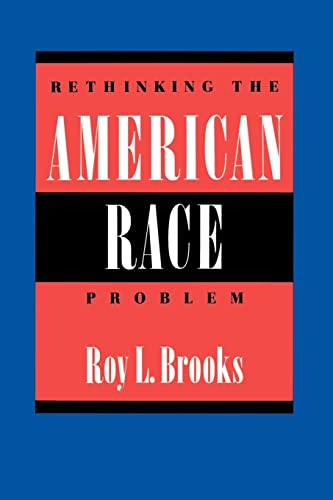
Inhaltsangabe
No detailed description available for "Rethinking the American Race Problem".
Die Inhaltsangabe kann sich auf eine andere Ausgabe dieses Titels beziehen.
Über die Autorin bzw. den Autor
Roy L. Brooks is Professor of Law at the University of Minnesota School of Law.
Von der hinteren Coverseite
"A path-breaking analysis of the advent and consequences of deep class stratification in African American society since the civil rights movement of the 1960s. Characterized by breadth of vision and reflective realism, Rethinking the American Race Problem is a worthy and welcome successor to Gunnar Myrdal's seminal work, The American Dilemma: The Negro Problem and Modern Democracy, published almost half a century ago."—Boris I. Bittker, Yale University
"Insightful, tightly argued, and deeply felt. . . . This brilliant book will affect the thinking of all who read it."—William A. Fletcher, University of California
"Rethinking the American Race Problem challenges the conventional understanding of the problem of race relations in the United States."—Gerrald Torres, University of Minnesota
"Offers a fresh and intellectually provocative perspective on the relationship between race and public policy in today's America."—Martin Kilson, Harvard University
"Insightful, tightly argued, and deeply felt. . . . This brilliant book will affect the thinking of all who read it."—William A. Fletcher, University of California
"Rethinking the American Race Problem challenges the conventional understanding of the problem of race relations in the United States."—Gerrald Torres, University of Minnesota
"Offers a fresh and intellectually provocative perspective on the relationship between race and public policy in today's America."—Martin Kilson, Harvard University
Aus dem Klappentext
"A path-breaking analysis of the advent and consequences of deep class stratification in African American society since the civil rights movement of the 1960s. Characterized by breadth of vision and reflective realism, Rethinking the American Race Problem is a worthy and welcome successor to Gunnar Myrdal's seminal work, The American Dilemma: The Negro Problem and Modern Democracy, published almost half a century ago." Boris I. Bittker, Yale University
"Insightful, tightly argued, and deeply felt. . . . This brilliant book will affect the thinking of all who read it." William A. Fletcher, University of California
"Rethinking the American Race Problem challenges the conventional understanding of the problem of race relations in the United States." Gerrald Torres, University of Minnesota
"Offers a fresh and intellectually provocative perspective on the relationship between race and public policy in today's America." Martin Kilson, Harvard University
"Insightful, tightly argued, and deeply felt. . . . This brilliant book will affect the thinking of all who read it." William A. Fletcher, University of California
"Rethinking the American Race Problem challenges the conventional understanding of the problem of race relations in the United States." Gerrald Torres, University of Minnesota
"Offers a fresh and intellectually provocative perspective on the relationship between race and public policy in today's America." Martin Kilson, Harvard University
Auszug. © Genehmigter Nachdruck. Alle Rechte vorbehalten.
Rethinking the American Race Problem
By Roy L. BrooksUniversity of California Press
Copyright © 1992 Roy L. BrooksAll right reserved.
ISBN: 9780520078789
Understanding the Problem
Combining elements of race and class, I attempt to establish two propositions in Part I of this book. First, certain societal hardships within socioeconomic classes are manifested along racial lines, creating racial inequalities that form today's race problem. Second, our fundamental civil rights policy, formal equal opportunity (examined in Chapter 1), denies priority to specific African American civil rights interests class by class and, as a consequence, such racial subordination accommodates, intensifies, and nurtures intra-class racial disparity, or the American race problem. At a deeper level, both of these propositions find expression in the "subordination question," a two-pronged question that asks whether formal equal opportunity (through its tenets, racial omission and racial integration) subordinates the civil rights interests of African Americans and, if so, whether such racial subordination contributes to intra-class racial disparity. Part I answers both questions in the affirmative.
In short, my response to the subordination question comes down to a simple lesson: By giving little or no priority to the interests of African Americans in equal opportunity, civil rights laws and policies, as developed and interpreted over the past several decades, ineluctably contribute to the American race problem .
The African American Middle Class
Compared to their white counterparts, middle-class African Americans suffer more employment discrimination ("complex racial discrimination") and segregation (racially stratified work environments), other employment hardships, housing discrimination and segregation, and low college enrollment. Chapter 2 focuses only on employment disparities; housing and education are considered later, in connection with the working class.
Formal equal opportunity's tenet of racial omission subordinates the civil rights interest of middle-class African Americans in equal employment opportunity in several ways. A primary problem is the priestly status given to the "strict scrutiny" test, a judicial construct used in constitutional litigation to vindicate this tenet. The strict scrutiny test, faithfully applied, gives low priority to the equal employment opportunity interest of middle-class African Americans by enjoining or discouraging public-sector employers from using race-conscious employment policies or practices that give qualified African Americans access to jobs from which they have been excluded in the past by societal discrimination. As a consequence of such racial subordination, there are fewer good opportunities in the legal arena to redress the socioeconomic disparity that is manifested along racial lines within the American middle class and that involves complex racial discrimination, segregation, and other job-related hardships, from loneliness and disaffection to stress and hypertension.
Similarly, judicial construction of statutory antidiscrimination law—mainly Title VII of the 1964 Civil Rights Act,17 —shifts to the plaintiff the burden of persuasion concerning a defendant's justification for a discriminatory practice and places a relatively high standard of causation on the plaintiff. Some courts have even shown a reluctance to apply Title VII to high-level jobs. These and other features discussed later subordinate the interest of middle-class African Americans in equal employment opportunity by substantially decreasing the odds of winning cases under Title VII. Consequently, legal remedies for complex racial discrimination and racial segregation in the nation's top jobs are significantly limited.
The African American Working Class
Like middle-class African Americans, working-class African Americans experience intra-class racial disparity in employment, housing, and higher education. But unlike the more affluent members of their race, members of the working class also encounter obstacles in primary education and additional hardships on the job. Although the employment problems they face, including the lack of time, money, and flexibility to pursue Title VII litigation, are extremely important, I have chosen to focus the argument in Chapter 3 on intra-class racial disparities in housing and education, both primary (here meaning kindergarten through high school) and higher education.
Legal doctrines, procedures, and policies designed to implement or vindicate the racial omission tenet subordinate certain housing and educational interests of working-class African Americans and consequently accommodate or sustain intra-class racial disparity in these areas. Chapter 3 specifically discusses the role of the "intent" test, the strict scrutiny test, the Fair Housing Act, and the Supreme Court's decision in the Bakke case.
The intent test, for example—another judicial creation that reigns supreme in the realm of constitutional litigation—makes the task of proving racial discrimination in housing and racial segregation in public schools extremely difficult and often impossible. Members of the African American working class find themselves unable to use litigation, an essential governmental resource, to effectively protect their interests in equal housing and educational opportunity. The housing discrimination and segregation traceable to race within the working class thus continue unabated. In primary education, problems such as the absence of cultural diversity and the dearth of educational resources (from books to desks to computers) in racially isolated inner-city public schools remain acute.
Faithful application of the strict scrutiny test invalidates any remedial use of racial occupancy controls, or "benign housing quotas," that could counteract complex housing discrimination and prevent housing resegregation through the "tipping" phenomenon. This gives low priority to the African American
working class's civil rights interest in open housing. The style of racial subordination supported by the strict scrutiny test can only contribute to the housing problems of working-class African Americans and prolong the struggle against discrimination and housing segregation—segregation that is especially pernicious not only because it usually entails poor municipal services and low-quality housing but also because it etches in the minds of both African Americans and whites an indelible image of yesteryear's racial hierarchy.
The African American working class's civil rights interest in fair housing is further frustrated by the poor structure and administration of the Fair Housing Act of 1968 and by the protracted litigation and the low amounts of monetary relief under both Section 1982 and (until recently) the Fair Housing Act.18 In failing to support the interest of working-class African Americans in equal housing opportunity, these acts of Congress have allowed housing discrimination and segregation to continue for at least a generation.
Likewise, the Supreme Court's momentous decision in Regents of the University of California v.Bakke —which some have incorrectly regarded as a constitutional precedent—has given college and university admissions officers reason to abandon admissions quotas for African Americans or to place undue weight on...
„Über diesen Titel“ kann sich auf eine andere Ausgabe dieses Titels beziehen.
Suchergebnisse für Rethinking the American Race Problem

Beispielbild für diese ISBN
Rethinking the American Race Problem
Verlag:
University of California Press, 1992
ISBN 10: 0520078780
ISBN 13: 9780520078789
Gebraucht
Softcover
Anbieter: Wonder Book, Frederick, MD, USA
Verkäuferbewertung 5 von 5 Sternen

Zustand: Very Good. Very Good condition. A copy that may have a few cosmetic defects. May also contain light spine creasing or a few markings such as an owner's name, short gifter's inscription or light stamp. Bestandsnummer des Verkäufers K03R-00505
Gebraucht kaufen
EUR 6,40
Versand gratis
Versand innerhalb von USA
Versand innerhalb von USA
Anzahl: 1 verfügbar
Beispielbild für diese ISBN
Rethinking the American Race Problem
Verlag:
University of California Press, 1990
ISBN 10: 0520078780
ISBN 13: 9780520078789
Gebraucht
Paperback
Anbieter: Midtown Scholar Bookstore, Harrisburg, PA, USA
Verkäuferbewertung 5 von 5 Sternen
Paperback. Zustand: Good. some shelfwear but still NICE! Standard-sized. Bestandsnummer des Verkäufers 0520078780-01
Gebraucht kaufen
EUR 2,40
EUR 5,33 Versand
Versand innerhalb von USA
Versand innerhalb von USA
Anzahl: 1 verfügbar
Beispielbild für diese ISBN
Rethinking the American Race Problem
Verlag:
University of California, 1990
ISBN 10: 0520078780
ISBN 13: 9780520078789
Gebraucht
Soft Cover
Anbieter: janet smith, Wheeling, WV, USA
Verkäuferbewertung 5 von 5 Sternen
Soft Cover. Zustand: Very Good. Clean tight copy with no markings. Size: 8vo - over 7¾" - 9¾" tall. Bestandsnummer des Verkäufers 012744
Gebraucht kaufen
EUR 3,21
EUR 5,33 Versand
Versand innerhalb von USA
Versand innerhalb von USA
Anzahl: 1 verfügbar
Beispielbild für diese ISBN
Rethinking the American Race Problem
Verlag:
University of California Press, 1992
ISBN 10: 0520078780
ISBN 13: 9780520078789
Gebraucht
Paperback
Anbieter: ThriftBooks-Dallas, Dallas, TX, USA
Verkäuferbewertung 5 von 5 Sternen
Paperback. Zustand: Very Good. No Jacket. May have limited writing in cover pages. Pages are unmarked. ~ ThriftBooks: Read More, Spend Less. Bestandsnummer des Verkäufers G0520078780I4N00
Gebraucht kaufen
EUR 9,14
Versand gratis
Versand innerhalb von USA
Versand innerhalb von USA
Anzahl: 1 verfügbar
Beispielbild für diese ISBN
Rethinking the American Race Problem
Verlag:
University of California Press, 1992
ISBN 10: 0520078780
ISBN 13: 9780520078789
Gebraucht
paperback
Anbieter: HPB-Emerald, Dallas, TX, USA
Verkäuferbewertung 5 von 5 Sternen
paperback. Zustand: Very Good. Connecting readers with great books since 1972! Used books may not include companion materials, and may have some shelf wear or limited writing. We ship orders daily and Customer Service is our top priority! Bestandsnummer des Verkäufers S_426873957
Gebraucht kaufen
EUR 6,63
EUR 3,33 Versand
Versand innerhalb von USA
Versand innerhalb von USA
Anzahl: 1 verfügbar
Beispielbild für diese ISBN
Rethinking the American Race Problem
Verlag:
University of California Press, 1990
ISBN 10: 0520078780
ISBN 13: 9780520078789
Gebraucht
Softcover
Anbieter: Better World Books: West, Reno, NV, USA
Verkäuferbewertung 5 von 5 Sternen
Zustand: Fine. Used book that is in almost brand-new condition. May contain a remainder mark. Better World Books: Buy Books. Do Good. Bestandsnummer des Verkäufers 54417361-75
Gebraucht kaufen
EUR 10,07
Versand gratis
Versand innerhalb von USA
Versand innerhalb von USA
Anzahl: 1 verfügbar
Beispielbild für diese ISBN
RETHINKING THE AMERICAN RACE PROBLEM
Verlag:
University of California Press, Berkeley, 1990
ISBN 10: 0520078780
ISBN 13: 9780520078789
Gebraucht
Trade Paperback
Anbieter: Russ States, Oil City, PA, USA
Verkäuferbewertung 5 von 5 Sternen
Trade Paperback. Zustand: Very Good. No Jacket. (1990), 256pp, slight shelfwear to cover, light soiling to pg edges. Bestandsnummer des Verkäufers 11-0055
Gebraucht kaufen
EUR 6,41
EUR 4,62 Versand
Versand innerhalb von USA
Versand innerhalb von USA
Anzahl: 1 verfügbar
Beispielbild für diese ISBN
Rethinking the American Race Problem
Verlag:
University of California Press, 1990
ISBN 10: 0520078780
ISBN 13: 9780520078789
Neu
Paperback
Anbieter: Poverty Hill Books, Mt. Prospect, IL, USA
Verkäuferbewertung 4 von 5 Sternen

Paperback. Zustand: New. BRAND NEW, Perfect Shape, No Remainder Mark,Fast Shipping With Online Tracking, International Orders shipped Global Priority Air Mail, All orders handled with care and shipped promptly in secure packaging, we ship Mon-Sat and send shipment confirmation emails. Our customer service is friendly, we answer emails fast, accept returns and work hard to deliver 100% Customer Satisfaction! Bestandsnummer des Verkäufers 9072638
Neu kaufen
EUR 16,44
EUR 3,55 Versand
Versand innerhalb von USA
Versand innerhalb von USA
Anzahl: 1 verfügbar
Foto des Verkäufers
Rethinking the American Race Problem
Verlag:
University of California Press, US, 1990
ISBN 10: 0520078780
ISBN 13: 9780520078789
Neu
Paperback
Anbieter: Rarewaves USA, HEBRON, KY, USA
Verkäuferbewertung 5 von 5 Sternen
Paperback. Zustand: New. If the conservative view of the American race problem is frightening, the traditional liberal view seems impotent. Analyzing the race problem from neither right nor left, Brooks sheds a new and clarifying light on America's longest running social and moral dilemma. This incisive book provides a bold new examination of the seemingly intractable racial problems confronting Americans at the end of the twentieth century. In a wide-ranging and probing study, Brooks calls into question the prevailing wisdom about racism, civil rights legislation, and the composition of the Black community, going on to offer a dramatic new approach to the race problem. In Brooks' mind, civil rights laws - laws targeted at racial discrimination - have not only failed to engender racial equality, but have in fact had a negative effect on the standard of living of many Blacks. Brooks defines the American race problem so as to carefully separate racial oppression from (economic) class oppression and explains how civil rights legislation since the 1960s has hurt Black Americans of every class.He offers a strategy for resolving the country's racial inequities, unique in its attentiveness to class division in Black society, that combines governmental remedies and an unprecedented program of Black self-help. While Brooks argues that the government has the means to resolve the race dilemma, he suggests that it lacks the spirit to do so. Thus, it may be time for Black Americans to come to grips with an unpleasant reality - namely, that they can count on the government only for minimal alleviation, and must take on the larger portion of responsibility for resolving the American race problem themselves. Certain to arouse controversy, "Rethinking the American Race Problem" offers new understandings of issues often clouded by misconceptions and backward notions. It is an important book for anyone concerned about the current state of race relations in America. Bestandsnummer des Verkäufers LU-9780520078789
Neu kaufen
EUR 35,54
Versand gratis
Versand innerhalb von USA
Versand innerhalb von USA
Anzahl: Mehr als 20 verfügbar
Beispielbild für diese ISBN
Rethinking the American Race Problem
Anbieter: PBShop.store US, Wood Dale, IL, USA
Verkäuferbewertung 5 von 5 Sternen
PAP. Zustand: New. New Book. Shipped from UK. Established seller since 2000. Bestandsnummer des Verkäufers L2-9780520078789
Neu kaufen
EUR 35,89
Versand gratis
Versand innerhalb von USA
Versand innerhalb von USA
Anzahl: Mehr als 20 verfügbar