
Verwandte Artikel zu Romancing the Past: The Rise of Vernacular Prose Historiogra...
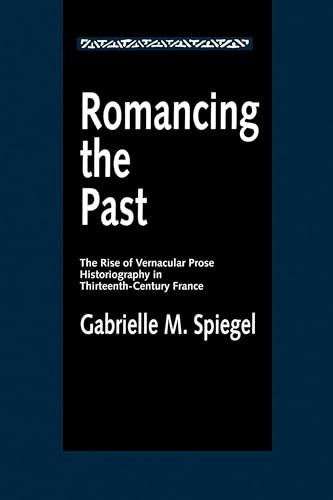
Romancing the Past: The Rise of Vernacular Prose Historiography in Thirteenth-Century France (New Historicism: Studies in Cultural Poetics, 23, Band 23) - Softcover
Inhaltsangabe
In a poststructuralist study of thirteenth-century French historical texts, Gabrielle Spiegel investigates the reasons for the rise of French vernacular prose historiography at this particular time. She argues that the vernacular prose histories that have until now been regarded as royalist were actually products of the aristocracy, reflecting its anxiety as it faced social and economic change and political threats from the monarchy.
Die Inhaltsangabe kann sich auf eine andere Ausgabe dieses Titels beziehen.
Über die Autorin bzw. den Autor
Gabrielle M. Spiegel is Professor of History at The Johns Hopkins University. She is the author of The Chronicle Tradition of Saint-Denis (1978).
Von der hinteren Coverseite
"Reading Spiegel's book is like seeing the scattered pieces of a jigsaw puzzle of history and literature suddenly assembled in a dazzling new image, a picture that could not have been made without the master piece, the manuscript that Professor Spiegel was the first person in almost 800 years to read and interpret. Her effort is a tour de force of no mean proportion."—Stephen G. Nichols Jr., author of Romanesque Signs
Aus dem Klappentext
"Reading Spiegel's book is like seeing the scattered pieces of a jigsaw puzzle of history and literature suddenly assembled in a dazzling new image, a picture that could not have been made without the master piece, the manuscript that Professor Spiegel was the first person in almost 800 years to read and interpret. Her effort is a tour de force of no mean proportion."Stephen G. Nichols Jr., author of Romanesque Signs
Auszug. © Genehmigter Nachdruck. Alle Rechte vorbehalten.
Romancing the Past
The Rise of Vernacular Prose Historiography in Thirteenth-Century FranceBy Gabrielle M. SpiegelUniversity of California Press
Copyright © 1995 Gabrielle M. SpiegelAll right reserved.
ISBN: 9780520089358
Introduction
"Lost causes," C. Vann Woodward once remarked, "especially those that foster lingering loyalties and nostalgic memories, are among the most prolific breeders of historiography . . . particularly so if the survivors deem the cause in some measure retrievable."1 The search for a usable past, capable of redeeming a cause that has been lost, in ideological if not actual political terms, becomes a compelling task for those who feel the need to mask the failure of their enterprise, to dissimulate the malaise that accompanies a fall from social grace, a decline in political authority, and a sense of the irrelevance of values that had guided comportment and identified the once-prestigious possessors of power and authority as central players in the social game. To fail, and to fail in a contest that discloses the possible historical obsolescence of the principles, beliefs, and prerogatives that had served to define the social and political status of those deeply committed to the lost cause, makes recourse to the past an essential element in the drive to recuperate a sense of social worth. It is here that ideological assertion comes into play, arguing for the continuing relevance of the values that the past enshrines; for the inherent rightness of the social order that had governed political life; for the importance of restoring to their former authority the rules of the social game that had acknowledged the perduring justice of the declining class's hegemony.
Ideology seeks to revive lost dreams of glory, to vindicate motives, and to mantle the discomfort that the contemplation of unwanted and adverse historical change germinates. Because failure is rooted in historical transformations, it is the past that becomes the repository of those dreams and desires, both because it can offer up a consoling image of what once was and is no longer, and because it contains within
it the elements by which to reopen the contest and offer an alternative vision to a now unpalatable present. Historical writing is a powerful vehicle for the expression of ideological assertion, for it is able to address the historical issues so crucially at stake and to lend to ideology the authority and prestige of the past, all the while dissimulating its status as ideology under the guise of a mere accounting of "what was."
This book examines the use of the past by the French aristocracy in the thirteenth century, as it developed in the patronage of a novel form of historical writing, the Old French prose chronicle. The underlying argument of the book is that both history and prose performed critical social functions in the life of the French aristocracy, which sought to embed its ideology in history and thereby endow that ideology with the prestige and imprescriptible character that the past was able to confer in medieval society. At the same time, by adopting prose as the language of history, chroniclers created a novel vernacular historiographic discourse, one that attempted to ground historical truth in a new system of authentication based on' prose as a language of "truth," hence uniquely appropriate for the articulation and dissemination of historical knowledge.
One of my concerns in this book is with what might be called the social function of prose. I argue that the rise of literary prose represents far more than a simple fact of literary history, whereby prose composition gradually took its place alongside composition in verse. Old French prose historiography was, rather, the product of a specific historical moment and situation that endowed prose with a particular value for those who patronized, produced, and consumed works written in that discursive register. Global assertions about the literary trajectory and significance of prose tend to assume that its appearance is a natural, if not inevitable, part of any culture's literary history, an assumption that remains undemonstrated and probably unwarranted. To be sure, most literary languages eventually develop prose narratives, but the exact timing, location, and generic embodiment that give rise to prose composition are not necessarily the result of "natural" linguistic progress. It is my belief that the conditions under which prose narratives originate are as various as the cultures that produce them. In some cultures and at some times prose may represent a natural evolution of literary language, while in other places and periods it is socially generated by precise cultural needs and possesses ideological functions and meanings. For this reason, I do not attempt to consider
the development of Old French vernacular prose in a comparative perspective, since my methodological goal is to demonstrate the advantages of situating historico-literary texts and developments in a local environment of social and political networks that, I believe, account for their specific form and function. References to other areas could never attain the particularity and density of this treatment and would, at best, constitute passing allusions to complex phenomena.
In France, the turn to prose as the preferred medium of historical writing occurred in service to an ideological initiative on the part of a threatened elite to authenticate its claim to historical legitimacy. At the same time, it worked to distinguish the vernacular chronicle, in both style and oral and fictional sources, from earlier Old French literary forms, namely epic and romance, against which vernacular historiography constructed its generic identity.
The "romancing of the past" represented by the rise of vernacular prose historiography, thus, has meaning on several levels. In its most ordinary and straightforward sense, the project entailed the translation of Latin histories into the rapidly developing language of Old French prose, a raise en roman that made available for the first time the historical legacy of both French and classical civilizations to lay-men hitherto barred from access to it by their ignorance of Latin. On a more profound level, the "romancing of the past" in vernacular historiography also addressed sentiments of loss and decline that plagued the French aristocracy in the opening decades of the thirteenth century, as the rise of a newly powerful monarchy threatened its traditional autonomy and sought to limit its exercise of traditional political and military roles. From this perspective, the rise of vernacular prose historiography entailed the quest for a lost world of aristocratic potency, one that could be discovered in the past and made, it was possible to hope, a patent for a revised present in which the adverse historical changes suffered by the French aristocracy might be reversed and overcome.
Some historians might argue that the situation of the French nobility in the opening decades of the thirteenth century was notb or not yetb sufficiently serious to suppose that French nobles felt themselves in need of ideological solace and support. Or that, in any case, whatever degree of decline in power the French nobility experienced during these decades, it proved both resourceful and resurgent in reestablishing its prestige in later ages. While it is certainly true that French nobles weathered worse challenges than those facing them in
this...
„Über diesen Titel“ kann sich auf eine andere Ausgabe dieses Titels beziehen.
Suchergebnisse für Romancing the Past: The Rise of Vernacular Prose Historiogra...

Beispielbild für diese ISBN
Romancing the Past: The Rise of Vernacular Prose Historiography in Thirteenth-Century France
Verlag:
University of California Press, 1995
ISBN 10: 0520089359
ISBN 13: 9780520089358
Gebraucht
Paperback
Anbieter: World of Books (was SecondSale), Montgomery, IL, USA
Verkäuferbewertung 5 von 5 Sternen

Paperback. Zustand: Good. In a poststructuralist study of thirteenth-century French historical texts, Gabrielle Spiegel investigates the reasons for the rise of French vernacular prose historiography at this particular time. She argues that the vernacular prose histories that have until now been regarded as royalist were actually products of the aristocracy, reflecting its anxiety as it faced social and economic change and political threats from the monarchy. Bestandsnummer des Verkäufers CIN0520089359G
Gebraucht kaufen
EUR 6,52
Versand gratis
Versand innerhalb von USA
Versand innerhalb von USA
Anzahl: 1 verfügbar
Beispielbild für diese ISBN
Romancing the Past: The Rise of Vernacular Prose Historiography in Thirteenth-Century France
Verlag:
University of California Press, 1995
ISBN 10: 0520089359
ISBN 13: 9780520089358
Gebraucht
Paperback
Anbieter: World of Books Inc, Montgomery, IL, USA
Verkäuferbewertung 4 von 5 Sternen

Paperback. Zustand: Good. In a poststructuralist study of thirteenth-century French historical texts, Gabrielle Spiegel investigates the reasons for the rise of French vernacular prose historiography at this particular time. She argues that the vernacular prose histories that have until now been regarded as royalist were actually products of the aristocracy, reflecting its anxiety as it faced social and economic change and political threats from the monarchy. Bestandsnummer des Verkäufers CIN0520089359G
Gebraucht kaufen
EUR 8,36
Versand gratis
Versand innerhalb von USA
Versand innerhalb von USA
Anzahl: 1 verfügbar
Beispielbild für diese ISBN
Romancing the Past : The Rise of Vernacular Prose Historiography in Thirteenth-Century France (New Historicism : Studies in Cultural Poetics, No 23)
Verlag:
University of California Press, 1995
ISBN 10: 0520089359
ISBN 13: 9780520089358
Gebraucht
Paperback
Anbieter: HPB-Red, Dallas, TX, USA
Verkäuferbewertung 5 von 5 Sternen
Paperback. Zustand: Good. Connecting readers with great books since 1972! Used textbooks may not include companion materials such as access codes, etc. May have some wear or writing/highlighting. We ship orders daily and Customer Service is our top priority! Bestandsnummer des Verkäufers S_348654811
Gebraucht kaufen
EUR 9,20
EUR 3,35 Versand
Versand innerhalb von USA
Versand innerhalb von USA
Anzahl: 1 verfügbar
Beispielbild für diese ISBN
Romancing the Past : The Rise of Vernacular Prose Historiography in Thirteenth-Century France
Verlag:
University of California Press, 1995
ISBN 10: 0520089359
ISBN 13: 9780520089358
Gebraucht
Softcover
Anbieter: Better World Books: West, Reno, NV, USA
Verkäuferbewertung 5 von 5 Sternen
Zustand: Very Good. 1 Edition. Former library copy. Pages intact with possible writing/highlighting. Binding strong with minor wear. Dust jackets/supplements may not be included. Includes library markings. Stock photo provided. Product includes identifying sticker. Better World Books: Buy Books. Do Good. Bestandsnummer des Verkäufers 56017165-75
Gebraucht kaufen
EUR 12,75
Versand gratis
Versand innerhalb von USA
Versand innerhalb von USA
Anzahl: 1 verfügbar
Beispielbild für diese ISBN
Romancing the Past: The Rise of Vernacular Prose Historiography in Thirteenth-Century France: 23 (The New Historicism: Studies in Cultural Poetics)
Verlag:
University of California Press, 1995
ISBN 10: 0520089359
ISBN 13: 9780520089358
Gebraucht
Paperback
Anbieter: WorldofBooks, Goring-By-Sea, WS, Vereinigtes Königreich
Verkäuferbewertung 5 von 5 Sternen
Paperback. Zustand: Very Good. The book has been read, but is in excellent condition. Pages are intact and not marred by notes or highlighting. The spine remains undamaged. Bestandsnummer des Verkäufers GOR009405305
Gebraucht kaufen
EUR 8,71
EUR 6,62 Versand
Versand von Vereinigtes Königreich nach USA
Versand von Vereinigtes Königreich nach USA
Anzahl: 1 verfügbar
Beispielbild für diese ISBN
Romancing the Past : The Rise of Vernacular Prose Historiography in Thirteenth-Century France (New Historicism : Studies in Cultural Poetics, No 23) (Volume 23)
Anbieter: Price-less Books, Urbana, IL, USA
Verkäuferbewertung 4 von 5 Sternen
Pb. Zustand: VG. 422pp. Extremities lightly rubbed. Endnotes; biblio.; index. Bestandsnummer des Verkäufers 246946
Gebraucht kaufen
EUR 13,80
EUR 3,48 Versand
Versand innerhalb von USA
Versand innerhalb von USA
Anzahl: 1 verfügbar
Beispielbild für diese ISBN
Romancing the Past: The Rise of Vernacular Prose Historiography in Thirteenth-Century France
Verlag:
University of California Press, Berkeley, 1995
ISBN 10: 0520089359
ISBN 13: 9780520089358
Gebraucht
Paperback
Anbieter: Daedalus Books, Portland, OR, USA
Verkäuferbewertung 4 von 5 Sternen
Paperback. Zustand: Near Fine. Zustand des Schutzumschlags: No Dust Jacket. A nice, clean copy.; New Historicism: Studies in Cultural Poetics; 23; 8vo; 422 pages. Bestandsnummer des Verkäufers 349018
Gebraucht kaufen
EUR 11,92
EUR 5,81 Versand
Versand innerhalb von USA
Versand innerhalb von USA
Anzahl: 1 verfügbar
Beispielbild für diese ISBN
Romancing the Past: the Rise of Vernacular Prose Historiography in Thirteenth-Century France
Verlag:
University of California Press, Berkeley, 1995
ISBN 10: 0520089359
ISBN 13: 9780520089358
Gebraucht
Paperback
Anbieter: Daedalus Books, Portland, OR, USA
Verkäuferbewertung 4 von 5 Sternen
Paperback. Zustand: Very Good. Clean and solid. ; New Historicism; 8vo; 422 pages. Bestandsnummer des Verkäufers 329880
Gebraucht kaufen
EUR 12,38
EUR 5,81 Versand
Versand innerhalb von USA
Versand innerhalb von USA
Anzahl: 1 verfügbar
Beispielbild für diese ISBN
Romancing the Past: The Rise of Vernacular Prose Historiography in Thirteenth-Century France
Verlag:
University of California Press, 1995
ISBN 10: 0520089359
ISBN 13: 9780520089358
Gebraucht
Softcover
Anbieter: Anybook.com, Lincoln, Vereinigtes Königreich
Verkäuferbewertung 5 von 5 Sternen
Zustand: Good. This is an ex-library book and may have the usual library/used-book markings inside.This book has soft covers. In good all round condition. Please note the Image in this listing is a stock photo and may not match the covers of the actual item,750grams, ISBN:9780520089358. Bestandsnummer des Verkäufers 8696714
Gebraucht kaufen
EUR 22,38
EUR 15,41 Versand
Versand von Vereinigtes Königreich nach USA
Versand von Vereinigtes Königreich nach USA
Anzahl: 1 verfügbar
Beispielbild für diese ISBN
The New Historicism: Romancing the Past: The Rise of Vernacular Prose Historiography in Thirteenth-Century France
Verlag:
University of California Press, 1995
ISBN 10: 0520089359
ISBN 13: 9780520089358
Gebraucht
Softcover
Anbieter: Anybook.com, Lincoln, Vereinigtes Königreich
Verkäuferbewertung 5 von 5 Sternen
Zustand: Good. This is an ex-library book and may have the usual library/used-book markings inside.This book has soft covers. In good all round condition. Please note the Image in this listing is a stock photo and may not match the covers of the actual item,700grams, ISBN:9780520089358. Bestandsnummer des Verkäufers 9892076
Gebraucht kaufen
EUR 22,38
EUR 15,41 Versand
Versand von Vereinigtes Königreich nach USA
Versand von Vereinigtes Königreich nach USA
Anzahl: 1 verfügbar