
Verwandte Artikel zu Tokugawa Village Practice: Class, Status, Power, Law
Inhaltsangabe
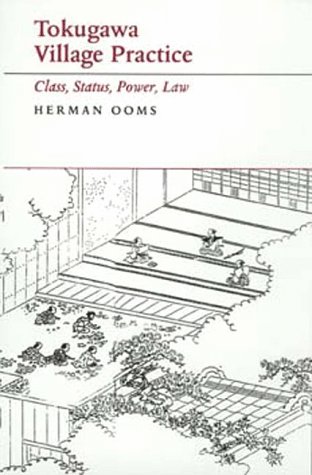
In contrast to modern Japanese citizens, during the Tokugawa period (1600-1868) villagers frequently resorted to lawsuits to settle conflicts. Herman Ooms uses colorful, skillfully analyzed case studies to trace the evolution of class and status conflicts through lawsuits and petitions in villages. Inspired by the work of Max Weber and Pierre Bourdieu, this exploration of social and legal history illuminates the texture and detail of village life, focusing on relations to authority.
Opening with a story of an angry peasant woman's lifelong struggle against village authority (a story involving murder and revenge), Ooms highlights the role played by obscure historical actors including local elites, commoners, women, and outcastes. He also discusses the important role lineages played in village politics and examines the origins of discrimination against Japan's burakumin, or outcastes.
Opening with a story of an angry peasant woman's lifelong struggle against village authority (a story involving murder and revenge), Ooms highlights the role played by obscure historical actors including local elites, commoners, women, and outcastes. He also discusses the important role lineages played in village politics and examines the origins of discrimination against Japan's burakumin, or outcastes.
Die Inhaltsangabe kann sich auf eine andere Ausgabe dieses Titels beziehen.
Über die Autorin bzw. den Autor
Herman Ooms is Professor of History at the University of California, Los Angeles. He is author of Tokugawa Ideology: Early Constructs (1570-1680) (1985) and Charismatic Bureaucrat: A Political Biography of Matsudaira Sadanobu (1758-1829) (1975).
Auszug. © Genehmigter Nachdruck. Alle Rechte vorbehalten.
Tokugawa Village Practice: Class, Status, Power, Law
By Herman OomsUniversity of California Press
Copyright © 1996 Herman OomsAll right reserved.
ISBN: 0520202090
Introduction
Class, status, power, and law are not new topics to non-Japanese macrostructural treatments of Tokugawa society (1600-1868). Scholars have described well their historical specificity, though often without discussing their interrelationship. Together, as a cluster of general questions, they constitute a Marxian-Weberian problematic perhaps so familiar that it seems disingenuous to persist in treating them still as questions. Indeed, one might ask what the point is of returning to them if they are in reality answers given long ago posturing posthumously as questions—an "answeramatic" disguised as a problematic. How is this book situated within the fields of Tokugawa history and general sociological theory? A second question a reader acquainted with my previous interest in Tokugawa ideology might raise concerns my new orientation.1 Why this shift from intellectual history and representations of reality to social history and institutional practice?
Post factum justifications for what one has gotten into in the first place without clearly knowing why, except that it looked interesting, partake of retrospective fiction. This is especially true for questions regarding one's intellectual trajectory. With the proviso that reflections of this genre never get at real reasons, I can offer some rationale that one may expect from an introduction.
Previous scholarship, including my own analysis of ideological constructs, approached the issues of class, status, domination, and so on, from a position that was located in the political center. The scholar's
My book Tokugawa Ideology: Early Constructs, 1570-1680 was published by Princeton University Press in 1985.
totalizing perspective—"modernist" some would call it now—from such a vantage point is the cognitive equivalent of the rulers' reach of dominion. Past works described how the system of governance was set up, how it functioned, reproduced itself, collapsed—and begat modernity. Even when I argued that the ideology of the times was not produced or even commissioned by the rulers, my emphasis was clearly that it served their interests. Perhaps less explicitly, I also implied that ideas or social representations mattered as much as they did because of their direct link to practice.
I formulated some of those structuralist and functionalist interpretations on the basis of insights gained from Pierre Bourdieu's writings. His writings have further led me to turn my attention to ways in which institutions, like laws, not only constitute sites of ideological embodiment but also define fields of practice and power contests. To a considerable extent, institutions circumscribe, directly, with less mediation by ideology than one might think perhaps, what people are, do, can be, can do, or feel instinctively to be unthinkable or impracticable. This simple truth calls for a kind of history that focuses on what people do within and with institutions. In regard to Tokugawa Japan, this insight translated for me into a desire to examine what peasants did and could do in their villages. How did the institutional setting of a military regime influence intravillage power distributions? Conversely, did village politics affect institutions?
Questions of this genre have received hardly any attention in Western scholarship, and although Japanese historians have produced a staggering amount of work about local rural history, very little of it has crossed the language barrier. Thomas C. Smith's admirable classic The Agrarian Origins of Modern Japan touches only briefly on intravillage politics. Scholars writing about peasant resistance (Bix, Kelley, Vlastos, and Walthall) deal mainly with what peasants did when they left their villages to protest extravillage authority and only occasionally with the allocation, use, and contestation of power within villages. These studies are also limited to the mid and late Tokugawa period, when the most dramatic collective protests took place.
Class has been discussed far more than status by these scholars, who either emphasize its growing importance or argue its irrelevance. Either way, the assumption has been that status may explain collective action in the first Tokugawa century but not later, when class in-
terests prevailed (or, according to an anticlass argument, when less stable group alliances cut across various social strata). Schematically, class either replaced status as the motor of social stratification or failed to do so contrary to expectations. In either case the issue was class, not status.
My critique of this kind of diachronic dichotomizing is inspired by Bourdieu's reworking of the Weberian categories of class, status, and power through his flexible model of convertible capital (economic, social, and symbolic). Within this perspective, class and status, far from being mutually exclusive, constitute forms of power that are complementary and occasionally substitutable for each other. Chapters 2 and 3 of this book address this class-status question and, like the two concepts, are hard to separate. In chapter 2 I concentrate on the role of class-based rural power even in the early period, following in this principally the lead taken by the Japanese historian Mizumoto Kunihiko. In chapter 3 I examine the manipulation of power through status positions in village political struggles throughout the period.
Some time ago class ceased to be an almost obligatory subject for social historians, many of whom were attracted to insights promised by discourse analysis or the new cultural history. Bourdieu's work, however, has opened up possibilities to engage the topic anew by "bringing in" status. In an interesting turnabout, in 1992 the well-known British historian David Cannadine also called for a reengagement with class analysis, via the study of status.2 I share this point of view.
When discussing class, it is important to maintain the distinction, however elementary, between objective socioeconomic conditions shared by a number of people or groups and subjective awareness or practice (not to be taken for granted) based upon a recognition of those conditions. Too often, either a subjective class is postulated automatically on the basis of the existence of objective conditions (in doctrinaire Marxism) or the significance of an objective class is belittled because of the absence of class agents (in anti-Marxist arguments). An objective class is an analytical construct that is simultaneously the initial impetus for a query and its final result. Although classes in seventeenth-century Japan (or France) obviously do not look the same as modern classes—a
See David Cannadine, "Cutting Classes," New York Review of Books , Dec. 17, 1992, 52-57, esp. 57.
fact that is often forgotten in class analyses of Tokugawa Japan—their absence clearly is hard to argue.3 An example of an objective class in this study is the dogo* , or rural magnates, which Japanese historians, long interested in class, have identified as existing as an identifiable socioeconomic stratum from the sixteenth through the eighteenth century. Yet even the term that names and thus constitutes this group as a group is a modern scholarly creation. When, however, dogo* organized armed resistance...
„Über diesen Titel“ kann sich auf eine andere Ausgabe dieses Titels beziehen.
Suchergebnisse für Tokugawa Village Practice: Class, Status, Power, Law

Beispielbild für diese ISBN
Tokugawa Village Practice: Class, Status, Power, Law
Verlag:
University of California Press, 1996
ISBN 10: 0520202090
ISBN 13: 9780520202092
Gebraucht
Hardcover
Anbieter: St Vincent de Paul of Lane County, Eugene, OR, USA
Verkäuferbewertung 5 von 5 Sternen

Zustand: Acceptable. BOOK EDGES AND/OR PAGES ARE SHOWING COMMON YELLOWING DUE TO AGE WITH POS.FOXING hardcover 100% of proceeds go to charity! Acceptable reading copy with obvious signs of use, wear, and/or cosmetic issues. Item is complete and remains readable despite notable condition issues. Bestandsnummer des Verkäufers 2DD-005-3154
Gebraucht kaufen
EUR 55,44
EUR 3,56 Versand
Versand innerhalb von USA
Versand innerhalb von USA
Anzahl: 1 verfügbar
Foto des Verkäufers
Tokugawa Village Practice: Class, Status, Power, Law.
ISBN 10: 0520202090
ISBN 13: 9780520202092
Gebraucht
Hardcover
Erstausgabe
Anbieter: Kitazawa Bookstore, ABAJ/ILAB, Tokyo, TOKYO, Japan
Verkäuferbewertung 5 von 5 Sternen
Hardcover. Zustand: Very Good. Zustand des Schutzumschlags: Very Good. 1st Edition. Tokugawa Village Practice: Class, Status, Power, Law. Herman Ooms. First edition published in 1996 by University of California Press (Berkeley, Los Angeles, London). This copy: First edition, 1996. Beige white jacket, grey beige hardcover binding. With original dust jacket. Size: 24.0 × 16.0 cm. Weight: 0.8 kg. Language: English. Pages: xviii, 425pp. Condition: Jacket Very Good (slight soiling). Body Near Fine (very good state). Binding Very Good (sturdy, slightly softened). Edges Very Good (slight soiling). Pages Near Fine (very good state). Text Near Fine (very good state). Description: A major study of Tokugawa Japan's rural society, this volume examines class divisions, legal practices, village autonomy, and power relations. Drawing on litigation records and customary law, Herman Ooms reveals the tensions between peasants and elites, patterns of resistance, and the operation of law in village life. Essential for scholars of Japanese history, legal history, and Asian studies. Shipping from Tokyo, Japan. International shipping available. Please note: All sales are final, especially for higher-value items. Returns are not accepted unless the item is significantly not as described. Bestandsnummer des Verkäufers SJ761
Gebraucht kaufen
EUR 76,71
EUR 49,09 Versand
Versand von Japan nach USA
Versand von Japan nach USA
Anzahl: 1 verfügbar