
Verwandte Artikel zu The Calligraphic State: Textual Domination and History...
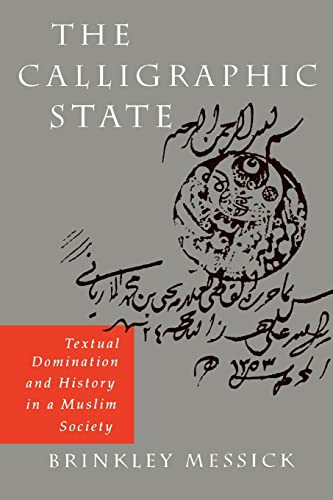
The Calligraphic State: Textual Domination and History in a Muslim Society (Comparative Studies on Muslim Societies, 16, Band 16) - Softcover
Inhaltsangabe
In this innovative combination of anthropology, history, and postmodern theory, Brinkley Messick examines the changing relation of writing and authority in a Muslim society from the late nineteenth century to the present. The creation and interpretation of texts, from sacred scriptures to administrative and legal contracts, are among the fundamental ways that authority is established and maintained in a complex state. Yet few scholars have explored this process and the ways in which it changes, especially outside the Western world.
Messick brings together intensive ethnography and textual analysis from a wealth of material: Islamic jurisprudence, Yemeni histories, local documents. In exploring the structure and transformation of literacy, law, and statecraft in Yemen, he raises important issues that are of comparative significance for understanding political life in other Muslim and nonwestern states as well.
Die Inhaltsangabe kann sich auf eine andere Ausgabe dieses Titels beziehen.
Über die Autorin bzw. den Autor
Brinkley Messick is Assistant Professor of Anthropology at the University of Michigan.
Von der hinteren Coverseite
"Throws completely fresh light on non-colonial yet modern systems of legality and moral power. . . . The picture given of Islamic legal education and practice is one of the best available . . . a compelling read and a fine book for teaching."—Paul Dresch, Oxford University
Aus dem Klappentext
"Throws completely fresh light on non-colonial yet modern systems of legality and moral power. . . . The picture given of Islamic legal education and practice is one of the best available . . . a compelling read and a fine book for teaching." Paul Dresch, Oxford University
Auszug. © Genehmigter Nachdruck. Alle Rechte vorbehalten.
The Calligraphic State
By Brinkley MessickUniversity of California Press
Copyright © 1996 Brinkley MessickAll right reserved.
ISBN: 9780520205154
Chapter 1
Genealogies of the Text
The theoretical descent of Roman jurisprudence from a Code, the theoretical ascription of English law to an immemorial unwritten tradition, were the chief reasons why the development of their system differed from the development of ours. Neither theory corresponded exactly with the facts, but each produced consequences of the utmost importance.
Sir Henry Maine
Viewed in detail, the development of the shari'a across the Muslim lands was a phenomenon involving specific men and specific texts. We know something about the particulars of this history because of the existence of accounts arranged in the form of biographical entries. Created by early Muslim historians, these biographical works played a crucial role in tracking the transmission of Islamic knowledge across regions and through successive generations. One such work, composed in twelfth-century Yemen, covers the early generations of Yemeni shari'a scholars. It also traces the arrival in the highlands of authoritative shari'a texts of the era, describing the specific teacher-to-student connections by which they were introduced and then diffused. A local node in one reported line of transmission was a man by the name of Faqih al-Nahi, until his death in 1171 a resident of the town of Ibb.1 The text in question was a famous one, authored by an eminent shari'a jurist of the preceding century named al-Shirazi who lived and taught in Baghdad, an international center of Islamic learning.2
"Between me and the author are two men," al-Nahi of Ibb used to say to his colleagues. In this shorthand manner al-Nahi expressed the particular legitimacy of his stature as a scholar and teacher. It was a remark worthy of citation in an intellectual world in which the texts of knowledge were literally embodied, their conveyance reckoned in terms of known relayers. Authority of this sort relied upon the specification of human links between intellectual generations. Al-Nahi could explain that he had learned the text from his teacher, who had received it from an individual who had acquired it directly from al-Shirazi, in the author's Baghdad lesson circle. Then, as now, Yemeni scholars were
travelers, circulating in search of teachers and knowledge not only throughout their native highlands but also northward to Mecca and beyond to Cairo, Damascus, and Baghdad. Completing his studies with al-Shirazi, the traveling scholar in question returned to reside in Yemen, where he taught the text to his own students, including a man who would later teach it to a third generation, which included al-Nahi of Ibb. Each of the two intervening scholars identified in al-Nahi's personal line of reception is the subject of a separate entry in the same biographical history.
Authoritative texts are as fundamental to the history of shari'a scholarship as they are to the history of the other intellectual disciplines. Such a text was "relied upon" in a place and time:3 the knowledgeable consulted it, specialists based findings upon it, scholars elaborated its points in commentaries, teachers clarified its subtleties, students committed its passages to heart. Authority in a text depended on a combination of attributes both ascribed and achieved: there were the built-in features of textual ancestry and authorship as well as an acquired reputation and record of dissemination. The fates of such texts were diverse, ranging from an enduring general prominence or more limited respect among the cognoscenti to a purely ephemeral authority and the all-but-forgotten status of the superseded. Since this authority would change radically in the course of the late nineteenth and the early twentieth century, its modalities must be examined in some detail.
A primary sort of textual authority was derived:4 it followed from the existence and importance of an original, genuine, and ultimately reliable text, which refers back to the position and identity of the Quran. "In the genealogy of texts," Edward Said writes (1983:46), "there is a first text, a sacred prototype, a scripture, which readers always approach through the text before them." A genealogy of authoritative texts in Islam must begin with a consideration of the Quran as the authoritative original. The paradigmatic, Urtext qualities of the Quran concern both content and textual form. Substantively, the Quran and the Sunna, the practice of the Prophet, constituted the two fundamental "sources" (usul , sing. asl ) for the elaboration of shari'a jurisprudence. Discursively, the Quran represents both the end and the beginning of the kitab (text, scripture, writing, book). Just as Muhammad was the last, the "seal," of the Prophets, and also the first Muslim, the Quran was the definitive and final kitab , whose particular authority would initiate and delimit a discursive tradition.
A central problem in Muslim thought concerns the difficult transi-
tion from the unity and authenticity of the Text of God to the multiplicity and inherently disputed quality of the texts of men. A concurrent underlying tension was generated in shari'a scholarship where an unresolvable gulf opened between divinely constituted truth and humanly constituted versions of that truth. Purists of all eras, including many contemporary "fundamentalists," have made a distinction between the divine shari'a, defined as God's comprehensive and perfect design for His community, and a humanly produced shari'a, or, more precisely, the corpus of knowledge known as fiqh (usually translated "jurisprudence"), a necessarily flawed attempt to understand and implement that design. In this gap between divine plan and human understanding lay the perennially fertile space of critique, the locus of an entire politics articulated in the idiom of the shari'a.
If the transition from the divine plan to its human versions was difficult, it was also necessary, for the truth of Revelation could only be implemented through the medium of human understanding. With the death of the Prophet Muhammad in 632, the Muslim community found itself cut off both from further Quranic Revelations and from the Prophet's own practice, that is, from further elaborations of the two "sources" of secure knowledge. Thereafter, the community confronted the problems of developing a more detailed corpus of rules and procedures while continually adjusting to new social realities.
The growth of the fiqh as a body of knowledge, resulting from the work of jurists in the early centuries of Islam, brought with it the inevitable disagreements associated with purely human creativity. Authoritative fiqh works endeavored to further define the already definitive. Their derivitiveness was both necessary to their nature and the crux of their problematic: they were texts in the world of the Text. Participating with self-assurance in an authentic tradition, such texts had their recognized antecedent sources and their means of establishing legitimacy. At the same time, they pertained to history rather than to the eternal; to societies of rifts and hierarchies rather than to the ideal communitas of the umma ; to difference rather than to certainty.
Condensed and practical fiqh manuals, known as the mutun (sing. matn , lit. "text"), were a distinct category of authoritative text. At first glance, such manuals seem to have little to recommend their consideration. Since they...
„Über diesen Titel“ kann sich auf eine andere Ausgabe dieses Titels beziehen.
Suchergebnisse für The Calligraphic State: Textual Domination and History...

Foto des Verkäufers
The Calligraphic State: Textual Domination and History in a Muslim Society (Comparative Studies on Muslim Societies) (Volume 16)
Verlag:
University of California Press, 1996
ISBN 10: 0520205154
ISBN 13: 9780520205154
Gebraucht
Softcover
Anbieter: ZBK Books, Carlstadt, NJ, USA
Verkäuferbewertung 5 von 5 Sternen

Zustand: good. Fast & Free Shipping â" Good condition. It may show normal signs of use, such as light writing, highlighting, or library markings, but all pages are intact and the book is fully readable. A solid, complete copy that's ready to enjoy. Bestandsnummer des Verkäufers ZWV.0520205154.G
Gebraucht kaufen
EUR 9,40
Versand gratis
Versand innerhalb von USA
Versand innerhalb von USA
Anzahl: 1 verfügbar
Foto des Verkäufers
The Calligraphic State: Textual Domination and History in a Muslim Society (Comparative Studies on Muslim Societies) (Volume 16)
Verlag:
University of California Press, 1996
ISBN 10: 0520205154
ISBN 13: 9780520205154
Gebraucht
Softcover
Anbieter: Greenworld Books, Arlington, TX, USA
Verkäuferbewertung 5 von 5 Sternen
Zustand: good. Fast Free Shipping â" Good condition. It may show normal signs of use, such as light writing, highlighting, or library markings, but all pages are intact and the book is fully readable. A solid, complete copy that's ready to enjoy. Bestandsnummer des Verkäufers GWV.0520205154.G
Gebraucht kaufen
EUR 9,40
Versand gratis
Versand innerhalb von USA
Versand innerhalb von USA
Anzahl: 2 verfügbar
Beispielbild für diese ISBN
The Calligraphic State: Textual Domination and History in a Muslim Society (Volume 16) (Comparative Studies on Muslim Societies)
Verlag:
University of California Press, 1996
ISBN 10: 0520205154
ISBN 13: 9780520205154
Gebraucht
Paperback
Anbieter: HPB-Ruby, Dallas, TX, USA
Verkäuferbewertung 5 von 5 Sternen
Paperback. Zustand: Very Good. Connecting readers with great books since 1972! Used books may not include companion materials, and may have some shelf wear or limited writing. We ship orders daily and Customer Service is our top priority! Bestandsnummer des Verkäufers S_478027289
Gebraucht kaufen
EUR 6,42
EUR 3,35 Versand
Versand innerhalb von USA
Versand innerhalb von USA
Anzahl: 1 verfügbar
Beispielbild für diese ISBN
The Calligraphic State: Textual Domination and History in a Muslim Society (Comparative Studies on Muslim Societies) (Volume 16)
Verlag:
University of California Press, 1996
ISBN 10: 0520205154
ISBN 13: 9780520205154
Gebraucht
paperback
Anbieter: HPB-Red, Dallas, TX, USA
Verkäuferbewertung 5 von 5 Sternen
paperback. Zustand: Good. Connecting readers with great books since 1972! Used textbooks may not include companion materials such as access codes, etc. May have some wear or writing/highlighting. We ship orders daily and Customer Service is our top priority! Bestandsnummer des Verkäufers S_386943357
Gebraucht kaufen
EUR 6,42
EUR 3,35 Versand
Versand innerhalb von USA
Versand innerhalb von USA
Anzahl: 1 verfügbar
Beispielbild für diese ISBN
The Calligraphic State (Comparative Studies on Muslim Societies)
Verlag:
University of California Press, 1996
ISBN 10: 0520205154
ISBN 13: 9780520205154
Gebraucht
Paperback
Anbieter: Book Alley, Pasadena, CA, USA
Verkäuferbewertung 4 von 5 Sternen

Paperback. Zustand: Good. Good. Used with wear and markings but is still in solid reading condition. Pasadena's finest new and used bookstore since 1992. Bestandsnummer des Verkäufers mon0000769418
Gebraucht kaufen
EUR 6,42
EUR 5,36 Versand
Versand innerhalb von USA
Versand innerhalb von USA
Anzahl: 1 verfügbar
Beispielbild für diese ISBN
THE CALLIGRAPHIC STATE: Textual Domination and History in a Muslim Society (Volume 16) (Comparative Studies on Muslim Societies)
Verlag:
University of California Press, Berkely, CA, 1996
ISBN 10: 0520205154
ISBN 13: 9780520205154
Gebraucht
Trade Paperback
Erstausgabe
Anbieter: Falls Bookstore, Readsboro, VT, USA
Verkäuferbewertung 4 von 5 Sternen
Trade Paperback. Zustand: Near Fine. No Jacket. illustrated (illustrator). 1st Edition. Grey background softcover with white print on spine and front cover. Red title box with white print on front, Black print on spine and graphic on frnt, Previous owner in ink at top edge of front fly leaf. Slight flair at two foredge tips p on front cover. Otherwise tight, sound and unmarked.527 pages including index. Bestandsnummer des Verkäufers 015718
Gebraucht kaufen
EUR 10,58
EUR 6,25 Versand
Versand innerhalb von USA
Versand innerhalb von USA
Anzahl: 1 verfügbar
Beispielbild für diese ISBN
The Calligraphic State: Textual Domination and History in a Muslim Society (Comparative Studies on Muslim Societies) (Volume 16)
Verlag:
University of California Press, 1996
ISBN 10: 0520205154
ISBN 13: 9780520205154
Gebraucht
paperback
Anbieter: Browsers' Bookstore, CBA, Albany, OR, USA
Verkäuferbewertung 5 von 5 Sternen
paperback. Zustand: Very Good. A nice copy. Clean text, solid binding. Bestandsnummer des Verkäufers mon0000190155
Gebraucht kaufen
EUR 14,04
EUR 4,69 Versand
Versand innerhalb von USA
Versand innerhalb von USA
Anzahl: 1 verfügbar
Foto des Verkäufers
The Calligraphic State: Textual Domination and History in a Muslim Society (Comparative Studies on Muslim Societies) (Volume 16)
Verlag:
University of California Press, 1996
ISBN 10: 0520205154
ISBN 13: 9780520205154
Gebraucht
Soft cover
Anbieter: Montelibri, Delft, Niederlande
Verkäuferbewertung 5 von 5 Sternen
Soft cover. Zustand: Fine. Bestandsnummer des Verkäufers bol+1
Gebraucht kaufen
EUR 13,59
EUR 14,50 Versand
Versand von Niederlande nach USA
Versand von Niederlande nach USA
Anzahl: 1 verfügbar
Foto des Verkäufers
Calligraphic State : Textual Domination and History in a Muslim Society
Verlag:
University of California Press, 1996
ISBN 10: 0520205154
ISBN 13: 9780520205154
Gebraucht
Softcover
Anbieter: GreatBookPrices, Columbia, MD, USA
Verkäuferbewertung 5 von 5 Sternen
Zustand: As New. Unread book in perfect condition. Bestandsnummer des Verkäufers 692985
Gebraucht kaufen
EUR 32,45
EUR 2,36 Versand
Versand innerhalb von USA
Versand innerhalb von USA
Anzahl: 9 verfügbar
Foto des Verkäufers
Calligraphic State : Textual Domination and History in a Muslim Society
Verlag:
University of California Press, 1996
ISBN 10: 0520205154
ISBN 13: 9780520205154
Neu
Softcover
Anbieter: GreatBookPrices, Columbia, MD, USA
Verkäuferbewertung 5 von 5 Sternen
Zustand: New. Bestandsnummer des Verkäufers 692985-n
Neu kaufen
EUR 35,95
EUR 2,36 Versand
Versand innerhalb von USA
Versand innerhalb von USA
Anzahl: 9 verfügbar